
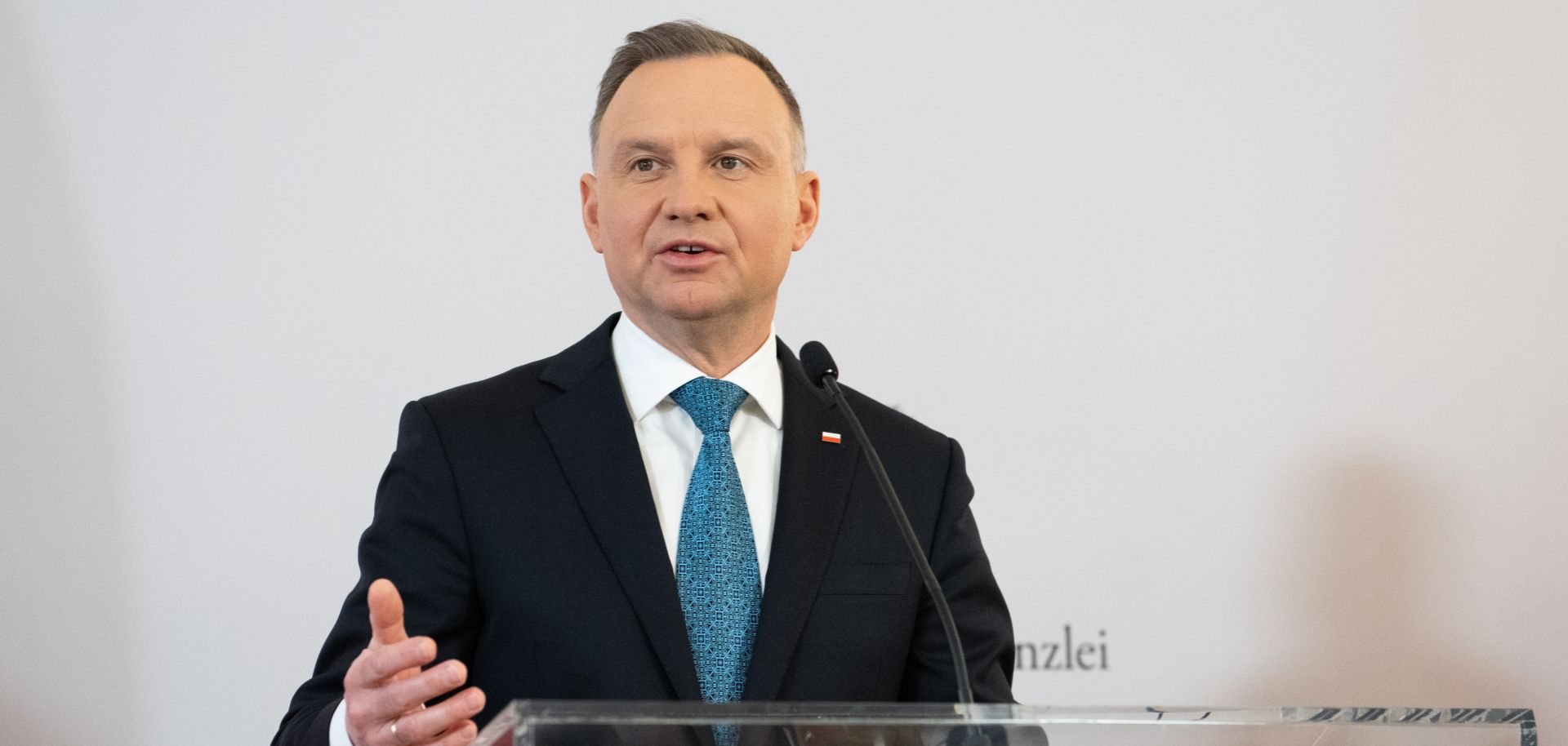
As the Polish general election approaches, the government will increase its nationalistic rhetoric and policies on issues ranging from migration to Ukrainian food imports, which will raise the risk of additional EU financial sanctions against Warsaw. On July 28, Poland's lower house of parliament, the Sejm, approved a law to create a commission to investigate politicians and government officials in the country who allegedly acted under Russia's influence between 2007 and 2022. Critics argue that the Polish government will use the commission to discredit and stigmatize opposition figures ahead of the next general election, which will take place in October or November. In June, pressure from the United States and the European Union led Polish President Andrzej Duda to propose amendments that reduce the powers of the new commission, which the Sejm confirmed in its July 28 vote. Regardless of the government's concrete uses of the law, this episode highlights both the heated political campaign in Poland, the risks of a weakening of the rule of law in the country, and the frequently tense relations between the nationalist government in Warsaw and its partners in Brussels and Washington.
- Since 2015, Poland has been governed by the United Right, a coalition of right-wing nationalist parties led by the Law and Justice (PiS) party. Over the years, the Polish government has implemented popular policies, such as child benefit payments. It's kept a hawkish position on Russia as well, demanding tough EU sanctions on Moscow and a stronger NATO presence in Central and Eastern Europe. However, the Polish government has also been subject to international criticism because of measures to increase government control over the judiciary and pressure on critical media outlets. These measures have seen the European Commission impose fines on Poland, as well as withhold billions of euros of post-pandemic recovery funds and cohesion funds earmarked for the country.
- Poland's main opposition alliance is the Civic Coalition, whose main party is the Civic Platform (PO) led by former Polish Prime Minister and former EU Council President Donald Tusk. Because Tusk was prime minister between 2007 and 2015, the PO argues that the commission to investigate Russia's influence in Poland is a plan by PiS to attack Tusk and his party.
The Polish government's moves against the opposition come as opinion polls suggest that the general election could be close, and that both the United Right and the Civic Coalition may need support from additional parties to form a government. Polls suggest that the ruling United Right coalition will win the general election but with lower support compared with the last general election in 2019. The opposition Civic Coalition, meanwhile, is expected to perform slightly better than it did in 2019. Against this backdrop, polls suggest that the right-wing Confederation alliance could become the kingmaker after the election. Confederation has hawkish positions on immigration and the European Union and is very conservative on social issues, which makes it a potential ally for the nationalist PiS because their agendas on these issues are similar. However, Confederation is libertarian on economic issues, which clashes with PiS's support for strong state intervention in the economy. The PO's pro-business agenda could also open the door to cooperation with the libertarian Confederation, though the two are likely to clash on topics like cooperation with the European Union and social issues. Confederation is thus a potential ally for both the PiS and the PO, though a coalition with either of them would also be prone to constant internal conflict due to ideological differences.
- According to a Social Changes opinion poll conducted July 21-24, support for the United Right is around 35%, down from 43.6% in the 2019 general election. The Civic Coalition is polling at 29%, up from 27.4% in 2019. This poll has Confederation in third place with 14%, from 6.8% in 2019.
In the coming months, the Polish government will use criticism of the European Union and anti-immigration rhetoric to improve its electoral chances, which will risk causing clashes with Brussels that could result in financial penalties. With the government's prospects for re-election uncertain, the ruling United Right coalition will increase its efforts to gain a margin over the opposition and consolidate its base ahead of the ballot. This will likely see Warsaw promise additional public spending, make appeals to its supporters' traditional values, and enact more measures to discredit opposition candidates. The government will likely also adopt a more confrontational stance toward the European Union in an effort to present itself as the defender of Polish sovereignty, particularly on highly politicized issues such as migration. As a part of this strategy, the Polish government announced plans in June to hold a referendum on a recent reform to the EU immigration and asylum system on the same day as a general election. Warsaw has claimed that combining the two votes will reduce costs. But critics have argued that holding a referendum on immigration policy — a key issue among United Right supporters — in conjunction with the general ballot is meant to boost the government's re-election prospects by bringing more nationalist and right-wing voters to the polls this fall. Poland will remain bound to the adjusted EU migration rules regardless, as it lacks the legal means to block a deal that was agreed upon by a qualified majority of EU member states. But if the United Right is reelected and Polish voters reject the European Union's migration reform, Warsaw may find itself forced to unilaterally ignore the EU migration reform in order to comply with the result of the referendum, which would violate EU law. This would further deteriorate already strained EU-Polish relations and most likely see Brussels resume financial penalties against Warsaw and extend its freeze of EU funds destined for Poland.
- In June, EU member states agreed to reform the bloc's migration and asylum laws, including yearly relocations of up to 120,000 irregular migrants and refugees arriving to the bloc. According to the reform, countries would have to pay 20,000 euros ($21,644) for each migrant they refused to take in. Poland was one of only two EU member states that voted against the proposal, criticizing it for including such ''fines'' for rejecting migrants. On June 15, the Polish parliament passed a resolution opposing the migration deal and the PiS announced plans to put the EU reform to a vote.
- Recent polls suggest around three-quarters of Polish voters oppose the European Union's migration reform, though respondents remain divided over whether to hold a referendum on the matter. Poland has already taken in between 1.5 and 2 million Ukrainian refugees since February 2022. Warsaw will likely use this as justification for not taking in more migrants in compliance with the EU migration reform, though Brussels is unlikely to accept this argument.
As a part of the same nationalist electoral strategy, the government could also close Poland's borders to Ukraine's agricultural products, which could negatively impact the Ukrainian economy. Shortly after Russia began invading Ukraine in February 2022, Brussels signed agreements with Kyiv to allow Ukraine to use EU member states' roads, railways and rivers to transport its agricultural products and reach its export destinations around the world. However, large amounts of Ukraine's agri-food products have remained stranded in Central and Eastern Europe due to various bottlenecks. This increase in the availability of food products resulted in lower prices that irritated local food producers. In April, Poland and several other Central and Eastern European countries threatened to close their borders to Ukrainian agri-food products unless the European Union restricted the sale of these products within their territories, which Brussels ultimately accepted. The restrictions are set to expire on Sept. 15 and Poland is pushing for an extension to prevent irritating Polish farmers (who represent a significant part of the government's electoral base) shortly before the general election. This shows that while Poland is one of Ukraine's strongest supporters in the European Union and NATO, domestic electoral calculations also limit Warsaw's solidarity with Kyiv. If the European Union fails to extend the ban, Poland will likely unilaterally close its borders to Ukrainian agri-food exports, which would negatively impact the Ukrainian economy at a time when Russia has also walked away from a deal to export grain through the Black Sea.
- Around 40% of Poland's population lives in rural areas, which is among the highest rates in the European Union. Rural voters largely support the socially conservative and interventionist policies put forth by the PiS party, which has consistently dominated these areas in elections since the mid-1990s.
- Bulgaria, Hungary, Poland, Romania and Slovakia recently issued a joint request to the European Commission to extend a ban on Ukrainian grain imports into their domestic markets until the end of the year.
