
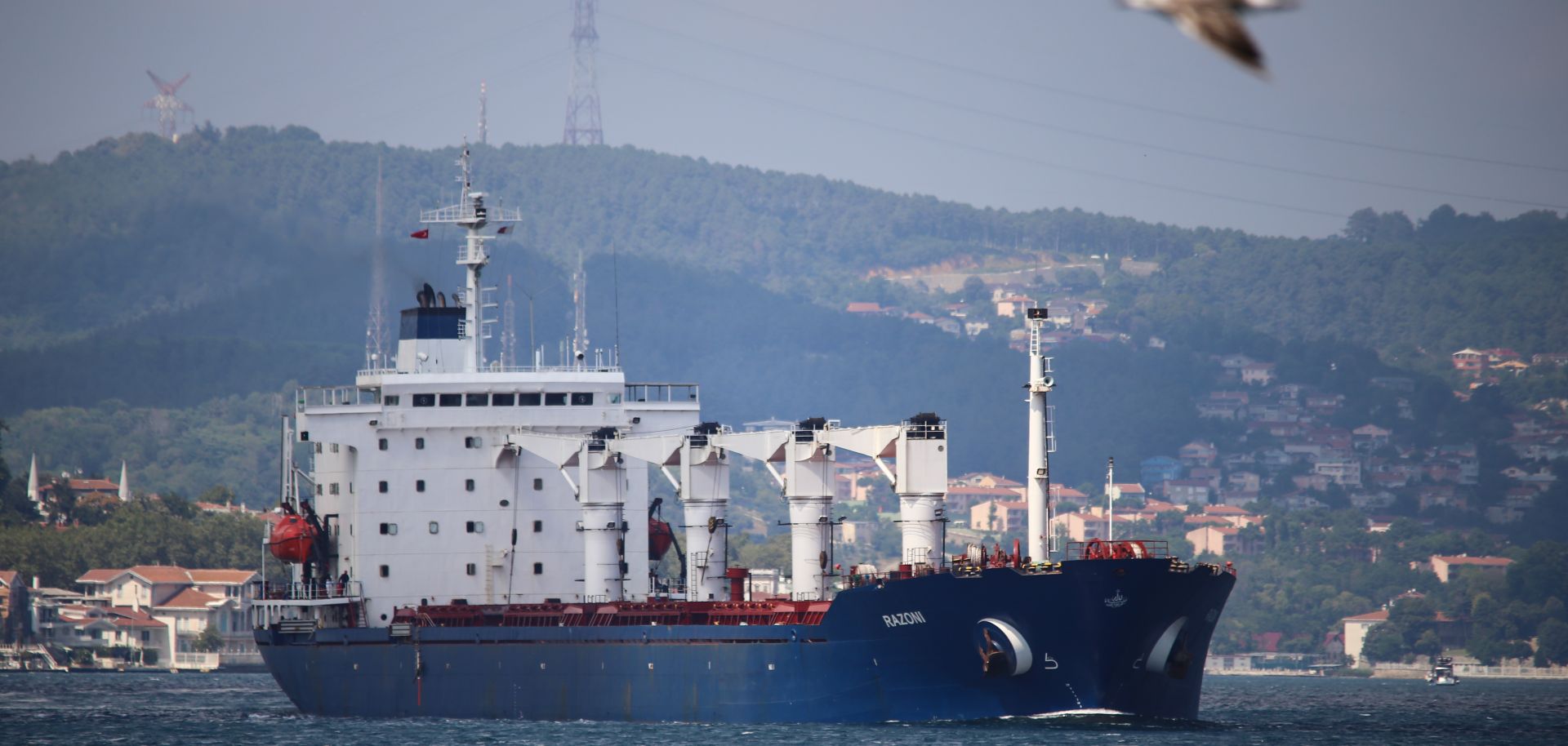
Russia's decision to leave the Black Sea grain deal nearly a year after it was signed will strain its relations with Turkey, further imperil Ukraine's war-torn economy and elevate global food prices, with poorer countries in the Global South being hit hardest. On July 17, Russia's foreign ministry announced the country would leave the agreement that has helped bring Ukrainian grain to the world's markets over the past year. As part of its withdrawal from the deal, Russia said it would no longer guarantee the safety of ships transiting the maritime humanitarian corridor in the Black Sea. It also said that the Joint Coordination Center, which had monitored the deal's implementation from Istanbul, would be disbanded. Russia claimed it decided to leave because its demands for extending the deal had not been met. But the announcement also came hours after an apparent Ukrainian maritime drone strike damaged the Kerch Strait Bridge linking Russia to Crimea. The attack fueled speculation about the extent to which the Ukrainian strike played a role in Russia's withdrawal from the grain export deal, though Kremlin Press Secretary Dmitry Peskov has denied the incident factored into Moscow's decision.
- On July 22, 2022, Russian and Ukrainian officials each signed separate agreements with Turkey and the United Nations allowing the export of grain from select Ukrainian ports on the Black Sea, in exchange for a memorandum of understanding aiming to facilitate shipments of grain and fertilizers from Russia to world markets.
- In March, Russia's U.N. ambassador named five ''systemic problems'' that needed to be resolved to allow the continuation of the grain deal: returning the Russian Agricultural Bank (Rosselkhozbank) to the SWIFT payment system; a resumption of supplies to Russia of agricultural machinery and spare parts; lifting restrictions on insurance and access to ports for Russian ships and cargo; unblocking accounts and financial activities of Russian fertilizer companies; and the resumption of an ammonia pipeline from the Russian city of Togliatti to the Ukrainian city of Odesa (the pipeline was damaged on June 7 but has not been in operation since the war began in February 2022). Russian officials explicitly left open the possibility of Russia returning to the deal, but indicated that progress toward the satisfaction of the above demands would have to be met first.
Moscow's frustration with the deal had been growing amid pressure from Russian nationalists who argued it was not in Russia's interests. Russia's abandonment of the deal is in part motivated by domestic political calculations. Over the past year, Russian President Vladimir Putin and other Russian authorities have struggled to make a compelling case to the Russian people about why the deal was needed — mainly claiming that it would benefit Russia's relations with foreign partners in Africa, Asia and the Middle East, which worried about agricultural price spikes. But this message failed to resonate, as Russian think tanks, state television and independent far-right bloggers regularly questioned whether the deal was ever in Russia's interest, and if it was, whether it remained so. Many of these skeptics saw the agreement as providing significant hard foreign currency flows to help Kyiv's cash-strapped economy stay afloat, thereby reducing financial costs that would otherwise have to be shouldered by the West. They also argued that the West would never observe the part of the deal pertaining to easing Russia's own agricultural exports because neither the United States nor the European Union, which were not parties to the agreement, showed signs they'd be willing to ease their sanctions regime on Moscow in exchange for the continuation of the grain deal. The Kremlin was likely keen not to further alienate these nationalist hard-liners who had long been calling for Russia's withdrawal — especially on the back of the Wagner Group's recent armed revolt.
- According to the U.N. Economic Commission for Europe, Ukraine's agriculture industry generated 9% of the country's GDP in 2022, making it a key economic sector despite the large overall fall in Ukrainian agricultural exports over the past year amid Russia's invasion. Influential Russian commentators had argued that ending the deal would not only serve a major blow to Ukraine by denying its government significant revenue, but would also exacerbate war fatigue in the West (and in particular Europe) by further elevating food prices.
- Prior to last month's Wagner uprising, the Kremlin may have thought that it could point to the significant domestic opposition to the grain deal as a way to increase its leverage in negotiations with the West. But the idea of using domestic opposition to gain greater concessions from the West has become much less attractive following the Wagner mutiny, which has made Moscow all the more hesitant to appear weak by highlighting the risks to the Kremlin of not having full control of domestic narratives opposing its policies.
Global food prices are unlikely to experience as intense and expansive of a shock as they did in spring 2022 in the wake of the deal's collapse, with the effects instead falling on poorer and more vulnerable countries. The U.N. Food and Agriculture Organization (FAO)'s global food price index reached a record high in July 2022 — the same month the export deal was originally signed, which was some four months after Russia began blockading Ukrainian wheat exports as part of its invasion. The global supply shocks brought on by the sudden loss of Ukrainian grain caused food prices to rise across the world in the spring of 2022. But the impact was particularly acute in poorer countries in the Global South, as well as among countries where Russia maintained defense and diplomatic ties (including Turkey, Egypt, India and nations throughout sub-Saharan Africa). The collapse of the grain deal following Russia's withdrawal will likely see price pains re-emerge in these countries. Food shortages risk worsening in Africa, in particular, as the agreement had reportedly seen Ukraine double its grain exports to African countries over the past six months, according to comments recently made by Turkey's transport minister. But global food prices are unlikely to reach the levels seen before the agreement was signed, as the loss of Ukrainian grain exports will this time be offset by above-average harvests expected from countries like Brazil and Argentina. The deal's collapse is expected to have a modest overall impact on global food prices thanks to these harvests — especially in the developed world, where stronger currencies will allow countries to affordably import food staples from abroad.
- The U.N. food price index declined 11.6% year-on-year after Russia and Ukraine signed the grain deal on July 22, 2022, enabling Ukrainian grain to reach global markets. But a sign of the declining impact of the deal came in the spring of 2023, as Ukraine reported fewer exports because of increased Russian inspections of Ukrainian grain ships. These inspections also resulted in the complete collapse of exports from Ukraine's Yuzhny port, which accounted for up to a third of exports previously. Despite this slowdown, the FAO continued to report declining food prices.
- Global climate conditions fueled improved harvest conditions, with El Nino bringing extra rain to places like Argentina, Brazil, and southern and western United States, where harvests in major agricultural hubs like California and Texas would benefit.
- The grain deal also helped support the United Nations' World Food Program, which brought much-needed relief to countries like Somalia, Ethiopia and Yemen. The program was already facing funding shortfalls caused by the effects of the COVID-19 pandemic, global inflation and commodity shocks caused by the war in Ukraine.
Moscow's withdrawal from the grain deal will make Western countries even less likely to facilitate Russia's agricultural exports, forcing Moscow to consider unattractive military operations to stop Ukraine from exporting its own grain. Upon exiting the grain deal, Russia lost significant leverage over the West. As a result, the European Union will cease its efforts to connect a subsidiary of the Russian Agricultural Bank to the Brussels-based SWIFT international payments system, which means Russia will continue to struggle to export its agricultural goods. To compensate for this loss, Russia will be tempted to intervene militarily to prevent Ukraine from continuing to export its grain by sea. However, there are few attractive ways to do this, as attempting to reimpose a full-scale blockade would put Russia's naval and air assets at high risk. Furthermore, directly sinking non-Ukranianian civilian vessels would damage Russia's image and could spark a military confrontation with the West. Therefore, Russia will likely instead seek to degrade Ukraine's civilian infrastructure by stepping up strikes on port and transit routes. But the effectiveness of such strikes would be questionable and could cause Moscow to waste its precious precision munitions.
- While Ukraine's overland export capability has expanded since 2022, Ukraine can export only a small portion of its grain overland, meaning it will be highly motivated to continue sea exports. Kyiv will work with the United Nations and insurers to continue coverage for any ships willing to continue using the grain corridor, meaning that in theory, some sea exports could continue, further reducing the strain on global prices.
- Russian naval and air assets have rarely sortied into the Black Sea en masse since the sinking of the missile cruiser Moskva, the flagship of Russia's Black Sea Fleet, in April 2022, largely moving in small groups to avoid Ukraine's anti-air and anti-shipping missile capabilities.
The end of the grain deal may also stoke fears of grain shortages and panic from Russia's partners in the Global South while causing minor harm to bilateral relations with Turkey. Moscow will face an uphill battle assuring partners in Asia, Africa and the Middle East that it can replace any loss of Ukrainian grain from the global market. But Moscow likely calculated that a relatively modest price shock will allow it to avoid significant backlash from partners in these regions. Moscow's first test will be on July 26, when African leaders — many of whom had urged Putin in person to stay in the grain deal just a month earlier — are in Moscow for a Russia-Africa summit. Relations between Moscow and Ankara will also grow more strained, as the end of the grain deal will exacerbate food price inflation in Turkey, as well as hurt Ankara's diplomatic clout and public support for its government at home. However, following the May reelection of Turkish President Recep Tayyip Erdogan, with whom Putin has a close working relationship, Moscow likely believes that any worsening of bilateral relations would be inconsequential, with Ankara seeking to preserve their close contacts even as it explores options to respond to Moscow.
- After renewing the grain deal for the first time on Nov. 2, 2022, Putin said Russia could still leave the deal but would not obstruct Ukraine's grain deliveries to Turkey ''in any case,'' demonstrating the importance of the deal to Russia-Turkey relations. But recent moves by Ankara likely angered the Kremlin, including Turkey's recent support for Sweden's NATO bid, the release of Ukrainian commanders that were supposed to stay in Turkey under a prisoner exchange, explicit support for Ukraine's NATO aspirations, and a new agreement to build Turkish military hardware in Ukraine.
- Russian media has speculated that the Turkish navy could play a role in securing grain exports from Ukraine. But NATO's involvement in securing the grain corridor remains highly unlikely given that one of the alliance's primary stated goals is avoiding direct conflict with Russia.
