
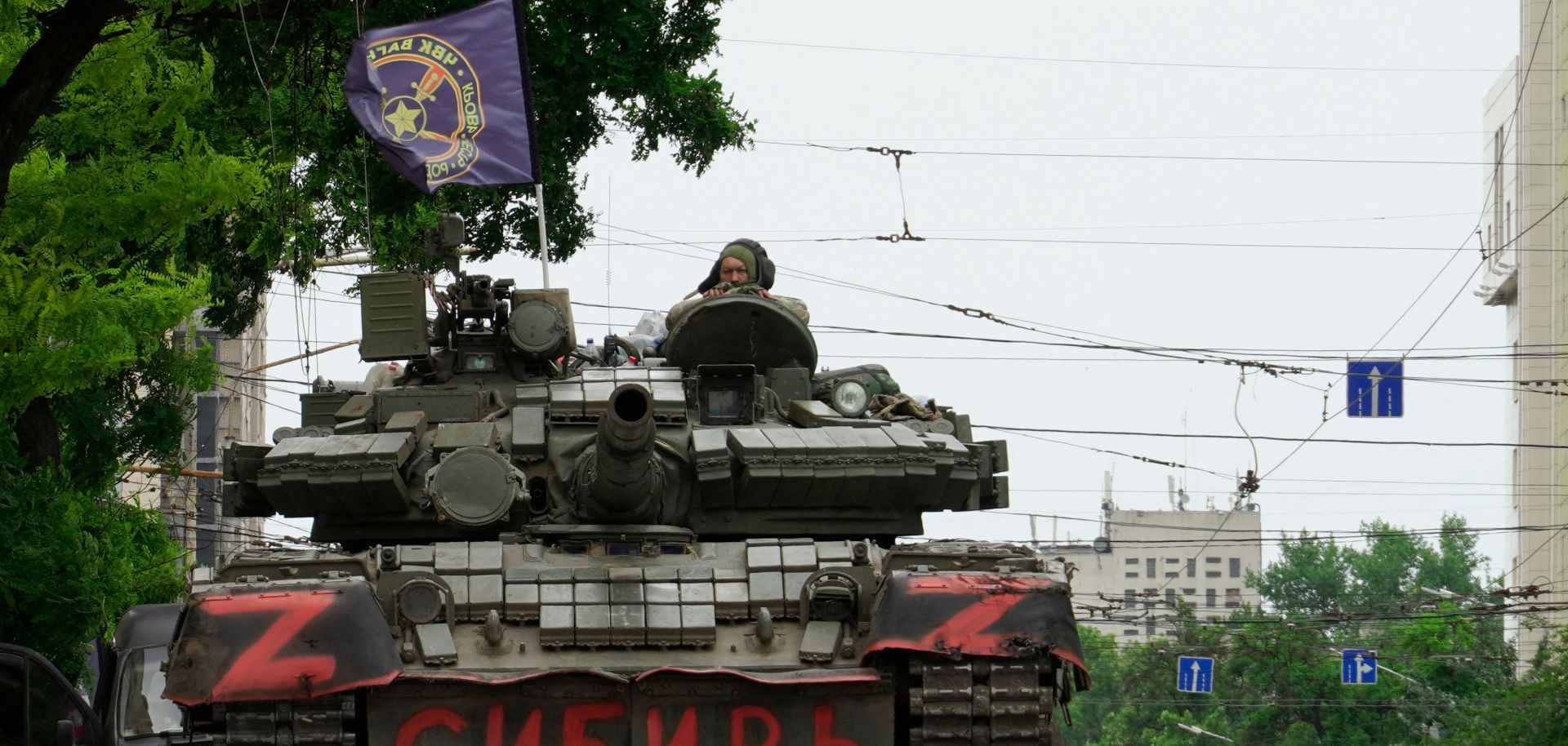
The demise of Yevgeny Prigozhin, the leader of Russia's paramilitary Wagner Group, will reduce domestic criticism of the Kremlin's handling of the Russia-Ukraine war, but also open the door to additional internal repressions and personnel changes that could impact Russia's strategy in Ukraine in the long run. On June 24, a convoy of Wagner mercenary forces stopped their so-called march on Moscow roughly 300 kilometers (186 miles) from the Russian capital, after several hours of uncertainty about their ultimate goal. The group had begun its march on the Russia-Ukraine border late on June 23, as Wagner leader Prigozhin said the measure was meant to protest the Kremlin's mishandling of the war. Hours after Prigozhin gave the order for his mercenaries to advance on Moscow, Russian President Vladimir Putin gave a televised address in which he said that the fighters of the Wagner Group were being "dragged into a criminal adventure" and pushed toward "an armed rebellion." The address did not mention Prigozhin by name, nor did it mention the actual goal of his uprising — namely, the removal of Defense Minister Sergei Shoigu and chief of the General Staff Valery Gerasimov over their months-long feud concerning the lackluster war effort against Ukraine. Instead, Putin praised Wagner's fighters and specifically underlined that he had been in contact with the "front commanders" in Ukraine to reassure the public that the events had not impeded Russia's "special military operation" in Ukraine. However, Putin also accused the march's participants of "treason," for which "they would answer before the law," and numerous Russian law enforcement agencies launched multiple criminal cases related to the incident.
- On June 23, Prigozhin declared a "march of justice" in support of his claim that Russian army forces lethally shelled a Wagner Group position in Ukraine, which Russia's Defense Ministry dismissed as "fake" and a "provocation." Early on June 24, Prigozhin's forces seized the headquarters of the Southern Military District in Rostov-on-Don, and several columns of Wagner forces began a loosely-organized drive toward Moscow, often having to take indirect routes to avoid roadblocks. Prigozhin eventually ordered the forces headed toward Moscow to stand down after he obtained "security guarantees" for them during negotiations with Belarusian President Alexander Lukashenko. At the time of writing, Wagner fighters had already begun withdrawing from the military headquarters in Rostov, meaning Wagner's occupation will end in the coming hours.
- Lukashenko's press service announced that Prigozhin accepted the president's proposal "to stop the Wagner movement in Russia and take further steps to de-escalate tensions" and that Prigozhin later confirmed that Wagner's vehicle columns moving toward Moscow would turn around and leave in the opposite direction. Prigozhin ended his political crusade before any major clashes with Russian forces could take place, which otherwise would have weakened sympathies for Wagner and Prigozhin's negotiating position. Prigozhin likely cut his losses because the disorganized columns of Wagner forces were unlikely to reach Moscow en masse or achieve their goals of removing Gerasimov and Shoigu upon arrival. State actors will reportedly drop charges against Prigozhin, who will relocate to Belarus in the coming days. It is expected that Wagner forces believed to have opened fire on Russian security forces — for example, those that reportedly downed Russian military helicopters — may still serve long prison sentences. However, in order for the Kremlin to avoid right-wing backlash, Wagner forces that did not fire upon Russian authorities will receive amnesty so they can continue fighting in the war against Ukraine.
Prigozhin's removal will result in a serious weakening of the Wagner Group in Russia and its allies' ability to oppose Putin, thereby consolidating the Kremlin's power. Still, the June 23-4 events will make it more difficult for Putin to continue echoing the military leadership's claims that Russia's "special military operation" in Ukraine is going according to plan. This will provide Putin with stronger grounds to eventually reshuffle military leaders, possibly including Shoigu and/or Gerasimov, as well as other high-ranking officials responsible for economic mobilization in support of the war effort. (However, these changes may not be immediate, as the Kremlin wants to avoid sending the message that it has capitulated to Prigozhin.) In the past, Putin has been reluctant to remove high-ranking officials, further transition the civilian economy to war production, and increase mobilization measures or preemptive detentions of opponents, as he considers these factors to be unpopular and politically destabilizing. However, against the backdrop of the revolt, he is likely to receive much greater support among the public and elite in applying the aforementioned measures, which would ultimately strengthen Russia's ability to continue waging war in the long term. The Kremlin will likely also use the revolt to further establish its control over information channels in the country by removing the Wagner Group and Prigozhin from power, thereby preventing the far-right community from drifting away from Shoigu and Gerasimov, and by extension, Putin.
- The Kremlin will also almost certainly use the incident to step up the repression of liberal Russians. While many of the Russian opposition movement's leaders do not sympathize with Prigozhin, as he is considered a bandit and warmonger who kills in Ukraine while pushing for escalation inside Russia, some enthusiastically shifted their stance to support him during the rebellion in hopes of destabilizing Putin's regime. For example, influential opposition voice and former political prisoner Mikhail Khodorkovsky called for Russians to arm themselves and prepare to support Prigozhin's move on Moscow, though it does not appear such calls achieved any result.
While the short-term impact of these events will have a minimal impact on the Ukraine war, Ukrainian forces could step up attacks and push up the timetable of their counteroffensive to capitalize on the chaos. There were several reports — and accompanying video evidence — that Wagner forces fired on and shot down multiple Russian helicopters that they likely believed would attack them. These and other Russian equipment losses — as well as the significant destruction of road infrastructure inside Russia near the Ukraine border — will hurt Russian forces and logistics, but are ultimately insignificant. Furthermore, the vast majority of Wagner's forces — likely no greater than around 25,000 — had already been taken off the frontlines in Ukraine, meaning the chaos inside Russia likely had little effect on units fighting at the front. Furthermore, the incident will enable Russia to push Wagner, other private military companies and "volunteer" units to sign contracts with the Defense Ministry in line with Shoigu's earlier order. These contracts will offer unity in military command by preventing private forces from interacting with different generals and carrying out separate logistical practices from regular Russian forces, which bred distrust and animosity on the ground. Still, some reports indicate that Ukrainian forces could be taking advantage of the tense political situation in Russia by moving more of their offensive units toward the front around Bakhmut, the southern Donetsk region and the Zaporizhzia region.
- At a meeting with influential ultranationalist bloggers and state media military correspondents on June 14, Putin appeared to tentatively back an order by Shoigu from June 11 for all "volunteer detachments" to sign contracts with the military by July 1.
