
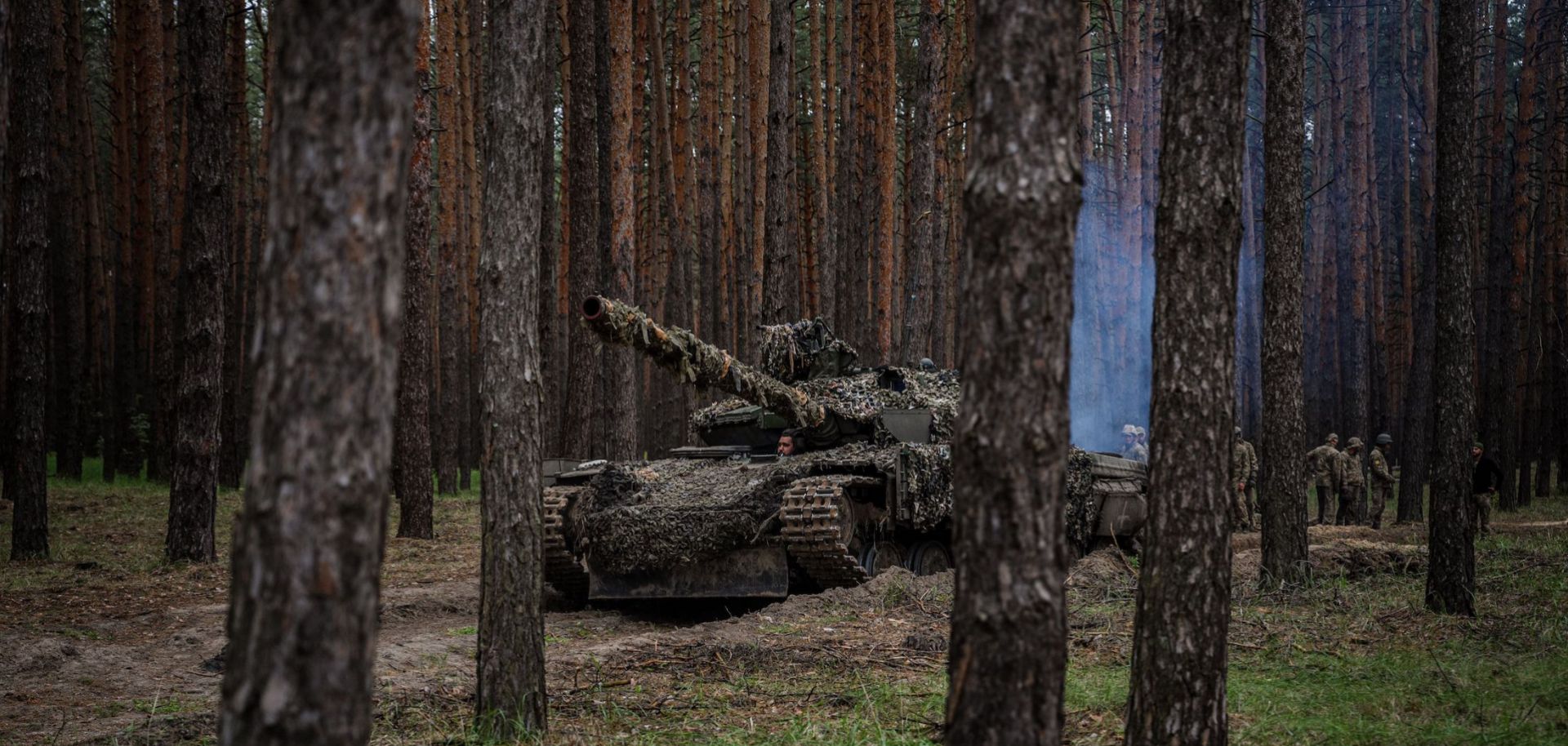
Ukrainian soldiers take part in a military exercise in the Kharkiv region on May 1, 2023, amid Russia's ongoing invasion of Ukraine.
While Ukraine's impending counteroffensive may initially make only limited territorial gains, it could still put Russian forces on the defensive and will likely eventually force Russian President Vladimir Putin to take more unpopular mandatory mobilization measures to continue his war. Kyiv's long-awaited counteroffensive finally appears imminent. Leaked U.S. intelligence documents suggest that most Ukrainian forces training in NATO countries like Germany and the United Kingdom were scheduled to arrive in their home country by May 1, meaning they will likely reach the front and be prepared for offensive operations in the coming weeks. Meanwhile, Ukrainian officials have indicated a counterattack is increasingly ready, with Defense Minister Oleksii Reznikov saying on April 28 that Ukrainian forces are already finishing their final preparations and were ''broadly ready'' for the offensive. Further evidence that the Ukrainian offensive may soon commence came on May 5, when Russian-installed occupation authorities in the Zaporizhzhia region announced the evacuation of 18 settlements near the front line in the region, claiming they had information that Ukraine's counteroffensive may commence in the coming days.
- According to reporting by The Washington Post, leaked U.S. intelligence documents suggest that upwards of 45,000 Ukrainian soldiers in at least nine brigades have been training to use Western weapons to conduct the counteroffensive. Between 15-20 Ukrainian brigades, largely supplied with Western weapons, could be committed to breakthrough attempts as part of the offensive.
- Multiple Western leaders have signaled the high stakes of the offensive for Ukraine and its Western backers. Czech President Petr Pavel, who chaired the NATO military committee from 2015-2018, remarked on March 19 that ''Ukraine will have only one attempt to carry out a major counteroffensive'' and that should that window of opportunity close, ''it will be extremely difficult to get funding for the next one.'' To that end, on May 6 Pavel warned Ukraine against rushing its counteroffensive, noting Kyiv should not be ''pushed into a faster pace before they are fully prepared.''
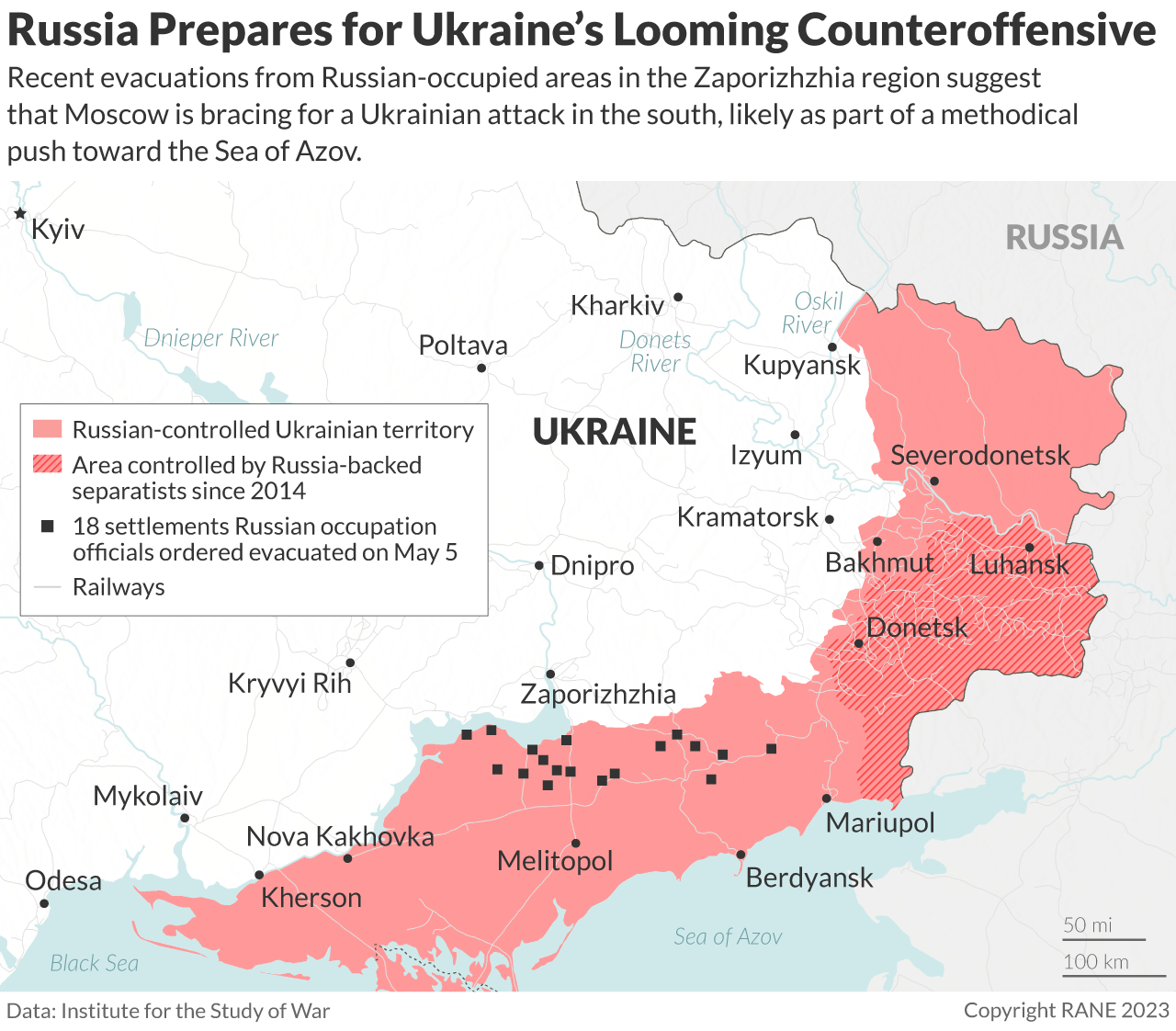
The main thrust of Ukraine's attack will likely be in the Zaporizhzhia region toward the Sea of Azov. Kyiv will not rush the launch of the offensive, waiting for sufficient stockpiles of Western weapons to reach key areas and favorable warm and dry weather conditions. Both the weapons and warmer weather could come this month, at which time Ukraine's high command will finalize a decision on what version of its counteroffensive to enact based on the disposition of Russian forces. The Ukrainians have likely prepared multiple broad plans for their offensive and numerous sub-variants of each, but Ukraine's primary effort will likely be focused on ejecting Russian troops in the south. Specifically, Ukrainian forces' main thrust will probably be into the Zaporizhzhia region toward the city of Tokmak and, ultimately, the Sea of Azov. There's a chance the counteroffensive could also target the Donbas region in eastern Ukraine, but there are several reasons Kyiv is more likely to focus on the south. First and most importantly, the combined arms maneuver warfare Ukrainian units have been specially trained for in NATO countries is much more conducive to the flatter and less forested Kherson and Zaporizhzhia regions, compared with the more heavily urbanized and hilly Donbas region in eastern Ukraine, where Russian forces are better supplied and have numerous barriers on which to anchor a defense. In addition to the south being more militarily favorable to Ukrainian forces, retaking the land corridor that connects Russia to Crimea would serve a far greater political blow to Putin's regime by making it much more difficult for Moscow to justify the costs of its war at home. This is because the Russian elite and public care far more about retaining access to the Dnieper River than retaining control of territories in eastern Ukraine's Donbas region, which they see as strategically insignificant in comparison. For Ukraine, demonstrating progress in retaking land in the corridor between Russia and Crimea would also pave the way for more territorial gains in other strategic areas of southern Ukraine, which would incentivize further Western weapons deliveries.
- The precise location of Ukraine's main thrust will depend on where Russia chooses to position its troops. Kyiv's counterattack will likely commence at numerous points across the entire front to stretch Russian forces and keep the location of Ukraine's primary breakthrough attempts unclear. Ukraine's plan will also remain flexible, responding to see where the Russians send additional units to plug breakthroughs; based on this, Ukrainian forces will press on from there, even if this may not have been the main effort originally.
- The second most likely target for the offensive is in the central Donbas region around Bakhmut. The goal of such an attack would be to destroy or encircle significant elements of the Wagner Group and the Russian military before they are able to deeply entrench around the city, and then push deeper toward the Severny Donets River in order to push the front line away from Ukraine's remaining strongholds in Donbas, Kramatorsk and Slovyansk. But this effort would be unlikely to move Ukraine toward its strategic objectives or any closer to ending the war.
- Ukraine's offensive is likely to involve significant amounts of deception, as well as some small-scale amphibious activity across the Dnieper River, in particular in the lower part of the river's delta and around the crucial town of Nova Kakhovka. But the impossibility of securing stable, long-term supply over the river means these efforts will likely only amount to raids to confuse and tie down Russian forces, while the main thrust will be a ground assault in the southern Zaporizhzhia region.
Key Strategic Points in Ukraine
The strategically important areas in southern Ukraine include Melitopol, the railway and transportation junction for all of the south; Energodar, the home to Europe's largest nuclear power plant; Nova Kakhovka, the Dnieper access point for the canal that supplies nearly all of Crimea's fresh water; and finally, all the access points to the Crimean Peninsula itself. The strategically important areas in eastern Ukraine's Donbas region include the well-defended Donetsk and Luhansk urban areas, and Mariupol, which was largely destroyed at the beginning of the war.
Ukraine likely lacks the resources to retake large swaths of territory from Russian troops in the coming months. But even relatively small, incremental gains could put Russian forces in a sufficiently worse position to constitute an operational success for Kyiv. Sowing confusion among Russian forces and achieving significant gains in the opening hours and days of the counteroffensive will be critical to Ukraine's ability to achieve operational (and not just tactical) success. However, major gains will be difficult because Ukrainian forces still lack sufficient ammunition and many important weapons systems, including long-range strike capabilities, needed to overcome Russian defenses and enable greater Ukrainian success. But even incremental gains toward the southern city of Melitopol and the Sea of Avov would constitute a significant operational success for Ukraine. Getting within 25 kilometers of the city or the sea would put Ukrainian troops in standard artillery range and make regular logistics across the land corridor from Donbas to Crimea untenable. This could, in turn, complicate Russia's ability to defend the vital land bridge by forcing Moscow to rely on a longer route via Crimea with vulnerable chokepoints to supply its remaining troops in both the corridor and the surrounding Kherson region. It would also mark demonstrable progress toward Ukraine's primary strategic objective of eventually retaking the entire corridor between Russia and Crimea. The lack of major rivers or other significant natural barriers on which to anchor its further defense in southern Ukraine would force Moscow to entrench on new terrain less suited for long-term defense, enabling Ukraine to continue its offensive campaign throughout this year's fighting season. Therefore, even relatively small gains that push the front line a few dozen kilometers toward the Sea of Azov could be considered an operational and strategic success for Ukraine.
- Reports suggest that the United States remains skeptical of rapid or territorially large Ukrainian gains in the coming months. The leaked U.S. intelligence documents reportedly suggest Kyiv still does not have enough ammunition stockpiled for a sustained counteroffensive or sufficient anti-air capabilities to simultaneously secure the front line and key rear areas. Additionally, reports indicate the administration of U.S. President Joe Biden is quietly preparing for the possibility of Ukraine's counteroffensive achieving fewer gains than expected and the implications this will have for the United States.
Ukraine's counteroffensive will also likely prompt Putin to authorize another wave of mobilization later this year that would further increase the political and economic costs of the war for Moscow. Russia's population is at least 3.5 times the size of Ukraine's population. But the mass casualties Russia suffered during its winter offensive mean it continues to face a more pressing manpower shortage compared with Ukraine, which has so far mobilized at least 700,000 individuals since the start of the war in February 2022. To help replenish its ranks, Russia launched a renewed volunteer drive in March with the aim of eventually recruiting 400,000 more troops to serve in Ukraine. But there is little reason to believe this drive will prove any more successful than the Russian military's last recruitment campaign over the summer, which by most estimates only drew only around 15,000 volunteers. Russia will thus likely have little choice but to force more of its men to fight in Ukraine by announcing another round of formal mobilization measures. The need for more troops will become particularly acute in the event the Ukrainian forces appear poised to seize Melitopol and reach the Sea of Azov. But while another round of mobilization is unlikely to quickly deal a fatal blow to Putin's regime, it will further undermine his popularity and the country's economy, which could eventually erode Russia's will to maintain its Ukraine invasion in the coming years.
- In testimony to the Senate Armed Services Committee on May 4, U.S. Director of National Intelligence Avril Haines said Russia will likely not be able to mount a ''significant offensive operation this year'' due to munitions and manpower shortages, regardless of the success of Ukraine's impending counteroffensive. Haines added that if Moscow does not initiate a mandatory mobilization and secure new substantial third-party ammunition supplies, Russian troops in Ukraine will find it increasingly difficult to sustain even modest offensive operations in the future.
- The Biden administration estimates that Russian casualties in Ukraine have doubled in just the past five months. On May 1, White House national security spokesperson John Kirby estimated that 100,000 Russian soldiers were either killed or wounded in the war since December, including over 20,000 killed in action.
- Recent upheaval within Russia's security apparatus has fueled doubts about Russia's preparedness to repel Ukraine's impending counteroffensive. On April 30, Russia's deputy defense minister in charge of logistics, Mikhail Mizintsev, was removed from his position without explanation after just seven months on the job. Then on May 5, Wagner head Evgeny Prigozhin escalated his feud with Russian Defense Minister Shoigu and General Staff Chief Valery Gerasimov by publishing videos berating their military leadership.
