
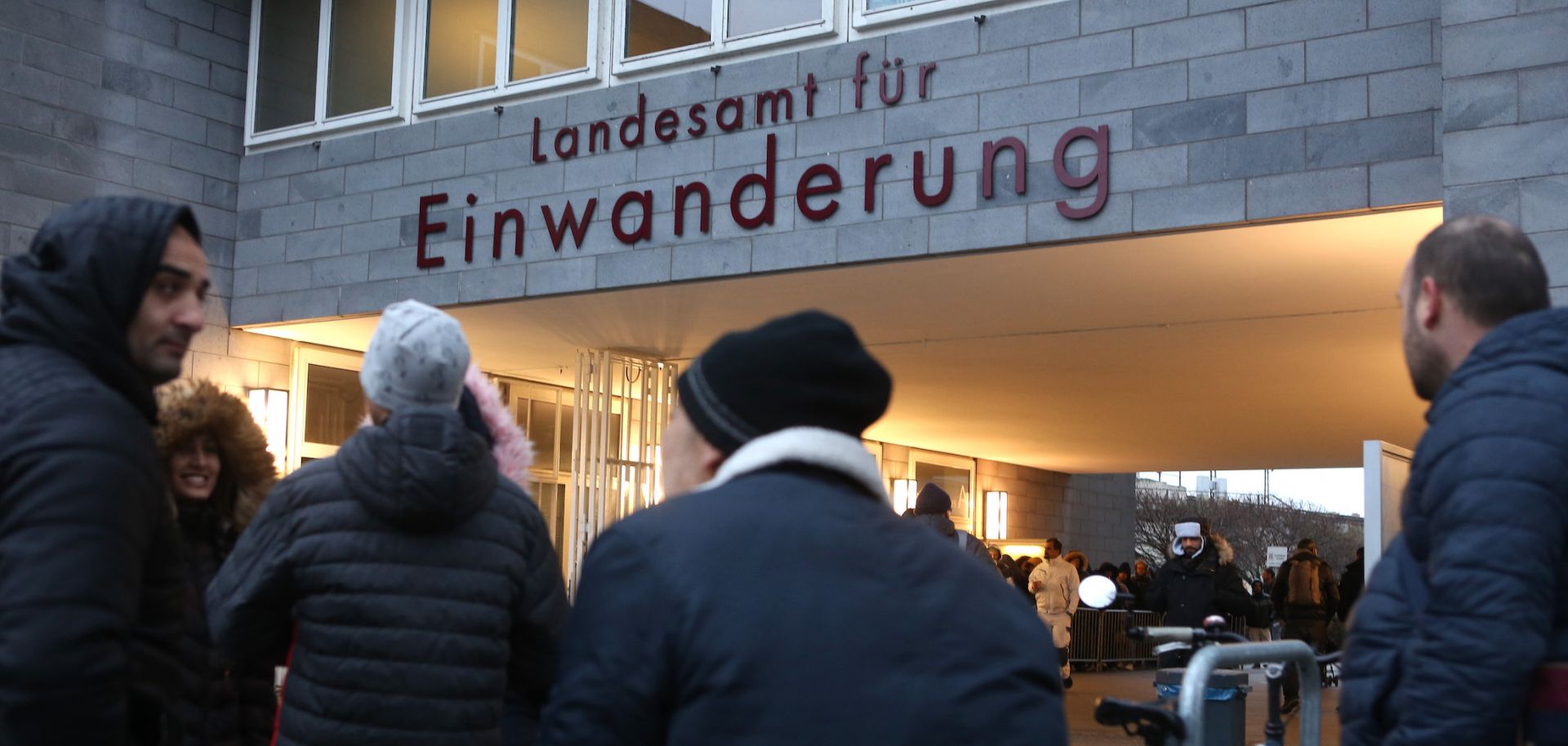
The German government's proposed overhaul of citizenship rules is part of a broader push to attract and assimilate more foreign workers as a way to plug Germany's labor and skills shortages, which are set to only grow in the coming years due to the country's aging population. But Berlin's efforts risk backfiring by accelerating the rise of far-right, xenophobic parties. On Aug. 23, the German government approved a draft law reforming the country's citizenship rules that aims to facilitate the naturalization of foreigners and their assimilation into the country. The bill will now face a vote in the German Bundestag, which could take place shortly after lawmakers return from summer recess on Sept. 5. If approved by the parliament, the reform will reduce the residence requirements for citizenship from eight to five years for everyone, and to only three years for people who have very advanced German language skills, exceptional academic or professional careers, and/or are involved in volunteer/social work. Other proposed measures include allowing the holding of multiple passports, simpler language requirements for foreign-born residents over 67 years old, and swifter routes to citizenship for migrants' children. On the other hand, people who are dependent on state support or who were convicted of hate crimes will not be eligible to apply for citizenship.
- Under the bill, all children born in Germany to foreign parents would automatically receive German citizenship if at least one parent has been living lawfully in the country for more than five years. Members of Germany's so-called ''guest worker'' generation — who moved to the country during the 1960s, mostly from Turkey — would also only need to pass an oral German language test to become citizens, instead of a written naturalization test as currently required.
- 14% of Germany's population (roughly 12 million people) do not hold German citizenship, according to statistics from the German government. Of those non-citizens, nearly half have been living in the country for at least ten years, and about 8 million hail from countries outside the European Union. Naturalization rates are lower in Germany compared with other EU countries, mostly due to Berlin's restrictions on holding multiple nationalities for non-EU nationals.
Germany has been facing labor shortages in recent years, with sectors spanning from professional services and tourism to steel, automotive and semiconductors reportedly struggling to fill vacancies. According to government statistics, the issue has started affecting more industries and professions amid an already extremely tight job market, a mismatch between supply and demand of jobs, and an ever-shrinking workforce due to the country's aging population following decades of low birth rates. The resulting labor shortages have further raised the cost of doing business in Germany by increasing workers' leverage to demand higher salaries. They've also fueled a wave of recent strikes and other disruptive labor actions by similarly increasing unions' bargaining power in wage negotiations. As more companies struggle to find employees at an affordable rate, the impact on business productivity and operation costs has, in turn, impeded Germany's economic growth and fueled inflation.
- Around 45.7 million Germans were employed in June 2023, according to the Federal Statistical Office, with the unemployment rate stuck at 3.1% despite two consecutive quarters of economic contraction and one of stagnation in Germany.
- A recent report published by Germany's Federal Labour Agency said 200 of the roughly 1,200 professions it surveyed had labor shortages in 2022, up from 148 in 2021. The agency expects that number to keep growing, noting that an additional 157 sectors will likely start experiencing shortages in the near future. The report also pointed to a mismatch between demand from employers and potential employees, with only 26% of unemployed skilled workers looking for a role in one of the 200 areas that faced labor shortages last year.
- A poll conducted by the German Association of the Automotive Industry (VDA) earlier this year found that over 70% of companies in Germany's crucial car-making industry were experiencing severe worker shortages. Another recent survey from the German Electrical and Electronic Manufacturers Association (ZVEI) showed more than 40% of companies in the digital and electrical industries were also struggling to fill vacancies, especially in the semiconductor sector.
While Berlin has also started taking steps to upskill the country's existing working population, revising Germany's immigration legislation to attract more foreign workers has become the government's main solution to the labor crunch. In addition to the newly proposed plan to make the path to citizenship easier, the German parliament on June 23 approved an immigration reform known as the Skilled Immigration Act, which Berlin hopes will double inflows of non-EU skilled workers into the country and help combat labor shortages by loosening stringent requirements on workers with qualifications recognized in Germany. Berlin has also been actively increasing efforts to attract foreign workers with other means, including by pushing an international advertising campaign dubbed ''Make It in Germany'' that's aimed at presenting the country as an attractive place for workers emigrating from countries in Asia, Africa and Latin America.
- The new Skilled Immigration Act is expected to bring an additional 60,000 foreign workers to Germany every year, and is set to gradually come into force between November 2023 and June 2024.
Without a major shift in its immigration policy, Germany's impending demographic deficit in its available workforce could threaten the country's prosperity and social welfare system. Changes to immigration rules will help Germany attract foreign workers by lowering the bureaucratic hurdles in applying for work, while changes to citizenship rules will help retain and integrate them into the country by offering prospects for a smoother and quicker path to nationality. Although the latter is not a condition of employment for migrants in Germany, these changes will help the government in pursuing its broader goal of turning the country into a preferred migration destination for foreign talent, similar to the United Kingdom, the United States and Canada. If successful, the increase in foreign workers would help plug existing labor shortages that have been hindering growth, disrupting services, and contributing to inflation. Moving forward, attracting foreign skilled workers will help contain emerging skills shortages in sectors such as renewable energies, semiconductors and IT that could become a significant bottleneck in the country's digital and green transition in the coming years. Over the longer term, as the country's demographic decline accelerates and begins to dramatically shrink the size of its workforce, attracting foreign labor will be key for Germany to sustain economic growth, reduce inflationary pressures, and maintain a financially sustainable welfare system. Still, with German authorities reportedly already overwhelmed by thousands of backlogged naturalization applications, long waiting times and cumbersome bureaucracy could frustrate efforts to quickly attract and absorb the hundreds of thousands of foreign workers Germany will need in the years ahead to replenish its dwindling pool of domestic labor.
- According to figures released by the Federal Employment Agency's Institute for Employment Research (IAB), Germany needs 400,000 new immigrants every year to offset the economic fallout from its aging population. The IAB also estimates the country will need 1.2 million more foreign workers every three years until 2060 just to maintain an adequate labor force. As of now, Germany's Federal Statistical Office expects a net yearly balance of 290,000 immigrants, leaving a shortage of 3.6 million workers in the job market.
- The Competence Center for Skilled Workforce Assurance (KOFA) at the German Economic Institute (IW) released a study in April 2023 that highlighted how Germany's skills shortage is threatening to slow down the country's energy transition. According to the report, the country needs around 216,000 more skilled workers — including electricians, heating and air-conditioning technicians, and IT specialists — to meet its decarbonization goals,
- Without an influx of foreign labor, German Labor Minister Hubertus Heil has warned that the German economy will have a shortage of 7 million workers by 2035, as the last members of the ''baby boomer'' generation (who currently comprise the majority of the country's workforce) retire.
- In this year's OECD ranking of its 38 member countries based on their ability to attract skilled foreign labor, Germany was in 15th place, down from 12th place in 2019. The OECD cited Germany's more cumbersome citizenship process as a key reason for the downgrade.
But an influx of foreign workers could also spur significant social and political backlash in the form of rising anti-immigration sentiments that fuel the ascend of far-right parties. Despite all the positive economic impacts, reforms to boost immigration from non-EU countries may prove a double-edged sword by fueling xenophobia among some parts of the German population and boosting support for far-right, anti-immigration parties like Alternative for Deutschland (AfD). The rise in popularity of such parties would complicate Berlin's plans to attract and retain foreign workers in the country's east, where many production facilities in traditional industries (like automotive, steel and metals) are located, and where many more factories in innovative sectors (like semiconductor and battery manufacturing) are being built. Eastern Germany is also where the AfD has polled strongly, which may deter foreigners from relocating there for work, while local policies may complicate federal plans to integrate those who would be willing to. Moreover, should Germany's next general election in 2025 yield a government that includes the AfD and/or other far-right parties, current government immigration plans may be reversed altogether — in which case, the country could find itself forced to rely almost entirely on increasing the productivity of the workers it already has in order to sustain economic growth. Germany may, for example, have to increase the retirement age to keep its welfare system afloat, though this would hardly contribute to growth or tackle the country's skills shortage, and would only hurt productivity. Under such a scenario, Europe's largest economy would thus likely remain sluggish for decades.
- Opposition parties, and particularly the AfD, have attacked the proposed changes to immigration and citizenship rules, citing concerns over allowing more foreigners into the country and granting them easier access to German nationality.
- The AfD has been growing steadily since Germany's last general election in 2021, when it only secured 10.3% of the votes. The far-right party is now polling at an all-time high of 20% nationwide — above Chancellor Olaf Scholz's Social Democrats and only behind the center-right Christian democratic political alliance CDU/CSU. In eastern Germany, the AfD is currently on track to win 2024 state elections in Thuringia, Saxony and Brandenburg.
- The conservative Christian Democrats (CD), the largest opposition force in the Bundestag, oppose the proposal and will likely vote against it in parliament. The party, which has so far refused to work with the AfD, will likely continue to support some pro-immigration measures aimed at attracting more skilled workers to fuel economic growth and tackle future labor shortages in the future but also oppose measures that ease the path to citizenship or excessively loosen the country's visa regime.
- In July, German Finance Minister Christian Lindner expressed concern about the rise of the far-right in the country's east, saying that ''the biggest business location risk for eastern Germany is the AfD'' while noting how ''a party that wants to seal off the country and serves xenophobic cliches is sand in the gears of the economy''.
- However, if the newly proposed citizenship reform is approved, the AfD's ascent could be somewhat tempered by the millions of first- and second-generation migrants (including Turks from the ''guest worker generation,'' as well as hundreds of thousands of Syrian refugees who arrived in Germany in 2015-16) that will receive a German passport and become eligible to vote in state and federal elections.
