
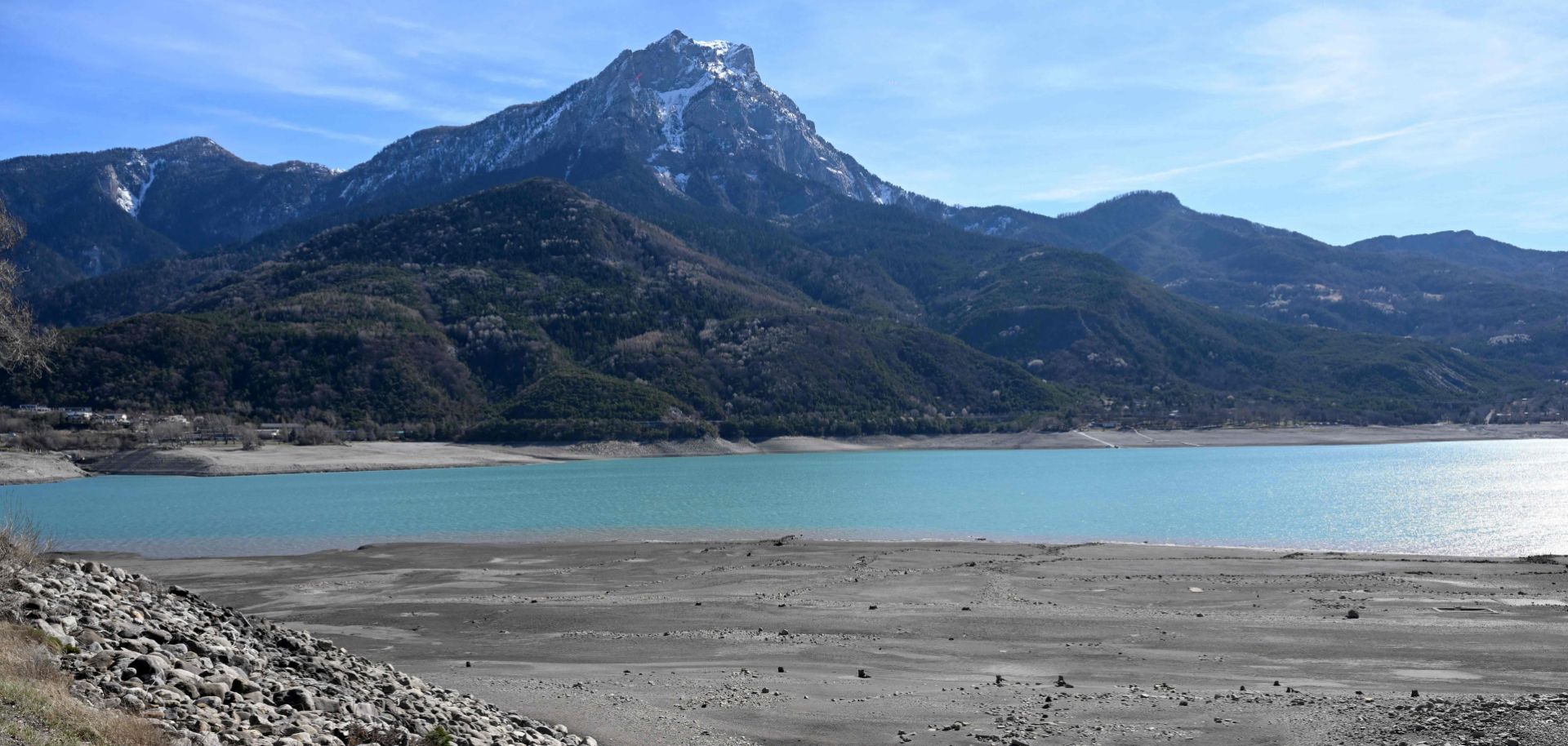
A photograph taken on March 16, 2023, shows Lake Serre-Poncon partially dry, near Embrun, in the French Alps.
In Europe, more frequent and severe droughts due to climate change will increasingly impact the Continent's drinking water supplies, agriculture, industry, energy generation and social stability. Last month, the European Drought Observatory (EDO) released a map showing alerts for low rainfall or low soil moisture in areas of northern and southern Spain, northern Italy, most of Greece, southern Germany and almost all of France, as well as large parts of the United Kingdom and Ireland. EDO's indicators suggest vast areas of the continent are far drier than they should be at this time of the year after what has been an exceptionally dry and warm winter. The lack of snow and rain in recent months has further strained Europe's water supplies, which were already low following the record-breaking temperatures that swept across the Continent over the summer. Amid the ongoing drought, several European countries are facing water shortages, and many have either introduced or are considering rationing measures to preserve what little water remains in their reservoirs ahead of what is set to be another sweltering summer.
- In France, which faced a month without significant rainfall between February and March (the longest such period since records began in 1959), local authorities in almost all departments across the country and in all seven major river basins have enforced water restrictions. President Emmanuel Macron on March 30 unveiled a crisis plan to tackle shortages and defined water as a ''strategic issue for the entire nation''.
- Spain has been in a state of drought since January 2022, particularly Catalunya, where authorities recently introduced restrictions including a 40% reduction in water used for agriculture, a 15% reduction for industrial uses, and an 8% cut in the average daily supply per inhabitant. The country's north, as well as parts of Andalucia and the south of Castilla-La Mancha, have also been hit hard.
- In Italy, water levels in the Po River were 61% down on the historical average for the month of February. Waterways, lakes, reservoirs and hydroelectric basins in the country's north are also in ''a very critical state,'' according to Italy's environment and energy security minister, Gilberto Pichetto. The Italian government is working on a special task force to tackle the effects of the severe drought through measures like significant water rationing.
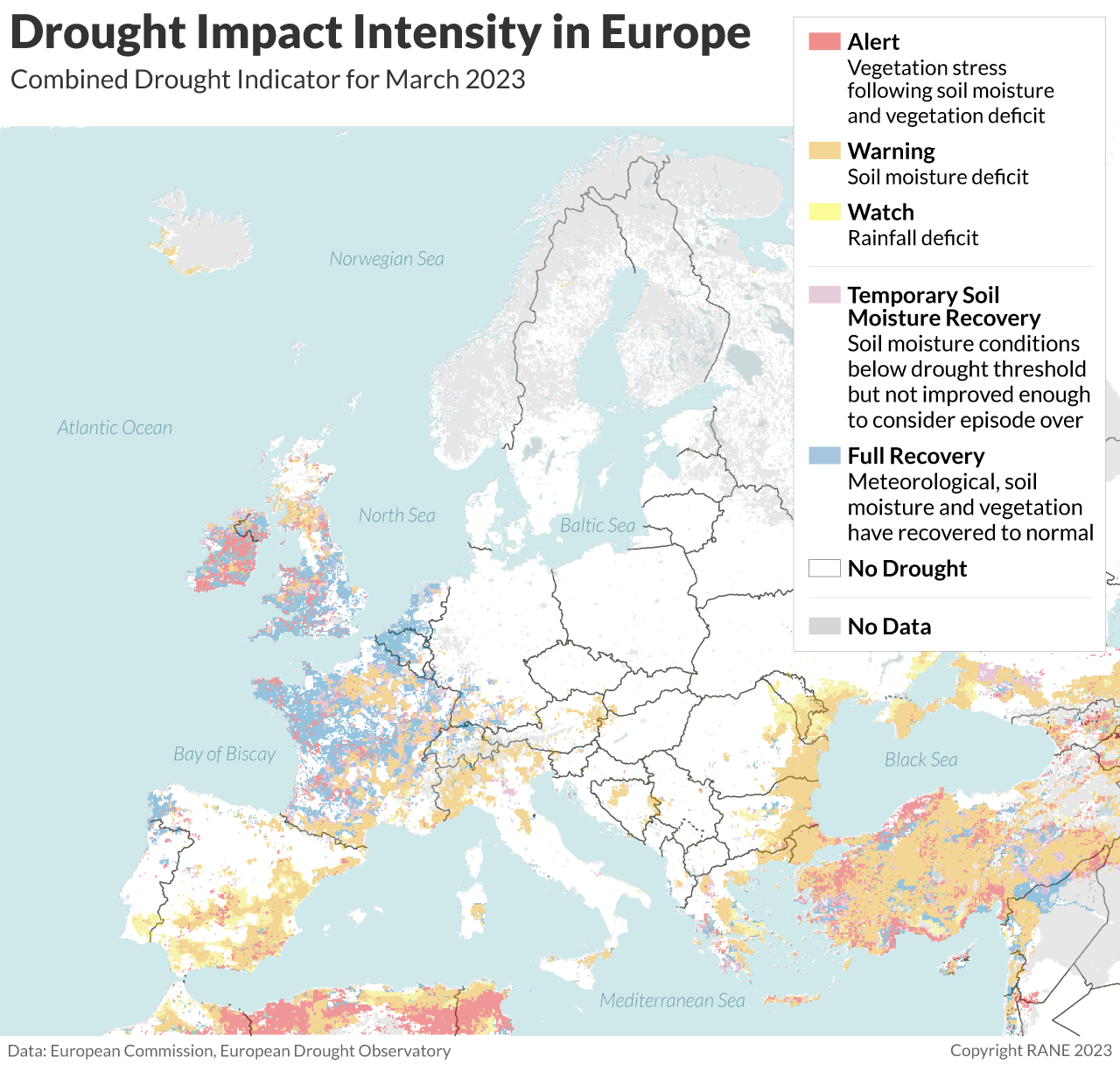
Low rain and snowfall during the 2022-23 winter following a severe summer drought in 2022 mean large parts of Europe will face water scarcity in the coming months. Europe's winter drought in late 2022 and early 2023 came just months after the Continent saw its driest summer in 500 years. Rainfall and snowfall would have been crucial to replete lowered water levels, so the lack of precipitation means most countries have yet to recover from last summer's drought right as another one is about to start. Dry spells are not unusual in some parts of Europe during the summer. But scientific research shows that climate change is bringing more frequent and severe droughts to the Continent that are affecting broader swaths of territory. Indeed, a recent study from the Graz University of Technology in Austria using satellite data to analyze groundwater reserves showed that Europe has been in a constant state of drought since 2018. For Central and Western Europe, climate change has already either tripled or quadrupled the risk of agricultural droughts (in which the top 1 meter of soil is dry, significantly impacting crops), according to a 2022 study from the World Weather Attribution (WWA) service — a trend that is only set to increase in tandem with rising global temperatures. For the coming summer, Europe is all but certain to face a water crisis, but the severity of that crisis will depend on the levels of rainfall seen in the coming weeks.
- A 2017 study for the European Commission titled ''Science for Disaster Risk Management'' argues how recent drought tendencies will likely persist in future decades, and projected that most of Europe will experience more frequent summer droughts in future decades, especially during the last few decades of the century, with the Mediterranean region being hit hardest. The effects of increased and prolonged droughts, although less severe than in south and western Europe, will also outbalance the effects of the projected precipitation increase over northern Europe.
- Climate change is also projected to bring increased rainfall and snowfall to Northern Europe, but scientists do not expect this added precipitation to offset the impact of Southern and Western Europe's more intense and prolonged droughts.
- A three to four times increase in the likelihood of summer droughts in Europe means that, instead of every 60 to 80 years, the region can expect such events to occur every 20 years in today's 1.2 degrees Celsius warmer world compared to pre-industrial levels. In a 2 degrees Celsius warmer world, which is becoming an increasingly likely scenario for well before the end of the century, this frequency would double.
More severe and frequent droughts will take an increasing toll on Europe's economy, with the most affected sectors being agriculture, shipping and energy production. Long-term future drought impacts are difficult to quantify as they depend on a combination of future climate conditions, climate change adaptation policy implementation, and drought management plans. However, significant damage to the agricultural, industry, energy and other sectors can still be expected over the next few years, assuming only limited changes in present socioeconomic conditions and water management measures in Europe. The Continent's agricultural production will be the first and hardest hit by the combination of record-high temperatures and record-low rainfall, with agriculture accounting for roughly half of the total estimates in drought-related direct economic losses. According to recent studies, lower water levels and drought conditions will make it harder for plants to extract water from the soil, leading to widespread stress on vegetation, crop failure and ultimately reduced crop yields — particularly in the Mediterranean region. In Northern Europe, drought-related economic losses in the agricultural sector will be lower due to generally lower temperatures. For northern countries like Norway, the most significant economic losses will instead come from lower power production, mostly due to the importance of hydropower in the region's overall energy mix. More severe and frequent droughts are also expected to increasingly strain Europe's nuclear power generation, which requires river water for the cooling of reactors. If water levels in rivers decrease and water temperatures rise, the capacity of rivers to play such an important role diminishes. This could particularly impact France, where nuclear power accounts for almost 70% of the country's total electricity generation.
- While recent estimates of drought impacts on Europe are in the order of 9 billion euros per year, climate change projections indicate this figure is growing with rising temperatures, particularly for Southern European countries like France, Spain and Italy.
- In March, France's ecological transition minister, Christophe Bechu, warned the country would have to cope with 30 to 40% less water by 2050, adding that the country was already on a ''state of alert'' and restrictions in some areas were fully justified.
- In January, Spain's environment minister Teresa Ribera said the country would face ''much longer cycles of extreme drought and periods of incredibly tough flooding,'' pointing to projections suggesting that the average amount of available water in Spain could drop between 14% and 40% by 2050.
Drought-related reductions in hydroelectric and nuclear power production will also risk impeding Europe's energy security and climate goals. The effects of reduced local hydro and nuclear power generation could ripple across the entire Continent, as countries that usually import electricity from hydro or nuclear power producers would need to obtain more energy from alternative sources, including by burning fossil fuels such as coal and natural gas. From an energy security standpoint, water crises thus have the potential to increase Europe's reliance on both energy imports and fossil fuels — impeding the Continent's ability to meet carbon-cutting targets, while making it all the more vulnerable to supply disruptions and price spikes (like those brought on by Russia's ongoing war in Ukraine). Finally, losses in the transport sector due to falling water levels in rivers will also increasingly add pressure on energy and industrial sectors, particularly in Central Europe. In Germany, for instance, the Rhine River is a key shipping route for a number of goods, including chemicals, minerals, coal and oil products. Lower water levels mean barges need to sail with reduced cargoes, translating into higher shipping costs and higher end prices for transported goods.
- In Italy, one of the European Union's largest agricultural producers and food processors, last year's severe drought caused crop yields to fall by up to 45%, according to the Italian farmers association Coldiretti. The country is also expected to cultivate nearly 8,000 fewer hectares of rice this year amid the ongoing lack of rainfall.
- According to Eurostat, hydropower is the European Union's second-largest renewable electricity source, accounting for about a third of renewable electricity production and 17% of total electricity output in the bloc. Austria, France, Italy, Spain and Sweden account for about 70% of the European Union's hydro generation. Italy, Spain and France — the countries hit hardest by last year's drought — generated 36%, 33% and 24% less hydropower, respectively, in 2022 compared with 2021, according to data from the European Network of Transmission System Operators.
- In Germany, the historic lack of rainfall in 2022 caused water levels in the Rhine to drop to such a low level that shipments through Germany's industrial heartland, from Switzerland to the North Sea and vice versa had to be loaded to only 30-40% capacity. In 2018, a similar drought cost Germany 5 billion euros in lost industrial output for the second half of the year alone.
Finally, recurring droughts could have significant socio-political implications by increasing food and energy costs, and forcing people to compete over scarce water resources. Droughts are already contributing to inflationary pressures in Europe by increasing food and energy prices, as less water means higher costs and lower production for farmers, energy producers and other industries. This, in turn, increases pressure on consumer purchasing power and prolongs the Continent's cost-of-living crisis. In the future, as droughts become more frequent and as water becomes an increasingly precious resource, food and energy prices will remain higher than in the past, contributing to increased living costs even after Europe's current inflation crisis is resolved. Moreover, water scarcity contributes to creating societal conflicts related to resource distribution. For instance, a major issue arising during droughts is the uneven distribution of water resources, which creates tensions between different regions, as well as between different social and economic groups. These dynamics are already visible in countries most affected by droughts in Europe, such as France and Spain, where tensions over the allocation of scarce water resources have recently led to social unrest, protests and even violent clashes between farmers, environmental groups and authorities. As more governments across Europe implement water management measures that may affect some groups more than others, access to water is bound to become an increasingly contentious and politicized issue, and similar social tensions could spread to more countries and become yet another new normal as a result of climate change.
- Governments in Europe will come under increasing pressure to prioritize who gets water during prolonged drought situations, but environmental and socioeconomic priorities often do not coincide.
- In March, the French government agreed to create irrigation reservoirs to collect and store rainwater that would otherwise naturally infiltrate the subsoil in winter, in order to provide a stable supply of water for farmers to use in spring and summer. But the decision has triggered an outcry among environmentalists due to the potential impact on natural ecosystems, which saw violent clashes break out between climate activists and the police near the French town of Sainte-Soline in March 2023.
- In Spain, the opposite is happening. In January, the Spanish government unveiled its new five-year Hydrological Plan, which prioritizes protecting ecosystems and of the ''ecological flow'' of rivers over agricultural needs. This sparked significant protests in January among farmers and trade unions who fear the move will hurt economic activity in the regions of Alicante, Murcia and Almeria.
