
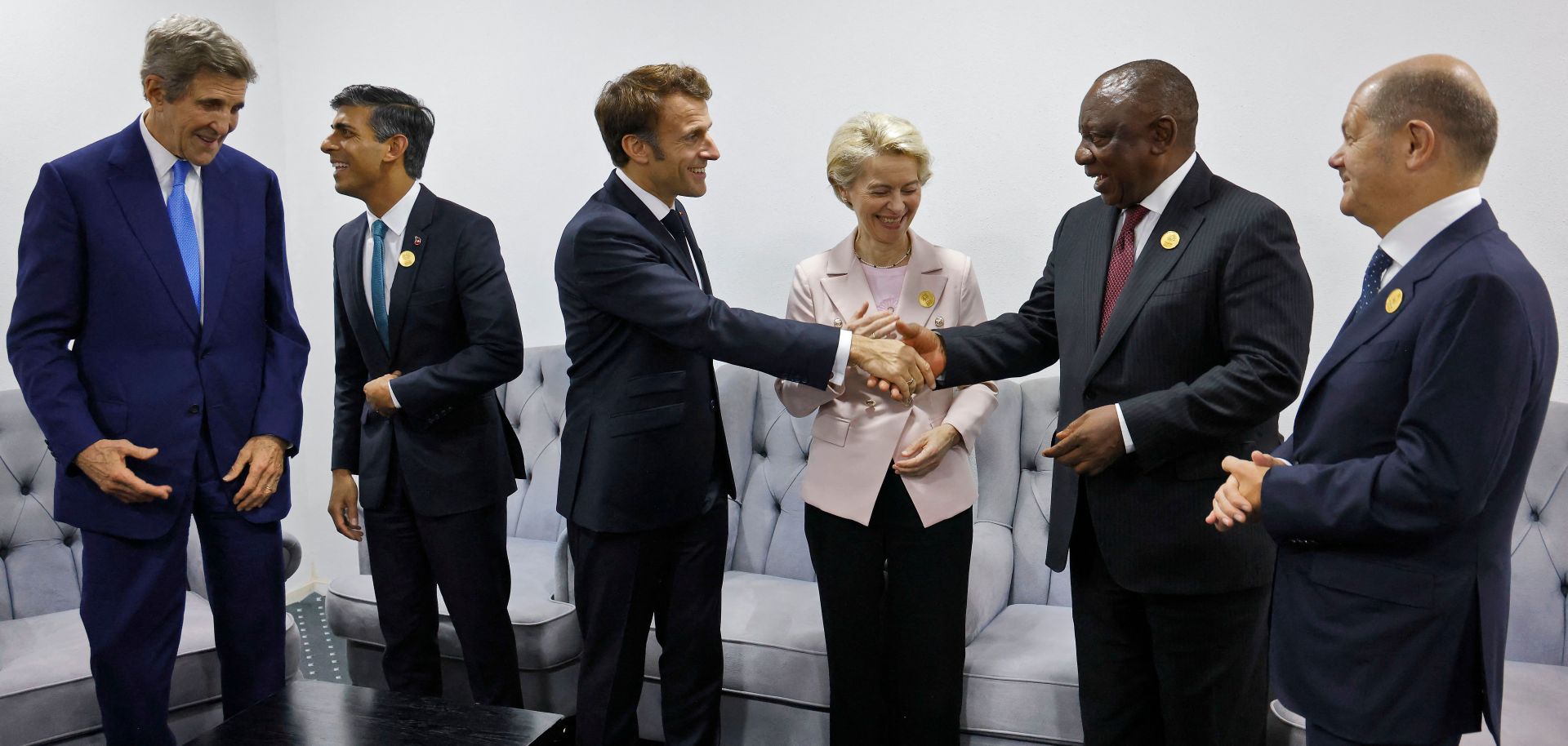
(From left to right) U.S. Special Presidential Envoy for Climate John Kerry, U.K. Prime Minister Rishi Sunak, French President Emmanuel Macron, European Commission President Ursula von der Leyen, South African President Cyril Ramaphosa and German Chancellor Olaf Scholz meet on the sidelines of the COP27 climate summit in Egypt on Nov. 7, 2022.
While the COP27 summit yielded a historic deal to help poor countries pay for damages associated with climate change, it also exposed deep divisions that will likely see future U.N. climate summits struggle to make agreements on emissions cuts. On Nov. 20, negotiators at the COP27 climate summit in Egypt reached a tentative agreement to create a so-called “loss and damage” fund where rich countries will financially help poor countries hit hard by the impacts of climate change, such as disruptive hurricanes and damaging droughts. While the fund is a significant milestone, the COP27 agreement does not include more aggressive text on phasing down unabated fossil fuel projects and instead just includes phasing out coal power — a commitment that countries had already agreed to before this year’s conference. The deal also does not include new pledges to accelerate emissions cuts.
- African, island nations and other poorer countries that will likely qualify for financial aid under the new fund have expressed support for the agreement, with U.N. Secretary-General Antonio Guterres saying it was an “important step towards justice.” The agreement was unexpected, as the issue of compensating poorer countries for climate-related damages and losses was not initially included in the conference’s agenda and was only added at the last minute. This suggests that developing countries (including Egypt, which hosted COP27) demanded that such a fund be included in order to agree to a final climate deal at the summit.
While the new fund will eventually help poor countries cope with climate change, U.N. negotiators will struggle to agree on how those countries will be paid, what damages they’ll be paid for, and with whose money. The deal on the fund is a high-level political statement, and does not include details about how it will be implemented. In fact, the COP27 statement aims to have negotiators hash out the specifics for operating and financing the fund at next year’s U.N. climate conference, which will kick off in Dubai on Nov. 30. The United States — the country that has emitted the most emissions to date — had previously pushed back against the idea of setting up such a fund, for fear of being exposed to financial liabilities and increased pressure to provide substantial funding to low-income countries. Indeed, just earlier this year, U.S. officials tried to block the use of the term “losses and damages” in a U.N. scientific report on the impacts of climate change. The establishment of the fund in the COP27 agreement will likely reinvigorate calls among U.S. climate change skeptics to once again withdraw from U.N. talks and the Paris Agreement (which former U.S. President Donald Trump did in 2020 before his successor Joe Biden rejoined in 2021). The European Union had also previously rebuffed calls to establish the fund, arguing other mechanisms to pay for loss and damages already existed. This resistance among the world’s wealthiest nations indicates that future negotiations over establishing and overseeing the compensation fund will be complicated.
- Both Europe and the United States will likely demand China — the world’s largest current emissions emitter — donate to the fund, along with large hydrocarbon-producing countries (like Saudi Arabia and its neighbors) and industrial powerhouses with high GDP per capita like South Korea. Countries including China and Saudi Arabia were classified as non-Annex I nations in the 1992 treaty that established the current U.N. framework on climate change talks, and therefore remain technically exempt from donating to other developing countries. The West argues that some of these countries are now much wealthier and produce far more carbon emissions thanks to 30 years of economic development, and should thus also help pay poorer countries impacted by climate change.
- Beyond deciding who will contribute to the fund, agreeing to what qualifies as “losses and damages” associated with climate change will also be contentious. Western governments are likely to try to narrow the scope of the definition in order to prevent poor countries from including issues that are indirectly or only mildly related to climate change. In a study published in June, the Vulnerable 20 (V20) Group — which includes African, Caribbean and South Asian countries that are particularly exposed to the impact of warming global temperatures — estimated that they lost a combined $525 billion of GDP over the past two decades due to climate change-related events. By comparison, contributions promised by developed countries to help compensate for these losses are typically made on the order of tens or low hundreds of millions of dollars, not billions.
The lack of progress in cutting carbon emissions and accelerating the transition from fossil fuels at COP27 suggests that the current U.N. negotiation process may be reaching a limit, which will force negotiators to scale back ambitions. The pledge to phase “down” unabated coal power and inefficient fossil fuel subsidies in the COP27 agreement is largely a reiteration of the pledge negotiators already agreed to at last year’s U.N. summit in Glasgow. Western negotiators had been pressing to strengthen the language to include all unabated fossil fuels, but those efforts ultimately failed amid pushback from developing countries dependent on fossil fuels and fossil fuel exports, like Saudi Arabia. Coal power is and will likely remain essentially the lowest common denominator in talks over phasing down fossil fuel use. Egypt, meanwhile, initially tabled language in the first draft of COP27 decisions that would have called on developed countries to have net negative emissions by 2030 — a full two decades before most Western countries' 2050 target date. This suggests that Western nations and developing countries, led by conference host Egypt, had extremely different goals in the talks, with the former wanting to phase out fossil fuels globally and the latter wanting the United States, Europe, Australia and Canada to accelerate their ambitions. At this point, most governments have made distant promises to reduce emissions, with most progress to be made slated to occur over the next decade. For governments, the immediate economic fallout from the fossil fuel- and carbon-cutting commitments they’ve already made will make it politically difficult to justify making further commitments. This will lead to an increasing divergence between countries wanting to prioritize combating climate change versus those more concerned with short-term economic growth and energy security.
- The final text of the COP27 agreement also weakens some fossil fuel provisions by calling for countries to reduce emissions through an “increase in low-emission and renewable energy.” This has led many climate activists to be concerned that “low-emission” energy would also include natural gas, which is being viewed as a bridge fuel to reduce emissions in the short term by many governments. For example, earlier this year, the European Union included natural gas-related investments in its taxonomy for sustainable investments.
- The lack of progress on emissions reductions at COP27 is unsurprising given that, for much of the last year, the world has been dealing with an energy crisis that has forced a number of Western governments to temporarily suspend or weaken some previous pledges over concerns about energy security. For example, on Nov. 4, the European-led Export Finance for Future (E3F) initiative weakened some of its commitments on ending public finance for overseas fossil fuel projects. The agreement says that the countries would agree to report publicly how they applied the pledge, including how they might apply limited exceptions. But due to pushback from Italy, which wanted more flexibility on what is exempted, the final draft struck out proposed language that would have explicitly had E3F countries pledge to end export finance by the end of 2022 for “exploration, production, transportation, storage, refining, distribution of coal, crude oil, natural gas, and unabated power generation.” During COP26, Italy and many other E3F countries previously promised to end public support for such projects by the end of 2022.
