
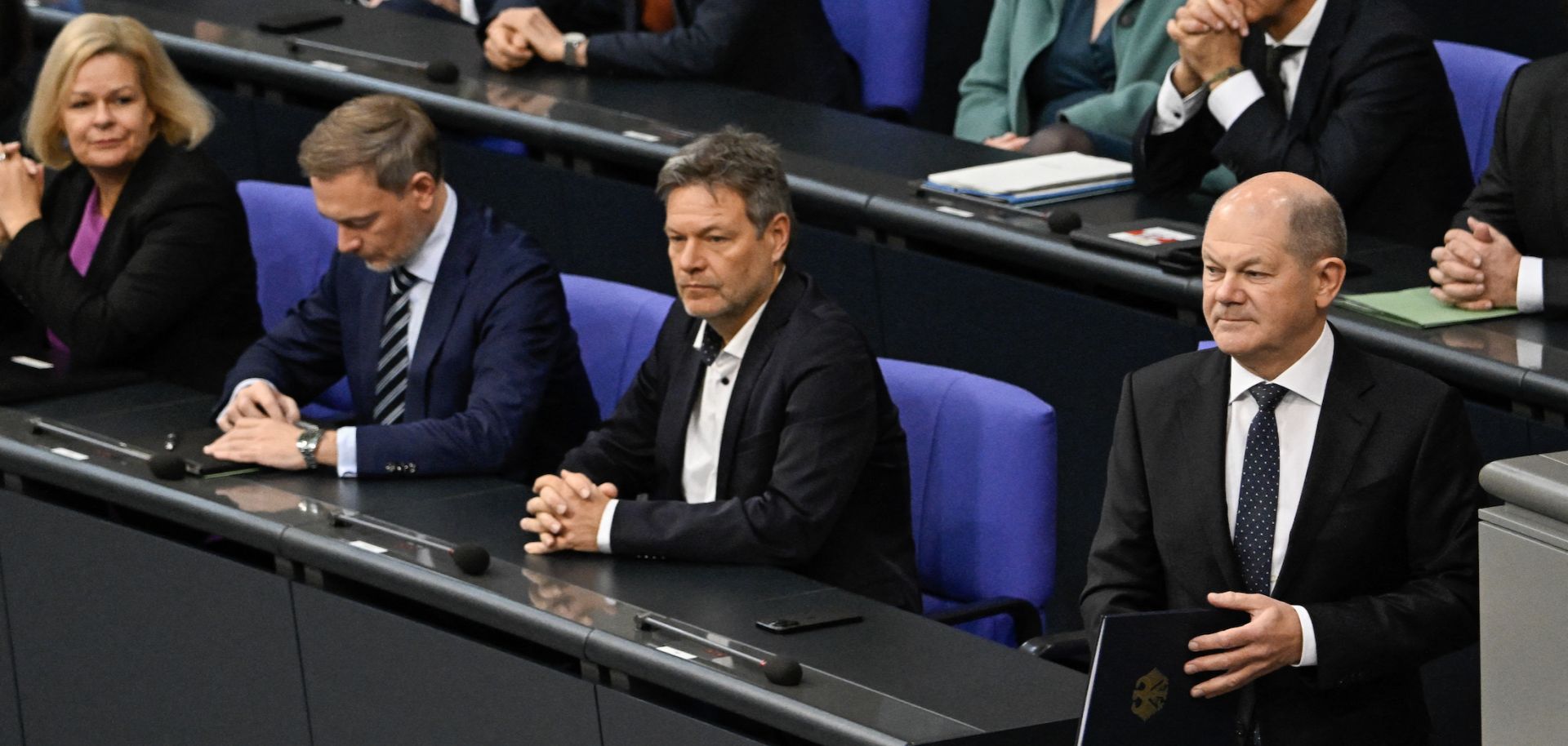
While the three members of Germany's coalition will likely reach a compromise to end the country's ongoing budget crisis, the upcoming complex negotiations over spending cuts could still collapse the government next year. On Nov. 14, Germany's Constitutional Court ruled that the federal government in Berlin cannot repurpose 60 billion euros in unused pandemic-related funds to finance policies related to the country's energy transition through 2027. This is forcing the three members of the ruling coalition — which includes Chancellor Olaf Scholz's center-left Social Democratic Party (SPD), Economy Minister Robert Habeck's environmentalist Greens party and Finance Minister Christian Lindner's business-friendly Free Democratic Party (FDP) — to make difficult choices about their spending priorities through the end of the government's term in 2025. On Nov. 27, the government unveiled a supplementary budget for the remainder of 2023 that temporarily lifts a constitutionally-enshrined debt brake (a self-imposed cap on government borrowing that limits budget deficits to 0.35% of GDP) so that Berlin can borrow extra money in financial markets. Still, the government has yet to make an announcement on the 2024 budget. According to Lindner, Germany faces a 17 billion euro gap in the 2024 budget, but German bank Berenberg has estimated the gap to be between 30-40 billion euros.
- Besides the 60 billion euros annulled by the court (corresponding to about 10-20 billion euros per year through 2027), the ruling also called for stricter rules on the use of special funds by the federal government and regional governments to finance various spending plans. This means the budget shortfall may be much larger than the scope of the ruling because the availability of up to 869 billion euros spread across 29 ''special funds'' outside the federal budget could be in question.
The court ruling has reignited a debate over the future of Germany's debt brake, but the controversial clause is unlikely to be reformed in the short-to-medium term due to insufficient support in parliament. The German government's current budget problems have rekindled a debate about the future of the constitutional debt brake, which Berlin introduced in 2009 during the peak of the financial crisis to send a strong signal to markets about its commitment to fiscal responsibility. The debt brake is popular in Germany, as many voters argue that it prevents Berlin from enacting the irresponsible fiscal policies that plunged Mediterranean Europe into debt crises in the early 2010s. Critics of the debt brake, however, argue that it unnecessarily constrains Germany's room to spend on areas such as infrastructure, the energy transition and defense — all of which are essential for the country's future amid low levels of economic growth, an aging population and rising geopolitical risks. Berlin has suspended the debt brake every year since 2020, first to justify pandemic-related spending and then to cope with the energy crisis in the country and the war in Ukraine. But this forces Berlin to constantly look for legal justifications for the suspension, which has prompted some members of the SPD and the Greens to call for the brake's removal. However, this would require reforming the German constitution, for which the government coalition does not have the required two-thirds majority in parliament — especially considering that the main opposition party, the conservative Christian Democratic Union (CDU), supports the brake. Moreover, the FDP itself is against constitutional reform, as fiscal responsibility is one of the party's flagship policies. This means that a constitutional reform is unlikely at least until the general election in 2025, which will force the government to look for other ways to fill its budget hole.
A compromise between the coalition members to suspend the debt brake for another year while also cutting some spending is likely, but failure to reach such a deal could bring about the government's collapse. Large factions of the SPD and the Greens are against significant spending cuts (especially if they target energy transition plans), while many FDP lawmakers are against suspending the debt brake for another year in 2024. However, a compromise between the three parties to simultaneously reduce spending and increase borrowing is still likely because they all want to keep their coalition intact. Should the government collapse, three scenarios are possible. The first is a minority government (probably including the SPD and the Greens), which would not be able to do much due to insufficient support in parliament. The second is a grand coalition including the SPD, the Greens and the CDU, but the CDU would likely be skeptical of joining a government in such financial dire straits. The third scenario is an early general election where the opposition would win. According to opinion polls, the SPD, the Greens and the FDP would all lose seats if an early election took place, while the CDU and the far-right Alternative for Germany (AfD) would make significant gains compared with the last general election in 2021. However, the competing interests within the coalition (particularly between the SPD/Greens and the FDP) mean the upcoming negotiations over spending cuts will likely be tense. Therefore, a scenario where the partners fail to reach a deal and the coalition collapses cannot be ruled out, which would leave Germany with either an inefficient government or an early election at a time of unresolved fiscal problems.
- According to SPD lawmaker Katja Mast, the party is convinced ''a justification can be found'' to declare an emergency situation that would allow Berlin to suspend the debt brake for another year in 2024. However, Lindner said on Nov. 29 that he was ''not yet convinced'' that the conditions for an emergency resolution to suspend the debt brake would be met in 2024, adding his ''concern was that if we describe the emergency situation for such events and do this every year, we fail to recognize that at some point a one-off emergency situation will become a deplorable and regrettable new normal.''
- On Nov. 27, Bavarian Premier Markus Soder (the leader of the Christian Social Union, the CDU's sister party in Bavaria) called for an early general election, arguing that voters have lost faith in the three-party coalition government.
- Even if the SPD, the Greens and the FDP overcome their current budget problems, tensions will remain due to their ideological differences. The elections for the European Parliament in June 2024, where the CDU and the AfD are likely to perform strongly, will create new rifts in the internally divided coalition.
