
Climate change, the reduction of Russian natural gas, high electricity prices and safer next-generation nuclear reactors will lead more European countries to invest in new nuclear reactors. But internal EU disagreements over nuclear power, as well as technical and financial hurdles, will complicate those efforts and introduce new challenges for nuclear companies. Italy is becoming the latest European country to offer political support for nuclear power. On Sept. 21, Energy Minister Gilberto Pichetto Fratin launched the National Platform for Sustainable Nuclear Power to develop guidelines in the next nine months to possibly reintroduce nuclear power to Italy's energy mix. In launching the platform, Fratin pointed out that Italy needed to secure electricity sources that, unlike renewables, can provide a stable supply of power, like nuclear power does, as the country phases out fossil fuels. If Italy builds nuclear reactors, it would most likely only consider small modular reactors or more advanced Gen IV reactors (which are safer but not expected to be commercialized until the 2040s), rather than the Gen III+ reactors being constructed today.
- Italy phased out nuclear power in 1990 after a 1987 referendum in the wake of the 1986 Chernobyl nuclear disaster. In the late 2000s, Italy sought to revive its nuclear power industry, but this was headed off by the 2011 Fukushima Daiichi nuclear disaster in Japan and another Italian referendum shortly thereafter where over 90% of Italians voted in support of repealing the laws passed by the government to revive nuclear power.
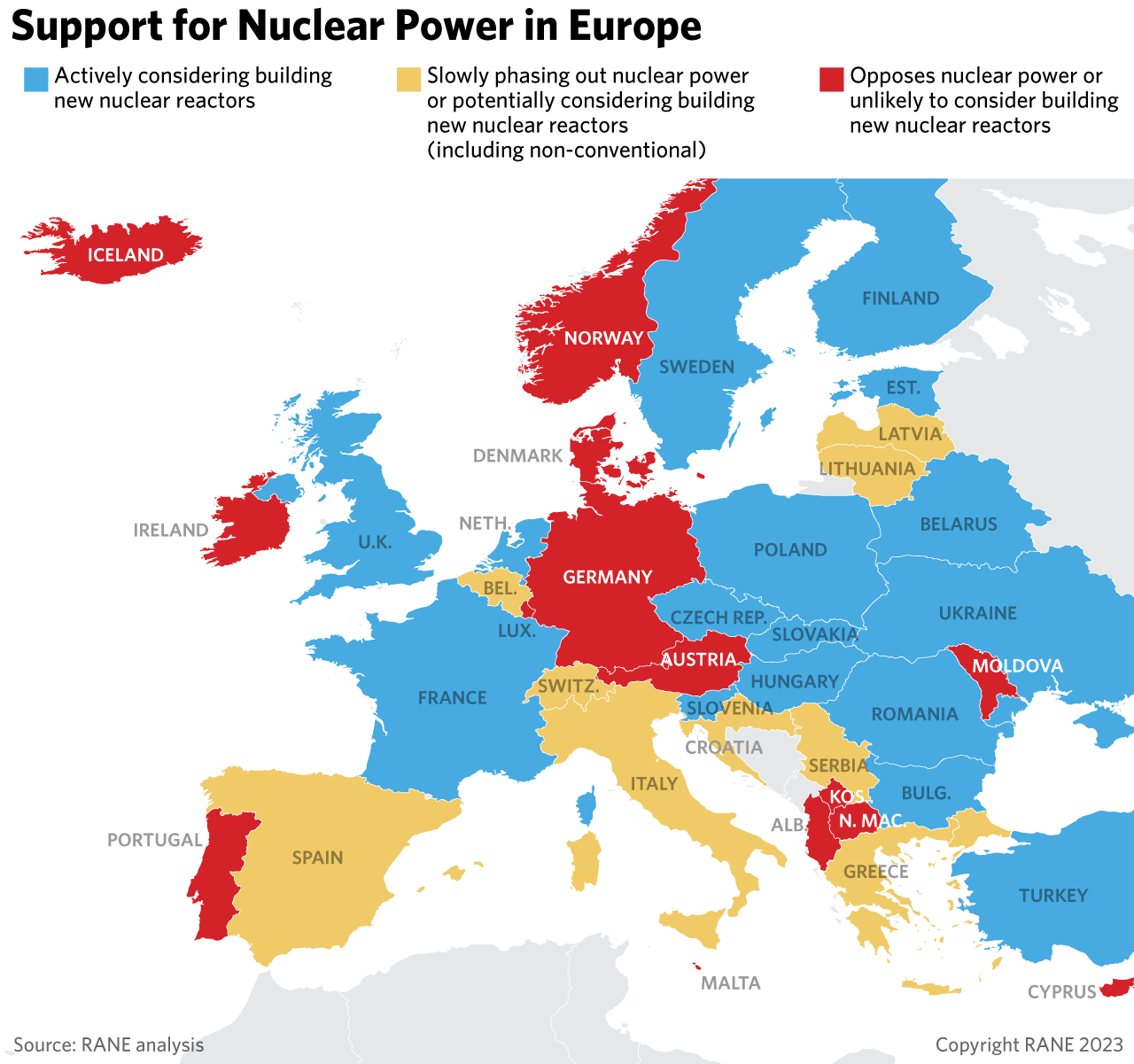
- In 2022, both the British and French governments announced new plans to build new nuclear reactors. France will build at least six new reactors, with plans to potentially build eight additional reactors, while the United Kingdom will build up to eight new reactors. In June 2023, the Swedish Riksdag also approved a new energy plan to build ten new reactors.
- In February 2023, France also led the creation of a Nuclear Alliance of 16 countries, with Italy being an observer and the United Kingdom as a guest country, designed to promote nuclear power within Europe. The other members are Belgium, Bulgaria, Croatia, Estonia, Finland, Hungary, the Netherlands, Poland, the Czech Republic, Romania, Slovenia, Slovakia and Sweden.
- Central and Eastern Europe is also becoming an increasingly important area for the development of emerging nuclear technologies in the region, as exemplified by the U.S.-led plan known as ''Project Phoenix,'' which aims to replace coal-fired power plants in countries like Romania, Poland, the Czech Republic and Slovakia with small modular reactors.
- On the other hand, Germany shut down its remaining nuclear power plant in April 2023 given that the Green Party is part of the government coalition. German Chancellor Olaf Scholz said on Sept. 2 that nuclear power was a ''dead horse'' in Germany, despite calls from both the opposition and members of his coalition government to halt the decommissioning of Germany's nuclear power plants.
Climate change, the war in Ukraine, energy security concerns, new nuclear energy technologies and high energy prices are all contributing to increased European interest in nuclear power. Last year, the outbreak of the Ukraine war and the subsequent EU decision to phase out Russian natural gas entirely by 2027 led to a spike in electricity prices driven by high natural gas prices amid limited supplies. This electricity spike prompted the European Union to temporarily loosen its state aid rules under a Temporary Crisis Framework, which allowed countries to implement subsidies, cash transfers and other mechanisms designed to combat the higher energy price environment. The Continent's push to phase out Russian natural gas following Moscow's invasion of Ukraine — coupled with the European Union's growing ambition to reduce net greenhouse gas emissions by 55% by 2030 under its Fit for 55 Package — means that European governments are under pressure to ensure that their policies simultaneously hit green targets and generate enough electricity from different sources by the end of the decade and at reasonable costs for future electricity. Adding to the challenges is the fact that Europe's ambitious electrification targets for the transportation sector (i.e. to get more electric vehicles on the road) and the heating sector (i.e. to install more electric heat pumps) are expected to help boost European electricity demand by about 20% in 2030 from 2021 levels, according to the International Energy Agency. Nuclear reactors are attractive for two main reasons: 1) they can improve Europe's energy security by offering a stable supply of low-carbon electricity that does not require a constant supply of fuel, unlike coal or natural gas power plants, and 2) unlike renewables like wind and solar (which generate power intermittently), nuclear reactors can operate uninterrupted throughout the day, providing a so-called base load to the electricity grid that helps keep the power grid balanced. Moreover, over the last decade, nuclear power companies have introduced Gen III+ reactors, which are viewed as being far safer than previous generations (like the Gen II reactors at Fukushima Daiichi and Chernobyl). In the future, small modular reactors also offer more promise for safety as they are designed in a way so that they do not really present a risk beyond their premises and aren't at risk of having a nuclear meltdown — making them even more politically attractive.
- Over the next few years, there will likely be more pressure on European governments to accelerate the energy transition, which nuclear power can help accomplish, as climate change intensifies and as evidence mounts that global actions to cut emissions are insufficient to achieve the goals outlined in the 2015 Paris Agreement. A technical report released on Sept. 8 ahead of the United Nations COP28 climate conference in November, which will be hosted by the United Arab Emirates, found a large gap between countries' current greenhouse gas emissions and the expected decline in emissions needed to achieve the Paris Agreement's targets.
- European environmental and climate activist groups generally oppose the use of both nuclear power and fossil fuels. But as the climate crisis worsens, some activists will likely become more pragmatic about nuclear power, viewing the environmental concerns with nuclear power as a lesser of two evils compared with climate change. Already, on Aug. 29, an activist group that was a part of Greta Thunberg's school climate strikes campaign launched a ''Dear Greenpeace'' campaign to convince the global environmental organization to drop its ''old-fashioned and unscientific'' opposition to nuclear energy, arguing that Greenpeace's anti-nuclear stance supported the fossil fuel industry.
But European countries' nuclear goals, especially the ambitious ones put forth by those like France and Poland, face significant threats from technical and financial hurdles. Recent European and North American nuclear power projects have had limited success. First-of-their-kind Gen III+ reactors developed by nuclear power companies like U.S.-based Westinghouse and France's Framatome have been plagued by cost overruns and lengthy delays. Finland's Olkiluoto 3 nuclear reactor — the first Gen III+ EPR reactor constructed by Framatome, Germany's Siemens and France's state-owned power giant — finally began normal operations in April 2023, 18 years after construction originally began in 2005, and four years after construction was originally scheduled to be completed in 2019. The cost of the reactor ballooned from 3 billion euros initially to around 11 billion euros. The second EPR reactor being built in France has also suffered a decade-long delay in its commissioning. In the United States, Westinghouse has run into similar issues with its AP1000 reactors, with its first reactor at a power plant in Georgia being commissioned in July 2023 after long delays and cost overruns. Such struggles are significant for Europe, as the AP1000 and EPR will likely comprise the bulk of the designs selected for new reactors on the Continent. EDF, Framatome, Siemens and Westinghouse will likely be able to reduce some of the delays and cost overruns, now that the first-of-their-kind reactors have been built — especially if they can introduce economies of scale to design and build multiple reactors at the same site or in the same country. But their efforts will only go so far without improvements to the structural issues in the West that are also contributing to the high price and lengthy timelines of these projects (including a shortage of nuclear energy experts, high labor costs, and strict regulatory and safety standards).
- Compared with Western countries, China and South Korea have been able to more quickly and cheaply build advanced nuclear reactors. But although both Asian countries have eyed the European nuclear market, China's involvement has become politically controversial in countries like the United Kingdom (where the government has pushed China out of multiple nuclear power projects in recent years), while South Korea has yet to prove it can export nuclear technology to Europe and meet higher European environmental and safety standards without increasing costs and timelines.
- The risks of cost overruns and delays are even higher in Italy (which is considering rebuilding nuclear reactors) and Poland (which is planning to build its first reactors). This is because neither country has an established workforce with a history of working in the nuclear power industry, nor a proven track record through their respective regulatory environments to make approvals quick and easy to implement.
- In Italy and other European countries that are trying to reverse a long-established anti-nuclear stance, the eventual revival of a nuclear program will face even more constraints and will likely take 10-15 years to materialize. Convincing the country's public opinion to change a deep-rooted distrust in nuclear energy, as well as finding sites to build new reactors and store nuclear waste amid local communities' traditional resistance to such infrastructure, will prove to be a long and challenging process.
The sustained push for nuclear power by some EU member states will continue to create disputes within the bloc, which will pose a financial and regulatory risk to countries and companies pursuing nuclear energy opportunities in Europe. Germany — along with fellow EU members Austria, Denmark, Luxembourg and Portugal, which have long opposed nuclear power — seem unlikely to reverse their anti-nuclear positions. In 2021 and 2022, these five EU countries pushed for nuclear power to be excluded from the EU Taxonomy Regulation for green finance. But while nuclear power was ultimately included in the taxonomy, political spats within the bloc over the controversial energy source have continued. Currently, EU member states are arguing over whether governments should be allowed to offer state-backed, fixed-price power contracts to existing power plants and then take the revenue to subsidize industries. France, as well as Bulgaria, the Czech Republic, Croatia, Hungary, Poland, Romania, Slovakia and Slovenia, want to be able to spend those subsidies on existing nuclear facilities. By contrast, Germany and other anti-nuclear states are concerned that such subsidies could undermine their own electricity market's competitiveness vis-a-vis countries with nuclear plants. EU negotiators hope to reach a compromise as a part of a broader reform to the bloc's electricity market by the time EU energy ministers finish their next meeting on Oct. 17. But even if EU members are able to reach an agreement on this particular dispute, the controversy over the subsidy issue nonetheless demonstrates that the debate over nuclear power in the European Union will likely continue to play out as the EU implements energy policy reforms in the coming years, with each major change likely re-opening disagreements over the role of nuclear power. For companies, this creates a degree of uncertainty and introduces political and regulatory risk around policies by pro-nuclear EU member states that are designed to support nuclear power-related investments or lifetime extensions. The technical, financial and regulatory challenges that have recently plagued the construction of new reactors in Europe also magnify some of the political disputes in the European Union surrounding nuclear power because they risk not only adding more delays, but reducing state support for and investor interest in such projects (especially if investors aren't able to label their nuclear investments as sustainable) — both of which are necessary for the construction of nuclear reactors to be economically feasible.
