
Editor's Note: This article is part of an ongoing RANE series on the shifting patterns of global trade. The first installment provided a broad overview of the geopolitical and economic implications of these shifts. Other installments have examined trade patterns in the Americas, the Strait of Hormuz, Japan and South Korea, India, Turkey, ASEAN countries, the digital landscape, Mercosur and maritime chokepoints (part one and part two).
The expansion of digital trade will incentivize the inclusion of digital matters into future trade agreements, but slow regulatory change and growing geopolitical tensions will hamper multilateral frameworks, though countries with digital trade deals will be better positioned to reap the benefits of expanding digital trade. In the last two decades, multilateral free trade agreements (FTAs) have facilitated the cross-border movement of goods and services. While the largest and most established FTAs include e-commerce chapters, even these are narrow in scope when considering how central electronic goods and services are to modern economies. Moreover, e-commerce chapters are increasingly outdated in the wake of rapid technological advancements. Among other things, the significant pace of internet expansion, particularly in developing countries, has fueled the entry of new e-commerce services and products across the globe while regulations and agreements have comparatively lagged. As digital trade increasingly encompasses a growing percentage of many countries' total trade activities, however, FTAs will become more integral for governments and businesses seeking to both profit off of and operate in the digital space.
- Digital trade as a concept is often poorly defined or misunderstood due to conflated or overlapping terminology. Broadly speaking, digital trade refers to the sale of goods or services that are digitally ordered or delivered. This can include both the purchase and use of software and digital content, such as cloud services and streamed movies, as well as physical goods purchased on e-commerce sites.
- According to WTO data last updated in July 2025, the value of cross-border digital trade grew by an estimated 10% between 2023 and 2024. In the last three years, between 2022-2024, global exports of digital services grew 25%.
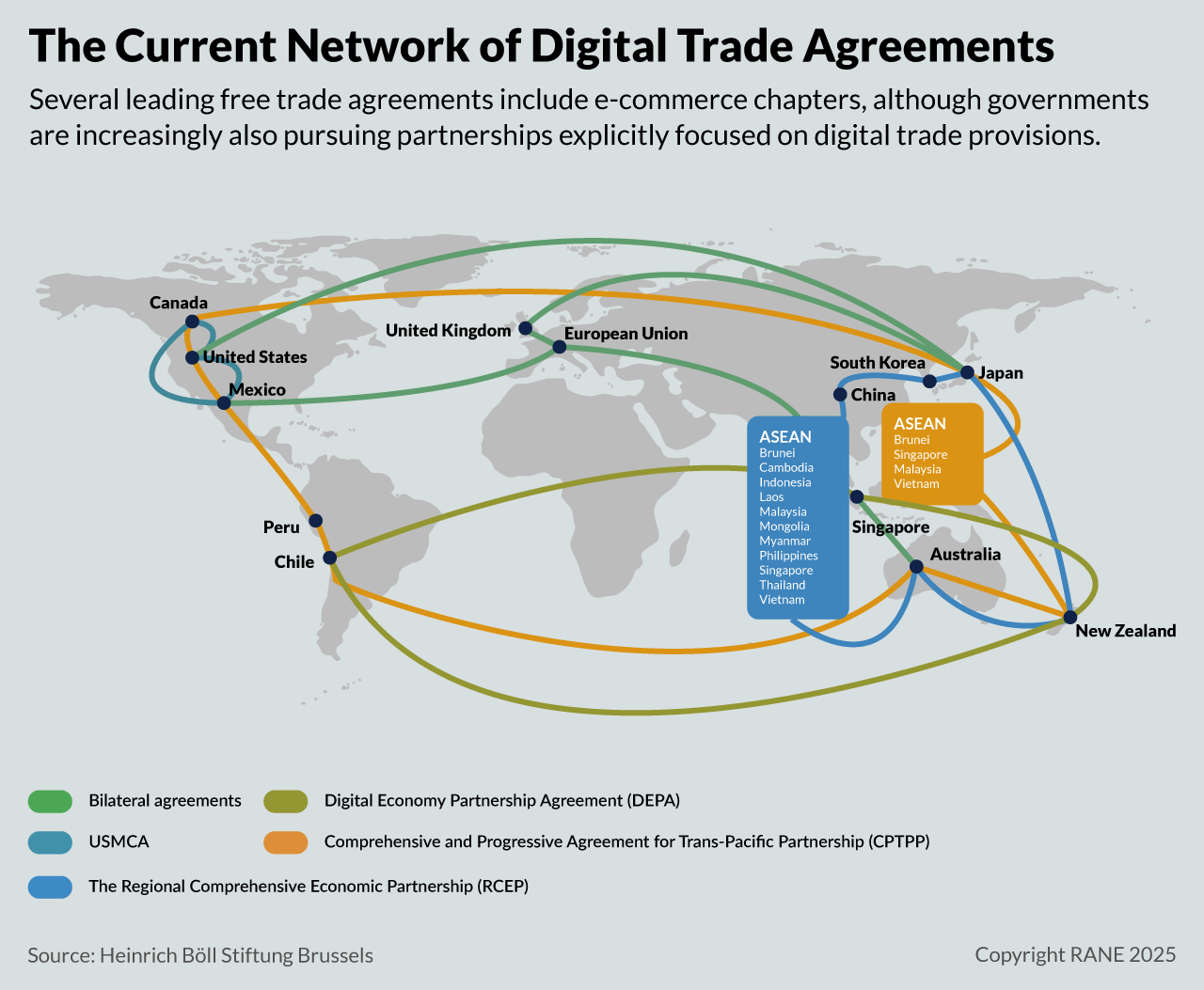
Digital trade agreements were first introduced as subcomponents to larger FTAs, but are also increasingly emerging as their own independent bilateral or multilateral partnerships that aim to streamline requirements to trade digital services across borders. The Comprehensive and Progressive Agreement for Trans-Pacific Partnership (CPTPP) is one of the earliest FTAs to address e-commerce, establishing a range of provisions that went into force in December 2018. Other significant and more recently established or reworked FTAs have also included e-commerce chapters, many of which are largely based on the CPTPP's structure and requirements. As e-commerce has grown at an increasingly rapid rate, some countries have pursued the establishment of digital economy agreements (DEAs) focused exclusively on digital trade. The Digital Economy Partnership Agreement (DEPA), penned originally between Chile, New Zealand and Singapore, became the first digital-only trade agreement open to all World Trade Organization (WTO) members in January 2021. In November 2023, the Association of Southeast Asian Nations (ASEAN) began drafting a proposed Digital Economy Framework Agreement (DEFA), which the bloc claims it expects to finalize by the end of this year, though this timeline appears highly ambitious based on past precedent. While ASEAN already has an Agreement on Electronic Commerce, the bloc is hoping to expand its coverage by introducing more robust requirements covering a broader range of issues. The European Union also has implemented a series of digital trade rules, including major legislation, such as the General Data Protection Regulation, Digital Services Act (DSA), Digital Markets Act (DMA), and Artificial Intelligence Act, which collectively introduce a range of requirements for member states and businesses operating in the bloc. Other countries also maintain bilateral DEAs, including Singapore, which has signed the most DEAs of any country, including with Australia, the United Kingdom and South Korea.
- The CPTPP includes Australia, Brunei, Canada, Chile, Japan, Malaysia, Mexico, New Zealand, Peru, Singapore, Vietnam and the United Kingdom (and originally the United States) and was signed in March 2018. Among CPTPP digital requirements, member states are prohibited from imposing customs duties on electric transmissions, engaging in other discriminatory measures like specific taxation or market access rules and requiring data localization. Members are also required to establish regulatory frameworks that do not create unnecessary barriers for data flows. Finally, member states are forbidden from transferring or accessing the source code of software as a condition for selling or using the product in their country.
- The United States-Mexico-Canada Agreement (USMCA), which replaced the North American Free Trade Agreement and came into force July 2020, includes a chapter on digital trade, which includes similar stipulations to the CPTPP.
- The Regional Comprehensive Economic Partnership (RCEP), which oversees the world's largest free trade zone (including the ASEAN bloc) and entered into force in January 2022, also has a chapter on e-commerce, generally based on the CPTPP.
- The DEPA is one of the first set of arrangements to address more novel aspects of the digital economy, including artificial intelligence, online safety and publicly accessible government data.
- As currently envisioned, DEFA will include nine core elements for digital trade: data flows and data protection, trade facilitation, e-commerce, electronic payments and e-invoicing, digital identities and electronic authentication, cybersecurity, competition policy, emerging technologies and "talent mobility and cooperation."
While countries will likely increasingly pursue bilateral or multilateral trade agreements with digital clauses, the slow pace of regulatory development, coupled with a global tendency toward protectionism, will impede the push towards building out more streamlined DEAs. With the growth of e-commerce and digital services, governments will be increasingly incentivized to develop and implement DEAs that will bolster their capacity to reap the benefits of digital trade. Still, though many governments are becoming increasingly aware of the need to update key FTAs to effectively integrate oversight and governance of digital trade, such agreements often take years to iron out diverging national interests and appropriately address all facets of the increasingly complex trade environment, especially for digital goods and services that have less historical precedent in regulating. Moreover, some countries whose economies are heavily involved in digital trade have also sought to increase rules around data flows to ensure foreign companies are adequately compensating the government through taxation for the profit they make by operating in the country. For example, while ASEAN members have been enthusiastic adopters of integrating and offering digital services — with estimates that its digital economy collectively could grow to as much as $2 trillion by 2030, up from $300 billion in 2023 — many of these same countries have also been among the most proactive in seeking to implement stricter rules on data transfers. Some of ASEAN's highest-growth markets like Vietnam, Indonesia, Cambodia and Laos have been among proponents of these stricter measures, including lowering de minimis limits (below which imported goods do not need to pay tariffs) and increased import duties for digital goods. Several countries, including those key to preexisting FTAs and DEAs, have also looked to elevate non-tariff barriers related to e-commerce. For example, digital services taxes (DSTs) have been adopted in Austria, Canada, France, India and the United Kingdom. While promoted as a means to ensure the domestic economy is protected by ensuring multinationals pay their fair share in taxes for the revenue they generate by operating in the country, technology companies have criticized DSTs as discriminatory, unfairly onerous and costly.
- In November 2023, CPTPP members announced they would conduct the first General Review of the trade agreement, which is expected to conclude later this year under Australia's leadership. The review is aimed at ensuring the agreement is still relevant and effective in upholding fair and free trade obligations.
- While ASEAN claims it will aim to complete DEFA by the end of the year, past agreements in the bloc have typically taken longer than expected. Getting the DEFA to be actionable will require the less developed ASEAN economies (many of which have informal sectors) to first build capability so that they actually benefit from the implementation of the rules which will also likely take extra time.
- EU leaders have repeatedly raised the potential of joining the CPTPP in recent years. Most recently, the European Commission presented scenarios in June around how the bloc could build out its trade alliances, the most promising of which was reportedly potential integration with the larger trade bloc. The EU has been hesitant, however, due to concerns about the alliance potentially clashing with the European bloc's efforts to advance WTO-led initiatives such as DEPA. Additionally, the EU's preexisting bilateral trade agreements with most CPTPP members have also curbed internal interest in formally joining the trade bloc.
Growing geopolitical and trade tensions between the world's largest economies — spurred particularly by the Trump administration's aggressive tariff policies and focus on reducing DSTs affecting U.S. firms — will force governments to choose between implementing rules or risking U.S. retaliation. In spite of the many incentives which governments will have to pursue the development and implementation of DEAs, national economic interests will also play a significant role and may ultimately conflict with the objectives of e-commerce agreements. U.S. President Donald Trump has already used trade talks to pressure countries to rein in their digital rules that the White House says unfairly punish American tech firms and stifle free speech. In particular, President Trump has increasingly criticized and threatened punitive measures against the EU for its digital legislation, including the DSA, DMA and AI Act. President Trump has also recently taken a more aggressive stance against other countries' DSTs U.S. pressure led Canada to abandon its DST entirely on June 30 in an effort to revive trade talks with Washington. Looking ahead, the Trump administration's ongoing efforts to influence other countries or jurisdictions' digital rulebooks is likely to impact how governments develop or pursue digital trade relations and illustrate that countries that have reached trade deals with the United States are still vulnerable to additional U.S. trade penalties. In some cases aggressive U.S. trade actions may compel other countries to seek trade pacts with partners perceived as more reliable than the United States. However, some states may be reluctant to risk retaliation from Washington by reaching agreements the White House believes are antagonistic to Trump's trade goals. The White House's divisive trade actions are also likely to contribute to a more balkanized split in data-flow restrictions, such as between the United States and blocs that refuse to alter their digital rules like Brazil and the EU. Multinationals will as a result find it more difficult to comply with conflicting regulatory frameworks.
- In April, the U.S. Department of Justice announced the formal implementation of a national security program which introduced bans on exporting "bulk U.S. sensitive personal data" to adversarial countries, including China, Iran, North Korea and Russia.
- On Aug. 25, Trump made a social media post in which he claimed, without further specification, that the White House would consider pursuing export controls and higher tariffs on countries with DSTs. On Sept. 5, following Google receiving a 2.95 billion euro ($3.5 billion) antitrust penalty from the EU, Trump threatened a trade probe against the bloc to force it to "nullify" what he said were unfair fines on U.S. tech firms.
- The White House has reportedly also begun considering sanctions against EU member and state-level officials involved in enforcing the DSA, saying the law censors free speech and imposes unfair costs on U.S. companies, Reuters reported Aug. 26.
- Brazil is a notable example of a country which so far adamantly opposed demands by the Trump administration to change its digital rules. While earlier this year the Brazilian government held off on advancing a DST proposal as it sought to advance trade talks with the United States, on July 23, Brazil's national congress proposed a 7% "Digital Social Contribution" tax on gross revenue of digital service providers. President Trump then announced 50% tariffs on Brazil, partially citing the country's digital rules as justification.
In spite of these challenges, the future outlook for DEAs will be integral for businesses in streamlining requirements across different jurisdictions and facilitating the transfer of digital goods, with countries that invest in such agreements better poised to reap the benefits of the growing e-commerce sector. While the hurdles around FTAs and the more nuanced DEAs are extensive, their importance will grow in the coming years as digital trade becomes an even more dominant aspect of many countries' economies. Updates to the largest and most robust trade agreements, like the CPTPP, will be integral to creating consistency and clarity across the largest trading blocs. Rapid innovation in fields such as AI will push many tech firms to argue that free and fair trade frameworks will be vital to ensuring they have clear expectations and requirements across major jurisdictions in which they operate. If successful, the creation of standardized digital trade rules would present companies with more streamlined expectations that minimize the potential for noncompliance resulting from confusion over conflicting or overlapping rules by country, ultimately making the countries and larger blocs that implement these rules more attractive for at least some types of digital trade. Companies operating in countries with DEAs will also enjoy better protections for digital products like source code and intellectual property, another benefit that is likely to become increasingly critical in an era of growing cyber threats linked to governments and cybercriminals.
- According to data released by UN Trade and Development in December 2024, developing economies exported more than a trillion dollars of digitally deliverable services for the first time in 2023. The total exports of digitally deliverable services totalled more than $4.5 trillion. However, the report also found that the world's least developed economies continue to lag significantly in digital services trade, in part due to restricted market access.
- A joint report by the WTO and the Organisation for Economic Co-operation and Development published in February 2025 studied how surging data flow regulations across the globe could have significant implications for GDP. According to their research, a "full fragmentation" scenario, wherein all economies fully restrict their data flows, could reduce global GDP by as much as 4.5% and exports by 8.5%.
- The next WTO Ministerial Conference will be held in Cameroon in March 2026, during which countries may decide to impose tariffs on "electronic transmissions" (which is still to be properly defined but likely to extend to some digital services). Indonesia is one of the countries lobbying most heavily for the tariffs, though analysts have suggested that small ASEAN businesses would be most disproportionately affected by such a system and that they would also curtail overall growth.
