
Editor's Note: This article is the second part of the 10th installment in an ongoing RANE series on the shifting patterns of global trade. The first installment provided a broad overview of the geopolitical and economic implications of these shifts. Other installments have examined trade patterns in the Americas, the Strait of Hormuz, Japan and South Korea, India, Turkey, ASEAN countries, the digital landscape and Mercosur. The first part of this installment on maritime chokepoints can be found here.
Key maritime chokepoints are vulnerable to a variety of political, security and environmental threats that endanger global shipping and trade. The Bab el-Mandeb strait, the Suez Canal, the Danish and Turkish straits, and the Panama Canal are a handful of the most crucial waterways that the International Monetary Fund lists as essential for international commerce. Because of their centrality to global trade, disruptions to any of these chokepoints would have severe implications for supply chains and the trillions of dollars worth of goods that transit these routes. Such disruptions could be caused by geopolitical tensions like those between NATO and Russia, physical security issues like militancy and piracy, and environmental concerns like drought.
The Bab el-Mandeb strait and the Suez Canal are key chokepoints responsible for facilitating the transit of $1 trillion worth of goods per year between Europe and Asia, and the waterways have in recent years experienced increasingly frequent and severe disruptions, primarily due to attacks by Yemen-based Houthi militants. The Bab el-Mandeb strait and the Suez Canal facilitate the movement of around 10%-15% of international maritime trade and some 30% of global container traffic. In addition, though minor compared with the quantity of energy supplies transited through waterways such as the Strait of Hormuz and the Strait of Malacca, the Bab el-Mandeb strait and the Suez Canal have in recent years also enabled the movement of around 9.2 million barrels of oil per day, about 9% of global consumption, in addition to some 8% of global liquified natural gas consumption. Much of what is being transited through the waterways moves from east to west, particularly oil and LNG originating from the Persian Gulf as well as goods originating from manufacturing hubs like China, which then head to Europe and the eastern United States; the waterways also facilitate the transit of agricultural products between Africa, the Middle East and Asia. The Bab el-Mandeb strait is distinctly vulnerable to disruption in part because it is only around 16 miles (26 kilometers) wide at its narrowest point, necessitating careful navigation. But both waterways' proximity to active conflict zones has only exacerbated challenges transiting them and prompted periodic disruptions in recent years, especially by Houthi militants in Yemen, who have sought to disrupt maritime trade and attack Israel-linked vessels in opposition to Israeli military operations in Gaza. Houthi militants have used missiles, uncrewed surface vessels and other munitions against these transiting ships, driving up insurance premiums and threatening crewmembers' personal safety. In response, the United States, several EU nations and others began escorting transiting vessels and have carried out multiple rounds of airstrikes on Houthi infrastructure, among other things, to better protect shipping and attempt to degrade Houthi capabilities, which has led to temporary lulls in the group's activity. Beyond the intensification of the Houthi threat, piracy has also remained a concern for ships transiting the surrounding waters. Though multinational efforts to combat piracy around Somalia in particular have reduced regional pirate activity since peaking in the 2010s, activity has gradually reemerged in recent years, with around 30 reported incidents since November 2023. This recent uptick has likely been enabled, at least in part, by a diversion of attention and resources from counter-piracy operations in the region to opposing the Houthi threat.
- The Houthis on July 7 claimed their first attack since late 2024, saying they had struck the Liberian-flagged bulk carrier Magic Seas on July 6 with gunfire, rockets and explosives-laden unmanned surface vehicles, sinking it in the Red Sea. Though the Houthis' claim that they had sunk the vessel was not immediately independently verified, the United Arab Emirates on July 7 did confirm the rescue of the 22 people aboard the vessel, and a representative for the Greek company operating the vessel said it took on water following the attack.
- Until the July 6 attack, the Houthis had not claimed any attacks on commercial shipping since November 2024. According to the commander of the European Union's Operation Aspides naval force, Red Sea marine traffic increased during this lull in attacks from a low of around 20-23 ships daily in August 2023 to around 37 ships a day from August 2024 to mid-2025. However, these figures remained well below the average of around 72-75 ships a day before the Houthis began their attacks on Red Sea shipping in opposition to Israel's military operations in Gaza. Reduced use of the route has been tied in part to lingering concerns over Houthi attacks, as well as the lack of EU naval ships to escort vessels through the area.
- Around 15%-16% of global wheat exports and 17%-18% of global rice exports pass through the Bab el-Mandeb strait and the Suez Canal; East Africa, Iran and Pakistan are especially reliant on wheat exports from Europe and Russia, which typically travel through the two waterways. In addition, around 15% of global corn exports transit through the Bab el-Mandeb strait, while 7% of global corn exports transit through the Suez Canal.
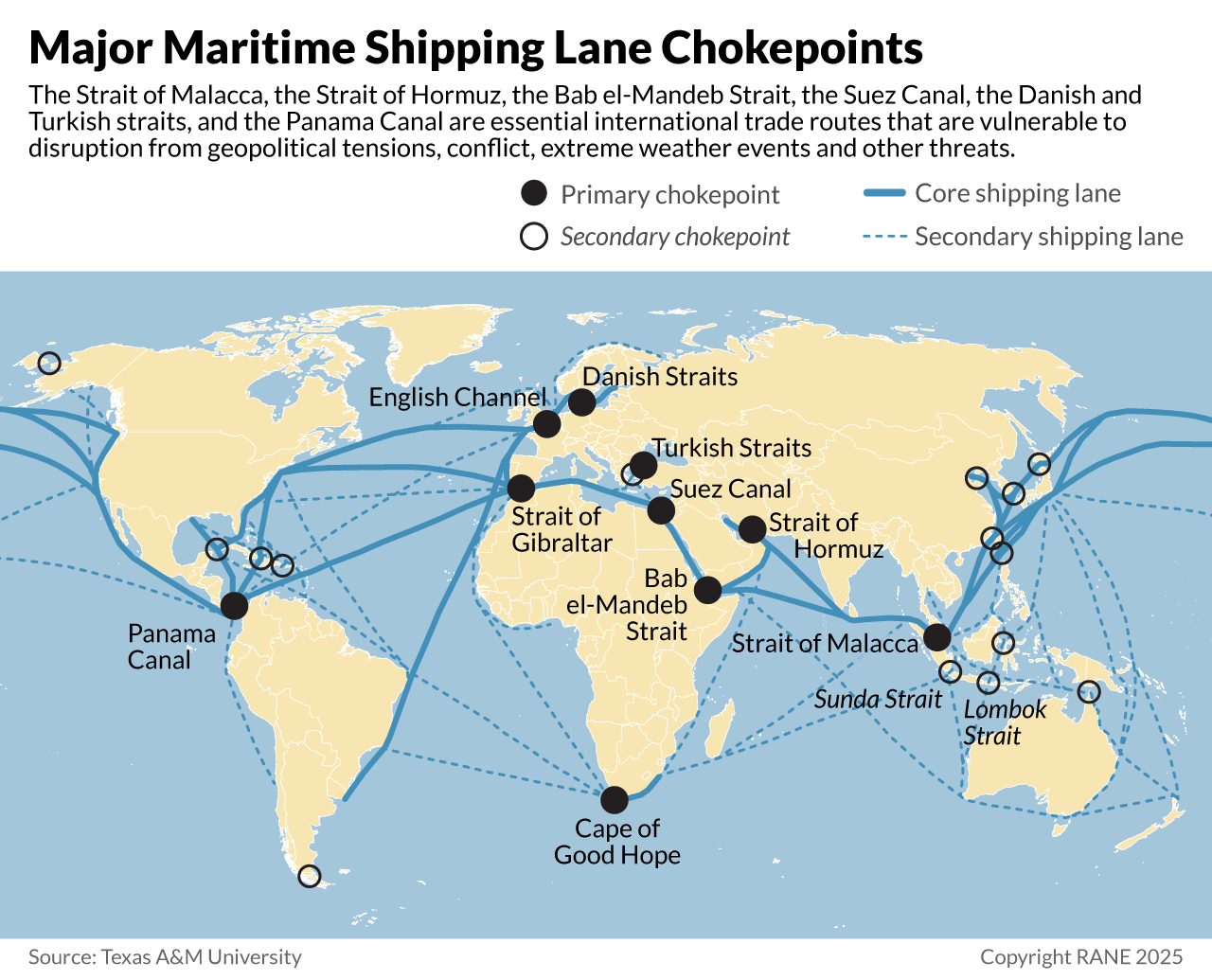
Especially over the coming months, the Bab el-Mandeb strait and the Suez Canal will remain vulnerable to flare-ups of nearby conflict (particularly those likely to trigger a Houthi response), while lingering piracy will contribute to elevated safety risks and insurance premiums for transiting vessels as well as threats of supply chain delays. Most immediately, conflict in the Middle East — and particularly Israel's intended prolonged military action in Gaza — will sustain a heightened possibility of Houthi attacks on vessels transiting the Bab el-Mandeb strait and the Suez Canal. Although the Houthis have endured an onslaught of airstrikes by U.S. and U.K. forces in recent months, the group has reportedly weathered these strikes and retains sufficient munitions to resume harassment of vessels in the Red Sea should it choose to do so — as demonstrated by its July 6 attack. This threat, alongside broader conflict in the Middle East, probably will also sustain countries' limited willingness and ability to focus on combating piracy, particularly as even the elevated number of piracy incidents around Somalia remains far lower than that which triggered global anti-piracy efforts in the 2010s. These challenges will be made more difficult by other evolving regional concerns, like Somalian security forces' own intensifying operations against local militias and Islamist extremist groups. Beyond consequent risks to personal safety and increased insurance costs, a resurgence in the Houthi threat or a high-profile uptick in piracy around the Bab el-Mandeb strait would risk depressing regional shipping and pushing vessels to take alternate routes, such as that around the Cape of Good Hope. Though such routes may involve less risk, the extra time typically needed for additional travel will disrupt supply chains and delay goods deliveries, particularly to the West.
- Concerns surrounding the links between the Houthis' activity and that of Somali pirates have been exacerbated by reports in recent years claiming growing relationships between the two actors. This includes a 2024 report by Seahawk Maritime Intelligence that noted a meeting in October of that year confirming the Houthis' "direct involvement in coordinating resources and military assets" for Somali pirates and the Islamist extremist group al Shabaab.
- The Israel Defense Forces said it had struck Houthi targets on Aug. 28 in Yemen, claiming it had sought to target a number of the group's senior commanders and officials. Israel is still working to verify the results of the strikes, but if successful, they would probably temporarily challenge the group's operations. That said, the group's historical resilience suggests it will remain capable and certainly intent on retaliating against Israel in subsequent weeks.
The Danish and Turkish straits are particularly important for facilitating Russian oil exports, with nearly half of the country's seaborne oil exports passing through the Danish straits alone. Russia is a heavy user of both the Danish straits, which link the North Sea and the Baltic Sea, and the Turkish straits, which connect the Black Sea to the Aegean and Mediterranean seas. The waterways' value has only grown since Russia's 2022 invasion of Ukraine, as the waterways enable Russia to export its oil and fund its war effort despite Western sanctions. As the top consumers of Russian oil, China and India have particular interest in ensuring shipping through both straits is uninterrupted, but even some Western countries prohibited from importing Russian crude by sea buy these oil products after they have been refined in third countries. Both the Danish and Turkish straits involve distinct navigational challenges, with the former's shallow waters, made worse by inclement weather, necessitating more experienced pilots to navigate. Meanwhile, the latter's strong currents and visibility challenges also present difficulties for transiting vessels, especially as they navigate the Bosphorus strait, whose width ranges from around 2,450 feet (750 meters) to 2.3 miles (3.7 kilometers). These challenges have grown starker as sanctions on Russian oil have pushed Russia to rely on a "shadow fleet" of older, often poorly maintained and insufficiently insured ships — frequently guided by less-skilled pilots — to transport oil. Exacerbating risks is the propensity for these ships' crews to undertake risky maneuvers, such as turning off tracking systems and undertaking ship-to-ship oil transfers, to evade Western sanctions. Concerns surrounding these ships are also threatening to worsen tensions in the Danish straits in particular. Though Denmark for years largely avoided inspecting or otherwise interfering with these Russian ships — citing a 19th-century treaty that enables ships to move freely through the waterway — the Danish Maritime Authority announced in February it would begin to carry out Port State Control inspections on Russian ships outside Skagen, reportedly out of concern for the growing risks of accidents and environmental disasters in the waterways. Multiple European countries have also sought to ramp up pressure on Russia's shadow fleet to prevent Russia from skirting Western sanctions and funding its military operations in Ukraine, as well as out of concern that these vessels are involved in sabotaging undersea cables and other maritime infrastructure in the area.
- Beyond energy supplies, the Danish straits are also responsible for facilitating the transit of containers comprising 3% of global seaborne trade volume, dry bulk comprising 3% of global seaborne trade volume, chemicals comprising 3% of global seaborne trade volume and cars comprising 2% of global seaborne trade volume. Meanwhile, the Turkish straits are responsible for the transit of chemicals comprising 4% of global seaborne trade volume, dry bulk comprising 3% of global seaborne trade volume, containers comprising 2% of global seaborne trade volume and cars comprising 1% of global seaborne trade volume.
Geopolitical tensions surrounding the free flow of oil and goods through the Danish straits are poised to worsen, while potential for disruptions to the Turkish straits will also remain high, risking economic disruptions, particularly to the top consumers of Russian oil, and challenges to Russia's war effort. Denmark's February decision to ramp up pressure on Russia's shadow fleet underscores the former's intensifying concerns surrounding the environmental threats posed by increasingly risk-tolerant Russian oil tankers, leaving the door open to increased Danish scrutiny of these vessels. European apprehension regarding U.S. President Donald Trump's evolving stance on Russia will also continue to drive other European countries to ramp up pressure on Russia's shadow fleet in an effort to prevent Russia from skirting sanctions and to restrict its funding for military operations in Ukraine. Such scrutiny may include increased port inspections and sanctions targeting specific ships, but could also grow as severe as a rise in visit, board, search and seizure operations or, in a worst-case scenario, broader European efforts to blockade Russian oil. Geopolitical tensions between NATO and Russia will also sustain elevated risks to the Turkish straits, as will their distinct navigational challenges. Maritime accidents or other developments in the Turkish straits would also have a greater immediate impact, given the heavily populated areas surrounding the straits. Disruptions to shipping in either waterway would not only threaten to restrict energy flows and hike prices for top consumers of Russian oil like China and India, but would also probably create challenges for some Western countries, given their reported purchases of such oil following refinement in third countries. Growing pressure on Russian oil exports — one of the most valuable sources of funding for Russia's war effort — will also risk heightening Russia's threat perceptions and consequent willingness to intensify its sabotage operations on European soil, and potentially even more direct risks of conflict with Europe. That said, this pressure could also help compel Russia to be more flexible in future negotiations with Ukraine, especially should pressure intensify and/or be sustained enough to prompt prolonged funding and resource challenges to Russia's war effort.
The Panama Canal is especially important to the United States, as it carries more than 40% of U.S. container traffic, but its operations have in recent years been disrupted by droughts and consequent low water levels, and it has come under scrutiny from President Trump. Though the Panama Canal facilitates the movement of only around 5%-6% of global trade annually, it is key to easing the movement of goods to the United States, with container traffic to the country carrying an estimated value of around $270 billion worth of goods per year. One of the Panama Canal's key vulnerabilities stems from its reliance on freshwater, particularly from Gatun Lake. As a result, periodic droughts and consequent decreased water levels occasionally limit the number of vessels able to transit the canal and the amount of cargo they can carry. In recent years, this vulnerability was most prominently demonstrated in 2023-24, when a severe and prolonged drought forced authorities to reduce the number of vessels transiting the waterway daily from around 36-38 vessels under normal circumstances to a mere 22. Meanwhile, the waterway has also faced increased scrutiny and geopolitical tension from Trump, who vented grievances about the canal in the early months of his second term, accusing canal authorities of treating the United States unfairly and of allowing undue levels of Chinese influence; he subsequently hinted that the United States could take back the canal by force if his grievances remained unaddressed. In response to U.S. pressure, Panamanian President Jose Raul Mulino agreed to withdraw from China's Belt and Road Initiative, audit a 25-year port concession held by a Hong Kong-based company, and enable the United States to deploy troops to Panama-controlled bases along the canal for training and other unspecified activities. These concessions, however, did not prove popular in Panama and have fueled subsequent protests against what critics say is a degradation of Panamanian sovereignty.
- In his claims of unfair treatment, Trump has specifically highlighted the United States' role in originally building the Panama Canal and being its largest user. Among other things, he has accused Panamanian authorities of "severely" overcharging the United States, and he has alleged that China operates the canal. These claims appear linked to the Panama Canal's treaty-bound neutrality and the United States' consequent lack of preferential pricing compared with other users, as well as a Hong Kong-based company constructing and managing two of the canal's new ports — though not the entire canal's operation.
The canal will continue to face periodic disruptions from severe weather, while U.S. grievances appear likely to linger, risking a resurgence in tensions with Panama that may prompt operational challenges to shippers and supply chains surrounding the waterway. The Panama Canal's reliance on freshwater means weather-related challenges will remain a primary concern for transiting vessels. Since reduced rainfall linked to the El Nino weather phenomenon occurs every two to seven years, the Panama Canal will continue to face periodic water shortages that limit the number of vessels and amount of cargo that can transit the canal, potentially for months at a time. Climate change may exacerbate these disruptions over the coming years, whether by making them more frequent or more prolonged. Meanwhile, though U.S. pressure has not disrupted the operation of the canal, and while Panama's response has tentatively eased tensions, it remains unclear whether Panama's actions will satisfy the Trump administration. Chinese companies are also all but certain to continue investing in Latin America (including in Panama and its canal) for the foreseeable future, probably sustaining further potential for U.S. pressure on Panama to reemerge. Direct disruptions to shipping through the canal would be most likely should the United States take the exceedingly escalatory step of attempting to militarily take control of the canal, though the costliness of such an action probably limits its likelihood. But even the uncertainty and tensions surrounding a reescalation in U.S. pressure on Panama may result in restrictions for some shippers, tariffs or other operational challenges less severe than the canal's complete shutdown. Meanwhile, renewed tensions between the two countries would risk flaring protests in Panama that may threaten the supply chains and thoroughfares that facilitate maritime trade, especially given the visceral reaction many Panamanians had to their government's recent efforts to appease the United States.
- Routes bypassing the Panama Canal exist, and some shippers used them during the drought in 2023-24 that limited the canal's capacity. These alternatives include sending vessels around the southern ends of South America or Africa, or sailing through the Suez Canal. However, these alternatives can add an estimated 10 to 42 days to the usual journey, depending on a ship's speed and route.
