
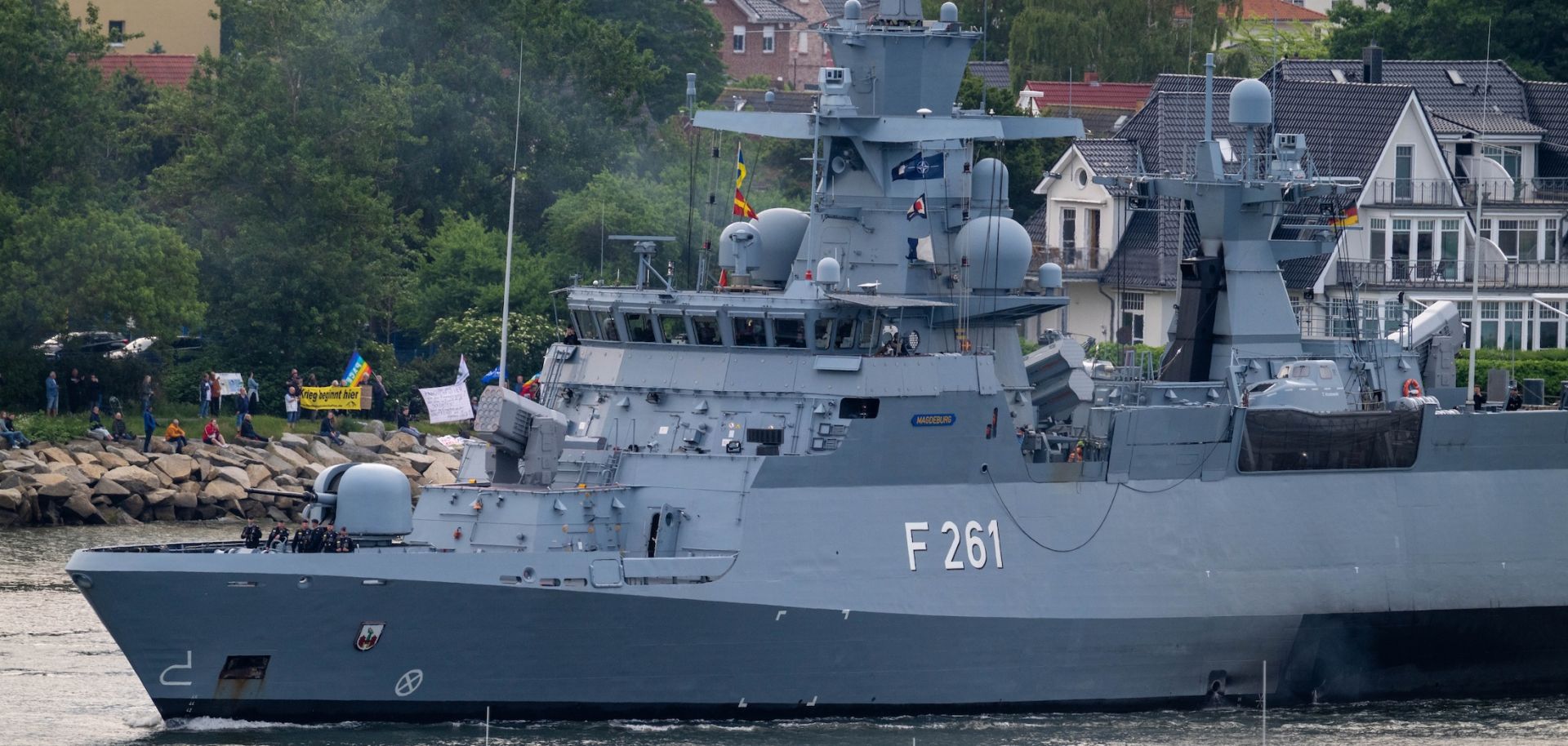
Europe is undergoing a process of rearmament and strategic transformation at a scale unseen in decades, driven by intensifying regional tensions and mounting uncertainty over the future of U.S. commitments to the Continent's defense. Nowhere is this transformation more visible than in the Baltic Sea region. Here, NATO members are rapidly scaling up defense spending, deepening military integration and reinforcing infrastructure to strengthen conventional deterrence and build resilience against hybrid threats.
This process is unfolding alongside growing confrontation with an increasingly assertive Russia, particularly at sea, where tensions are mounting over surveillance, sabotage and contested navigation rights. While NATO countries in the region are increasingly assertive in defending their sovereignty and strategic assets, Moscow is escalating its use of sub-threshold tactics to test their resolve and challenge the new status quo, turning the region into one of the most complex and volatile theaters in Russia's confrontation with the West.
As military buildup accelerates and mutual suspicion deepens, the Baltic's strategic significance to both sides — combined with its complex geography and the sheer density of maritime traffic and infrastructure — has made it an increasingly volatile flashpoint for brinkmanship and potential conflict, where even minor incidents risk triggering major escalation. While tensions will remain elevated for the foreseeable future, particularly as the Russia-Ukraine war drags on, the long-term stability of this critical maritime corridor will compel both sides to eventually recognize the need for a new equilibrium.
NATO's Remilitarization Spreads Across the Baltic
Across the Baltic region, a sweeping process of rearmament and strategic reorganization is reshaping the defense landscape. Germany announced a historic turning point, or Zeitenwende, days after Russia's 2022 invasion of Ukraine, with then-Chancellor Olaf Scholz launching a 100 billion euro ($115 billion) rearmament fund to reverse decades of defense underinvestment. Under current Chancellor Friedrich Merz, these efforts have accelerated, with Berlin now aiming to raise defense spending to 3.5% of GDP by 2029, thanks to recent constitutional reforms lifting borrowing limits on defense spending. Germany's deployment in May of a NATO-backed enhanced forward presence battlegroup to Lithuania — Berlin's first permanent foreign troop deployment since World War II — further underscores its deepening commitment to collective deterrence and NATO's eastern flank. Poland, for its part, is pursuing one of Europe's most ambitious rearmament and military modernization efforts, aiming to build the Continent's largest land force while simultaneously replacing Soviet-era systems with Western equipment. Poland is also investing in its largest infrastructure projects since the Cold War, such as the ''Eastern Shield,'' which aims to strengthen Polish borders with Belarus and Russia's Kaliningrad exclave. Naval modernization is also underway, with plans for new frigates, submarines and strengthened coastal defenses. Poland's defense spending is already set to hit 4.7% of gross domestic product in 2025, with plans to reach NATO's new 5% target well ahead of its peers and discussions to potentially reintroduce conscription to build a 500,000-strong standing army.
Lithuania, Latvia and Estonia are moving in the same direction. Lithuania recently reestablished its 1st Mechanized Division, incorporating three brigades and several key military units into NATO structures, and is expanding its conscription system while aiming to increase defense spending from 3.9% to 6% of GDP by 2026. Latvia is likewise expanding its armed forces and crisis reserve while targeting a rise in defense expenditure from 3.65% to 5% of GDP by 2028. Estonia, too, is enhancing its reserve force while investing in advanced artillery and mobility infrastructure and expanding its already sophisticated cyber capabilities, with plans to increase defense spending from the current 3% to 5% of GDP by 2026. Across all three countries, short- to medium-term procurement priorities include ammunition, medium-range air defense systems and armored vehicles, while longer-term efforts focus on deepening capabilities in air defense, unmanned systems, electronic warfare and long-range fires. Together, the three countries are developing a joint system of border fortifications, bunkers and prepositioned equipment along their borders with Russia and Belarus (a project known as the Baltic Defense Line) to strengthen deterrence and improve rapid NATO deployment capabilities. Additionally, the three announced their withdrawal from the 1997 Ottawa Treaty banning anti-personnel landmines, alongside Poland and Finland.
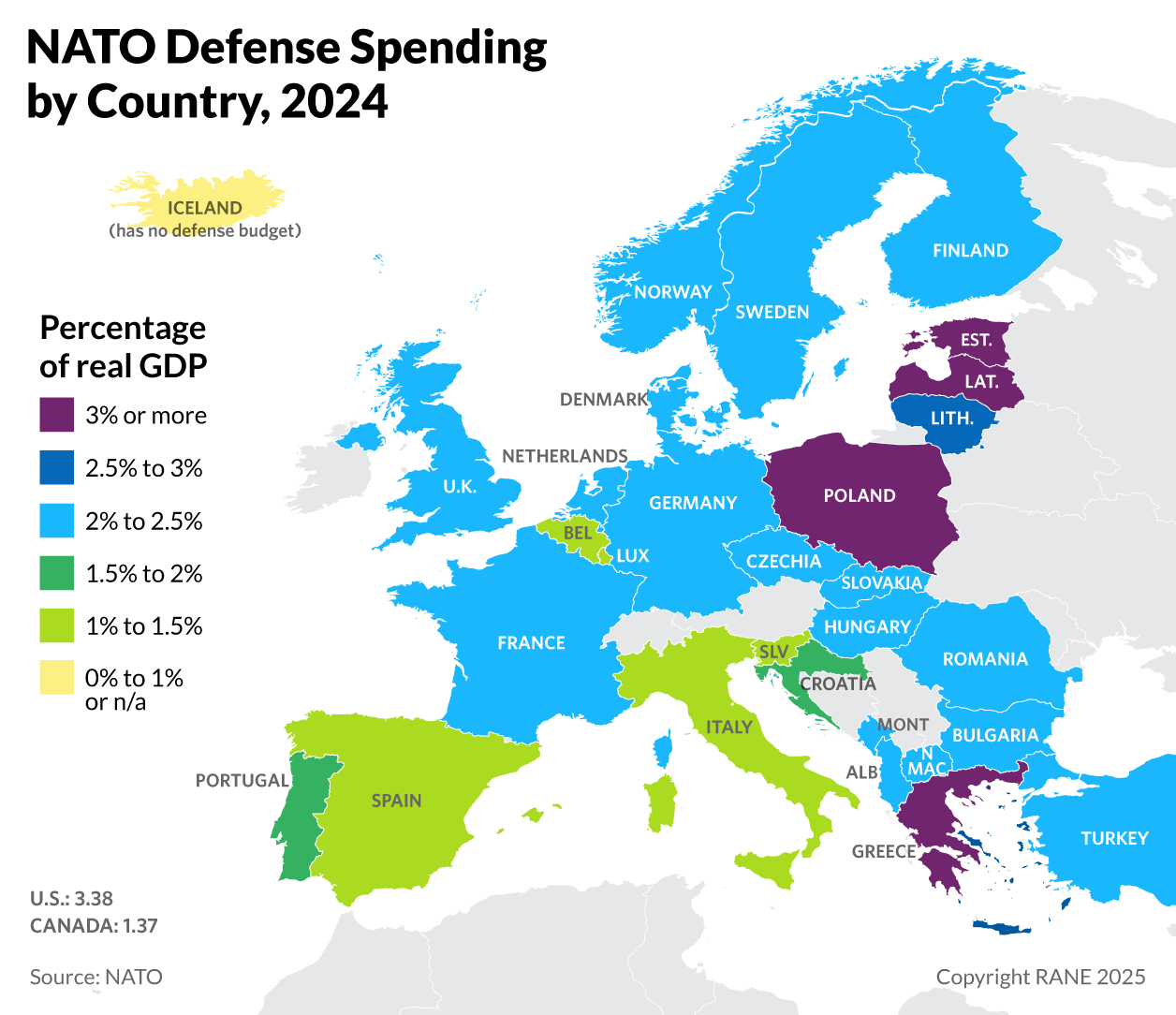
The Nordic countries — having abandoned long-standing policies of neutrality, non-alignment and EU defense opt-outs following Russia's 2022 invasion of Ukraine — are also undertaking major defense investments and moving toward deeper regional integration. Finland's 2023 accession to NATO added over 1,300 kilometers of direct border with Russia but also a sizable and well-prepared military force to the alliance, as Finland boasts more artillery than France and Germany combined, a high-readiness standing force of 280,000 troops and 900,000 trained reservists. Helsinki is now scaling up investments in long-range precision fires, air defense systems and munition stockpiles, aiming to double defense spending from 2.5% to 5% of GDP by 2032. Sweden, which joined NATO in 2024, is reversing decades of post-Cold War demilitarization by expanding conscription, reestablishing military presence in strategic regions like Gotland island, and modernizing equipment with investments in new submarines, fighter jets and integrated air defense systems. Denmark, which ended its EU defense opt-out in 2022, has similarly been reorienting its defense posture by meeting NATO's 2% of GDP defense spending threshold in 2023, reaching 3.2% in 2025 and putting itself on track to meet the new 5% target by 2035. Denmark is also investing in modernizing its air force and naval capabilities, including by acquiring new F-35 fighter jets and advanced missile systems.
This wave of national rearmament comes against the backdrop of a broader shift in NATO's regional deterrence posture. Following Russia's annexation of Crimea in 2014 and growing pressures from the United States to increase defense spending, Baltic and Nordic states began reorienting their defense policy and cooperation from cost-efficiency and optimization to remilitarization and joint capability-building. Russia's reinvasion of Ukraine in 2022 further accelerated this process and eliminated the last political and strategic barriers to deeper regional defense integration, culminating in Finland and Sweden's accession to NATO. The Baltic region has since assumed greater strategic centrality within the alliance, which has been pivoting from a doctrine of ''deterrence by reinforcement'' to one of ''deterrence by denial,'' aimed at preventing aggression on allied territory altogether rather than responding after the fact. In line with this shift, NATO is reconceptualizing enhanced forward presence battlegroups in Estonia, Latvia, Lithuania and Poland, evolving them from a ''tripwire'' presence into the foundation for more robust, combat-ready deployments integrated into preplanned reinforcement schemes and supported by pre-positioned equipment, enhanced infrastructure and rapid response capabilities.
Competition Is Rife in the 'NATO Lake'
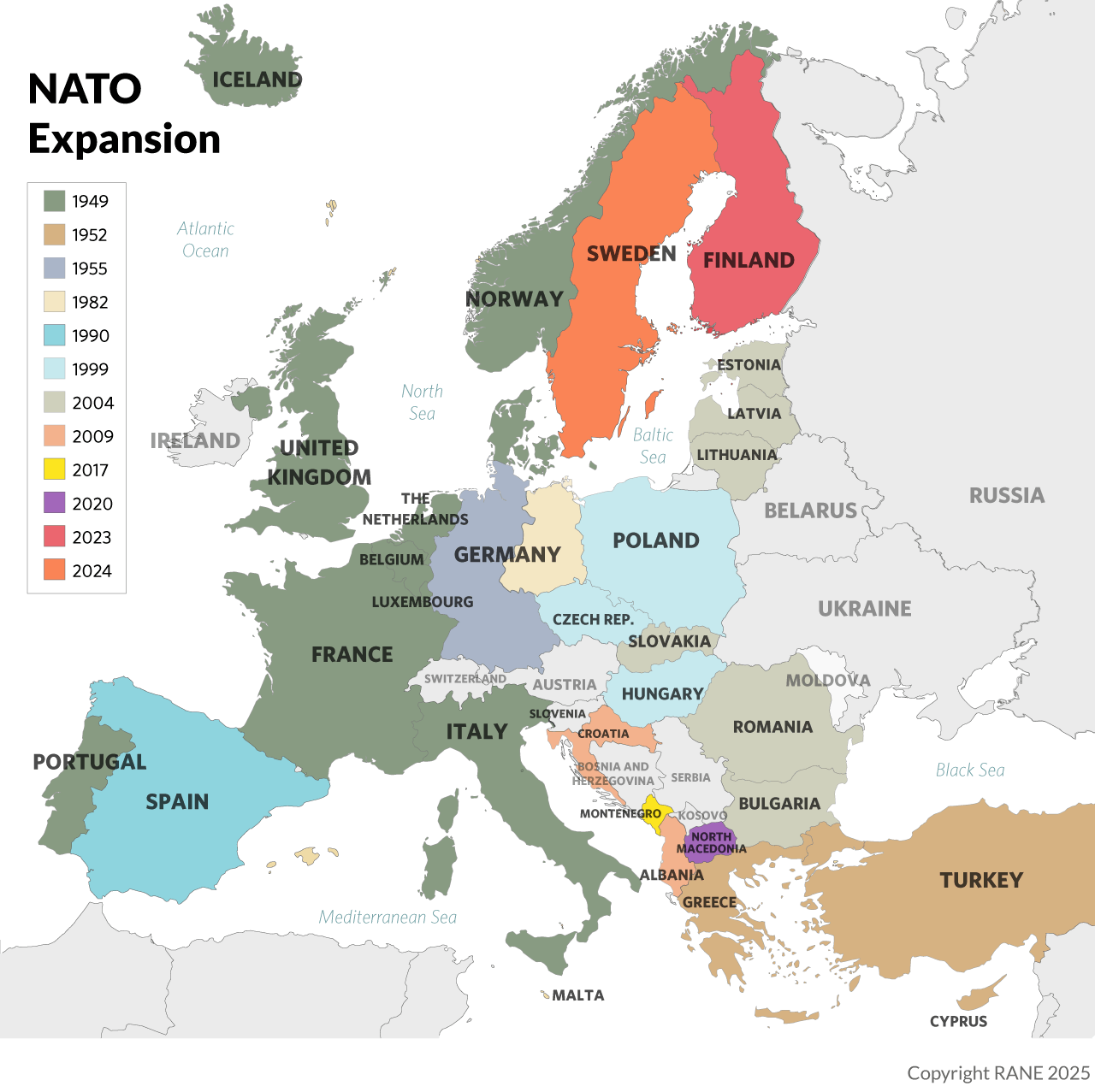
These strategic shifts, in particular the accession of Finland and Sweden to NATO, prompted some commentators to declare that the Baltic Sea had effectively become a ''NATO lake'' — a body of water almost entirely encircled by allied territory and seemingly secured by the alliance's expanding presence and mandate. A glance at the map helps explain this perception. The Baltic Sea now borders seven NATO members and hosts multiple forward-deployed battlegroups, significantly enhancing the alliance's capacity for regional defense coordination. This marks a substantial shift from the Cold War era, during which only Denmark and West Germany — at the western edge of the sea — belonged to the alliance. Even after the collapse of the Soviet bloc and NATO's enlargement with Poland in 1999 and Lithuania, Latvia and Estonia in 2004, Finland and Sweden remained formally neutral. Yet this narrative masks a more complex reality, one in which Russia not only retains the means to challenge NATO's posture in the Baltic but is increasingly prepared and motivated to do so.
For Russia, the Baltic is not just a theater of confrontation with the West; it is a vital artery for both military operations and commercial shipping. Ports like St. Petersburg, Primorsk and Ust-Luga form the backbone of Russia's maritime export infrastructure, handling a large share of oil exports as well as critical imports of food and other consumer goods. Without access to these ports, Russian cargo would face significantly longer and more costly routes around Finland and Norway, with loading and unloading taking place far from Russia's core economic hubs and major metropolitan areas. Kaliningrad — home to the Russian Baltic Fleet and key elements of the country's nuclear deterrent — has grown even more critical as a maritime logistics node, particularly as overland access via Lithuania and Poland has narrowed since Russia's 2022 invasion of Ukraine, and it is home to Russia's only Baltic port with year-round ice-free access. Against this backdrop, Russia's hybrid activity in the region is not only about testing NATO's defenses, vulnerabilities and resolve, but about asserting maritime rights and defending strategic trade routes. Increasingly worried about NATO's encroachment and regional rearmament in the Baltic, Russia will not cede influence in the region without a fight and will continue to push back against what it sees as illegitimate Western restrictions on its economic activity.
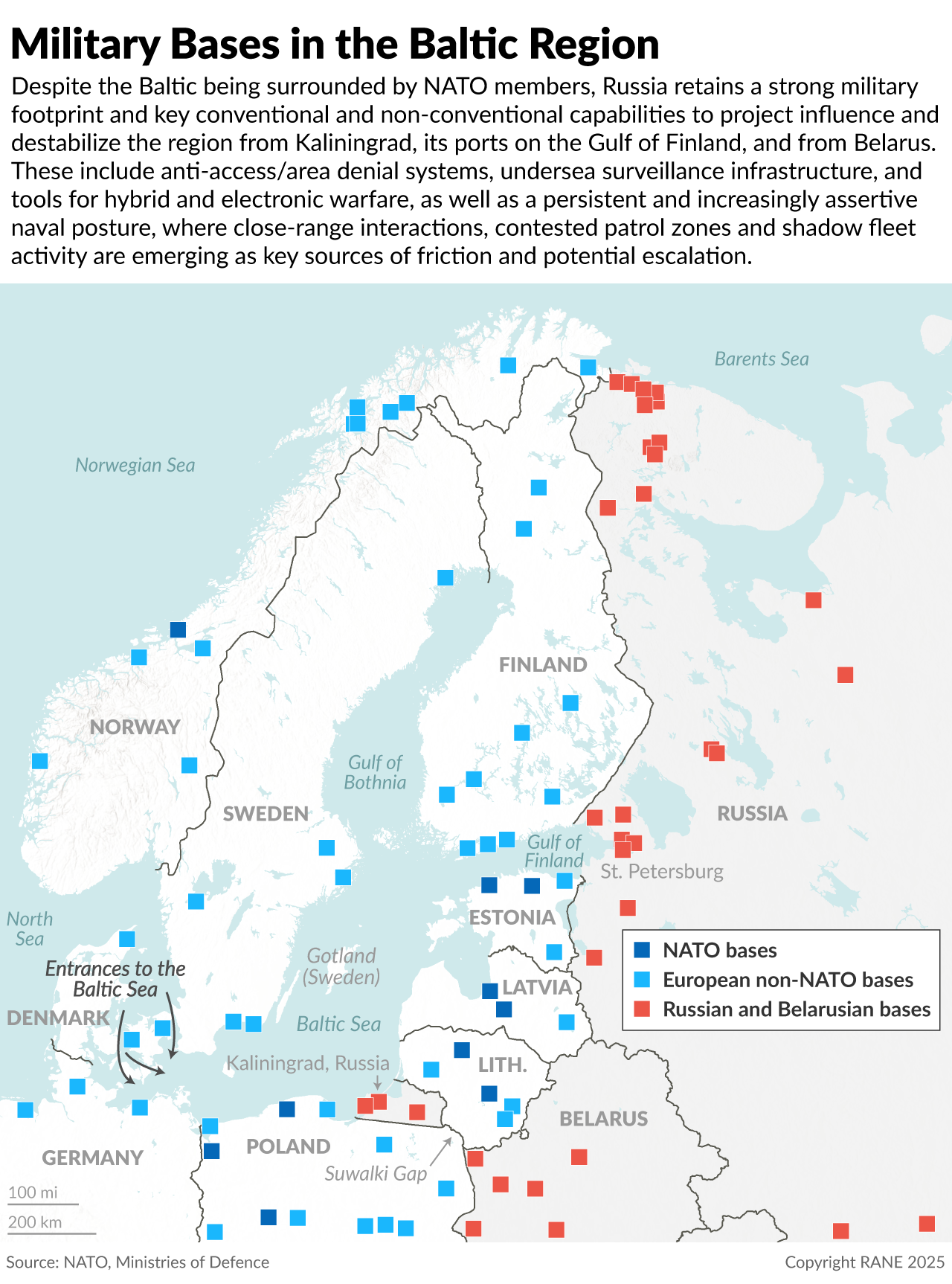
While the nature of the current Russian threat in the region differs markedly from that of the Cold War due to Russia's weaker Baltic Fleet, Moscow maintains important conventional and nonconventional capabilities to project influence and/or destabilize the region. These include anti-access/area-denial capabilities (including Iskander missiles and advanced air defense systems) from its heavily militarized Kaliningrad exclave, de facto control of Belarusian territory, and significant undersea capabilities ranging from intelligence collection to sabotage and electronic warfare. Crucially, however, Russia does not even require particularly sophisticated means to generate potentially very significant disruptions in the region. For instance, asymmetric actions such as damaging subsea cables or pipelines often require no more than an old oil tanker and an anchor, creating significant economic and security disruptions while still falling below the threshold of armed conflict and offering plausible deniability. Asymmetric actions like these enable the attacker to bear relatively low cost and exposure, while the defender must commit extensive resources to surveillance, infrastructure hardening and naval patrols in order to safeguard critical assets spread across a shallow and congested maritime space. This dynamic offers Russia a persistent and cost-effective means of exerting pressure while limiting escalatory risks, at least until recently.
Over the past three years, the Baltic Sea has become an increasingly active theater for suspected acts of sabotage targeting critical infrastructure like subsea power and internet cables. Although conclusive evidence of Russian involvement in specific incidents remains elusive, Moscow's broader and increasingly aggressive sabotage and destabilization campaign across Europe has raised suspicion of direct involvement or at least complicity. Vessels linked to Russia's so-called shadow fleet — a network of aging, uninsured oil tankers operating under obscure ownership to circumvent Western sanctions — have been repeatedly observed loitering near offshore wind farms, subsea cables, pipelines and key energy terminals across the Baltic and North seas, and Western intelligence services increasingly believe that Russia is using at least parts of this fleet for intelligence collection and hybrid operations. Whether or not Russia is directly responsible for recent incidents, the pattern of activity has exposed the vulnerability of the region's maritime infrastructure.
Escalation Risks in an Overcrowded Security Theater
These patterns of hybrid activity, infrastructure vulnerability and tightening of sanctions enforcement are steadily transforming the Baltic Sea into one of the most volatile frontlines in Europe's confrontation with Russia. NATO launched Operation Baltic Sentry in January to step up surveillance of maritime critical infrastructure, deploying more patrol aircraft, warships and drones across the region. Individual governments in the region are also adopting increasingly assertive measures, such as vessel seizures, preemptive inspections and expanded legal mandates. Estonia, for instance, passed legislation in April authorizing its defense forces to use force against foreign civilian vessels suspected of threatening undersea infrastructure, while both Estonia and Poland now instruct their coast guards to intercept suspicious ships preemptively, before any damage occurs. In February, Denmark began Port State Control inspections on Russian vessels outside Skagen. In July, Sweden started collecting insurance data from transiting ships. And in June, the United Kingdom joined a coalition of Nordic and Baltic countries pledging coordinated maritime enforcement and interdiction operations targeting Russia's shadow fleet.
These increasingly assertive policies are prompting sharper responses from Moscow. In recent months, Russian warships and aircraft have ramped up patrols near key chokepoints and contested waters. In June, a Russian corvette escorted two shadow fleet tankers through the English Channel in a deliberate show of force, signaling Moscow's willingness to use its navy to protect Russian commercial interests. The previous month, Estonian forces attempted to inspect an unflagged, sanctioned oil tanker — the Jaguar — only to be circled over by a Russian Su-35 fighter jet that briefly violated NATO airspace. Five days later, Russian authorities detained a Greek-owned tanker that had just departed Estonia, the Green Admire. That same week, Polish military forces conducted a patrol flight to deter a shadow fleet vessel ''performing suspicious maneuvers'' near an undersea power cable linking Poland and Sweden. These incidents reflect a shifting security dynamic and escalating pattern of confrontation. Regional governments are increasingly willing to act unilaterally and more assertively to protect critical infrastructure, while Russia appears equally determined to challenge this resolve by deploying military assets in defense of its commercial interests. The result is a steadily intensifying contest over legal authority, strategic signaling and physical control.
This new dynamic and escalating pattern of confrontation over sovereignty, strategic signaling and physical control is especially volatile given the Baltic Sea's complex geography. A small, shallow, enclosed and heavily trafficked body of water, it features narrow chokepoints such as the Danish Straits — now hotspots for overlapping military and coast guard activity — alongside irregular coastlines, low salinity and dense undersea infrastructure. These characteristics make the Baltic both difficult to defend and highly prone to accidents or miscalculations, as military movements frequently occur in close proximity to NATO or Russian forces, commercial vessels and critical assets. This density creates a flashpoint-rich environment where the risk of miscalculation grows exponentially. Incidents that might once have been dismissed as accidents — e.g., an anchor drag, a severed cable or a navigation error — now risk misinterpretation and retaliation in the current atmosphere of deep distrust and heightened tension, where even a minor misstep could quickly escalate into a diplomatic crisis or military confrontation.
The Need for Guardrails in a Region on the Edge
NATO is seeking to assert strategic control over the Baltic Sea through military buildup, deeper defense integration and a more assertive approach to enforcing sanctions and safeguarding territorial waters and critical infrastructure. Russia, in turn, is trying to undermine this very effort through a persistent campaign of sub-threshold activity aimed at raising the stakes and testing the alliance's unity and resolve. Moscow's willingness to engage in grey-zone activities largely stems from its own self-perception as having a higher risk tolerance than NATO, and that such actions come with minimal costs due to attribution challenges and plausible deniability. To change this perception, NATO Baltic members are trying to refine their messaging to Moscow to convey red lines more clearly, consistently and assertively, and ensure Russia understands these tactics do, in fact, carry a cost.
So far, however, these efforts have only heightened tensions further, raising the threshold of acceptable behavior on both sides and increasing the risk of miscalculation. With both NATO and Russia adopting more confrontational postures, the space for ambiguity is narrowing and the escalation ladder is getting shorter. And in a region marked by narrow chokepoints, dense undersea infrastructure, crowded maritime traffic and overlapping patrol zones, the margin for error is dangerously thin. The Baltic's strategic value only amplifies this volatility. As a vital maritime corridor linking the North Sea, the European Arctic and the Atlantic, it is central to the military logistics, commercial shipping and critical energy and digital infrastructure of both sides. Control over these waters thus carries significant military and economic weight. But while this strategic importance is currently raising the risk of conflict, it may also eventually facilitate risk reduction due to a mutual desire for a stable Baltic Sea.
Though tensions will remain high for the foreseeable future, it is in neither side's interest for this region's long-term security to rest on perpetual brinkmanship. Over time, this may see a new equilibrium emerge — but only if several conditions are met. First, a durable ceasefire and resolution in Ukraine must be reached. Second, Russia must gradually shift its posture toward Europe away from coercion and destabilization. And finally, NATO needs to transition from reactive posturing to more structured risk management through established deterrence frameworks and at least minimal post-conflict diplomatic re-engagement. If these prerequisites begin to materialize, there may be room for both sides to reintroduce military-to-military communication channels and reach at least an implicit understanding on rules of behavior that reduce the risk of incidents, miscalculation and unintended escalation — re-establishing the basic guardrails needed for relatively safe and stable commercial activity to resume. Absent such a recalibration, however, the Baltic will remain a highly volatile flashpoint with significant escalatory potential for direct confrontation between NATO and Russia.
