
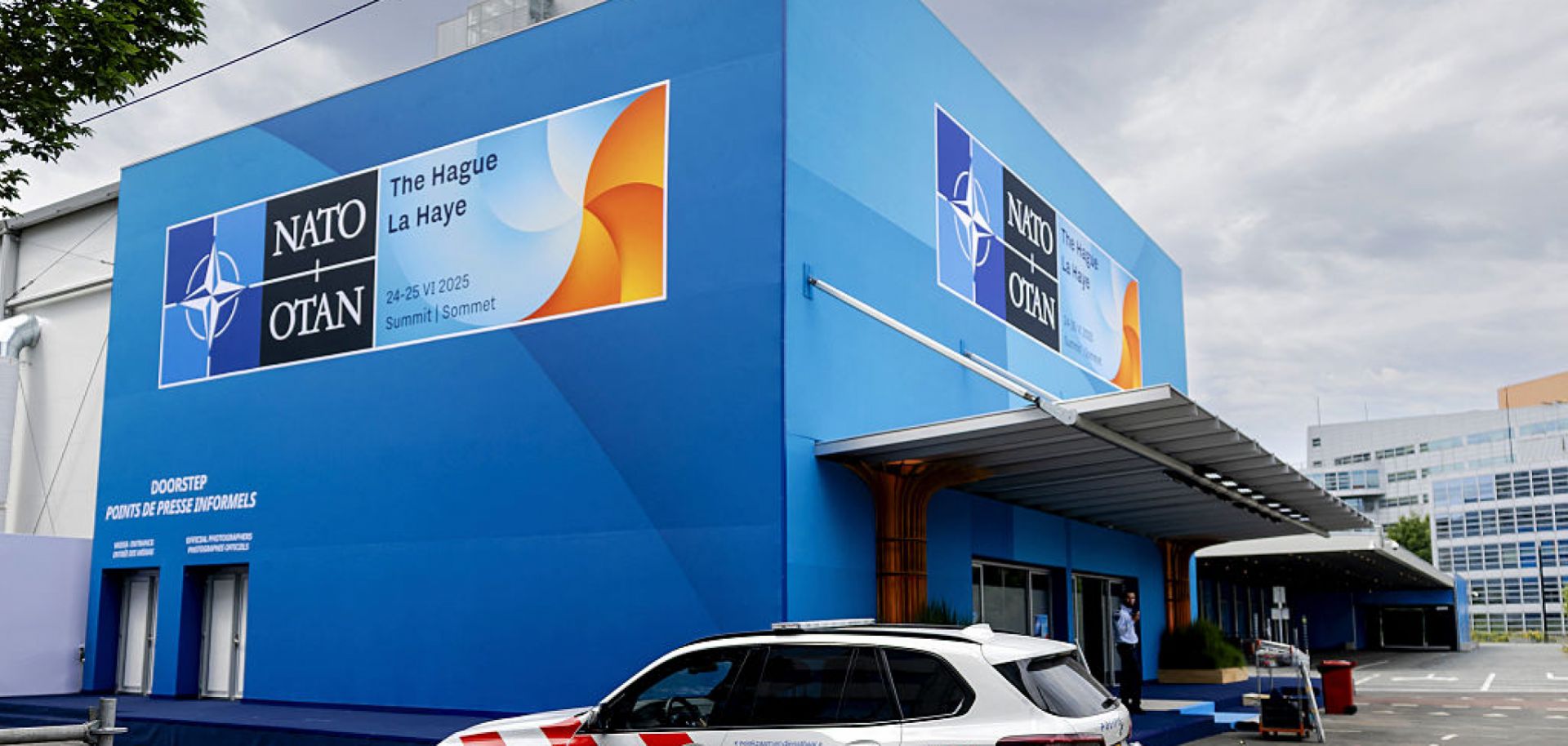
The upcoming NATO summit will likely produce a political agreement on higher defense spending targets and underscore Europe's push to gradually assume more responsibility for its own defense, but structural and financial constraints could slow this transformation in the long run. NATO leaders will convene in The Hague, Netherlands, on June 24-25 for the alliance's annual summit. New NATO Secretary-General and former Dutch Prime Minister Mark Rutte will chair the summit for the first time, and U.S. President Donald Trump will attend for the first time since his reelection for a second term. The main item on the agenda will be Rutte's proposal to raise NATO's collective defense spending target from the current 2% of GDP to 5% of GDP by 2032, with 3.5% dedicated to core military budgets and 1.5% to be allocated to cybersecurity and other defense-related areas. Two other priority agenda items will be the escalating conflict between Israel and Iran — particularly following the U.S. direct involvement alongside Israel in bombing Iranian nuclear sites — and continued support for Ukraine. To the latter point, Rutte stressed ahead of the summit the need to ensure Kyiv is positioned strongly both during the ongoing conflict and in any future peace negotiations, with discussions expected to include collective military and financial assistance as well as measures to scale up Europe's defense industrial capacity.
NATO's debate over higher defense spending comes as Europe accelerates efforts to rearm itself and build a more self-reliant defense architecture driven by Russia's increasing aggressiveness and growing fears of a U.S. retreat from its traditional security commitments on the Continent. Rutte's proposal for new NATO defense spending targets comes in response to mounting U.S. pressure on Europe to take on a larger share of the collective defense burden. Washington has long expressed frustration over the sharp decline in European defense budgets and military capabilities since the end of the Cold War, with European governments redirecting resources toward expansive welfare programs while growing increasingly reliant on the United States for their security. Although Russia's annexation of Crimea in 2014 prompted NATO members to pledge to raise defense spending to 2% of GDP within a decade, only a few delivered. It was not until Russia's full-scale invasion of Ukraine in 2022 that most allies began meeting the target, and about a third of them still had not done so as of 2024. But on the campaign trail first and now in office, the Trump administration has taken a far more confrontational approach, explicitly tying U.S. defense guarantees to allies' financial contributions and casting doubt on the reliability of collective defense clauses under NATO's Article 5. Beyond the spending issue, tensions within the alliance have deepened, with Washington announcing a halt to future joint military exercises in Europe and Trump openly floating the annexation of allied territories such as Greenland and Canada, repeatedly refusing to rule out the use of force. The administration's handling of the Russia-Ukraine war contributes to European unease, with its diplomatic overtures to Moscow, relegation of European allies to a secondary role in negotiations and efforts to coerce Kyiv into peace talks — including through temporary suspensions of military aid and intelligence sharing — further undermining trust.
- Trump proposed the 5% of GDP defense spending target in January 2025, and NATO allies initially reacted with skepticism, given that many still struggle to meet the existing 2% benchmark. However, as reports surfaced suggesting Trump would not attend the NATO summit in The Hague without firm commitments toward the 5% goal, Rutte stepped up behind-the-scenes diplomacy to secure at least verbal backing from key European capitals and build broader consensus.
- U.S. Defense Secretary Pete Hegseth said ahead of the summit that NATO allies were "very close, almost near consensus" on raising defense spending targets to 5% of GDP. So far, only Spain has openly opposed the target, stating it is not ready to meet even the proposed 3.5% commitment, but clarified it will not veto an alliance-wide decision to raise the goal (with NATO traditionally making decisions by consensus). Tensions emerged on June 23, when Spanish Prime Minister Pedro Sanchez declared that Madrid would not meet the new defense spending target despite endorsing the summit statement; Rutte, meanwhile, rejected any notion of an "opt-out," insisting that Spain is expected to fulfill its military commitments like all other NATO members. Italy, for its part, said it supports the new target in principle but that reaching it could take up to a decade.
- As of 2024, 23 of NATO's 32 members had reached the current 2% of GDP defense spending target. NATO typically releases updated figures just ahead of the summit, and that number is likely to have risen this year.
Agreeing to a new defense spending target will help ease NATO's internal tensions, but implementation will remain uneven across Europe, while an increasing share of funds will be directed toward European suppliers to bolster strategic autonomy and defense self-reliance. In the short term, a higher defense spending target will help ease internal tensions by signaling a commitment to fairer burden-sharing, appeasing the Trump administration in a bid to credibly anchor the United States to Europe's defense, and reducing NATO's long-standing dependency gap on Washington for key capabilities like command and control, logistics and conventional deterrence. Still, new targets — even the baseline 3.5% of GDP — will remain aspirational for many NATO allies for years to come. Significant financial and political constraints mean defense spending levels will increasingly vary across Europe. Countries near Russia's borders, such as Poland and Nordic and Baltic states, are already approaching 5%, while members farther from the frontline — particularly fiscally constrained and highly indebted southern members like Spain and Italy — will see much slower progress. Where European countries spend their defense budgets will also shift. Amid growing uncertainty over U.S. reliability, many governments will begin to gradually prioritize domestic or European suppliers over U.S. platforms, supported by EU initiatives such as the European Defense Industrial Program and ReArm Europe Plan to coordinate joint development, production and procurement of defense products. Over time, this reorientation will accelerate the consolidation of Europe's defense-industrial base while strengthening the region's strategic autonomy and improving overall military readiness.
- The 5% of GDP defense spending target remains largely symbolic — a ceiling pushed by Trump and supported rhetorically by some allies, but unlikely to become a binding or enforceable benchmark in the near to medium term. While agreement on the headline figure is likely, the main unresolved issue may be the timeline, namely whether NATO members will need to meet the 5% target by 2032 or some later date. While Russia hawks like the Baltic states are pushing for an even earlier target (2030), most other European allies favor a more distant deadline. Another point of contention is what exact expenditures count toward the 5% defense spending target, particularly the 1.5% portion that would supplement the 3.5% allocated for traditional military expenditures. Broader categories such as infrastructure, cybersecurity, civil defense and likely even aid to Ukraine may be included toward this additional share. Still, NATO members are unlikely to agree on precise definitions at the summit, as many governments prefer to preserve some level of ambiguity to maintain flexibility and increase their chances of meeting the target on paper. For instance, Spain said it will, for the first time, reach the 2% benchmark this year, but it will allocate about 17% of that defense spending on climate disaster relief. But regardless of how the details are handled, the agreement will still likely be framed as a political win for both Trump and the broader alliance.
In the longer term, sustaining elevated defense spending levels in Europe will remain politically and fiscally difficult, absent a lasting shift in threat perceptions and broader public acceptance of prolonged social trade-offs. Sustaining defense spending at levels not seen in Europe since the late 1960s will depend on a combination of domestic political will, fiscal flexibility and evolving external threats. EU-level tools, such as new funding packages, redirecting cohesion funds or mobilizing private capital, will provide some support. However, the bulk of rearmament costs will ultimately fall on taxpayers and place additional strain on Europe's already expensive social security systems. To justify the necessary budgetary trade-offs, governments will need to craft compelling public narratives, particularly as offsets beyond relatively easy targets like climate subsidies or foreign aid will likely require politically sensitive cuts to pensions and healthcare. With aging populations, rising welfare costs and shrinking workforces, public finances will come under increasing pressure, further complicating efforts to sustain large-scale defense spending. The ability to maintain these commitments will thus largely depend on how threat perceptions evolve, including the outcome of the war in Ukraine and what kind of Russia emerges from it, and whether Europe's sense of abandonment by the United States will continue or subside. Without a strong and sustained sense of urgency, it will be difficult to secure broad public support to sustain elevated military budgets, especially when coming at the expense of social spending.
NATO will undergo a fundamental transformation as Europe assumes greater responsibility for its own defense while the United States gradually pivots to the Indo-Pacific. But the alliance will endure, supported by increased defense spending commitments and a shared interest on both sides of the Atlantic in preserving Western security cooperation. Meeting U.S. demands on defense spending could help ease recent strains and enable a more orderly, phased transition in which Europe gradually takes on greater responsibility for conventional defense and deterrence within NATO, which will remain the cornerstone of Europe's security architecture for the foreseeable future. Europe faces major structural, financial and political constraints that significantly limit its ability to rapidly achieve full self-reliance on defense. At the same time, the United States retains strong incentives to maintain a military and defense-industrial footprint on the Continent due to the economic and strategic benefits it derives from a stable, functional and aligned Europe, even as Washington gradually shifts attention and resources to other priority areas like the Indo-Pacific. European leaders, for their part, increasingly recognize the need for greater self-reliance but also understand the importance of maintaining close cooperation with Washington as they progress toward that goal — especially given their awareness of the cyclical nature of U.S. foreign policy, with future administrations potentially seeking to instead reaffirm transatlantic cooperation. A new defense spending agreement would represent a key step toward rebalancing NATO, aligning European commitments with the United States' expectations while gradually reducing the U.S. share of the burden without breaking the alliance's foundational framework. NATO is thus unlikely to dissolve anytime soon, but it is set to undergo a transformation, with Europe shouldering more of the conventional burden while the United States gradually steps back, retaining its role as NATO's ultimate security guarantor.
