
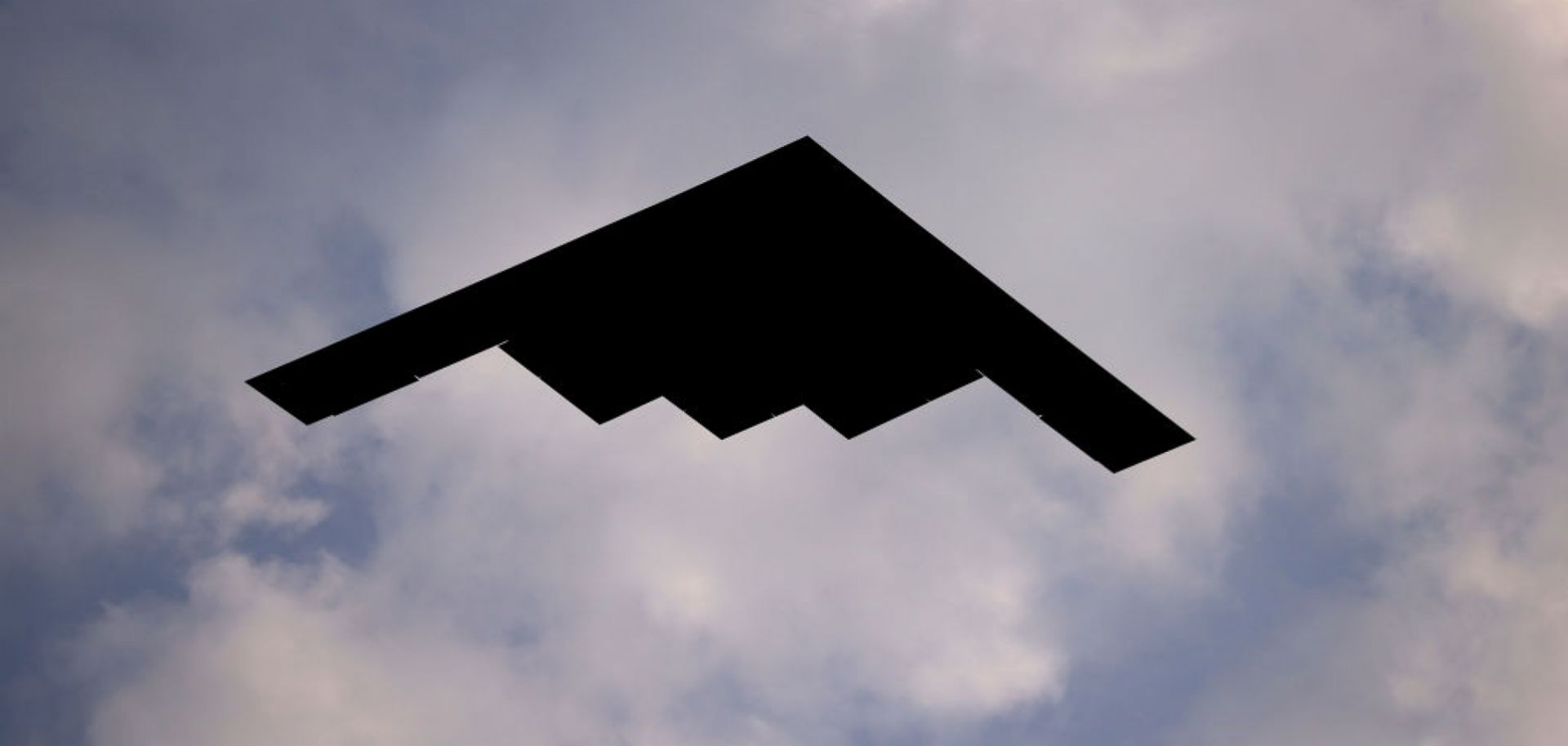
A Northrop B-2 Spirit on July 4, 2020, near the White House in Washington.
Iran will likely try to calibrate its kinetic response to the U.S. strikes on its nuclear facilities to avoid significant escalation, but its response will open the door to further attacks that include Iran targeting regional oil and gas production. Iranian Foreign Minister Abbas Araghchi on June 22 said that the United States had "blown up" diplomacy with its decision to strike three Iranian nuclear facilities earlier that day, and that "we have to respond" following what has been more than a week of Israeli attacks that began on June 13. When asked by a reporter about potential retaliation options, Araghchi would not rule out an attempt to close the Strait of Hormuz or harass ships in the strait, or an exit from the nuclear Non-Proliferation Treaty. In response to the attacks, Iran's Islamic Revolutionary Guard Corps (IRGC) said in a June 22 statement that the United States had put itself at the "front lines of aggression" and that U.S. military bases in the region were a "point of vulnerability," but did not explicitly say that Iran intends to carry out strikes on U.S. bases. Iran's parliament voted unanimously to close the Strait of Hormuz, but left the decision to do so to the Supreme National Security Council.
- Araghchi announced that he will travel to Moscow on June 23 to discuss the attacks. As expected, Russia's foreign ministry issued a statement condemning the U.S. strikes on Iran, saying they were "irresponsible" and a "gross violation of international law." Iran and Russia signed a comprehensive partnership treaty in January 2025 covering many areas, including defense, but it does not include a mutual defense clause akin to NATO's Article 5.
- In the June 22 strikes on Iran, the B-2 bombers dropped 16 GBY-57 Massive Ordnance Penetrators — two on Iran's Fordow nuclear facility and the rest on the Natanz and Isfahan facilities, according to Chairman Gen. Dan Caine of the U.S. Joint Chiefs of Staff. The U.S. military also launched more than two dozen Tomahawk missiles against several key "surface infrastructure targets." The extent of the damage to Fordow and other nuclear facilities is unclear, though U.S. Defense Secretary Pete Hegseth said that "Iran's nuclear ambitions have been obliterated."
- A spokesperson for the Israel Defense Forces (IDF) said that Israel had a "variety of goals" in its air campaign against Iran and that it continues to strike Iran. After the U.S. attacks, Iran also launched another round of strikes on Israel involving ballistic missiles.
- Immediately after the U.S. attacks, Iranian state media said that the three targeted sites had been evacuated, and about 12 hours later, the Iranian Red Crescent Society said there were no deaths.
Initially, Iran will likely try to limit its kinetic retaliation, possibly by only targeting a limited number of U.S. bases in the region and providing some advance warning to the United States. With its regional proxies and its own conventional capabilities heavily degraded, Iran has few good options to respond to the U.S. attacks. Moreover, Iran's lack of ability to defend itself means that any significant response will only invite more U.S. strikes on Iran that could go well beyond its nuclear program and could include an assassination strike on Supreme Leader Ali Khamenei, as well as other senior leaders. Faced with this reality, along with ongoing significant attacks from Israel, Iranian leaders will likely prioritize regime survival and try to minimize the likelihood of further escalation, while still retaliating to save face. While Iran could privately signal an intent to return to nuclear talks with the United States in the future, negotiations are likely off the table for now, as Iran and regional allied militias likely need to retaliate against the U.S. strikes with at least some level of military action in an effort to demonstrate a level of response to the Iranian people and hard-liners within Iran's political system demanding a more forceful reaction. Such a response may be a limited missile or drone attack on a handful of bases in Iraq, Syria and Jordan housing U.S. forces. But in an effort to limit the potential for American casualties, Iran would likely heavily telegraph any attack on U.S. forces both publicly and privately through traditional intermediaries, like Oman. This is particularly because the apparent lack of Iranian deaths in the U.S. strikes means Iran will not be under as much pressure to mount a mass casualty attack against the United States, unlike Iran's ongoing attacks on Israel. Iran may also attempt to placate hard-liners in the parliament and demonstrate to the United States its capabilities in the Strait of Hormuz by seizing a tanker carrying oil for a U.S. entity or destined for the United States. Additionally, Iran will probably respond with a variety of non-kinetic actions as well, including likely withdrawing from the nuclear Non-Proliferation Treaty, reducing cooperation with nuclear inspectors and vowing to rebuild its enrichment program, despite the damaged state of its facilities at Natanz, Fordow and Isfahan.
- Iran has demonstrated a willingness to try to limit its response to previous high-profile U.S. attacks on its forces. Notably, following the U.S. assassination of IRGC Quds Force commander Qassem Soleimani, Iran heavily telegraphed a strike on an Iraqi base in 2020 housing U.S. forces in order to give American forces time to take cover before the retaliatory attack.
- After the U.S. strike on Iran, Yemen's Iran-backed Houthi movement said in a statement that it was "ready" to target U.S. ships in the Red Sea, following the group's agreement with the United States in May to halt such attacks.
Even if carefully calibrated, Iranian retaliation of any form risks triggering more U.S. strikes and greater escalation that could result in Iran following through on more of its significant threats against the regional oil and gas sector and/or the United States. In his June 21 public address on the strikes, U.S. President Donald Trump threatened to carry out more attacks on Iran if the country does not "make peace," adding that there were "many targets left." Iran will thus not be able to guarantee that even a heavily telegraphed strike that does not kill any American soldiers will not result in Trump quickly ordering another, broader strike on Iran or greenlighting a decapitation strike on Khamenei — not to mention further large-scale attacks by Israel. Iran will also not be able to guarantee that a widely publicized strike, even if intended to minimize U.S. casualties, will not result in American fatalities. Moreover, an announcement to withdraw from the nuclear Non-Proliferation Treaty may even be interpreted by the U.S. and Israeli administrations as a de facto statement of intent to build a nuclear bomb, even if Iran chooses not to do so (or does not have the ability to do so for months, if not years). If Iran's initial kinetic and non-kinetic responses result in another, broader round of U.S. strikes, Iran may then authorize a broader retaliation strategy that includes larger scale strikes on regional oil and gas infrastructure, shipping in the Strait of Hormuz and/or U.S. military assets in the region with an intent to kill by not providing advanced warning. Such attacks could take significant volumes of oil production offline, either directly by damaging facilities or indirectly by reducing shipments through the Strait of Hormuz, which could drive global oil prices north of $100 per barrel if a substantial amount of oil remains offline for an extended period. While Iran lacks the military prowess to prevent further U.S. strikes, it likely has the missile, drone and various asymmetric capabilities (like sea mines) to cause significant casualties and damage across the region in a scorched earth retaliation that would prolong the conflict.
