
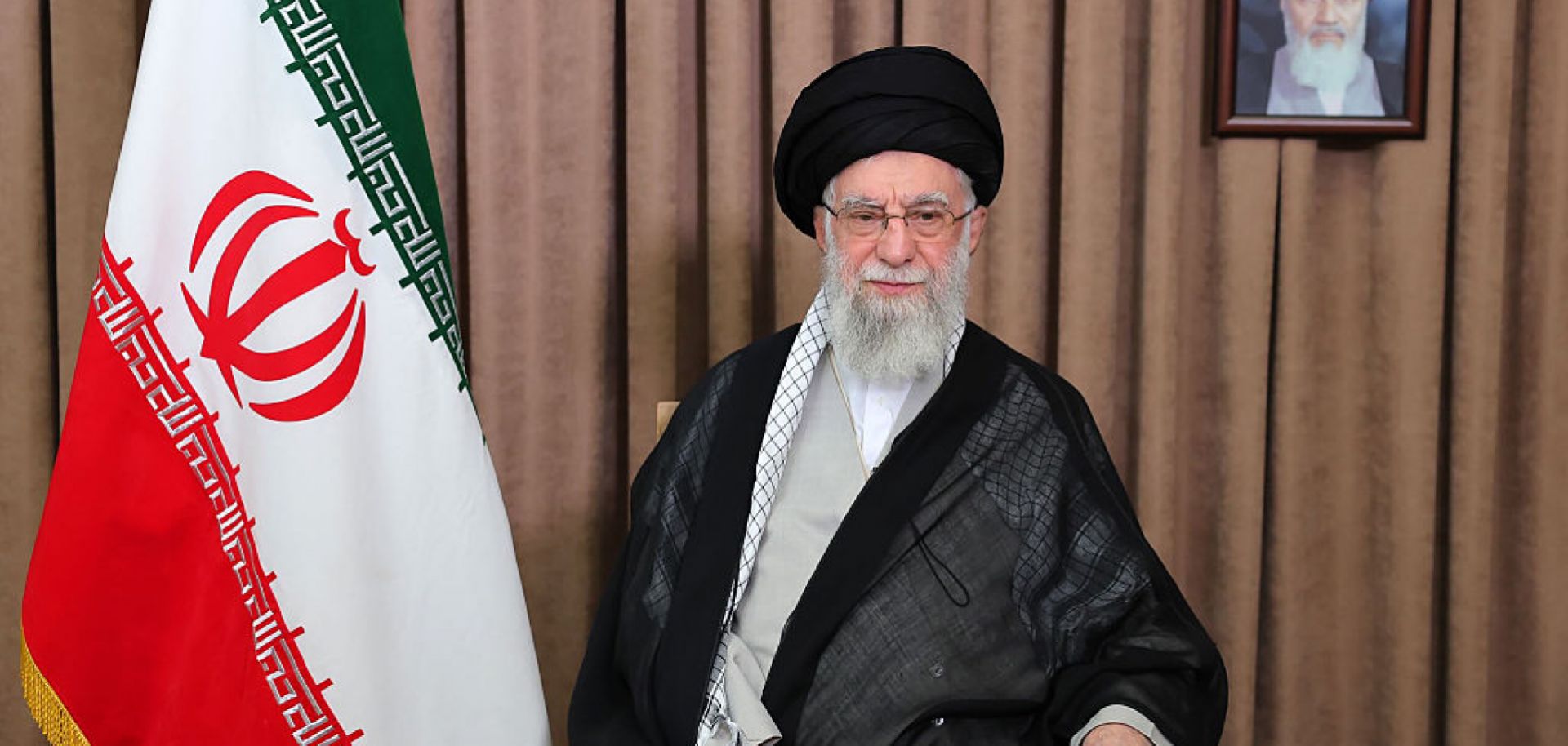
Regime change: the two words that have haunted the Islamic Republic of Iran for decades, and have long been venerated by its critics.
In 2002, while speaking before a U.S. congressional committee, Israeli Prime Minister Benjamin Netanyahu, jokingly called for the United States to set transponders to beam the "subversive" television shows Melrose Place and Beverly Hills, 90210, to Iran, in an effort to stoke protests to topple the government. Fast-forward 23 years, Israel now appears to be trying to achieve that goal through its newly launched airstrike campaign against Iran, called Operation Rising Lion. Netanyahu has also called on Iranians to "stand up" to the Islamic Republic, and many members of Israel's government, as well as many Iran hawks in the United States, have expressed hope that regime change could be in the air.
Israel's attacks increasingly appear aimed at not only significantly setting back Iran's nuclear program — the original justification for the June 13 start of strikes — but also to generate economic and political instability within Iran. This is evidenced by Israel's growing targeting of political entities, such as the IRIB state media building and close political advisors to Supreme Leader Ali Khamenei, as well as Iran's economic infrastructure, including energy facilities, designed to amplify economic disruption for the Iranian populace. Although U.S. President Donald Trump reportedly rejected a previous Israeli strike to kill Khamenei, such an assassination attempt remains possible, particularly as the United States considers deeper involvement in the conflict.
Operation Rising Lion may lead to the Islamic Republic's eventual downfall or transformation. However, sustained air campaigns, much like historical blockades and sieges that sought to degrade and control an adversary, rarely cause regime change on their own. The two most recent air campaigns that helped topple governments were the 1999 NATO bombing of Yugoslavia during the Kosovo War and the 2011 NATO-imposed no-fly zone on Libya during the Libyan Civil War. But in both of those instances, a significant amount of time passed between the attacks and the actions by protestors and other actors on the ground that eventually overthrew the governments. Additionally, there have been many cases where an air campaign is neither accompanied by nor leads to a domestic ground movement, and in turn fails to achieve regime change, as seen in the 1991 Gulf War air campaign following then-Iraqi President Saddam Hussein's invasion of Kuwait. The Empire of Japan's surrender in 1945 after the United States detonated two atomic warheads over Hiroshima and Nagasaki is arguably the closest parallel for an air campaign leading to regime change. However, even this comparison is problematic, as the United States' prolonged multi-year air campaign against Japan took place in the context of a total war between the two nations.
Constraints To Regime Change
For now, it appears unlikely that Israel's air campaign will coincide with the start of a strong movement inside Iran to overthrow the government, akin to the Yugoslavian and Libyan comparisons, where protests were either already ongoing or occurred after the launch of airstrikes. While many Iranians oppose their country's regime, many also share a deep-seated resentment of Israel, a sentiment prevalent across the Muslim world. Israel's new airstrike campaign will thus likely intensify Iranian nationalist feelings, fostering a "rally around the flag" effect among both secular and Islamist factions alike, at least initially.
Indeed, the more that Israel targets civilian infrastructure, the easier it will be for the Islamic Republic to tap into domestic nationalist sentiment to maintain some level of control over the system. Israel's air campaign will certainly further degrade the Iranian economy, which has struggled under the weight of U.S. sanctions for decades. But there is little sign it will quickly lead to the emergence of protests that Iran's security apparatus would be unable to disrupt.
Over the last three decades, Iran has endured many rounds of protests, including the 1999 student protests, the 2009 Green Movement protests, the 2017-18 protests, the 2019-20 fuel protests, and the 2022-23 Mahsa Amini protests. But while these demonstrations all led to some policy changes, none resulted in a government overthrow or substantial splits in Iran's security establishment. In the wake of Israel's recent attacks, there are few indications that splits within Iran's Islamic Revolutionary Guard Corps and security apparatus are emerging. If anything, the ongoing airstrikes will likely, in the short term, drive Iran's hard-liners and ideologues (many of whom are in the IRGC) toward cooperation.
Moreover, recent Iranian protest movements have struggled to rally around a singular, powerful leader. Reza Pahlavi, the 64-year-old son and Pahlavi Dynasty successor to Shah Mohammed Reza Pahlavi, is the closest figure to a political leader outside the current system. However, he has not been in Iran since his father was overthrown by the 1979 Islamic Revolution, and, unlike Ayatollah Ruhollah Khomeini upon his return to Iran, he has almost no internal support base.
Even Khamenei's assassination would unlikely result in major changes for the Islamic Republic of Iran. While Netanyahu suggested in a June 16 interview that the Supreme Leader's death would "end the conflict" rather than escalate it, history shows numerous instances where slain Iranian leaders are replaced by figures who largely maintain the status quo. This is, in part, because Iran's governmental structure is significantly more institutionalized than many other authoritarian regimes reliant on a single dictator's authority, such as Saddam Hussein's Iraq.
According to the Iranian constitution, Khamenei's death would result in his immediate replacement by a council comprising Iranian President Masoud Pezeshkian, judiciary head Gholam-Hossein Mohseni-Ejei, and a representative from the Guardian Council, a body within Iran dominated by hard-line conservatives. In practice, the Guardian Council and Expediency Council, another hard-line conservative-dominated body, would wield significant power and likely limit the influence of Pezeshkian, a reformist, on the government. The Assembly of Experts, yet another hard-line conservative-dominated body, would then elect the next Supreme Leader.
Virtually all of the prominent names that have been floated as Khamenei's successor — including his son Mojtaba Khamenei, cleric Alireza Arafi and Mohseni-Ejei — are cut from the same ideological cloth as the current Supreme Leader. Some are even more hard-line than Ali Khamenei, who has on many occasions acted as a moderating influence against Iranian hard-liners.
The political climate in Iran also significantly influences the Supreme Leader succession process, as seen during the 1989 transition, when then-President Ali Khamenei was elected to replace then-Supreme Leader Ayatollah Ruhollah Khomeini. At the time, Khamenei did not necessarily have the highest religious credentials (he was a hojatoleslam, not an ayatollah). But he wielded substantial political influence as president and was able to take advantage of Khomeini's falling out with his anointed successor. Khamenei then sealed a political deal with the then-parliamentary speaker to help maneuver his way to become Supreme Leader. Should Israel assassinate Khamenei, Iran's most hard-line and staunchest opponents of Israel would likely control the election for a new supreme leader, shaping the process to their advantage.
Past Instances of Regime Change in Iran
Nevertheless, regime change is not unprecedented in Iran. Over the last century, Persia and Iran have undergone four distinct regime changes, offering insights into how such a political transformation could happen again.
The first occurred when the U.K.-backed Persian Cossack Brigade, led by Reza Shah, carried out a coup in 1921 and ultimately overthrew the Qajar monarchy in 1925, as the British hoped to minimize Russian influence in the country. The second came in 1941, during World War II, when Reza Shah was forced to abdicate the throne to his son, Mohammed Reza Shah, following the Anglo-Soviet invasion of Iran, as the allied powers sought to marginalize German influence. A decade later, in 1951, Mohammad Mossadegh, asserting that the Shah was not the ultimate political authority in Iran, was able to strip some power away from Mohammed Reza Shah and nationalize the Anglo-Iranian Oil Company. As this intra-elite power struggle continued Iran, the United States and the United Kingdom, seeking oil supplies, then orchestrated a coup in 1953 to remove Mossadegh and reinstate the Shah as a monarchist leader.
In each of these early instances of regime change, the political shifts in Iran were largely instigated by external forces, often with a significant foreign military presence. This drove Iran and the Islamic Republic to seek to minimize foreign influence on its soil in the following decades. But the last regime change, the 1979 Islamic Revolution, was instigated by Iranians themselves. Long-simmering anger over Iran's poor economic conditions and repressive political climate saw a diverse opposition of secularists, communists and Islamists unite against Mohammed Reza Pahlavi, leading to years of protests that ultimately forced the Shah into exile by demoralizing the military through mutinies and widespread defections.
The example of the 1979 Islamic Revolution is significant, as it demonstrates that sustained protests, fueled by prolonged economic hardship and repression, can foment a revolution in Iran if the security establishment shows signs of weakening. However, Khomeini and later Khamenei established the IRGC as an internal security force, initially with the primary purpose of safeguarding the revolution from both external and internal threats. Unlike Iran's regular army, which remains in existence, the IRGC was designed to be loyal to the supreme leader and the clerical establishment.
Potential Future Regime Change Scenarios
So while regime change in Iran is unlikely, it is not impossible. There are several ways such a political transformation could unfold in the coming months and years.
Hard-Liners Seize Power, Resulting in an Effective Dictatorship
In the most likely scenario, persistent Israeli attacks drive hard-liners in Iran to stage a palace coup that replaces the current regime with a de facto military dictatorship. For this to happen, Israel would likely need to maintain a high tempo of operations targeting Iran and its senior leadership, most likely killing Khamenei in the process. This would then embolden hard-line factions of Iran's existing regime — most likely including elements of the IRGC, rather than Iran's regular army — to oust Pezeshkian and establish a junta or military-led body. Their justification would be that full militarization is necessary to preserve the regime and better defend against the growing Israeli threat. The new military government would retain the support of Iran's clerical establishment but might replace Khamenei with a council effectively subservient to the military leadership, rather than a figure of comparable power. Ultimately, this outcome would not benefit Israel and the United States, as it would result in an even more hard-line Iran that is potentially even more supportive of pursuing nuclear weapons.
Pragmatic-led Palace Coup Leads to Normalization
In a less likely scenario, more moderate members of the existing regime and/or political system orchestrate a palace coup in an effort to preserve elements of the existing Islamic Republic of Iran. This would likely necessitate a sustained and extensive Israeli bombing campaign, possibly coupled with a U.S. attack on Iran's nuclear sites, including the Fordow Fuel Enrichment Plant (which has so far been largely unscathed by Israeli attacks, but may be bombed by the United States in the future), to the point where Iran can no longer effectively pursue nuclear weapons for the foreseeable future. Faced with a lack of true deterrence against further U.S. or Israeli attacks, moderate elements within the Iranian military and political system stage a coup to minimize the influence of hard-line elements and potentially replace Khamenei, if he dies or is killed, with a more moderate figure. This, in turn, results in a government that is better positioned to negotiate with the West and Israel and is more willing to concede on issues like Iran's nuclear program.
But while certainly possible, this scenario remains unlikely due to several constraints. First, Iran's clerical establishment deeply supports Khamenei and Khomeini's vision of Velayat-e Motlaqaye Faqih, the notion that senior Shia clerics should oversee society until the return of the 12th Imam Muhammad al-Mahdi. This means palace coup leaders would need to rapidly assemble a movement large enough to arrest, detain, intimidate or otherwise marginalize the clerical leadership. Second, while an IRGC commander or mid-ranking official may be involved in the coup plot, the IRGC's ideological commitment to support the Islamic Revolution makes it more likely that the vast majority of IRGC members — if not all of them — would seek to halt a coup attempt by another element of the regime and/or quickly carry out a counter-coup attempt. The IRGC's vast internal intelligence gathering network will also make it difficult for would-be coup plotters to act without alerting the IRGC. Finally, the coup leaders would have to marginalize Iran's hard-line elements in other parts of the government, including the parliament, which is currently chock-full of traditional and hard-line conservatives who would largely oppose a more liberalizing takeover. This contrasts with the period between 1951 and 1953, when Mossadegh was able to initially use the Majles as a cudgel to pry power away from Mohammed Reza Shah, before becoming more autocratic himself. Such a coup attempt could also quickly go awry and lead to a deep civil war between those backing the new leadership and those seeking to maintain the status quo, and it is unlikely that the moderates would win unless significant factions of the IRGC defect to their side.
Grassroots Popular Uprising Leads to Government Collapse
Although less likely to occur amid Israeli and/or U.S. attacks, a popular uprising, reaching a critical mass, could also potentially overthrow the Islamic Republic of Iran if the economic fallout from the attacks significantly worsens living conditions in the country.
In this scenario, Israeli and potential U.S. strikes further weaken the Iranian economy by destroying civilian infrastructure, including energy infrastructure. This makes it difficult, if not impossible, for Iran to supply sufficient gasoline and fuel to the lower and middle classes. The consequent rise in living costs then prompts struggling Iranians to take to the streets, staging mass protests reminiscent of those that spurred the 1979 revolution following more than a decade of economic and social fraying. Although Iran has weathered economically motivated and anti-government protests many times, conditions deteriorate to the point where the size and/or frequency of the protests increase and, more importantly, more elements of the existing moderate and reformist camp of Iran's political establishment directly or indirectly support them. Initially, Iran's security apparatus cracks down on protesters, and potentially triggers an incident similar to Iran's Black Friday in 1978, where around 100 protesters were killed and over 200 injured (a critical catalyst of the 1979 revolution). This allows the popular uprising to eventually reach a critical mass, causing the government to fall.
In this scenario, moderate and reformist leaders would likely lead a transitional council, given the limited size of Iran's opposition inside and outside the country. This council would rewrite the constitution and/or hold new elections without oversight of bodies like the Guardian Council, which currently approves candidate lists for elections and routinely rejects moderate and reformist candidates.
Though this scenario mirrors the 1979 revolution, it faces considerable limitations. Unlike 1979, there is no real credible opposition inside Iran today. And external Iranian figures, such as Reza Pahlavi and Mojahedin-e-Khalq (MEK) leader Maryam Rajavi, have almost no support base inside Iran. The emergence of a Khomeini-like figure — i.e., one possessing broad-based internal support capable of sustaining protests through influential rhetoric, as Khomeini did — is thus unlikely. Nevertheless, history offers examples of rapid leadership emergence in other countries, such as Poland's Lech Walesa, an electrician who swiftly rose to lead the Solidarity movement that ultimately toppled the country's communist regime in 1989. Additionally, Iran's economy has already faced stress for years, and it is unclear whether Israeli and possibly U.S. airstrikes would inflict enough additional damage to worsen economic conditions to a degree that sparks widespread protests. Iran's IRGC and especially its paramilitary militia Basij, which claims to have over a million members, also have extensive experience in breaking up protests and demonstrations. The Basij, for example, has carried out pro-regime demonstrations or intimidated would-be protesters to disperse them or limit their numbers. Moreover, today's Islamic Republic of Iran is more ideologically homogeneous than the Shah's regime, which was largely unified around the Shah himself. This makes widespread defections, which characterized the final days of the Shah's rule, far more difficult. Although alternative groups like the communist Tudeh Party and various leftist factions have existed during the Islamic Republic's reign, Khamenei and his allies have largely neutralized them, rendering them inconsequential today.
A Western or Israeli-Backed Coup Overthrows Existing Government
Although it is a highly unlikely scenario, Israel (and the United States) have clearly penetrated the Iranian government and Iranian society to the point where another foreign-imposed regime change and/or coup could topple the government, or at least significantly change it, cannot be entirely ruled out. For such a coup to succeed, close cooperation between Israel and the United States would be essential. They would need to persuade influential figures within Iran, or those already receptive, to execute the overthrow. In return for success, rapid normalization with the new leadership would be offered.
In practice, this scenario faces all the same constraints as the above scenario, as well as several others. For one, the Islamic Republic has worked hard to minimize external political influence, and even Tehran's recent agreements with Russia and China have sparked domestic controversy over potential foreign manipulation. External powers also currently lack the political actors and hard power on the ground to orchestrate a coup, as they once could. While Israel's Mossad has significantly infiltrated Iran, it would be extremely difficult for Israel to unilaterally execute a coup because it would necessitate co-opting a critical mass of the IRGC, clerical establishment and other existing Iranian government entities. If Israel possessed this level of influence, it would have already likely tried to exploit it. It is more likely that an ambitious coup leader in Iran — such as one that emerges from a popular uprising, as in the above scenario — would seek support from Israel and/or the United States, rather than coordinating a coup with outside powers. But given Iran's history of foreign manipulation and coups, any hint that a successful coup organizer received outside support would risk becoming a future liability.
Iran Fully Folds to U.S. Demands and Commits to Political Reform
Such a scenario would require near-constant Israeli or U.S. bombardment to persist for months and for Iran's leadership to effectively run out of its own hard military power (i.e., drones and missiles) to retaliate. In a low probability, high impact variant of this scenario, Israel could detonate a nuclear warhead to demonstrate its resolve, hoping to get Iran to capitulate.
Finally, total capitulation by the Islamic Republic of Iran and its leadership to significant political reforms and an overhaul is conceivable, though it is by far the least likely regime change scenario. Should Israel and potentially the United States expand aerial strikes to repeatedly target Iran's political leadership, including members of the parliament, judiciary, Guardian Council and other non-military targets, Iranian leaders may conclude that surrendering to the United States is the only path for the Islamic Republic of Iran to endure in some capacity. This scenario would require near-constant Israeli or U.S. bombardment to persist for months, and for Iran's leadership to effectively run out of its own hard military power (i.e., drones and missiles) to retaliate. In a low probability, high impact variant of this scenario, Israel could detonate a nuclear warhead to demonstrate its resolve, hoping to get Iran to capitulate.
The scenario as written above, particularly the Israeli use of a nuclear weapon, was deliberately taken to the edge of implausibility. This is because, in all reality, the Islamic Republic would most likely quickly enter preservation mode at the first sign of such a situation, including by offering significant concessions on its nuclear program if it perceives this as the only way to ensure the regime's survival. Indeed, regime preservation has been a core principle of the Islamic Republic of Iran since its inception, which explains why Iran would likely negotiate with the United States and yield on previously non-negotiable stances, such as uranium enrichment, to avert any scenarios that could lead to regime change.
Perhaps the most well-known example of this occurred in 1988, when Ayatollah Ruhollah Khomeini signed a ceasefire to end the Iran-Iraq War, a significant reversal after years of rejecting such agreements. His profound distress over the decision was evident in a letter where he famously expressed his unhappiness that he was still alive, stating that signing the ceasefire "was more deadly than drinking from a poisoned chalice. I submitted myself to Allah's will and took this drink for his satisfaction."
Should growing Israeli and/or U.S. pressure eventually force current Supreme Leader Ali Khamenei to make a similar decision, he will likely follow in his predecessor's footsteps and drink from the poisoned chalice, rather than let the Islamic Republic fall.
