
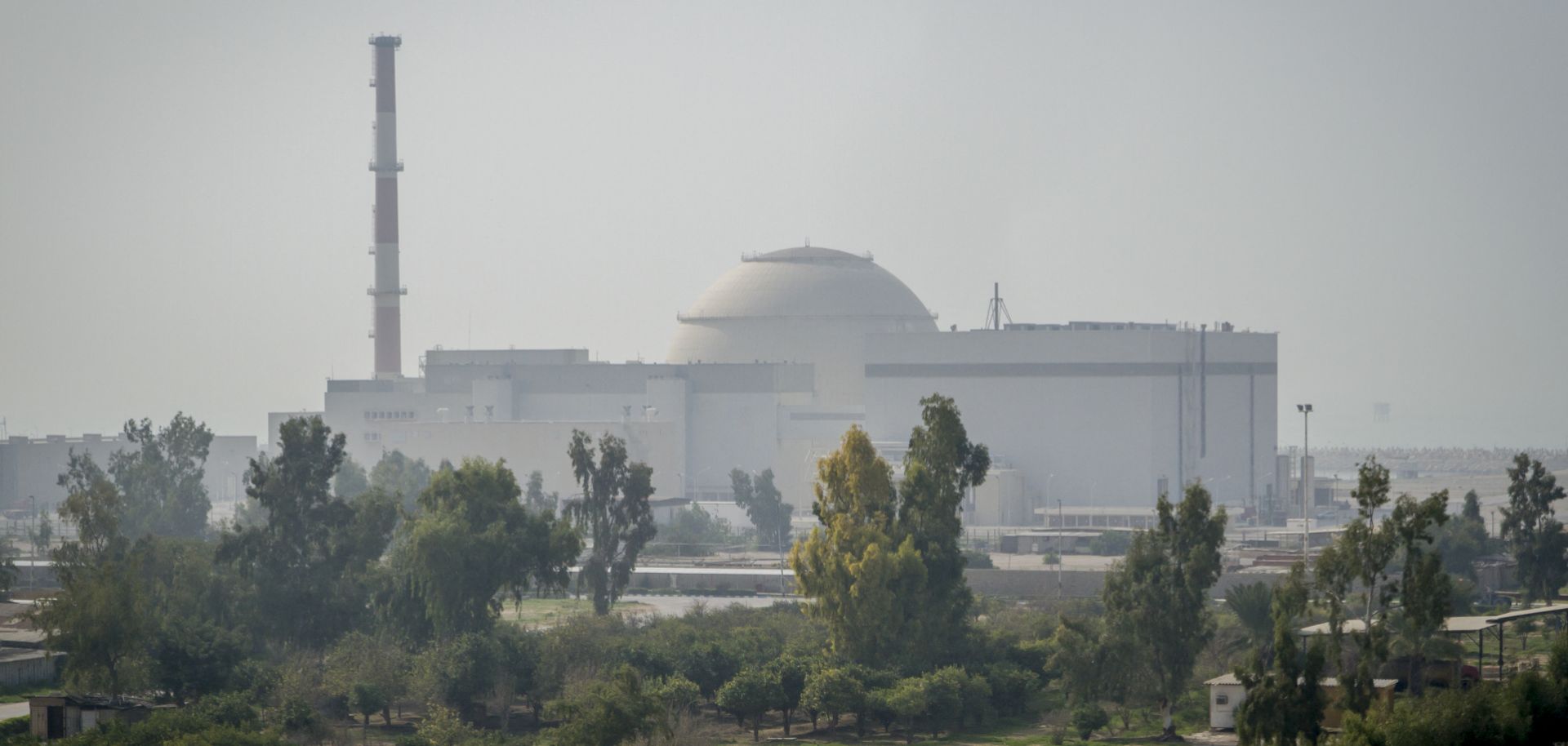
A view of the Bushehr nuclear power plant.
Israel's unprecedented attacks on Iran's nuclear and military infrastructure mark a deliberate escalation aimed at degrading both Iran's nuclear capabilities and leadership command, likely triggering sustained retaliation, regional instability and the collapse of U.S.-Iran nuclear talks in the near term. In the early hours of June 13, Israel launched extensive attacks on Iranian targets, involving around 200 aircraft and 330 munitions hitting approximately 100 sites across Iran. The offensive, announced by Prime Minister Benjamin Netanyahu as a multiday operation to neutralize what he called an existential threat, focused on critical nuclear infrastructure, including the Natanz, Khondab, Khorramabad and Tehran-area enrichment facilities. Strikes also targeted military assets — such as missile factories, air-defense systems and command centers — as well as residential neighborhoods housing senior Islamic Revolutionary Guard Corps leaders. Among those reportedly killed were IRGC Commander-in-Chief Gen. Hossein Salami, Armed Forces Chief of Staff Gen. Mohammad Bagheri, and prominent nuclear scientists Fereydoun Abbasi-Davani and Mohammad Mehdi Tehranchi, along with senior officials Gholam Ali Rashid and Ali Shamkhani. Civilian casualties were reported in urban areas. In response, Iran launched more than 100 drones toward Israel, triggering nationwide alerts and a state of emergency.
- Israel closed Tel Aviv's Ben Gurion Airport, the country's main international airport, and placed its air defenses on high alert, while Iran and Iraq also shut their airspace.
- Iranian Supreme Leader Ali Khamenei and the IRGC vowed severe retaliation against both Israel and potentially the United States, though Washington denied direct involvement in the Israeli attacks, asserting only that it would defend its regional assets.
- The strikes have caused global economic ripples, pushing oil prices up by 10%, dropping U.S. stock futures and driving gold to record highs.
Israel's goal was to target not only Iran's nuclear program, but also the Iranian regime. The targeting of nuclear enrichment sites like Natanz, Khondab and Khorramabad clearly indicates Israel's immediate goal of preventing Iran from achieving nuclear breakout capacity. Additionally, targeted attacks against nuclear scientists demonstrate Israel's intent to limit Iran's long-term nuclear expertise and technical capabilities and prolong any potential future rebuilding efforts. The simultaneous targeting of senior IRGC commanders, key figures and advisers, however, reveals deeper strategic intentions. Israel is extending its proven strategy of "leadership decapitation," previously employed effectively against proxies such as Hamas and Hezbollah, to directly weaken Iranian command and control structures, aiming to sow confusion, disorganization and internal discord.
- During the past year's wars between Israel, Hamas and Hezbollah, the Israeli military focused on degrading these groups' command and control structure and operational capabilities by eliminating its senior leaders, which weakened their capacity to retaliate effectively during their conflict.
With Israel announcing that the military operations will be extensive, there will likely be several direct exchanges between Iran and Israel in the coming days, and possibly weeks. Netanyahu's announcement that this campaign may take more than just a day means that there will be more attacks against Iran's nuclear program and military capabilities, which will invite Iranian retaliation against Israel's military bases but also governmental buildings and leadership. Additionally, given that Israel struck civilian structures in Iran, Tehran is likely also to target Israeli civilian infrastructure, including Ben Gurion Airport. Iran has already started its response by launching hundreds of drones toward Israel, and will likely use a combination of drones and missiles in future waves of attacks. Iran is likely to also engage in covert operations abroad against Israeli targets, embassies and officials. Despite this escalation, Iran will likely respond forcefully, but simultaneously allow for an offramp from escalation, especially with the United States. With Gulf Arab nations condemning the attack and the United States distancing itself, Iran is unlikely to target Arab oil and gas infrastructure, the Strait of Hormuz, or U.S. assets in the region, at least for now.
- Iranian proxies like the Houthis and Iraqi militias may participate in symbolic military operations against Israel, though, just like Iran, are still unlikely to escalate regionally against U.S. targets given Washington's distancing from the attacks.
- Iran is unlikely to target Israeli energy infrastructure, or the Strait of Hormuz yet, given that its own oil infrastructure still has not been targeted. This would become more likely if any future Israeli attacks target Iran's crucial oil sector, such as Kharg Island terminal.
- Iran has already launched hundreds of drones toward Israel, but is likely also to use its ballistic missiles in future attacks.
The attacks will likely harden Iran's stance on the nuclear negotiations with the United States, eroding any trust built during negotiations and making a deal unlikely in the short to medium term. Israel's attacks will likely bolster Iranian hard-liners who have long opposed engagement with the West. They will likely use the attack to discredit moderates (including President Masoud Pezeshkian) and argue that the United States either supported Israel or failed to prevent Israel's actions — undermining any argument for continuing talks. Moreover, Iran's retaliation for the Israeli attacks will complicate diplomacy. Even if the United States had no role in the Israeli attack, domestic political pressure will likely rise to back Israel or abandon talks perceived as rewarding Iran during a conflict. This could shift the U.S. negotiating posture or pause talks altogether. Moreover, depending on how extensive the damage is to Iran's nuclear infrastructure, some in the U.S. government will question the need for a deal to limit a program that has already been set back by force — thereby weakening the political will on all sides to finalize an agreement, at least for the next few months.
- In a statement after the Israeli attack, the Iranian government said that, "The world now better understands Iran's insistence on the right to enrichment, nuclear technology, and missile power."
