
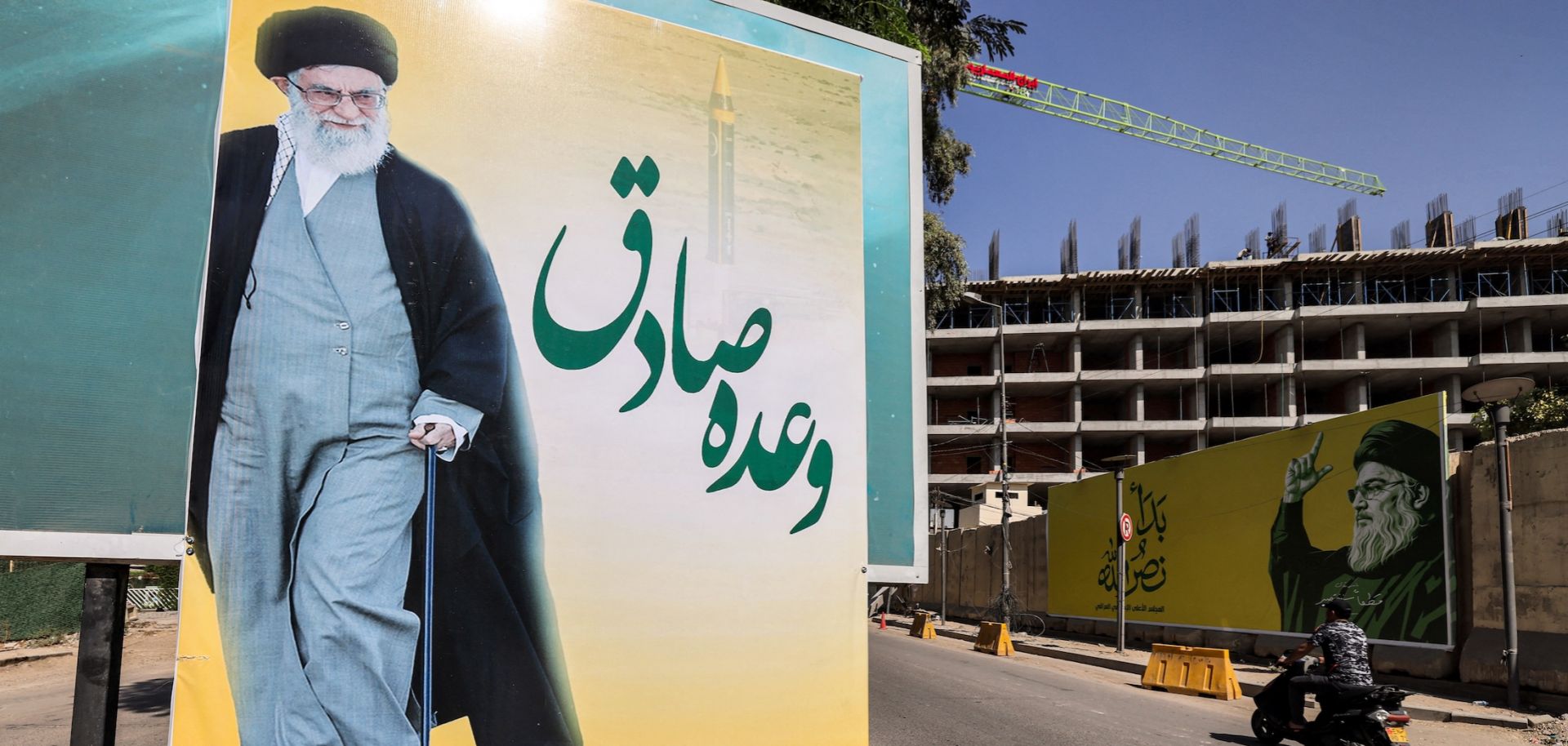
Prospective nuclear talks between Iran and the United States are unlikely to make headway, if they begin at all, due to a lack of trust and an unwillingness to compromise on both sides, keeping tensions over Iran's nuclear program — and the prospect of Israeli or U.S. military strikes on it — high. On March 8, Iran's Supreme Leader Ali Khamenei objurgated U.S. President Donald Trump's call for nuclear talks between Tehran and Washington, saying that ''some bullying governments'' seeking talks with Tehran did not seek to ''resolve issues'' but ''impose'' new demands on Iran, and that those demands would ''definitely not be accepted by Iran.'' Khamenei's remarks came after Trump said in a March 6 interview that he had sent Iran's leader a letter calling for the launch of new nuclear talks. The developments also come amid U.S. media reports that Trump personally asked Russian President Vladimir Putin in a phone call earlier this year to help broker talks with Iran, and that Russian and U.S. officials discussed this matter during their Feb. 18 meeting in the Saudi capital of Riyadh. Meanwhile, Trump has also resumed the ''maximum pressure'' campaign on Iran that he began during his first term, with the ultimate aim of reducing Iran's oil exports to zero.
- There have been no public reports of low-level or indirect talks between U.S. and Iranian officials, other than a one-hour meeting that reportedly took place in November between Elon Musk and Iran's ambassador to the United Nations at the former's residence in New York.
- As a part of the Trump administration's maximum pressure campaign, White House officials are discussing a plan to have U.S. allies and partners inspect tankers suspected of carrying sanctioned Iranian oil in key global chokepoints, like the Malacca Strait, Reuters reported on March 6. Additionally, the United States let a key sanctions waiver lapse on March 8 that allowed Iraq to import Iranian electricity.
- Iranian President Masoud Pezeshkian, who took office in late July 2024, has also expressed interest in talks with the United States, after campaigning on a platform to seek U.S. sanctions relief to boost Iran's economy. Iranian officials have since debated whether or not to engage with the United States in talks.
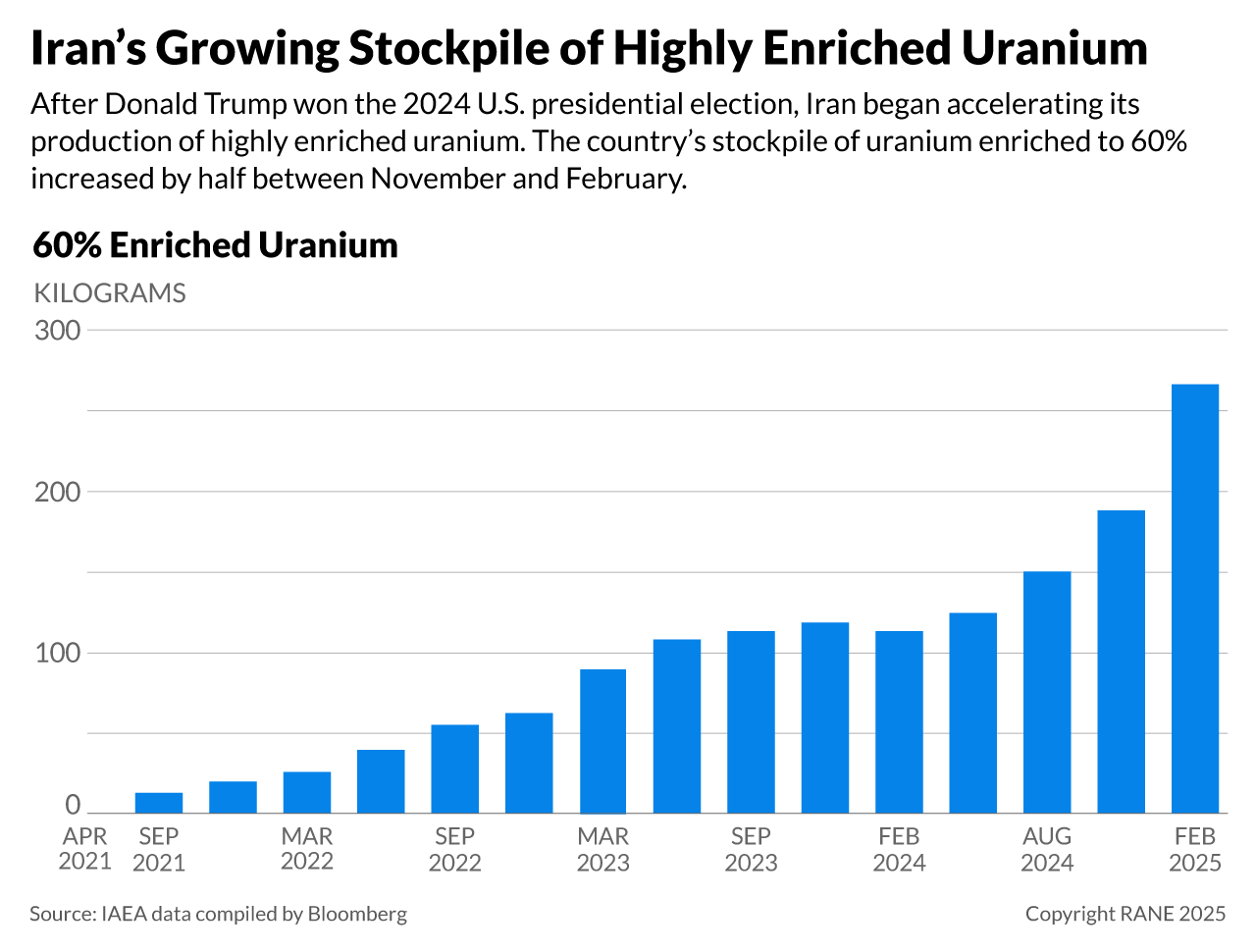
Concern over Iran's expanding nuclear program is driving the Trump administration to find ways to diplomatically resolve the issue, but the White House will still maintain a hard-line stance in any talks. Iran has significantly ramped up its nuclear activity over the last year. Most notably, over the past three months, Iran has accelerated its production of uranium enriched up to 60%, which is very close to the 90% standard that is weapons grade. In February, the International Atomic Energy Agency (IAEA) reported that Iran's stockpiles of such highly enriched uranium rose by more than 50% to 274.8 kilograms in the three months since Trump was elected in November 2024. Moreover, U.S. intelligence also recently concluded that Iran had been conducting technical research on how to build a crude nuclear bomb quickly in case its leadership decided to develop nuclear weapons. This concern has only been reinforced by the dismantling of Iran's so-called Axis of Resistance over the past year, with the collapse of Syria's Bashar al Assad in December 2024 and the significant weakening of Hamas and Hezbollah by Israel over the past year. Many in Washington believe this loss of regional proxies may force Iran to develop — or at the very least accelerate research into developing — nuclear weapons as a form of deterrence against Israel and the United States. In any hypothetical talks between Iran and the United States, the Trump administration will likely take a tough stance on key technical aspects of Iran's nuclear program that go beyond the 2015 Joint Comprehensive Plan of Action (JCPOA), which allowed Iran to enrich uranium up to 3.67%. Trump and other Republicans criticized the 2015 deal as being insufficient because it allowed Iran to continue enriching uranium. This means the White House will likely demand that Iran, at a minimum, cease uranium enrichment and destroy or render inoperable most, if not all, of its centrifuges. Republicans also criticized the JCPOA as being only focused on Iran's nuclear program and ignoring other security concerns regarding Iran, including its support of regional proxies and its missile (and more recently drone) programs. This indicates the Trump administration will likely demand concessions on these issues as well, especially in the wake of Hamas' 2023 attack on Israel and multiple Iranian drone and missile attacks on Israel over the past year.
U.S. demands will almost certainly be too high for Iran to accept unless its economy deteriorates to the point where it risks triggering mass anti-government protests that could pose an existential threat to Tehran. From Iran's perspective, the United States — and Trump in particular — has proven to be an untrustworthy negotiating partner after Trump moved to exit the JCPOA in 2018 without Tehran violating the deal first. Iran will thus seek to ensure that any new nuclear deal includes guarantees that protect Tehran from another U.S. withdrawal from the agreement. The JCPOA lacked such guarantees, as its dispute mechanisms were designed to respond to an Iranian, not U.S., exit from the deal. Iran's concerns about the United States walking away from a new agreement will only harden its position on technical issues, including demanding the right to enrichment and only dismantling (as opposed to destroying or rendering inoperable) and storing its advanced centrifuges. This resolute negotiating position by Iran will, in turn, limit the prospects of a deal. Russia's growing relationship with Iran may enable Moscow to play a role in easing Tehran's concerns in talks with the United States and create options for concessions to be made. Russia could, for example, promise to continue nuclear cooperation with Iran during a deal, or offer to let Iranian scientists carry out certain nuclear research in Russia. However, Iran's hard-liners have already rejected Russia's mediation in the conflict, making this unlikely. A worsening of Iran's domestic political stability could also prompt Tehran to soften its negotiating stance, but this will likely only occur if Iran faces dramatic nationwide protests similar to the ones that broke out in 2019-20 and 2018-19, which lasted for weeks and months, respectively. Even then, Iran may seek to delay talks until well after protests are over to avoid appearing like it is negotiating from a point of weakness due to the unrest at home.
- Iranians harbor deep-seated fears about outside powers — most famously, Great Britain and Russia during the 19th century — undermining their country's interests, making ideas like Russia mediating talks with the United States amid a Russia-U.S. rapprochement unappealing. These fears most notably resurfaced in 2016 after Iran revoked its decision to let Russia use Iranian military bases for airstrikes in Syria (in support of Assad, an Iranian ally) after Russia made such use public, triggering social backlash domestically in Iran over the approval.
While Iran's economy faces significant stress, Tehran appears to be in no rush to talk with the United States. Iran has not experienced a major round of nationwide protests since the 2022 Mahsa Amini protests, and even these were not initially driven by economic grievances. While Pezeshkian campaigned on rehabilitating the Iranian economy and securing sanctions relief, his political strength has declined since taking office due to Iranian hard-liners' control of institutions like the judiciary and parliament, which they have leveraged to significantly undermine Pezekshkian's government, including by impeaching Finance Minister Abdolnasser Hemmati on March 2. Hemmati's removal was officially attributed to Iran's poor economic performance in recent months, particularly the country's depreciating currency. However, the move also indicates that Iran's hard-liners will continue to reject talks with the West, knowing this prevents Pezeshkian from fulfilling economic promises, while enabling them to blame his government for Iranians' ongoing economic hardship. Still, the United States hopes that further straining the Iranian economy via sanctions will push Tehran to the precipice, though Iran has so far proven to be considerably resilient to such pressure after having survived nearly seven years of U.S. sanctions without a full economic collapse.
- Since Pezeshkian took office in July, the Iranian rial has declined from about 580,000 to the dollar to around 930,000 to the dollar. According to official figures, Iran's annual inflation rate is around 32%, though this has been the standard level since Trump exited the JCPOA in 2018. In a sign of economic resilience, Iran's official unemployment rate has actually declined in recent years and is now below 8%. And while U.S. sanctions on Iran's oil exports have hit a crucial source of government revenue and foreign currency, the Iranian economy, unlike other Gulf oil producers, is highly diversified, with the oil and gas sector only representing around a sixth of the country's GDP.
Limited or no progress in U.S.-Iran talks would likely drive Trump to more aggressively back Israeli action against Iran, which would reinforce Iran's own drive to boost its nuclear research, though Tehran would still seek to avoid a full-blown conflict with Israel and the United States. With Iran's hard-liners becoming more influential as Pezeshkian's power wanes, Iran will likely maintain its aggressive uranium enrichment strategy and continue to expand research into military dimensions for its nuclear program, even if it falls short of actually developing weapons. If Iran fails to at least entice Trump with the prospect of talks, the U.S. president's impatience on the issue would likely prompt him to consider backing more Israeli strikes designed to set back Iran's nuclear breakout time by weeks or months. However, any new Israeli strikes targeting its nuclear facilities would only deepen Iran's resolve to keep the option of developing nuclear weapons on the table, making Tehran even less likely to agree to concessions demanded by Washington in the future. Such strikes would likely also trigger Iranian retaliation against Israel and potentially the U.S. military targets in the region if the United States aided in the attacks. Iran could exit the Non-Proliferation Treaty as well, which would only exacerbate U.S. and Israeli concerns over Iran's intent with its nuclear program. Nevertheless, Iran would likely seek to avoid full escalation with the United States and Israel, particularly following the weakening of its regional proxy network, as such a conflict could evolve into a more existential threat to Iran if the United States intervenes directly, up to and including U.S. military operations on Iranian soil.
- Iran reportedly halted plans to retaliate against Israel's last round of strikes in October to assess Trump's approach to Iran.
