
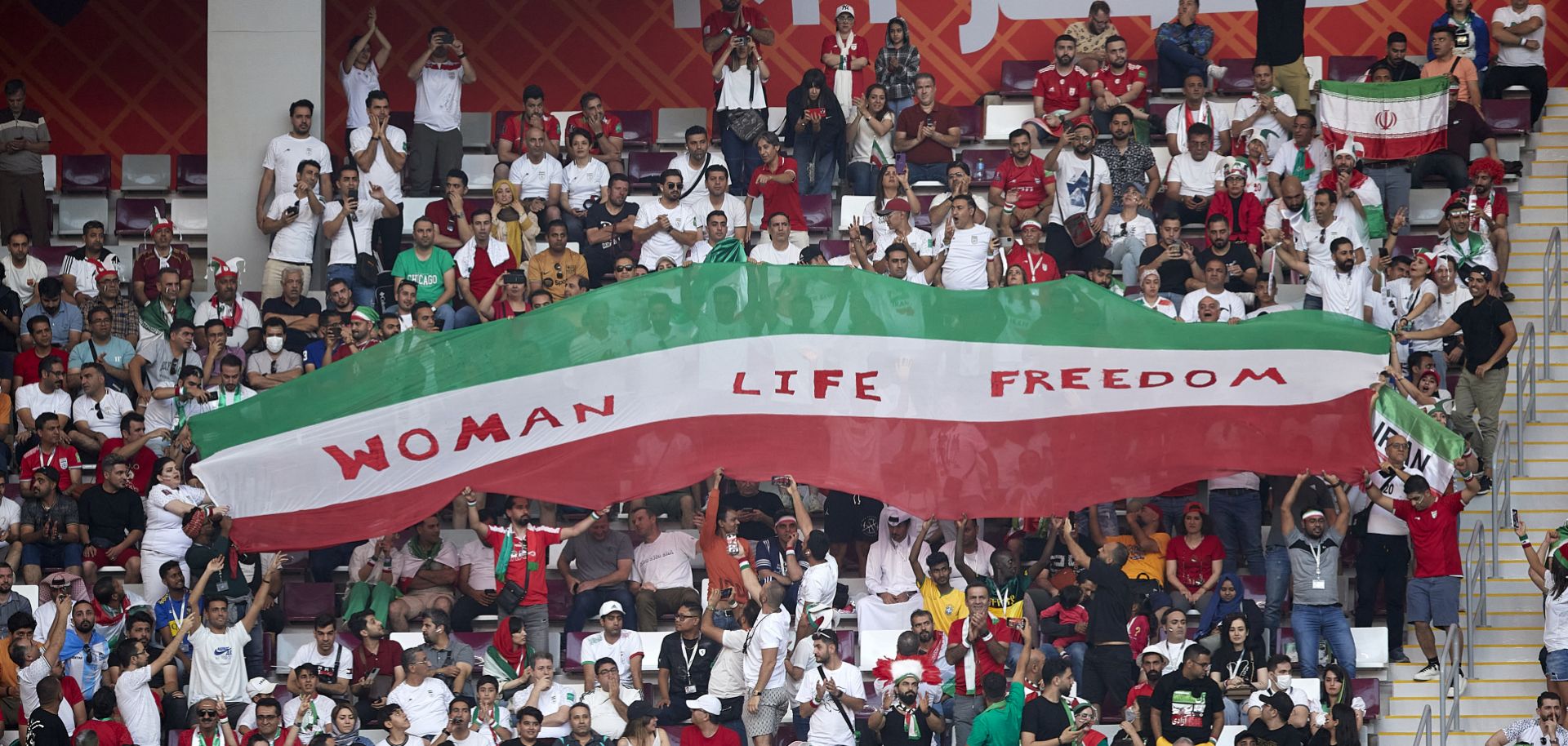
Iranian soccer fans hold up a ''Woman Life Freedom'' sign in solidarity with the protests at home during Iran's match with England at the World Cup in Doha, Qatar, on Nov. 21, 2022.
The mass protests in Iran are highly unlikely to change the country's political system, but their persistence will drive domestic instability, harden the government against social reforms, and damage Iran's foreign relationships. Over the past two months, Iran has seen large-scale anti-government protests following the in-custody death of a young woman who was arrested for improperly wearing her hijab. The government has responded with a heavy-handed crackdown, resulting in clashes with security forces that activists say have so far killed over 400 protesters. But thousands of Iranians have nonetheless continued to take to the streets nationwide, even in the face of violence and repression. This resilience — along with the size and geographic scope of the demonstrations — has drawn a significant amount of international attention and solidarity. It has also stoked questions about the movement's political consequences. While an end to the Islamic Republic remains unlikely, the protests will probably endure at a low level and have a slow-moving effect on the country's political system and social policies over time.
- On Sept. 16, a 22-year-old Iranian woman named Masha Amini died after morality police arrested her in Tehran earlier that week for allegedly violating Iran's strictly enforced dress code by improperly donning her hijab. The demonstrations over her death have since spread to all 31 Iranian provinces. Clashes on the street have so far killed over 50 members of Iran's security forces; the Iran Human Rights NGO estimates at least 448 people have been killed in the unrest, including demonstrators.
- Some protesters are demanding gradual changes to the Iranian government's social policies and treatment of women, including liberalizing the strict dress code that led to Amini's arrest. Others are calling for a total overhaul of the country's current system of governance, arguing that Iran's four-decade-old Islamic theocracy does not represent the interests of Iranians.
- Pro-reform protests are common in Iran. But the current rash of demonstrations is more geographically widespread than usual and more intersectional between multiple Iranian social classes and groups, revealing broad anti-government sentiment.
Unity between Iran's political authorities, legal institutions and security apparatus will help the government maintain its crackdown on the movement and defend itself against protesters' growing calls for sweeping political change. Iranian legislative, judicial and executive authorities are united in their resolve to quelch the anti-government demonstrations without offering reforms. For Tehran, enacting some of the reforms protesters are demanding would risk signaling that other protest demands — including the downfall of the political system — are also within reach and set a dangerous precedent of caving into demands that could fuel future protests. Out of self-preservation, the Iranian government is thus unlikely to pursue meaningful reforms beyond some surface-level adjustments to how the country's morality police operate. Security forces — including local police, Basij militia forces, and the Islamic Revolutionary Guard Corps (IRGC) — have remained cohesive and aligned with government imperatives and orders to dispel the unrest. President Ebrahim Raisi's government and Iran's powerful unelected ruling elite are both heavily conservative and support a more hard-line position on issues like women's rights and freedom of the press. Most of the country's elected lawmakers and unelected leaders are also against offering minimal concessions that could appease some of the demonstrators. It would take cracks within Iran's ruling elite, signs of solidarity between security forces and protesters, and obvious policy disagreements between elected legislators and unelected politicians, for demonstrations to be able to force authorities to introduce reforms — none of which are currently happening.
- In Iran, elected officials — which include members of parliament and the president — can influence domestic policy. But their decision-making power is limited within the country's political system, which largely favors unelected bodies like the Supreme National Security Council, Guardian Council and the Expediency Council. These unelected councils — which are composed of clerics and led by Supreme Leader Ayatollah Ali Khamenei — oversee major decisions impacting Iran's economy, government institutions, foreign policy and national security.
Sporadic protests in Iran will likely keep cropping up over the next year, but may not survive a severe crackdown from Iran's security forces. The evolution of the movement will hinge on Iranians' determination to continue protesting in the face of crackdowns and arrests in the coming months. Grassroots energy driven by long-standing social and economic grievances is propelling the protests and making it difficult for the government to extinguish them altogether. But while they may persist for several more months, the demonstrations will likely eventually subside amid the government's unrelenting crackdown. Authorities will continue to restrict internet access and block popular social media sites in order to disrupt protesters' attempts to organize and generate more support for their cause. Iranian security forces will also continue to physically restrain and arrest demonstrators (and journalists) in the hopes of deterring future rallies and squelching dissent. This — along with the protest movement's lack of clear leadership — will keep demonstrations scattered and limit their size, thereby reducing their power to force the government to initiate reforms.
- Iranian authorities have arrested an estimated 15,000 demonstrators, activists and journalists over the last two months, removing some of the movement's organizing power and likely spooking some would-be protesters from participating.
- The 2009 Green Movement protests were the last substantial demonstrations in Iran motivated by similar social and political factors. The movement was sparked by allegations of election fraud after incumbent candidate Mahmoud Ahmadinejad defeated a reformist candidate in Iran's 2009 presidential race. The Green Movement protests lasted for approximately six months before government crackdowns disbanded them. According to opposition estimates, only 72 Iranians were killed in clashes between security forces and demonstrators in those six months, compared with the hundreds who have so far been killed in just the two months since the demonstrations over Amini's death began. This indicates that the current wave of protests may be facing a harsher crackdown by Tehran and increased resolve by protesters.
Even if the current wave of protests eventually dies down, the ground will remain fertile in Iran for social and political movements to demand reforms in the future. The influence of Iran's reformists, who generally push for more socially liberal policies, has been reduced in recent years amid electoral losses and efforts by unelected conservative officials to disqualify them from running for office. Reformist political figures are almost sure to channel the sentiment being seen on the streets to bolster their support in future elections, as well as inspire new reformists to run for office. Iran's conservative and hardliner leaders, meanwhile, will point to the current unrest as evidence that reformist leaders pose a national security threat and may disqualify popular ones from standing in elections. This, along with efforts to silence reformists through arrests or co-optation, will help conservatives and hardliners maintain their hold on power in the short term. However, without substantial social and political reforms, new waves of protests could emerge in the future — inspiring a new generation of reformist leaders seeking to change Iran's political system.
- Instead of parties, Iran's political system has factions that range from reformist (the most socially liberal) to hardline (the most socially conservative). Reformists in Iran believe that in order for the country's political system to survive and thrive, it needs to evolve through the gradual introduction of social, economic and political changes.
- The IRGC — the most powerful of Iran's armed forces — has expanded its political influence in recent years, with IRGC and other military-affiliated officials holding more cabinet positions and frequently running in elections. If Iran's religious leadership appears incapable of stamping out the current unrest, the IRGC could seek to place its members in more positions and call for harsher policies in response. It could also try to replace some of Iran's more overtly religious institutions with more secular, military ones in an effort to protect the country's overall governance system from attacks on its clerical aspects. This ultimately would not structurally change the Iranian government, but would gradually alter how the government presents itself domestically.
The protests will worsen Iran's relations with the West, making progress on issues like Tehran's nuclear program all the more unlikely. The Iranian government has been blaming external forces and foreign media for inspiring the protests. Western governments have also been imposing new sanctions on the Iranian entities involved in the heavy-handed crackdown on demonstrations. This is exacerbating Iran's fraught foreign relationships, especially with the United States and Europe. Increased tensions between Tehran and the West will further dim prospects for any breakthroughs in stalled negotiations to restore the 2015 Iran nuclear deal. The current wave of anti-government protests will also make Tehran all the warier of appearing weak by conceding to external powers over issues like the country's nuclear program.
- U.S.-Iran nuclear negotiations have been frozen for months, and show no sign of resuming anytime soon. Iran, meanwhile, has been steadily advancing its nuclear development beyond the limits established in the 2015 deal.
