
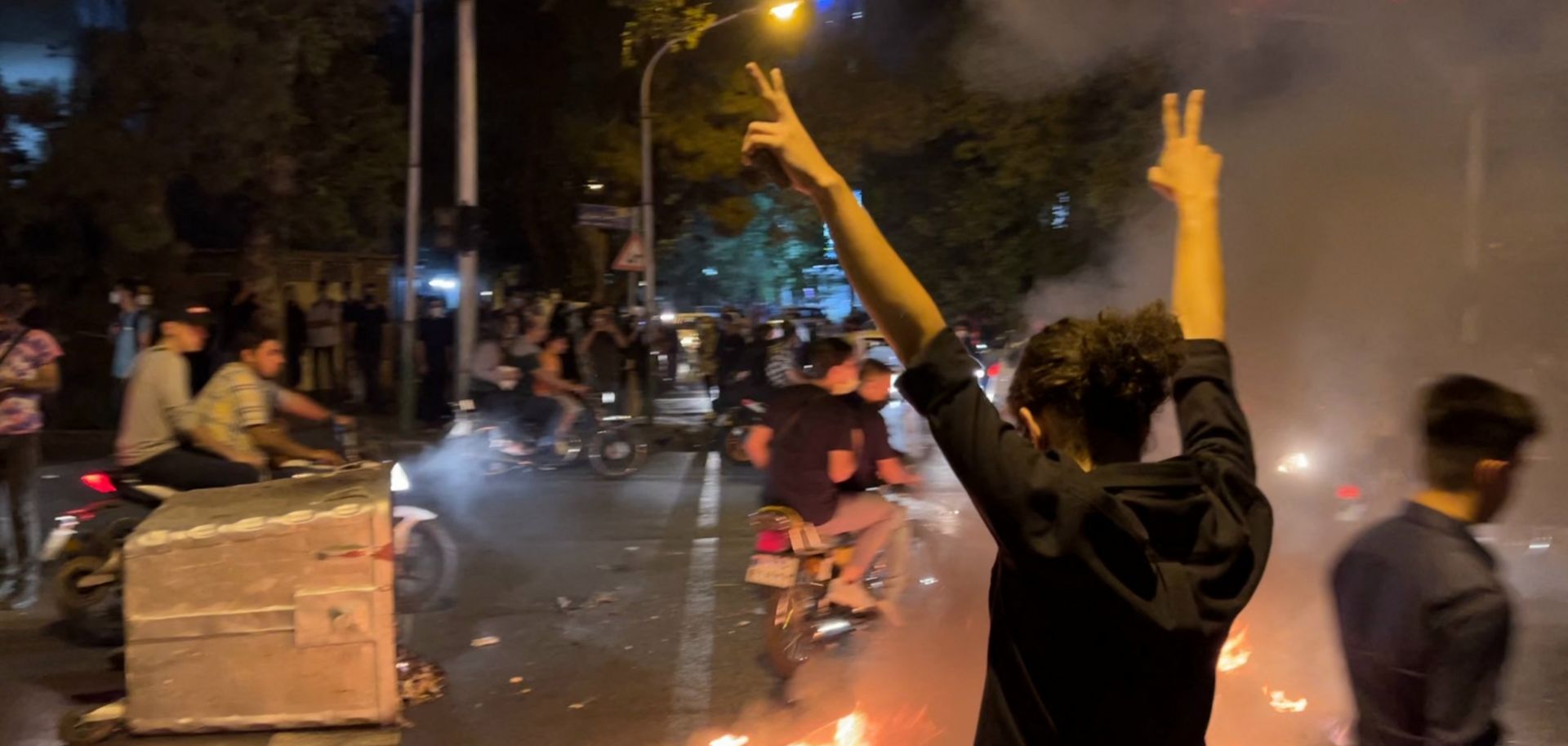
A picture obtained by AFP shows a demonstrator raising their arms during a protest for Mahsa Amini, an Iranian woman who died after being arrested for incorrectly wearing her headscarf, in Tehran, Iran, on Sept. 19, 2022.
In Iran, the quick eruption of nationwide protests over the death of a young woman in police custody points to many Iranians' deepening anger with their country's social, economic and political restrictions, which will continue to destabilize the government and influence Tehran's foreign policy. Demonstrations in Iran continue to rage on over the death of Mahsa Amini, a 22-year-old Iranian woman who was arrested and allegedly beaten into a coma by morality police for wearing her headscarf incorrectly. According to authorities on Sept. 21, a total of 17 people — including protesters and police officers — have so far been killed in clashes on the streets since the demonstrations began following Amini's funeral on Sept. 17. The protests have been the largest in Iran's northwestern Kurdistan region (where Amini was from) and in the capital of Tehran (where she was arrested and killed). But rallies have also begun cropping up in other major cities, including Shiraz. In response to the ongoing unrest — which is the worst Iran has seen in several years — the government has reportedly limited internet connectivity across the country. Authorities have also heavily restricted access to popular social media sites like Telegram and Instagram after #MahsaAmini became one of the most shared hashtags ever on Iranian platforms in posts decrying government forces for their alleged violent treatment of Amini.
- Amini died Sept. 16 after morality police arrested her in Tehran earlier that week for allegedly violating Iran's strictly enforced dress code by improperly donning her headscarf, or hijab. According to numerous global media outlets, officers beat Amini in the police van transporting her, seriously injuring her. Amini's funeral was held on Sept. 17 in her hometown of Sanandaj, where thousands of Iranians took to the streets to voice their anger — setting off the first protests of the current wave. Activists and sympathizers who want to see a change to Iran's social restrictions have since responded in droves, demanding government accountability and change.
- Since the 1979 Islamic Revolution, Iranian law has mandated women to wear hijabs in public. Over the decades, Iran has frequently seen protests against the compulsory hijab law, but they've accelerated in recent years, with some activists promoting footage of women removing their hijabs in public on certain days of the week as a statement.
- The current protests over Amini's death are the largest Iran has seen since 2019, when a fuel price hike triggered widespread demonstrations. The 2019 unrest was also the last time the Iranian government severely curbed internet access.
While these specific protests are likely to remain sporadic and localized, Iran's worsening economic conditions offer a fertile ground for additional anti-government demonstrations. The Iranian government maintains tight control over the flow of information across the internet, telecommunication networks and social media platforms, which will help authorities keep some protests from escalating by isolating Iranians who might want to participate. In addition, security forces — including police and volunteer Basij militants linked to Iran's Islamic Revolutionary Guard Corps) have enough manpower and equipment to disperse most protests in the areas where they are strongest. But in Iran, protests over one issue (in this case, police brutality and social restrictions on women) have historically often ignited anger over other issues, such as economic grievances. At a time when Iran is dealing with rising food and energy prices, more sporadic protests are likely to surface in the near term and create transportation and commercial disruptions.
- Iran's annual inflation rate reached 52.2% in August, according to the latest government figures. International sanctions related to Tehran's nuclear and missile activity, as well as human rights violations, have prevented Iran from trading freely for years — contributing to sky-high consumer prices, which the global fallout from the Russia-Ukraine crisis has only exacerbated over the past year.
- Certain geographic areas in Iran have more deeply-rooted grievances against the Iranian government due to historic disenfranchisement and inequitable distribution of resources. This includes the Kurdish-majority area that Amini was from and where the current wave of protests began.
Iran's current conservative government remains unlikely to implement social reforms, ensuring that this issue remains a trigger of sporadic unrest even after the current wave subsides. President Ebrahim Raisi's government is composed of conservatives, many of whom hold hard-line or hawkish views on social, economic and national security issues. Neither Raisi nor Iranian Supreme Leader Ali Khamenei has expressed any flexibility on the country's restrictions on women (including the compulsory hijab law) that are rooted in the Islamic ideology from which Iranian leaders derive their power. To pacify angry protesters, the current government in Tehran is far more likely to pursue surface-level reforms related to police brutality and shuffle around personnel, rather than engage in deeper social reforms (like loosening dress code restrictions on women). But while such cursory policy and personnel shake-ups involving the morality police might help ease the current wave of unrest, the protests that have erupted across the country in recent days have nonetheless shown that many Iranians disagree with the government's strict and heavily gendered legislation. Protesters' tactics for evading arrest and escaping police forces' crowd-control techniques also seem to be evolving — posing a question of whether Iran has entered an age of newer and bolder anti-security force action, driven by a younger generation's changing perspectives. With the core driver of the current demonstrations over Amini's death unresolved, incidents of sporadic unrest could intensify in scope and scale over the coming years, as young Iranians — who have never lived in a country that wasn't governed by a religious theocracy with strict social mores, and who have more access to outside information than previous generations of Iranians — challenge their government's conservative values.
- In the wake of Amini's recent death and the subsequent protests, President Raisi and several other powerful government officials (including the speaker of Iran's parliament and the country's foreign minister) have made rare statements about the need for investigations into the morality police, indicating that authorities may be considering some reshuffles and changes to the moral police's function and powers.
- Since the Islamic Republic's founding over 40 years ago, laws governing social behavior in Iran (including the compulsory hijab mandate) have seen the fewest changes — even under reformist governments — compared with economic, defense or national security-related legislation.
The uptick in unrest at home will make Iran all the more wary of appearing weak abroad, which could further impede progress in stalled U.S.-Iran nuclear talks. The risk of rising internal unrest and anti-government anger puts the Iranian government in a weak position domestically and abroad, which will likely result in foreign policy gestures to show strength or defend Iran's image. Within this context, Iran will be even more hesitant to be seen as capitulating to any outside demands — especially those made by its foreign rivals (like the United States) that involve particularly sensitive issues (like Tehran's nuclear program). This bodes ill for embattled talks in Vienna between Iran, the United States and other signatories of the 2015 nuclear deal, which have once again stalled in recent weeks after a last-ditch by the European Union failed to broker an agreement amid Tehran's continued refusal to compromise on key sticking points. Until the current wave of protests in Iran subsides (and potentially longer), Tehran will likely continue to refuse to back down on its demands for sweeping guarantees from the U.S. government, which could result in nuclear talks dragging on or collapsing altogether without a deal in place.
- Citizens and government officials around the world have widely condemned Iran's handling of Amini's death and the subsequent protests. The United States, in particular, has sanctioned Iran's morality police, as well as seven leaders of various Iranian security organizations. On Sept. 23, the U.S. Treasury also issued a license that authorizes technology companies to extend electronic communication tools and platforms to Iranian citizens without fear of sanctions-related penalties, under the aim of ''increas[ing] support for internet freedom in Iran.'' The sanctions and internet license could further jeopardize nuclear talks by increasing U.S.-Iran tensions and sowing more distrust between Washington and Tehran.
- The Iranian government is especially sensitive to how its actions are perceived on the global stage. Tehran's current crackdown on domestic internet usage likely has just as much to do with limiting Iranian citizens' exposure to the unfavorable outside views of the events unfolding in their country, as it does with limiting their ability to engage and mobilize more demonstrations.
