
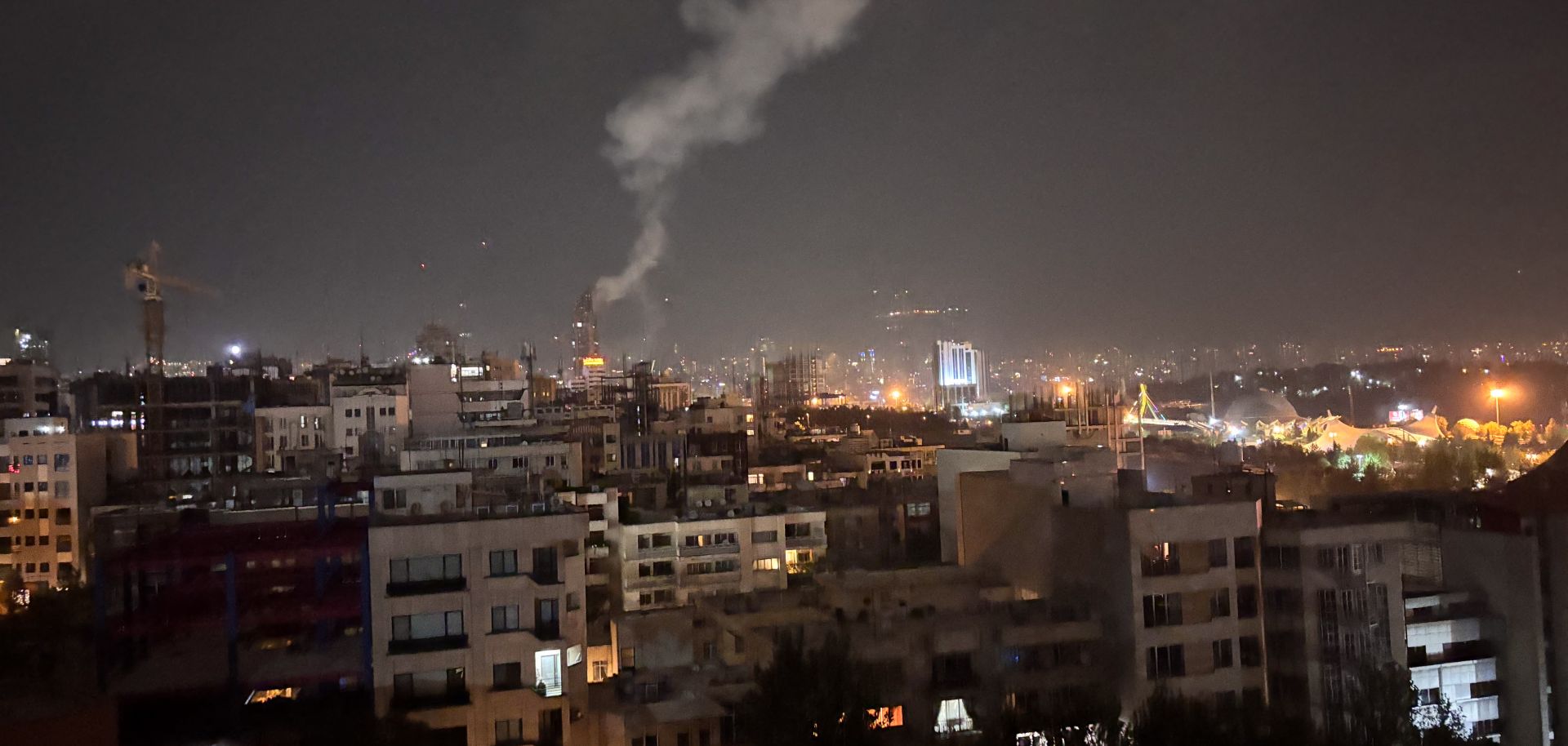
Smoke rises from a location allegedly targeted in Israel's wave of strikes June 13, 2025, in Tehran, Iran.
Israel and Iran are increasingly likely to expand the scope of their attacks to include targets like each other's political leadership, energy infrastructure and other sensitive targets that would open the door to a wider regional war. On June 13, Iran responded after Israel's initial attacks on Iranian nuclear and military targets with two major barrages of ballistic missiles against Israel, including one that resulted in direct impacts in Tel Aviv. Earlier, Israeli attacks struck Iran's key nuclear sites of Fordow and Isfahan, two locations not reportedly part of the initial attacks.
- The initial Israeli attack targeted 100 sites throughout Iran and killed several of Iran's top military leaders, including commander-in-chief of the Islamic Revolutionary Guard Corps Hossein Salami; head of the Islamic Revolutionary Guard Corp's Quds Force Gen. Esmail Qaani; and Major Gen. Mohammad Bagheri, the chief of staff of the armed forces, in addition to six scientists affiliated with Iran's nuclear program. Iranian Supreme Leader Ayatollah Khamenei wrote on X that Israel had committed a "reckless act" and vowed revenge. Iran responded with a barrage of 100 drones, but they were intercepted by Israeli air defenses.
- The Iranian army claims that its air defenses shot down at least two Israeli fighter jets and Iran captured an Israeli pilot who reportedly ejected from the plane, but these reports are currently unconfirmed.
- The strike in Tel Aviv reportedly targeted the Israel Defense Force headquarters. Up to 35 were reported injured and several civilian buildings in the area were also damaged.
The sophistication and scope of Israel's initial attacks indicate that Israel significantly infiltrated Iran many months ahead of the attack, but the degree to which Israel's operations were closely coordinated with the United States remains unclear. For years, Israel has demonstrated a strong ability to operate covertly inside Iran, gathering vast amounts of intelligence and carrying out a string of assassinations, sabotage and other attacks designed to be at least somewhat deniable compared to direct and highly public aerial strikes on Iran. In 2024, Israel broke through the latter threshold with two rounds of direct strikes against Iran, in April and October, the latter of which decimated Iranian air defenses. Meanwhile, the July 2024 assassination of Hamas Political Bureau leader Ismail Haniyeh in Tehran in a covert attack, in which Israel planted a bomb in the room in which he was staying, confirmed Israel's capacity to carry out highly complex attacks against high-profile targets in Iran. Israel appears to have used this window of opportunity and potential proof of concept to plan — or make significant progress in existing plans — for aerial strikes against Iran, in tandem with covert operations, to attack targets it had previously refrained from targeting. According to media reports about the first Israeli attacks June 13, among other things, Israeli operatives and Iranian assets were able to deploy armed drones within Iran to coincide with the airstrikes, and to carry out a number of other expansive attacks designed to support the unprecedented aerial display of force. These efforts reportedly included operations to damage Iran's remaining air defense infrastructure and undermine its capacity to respond by eliminating senior military leaders, some of whom may have been assassinated using similar tactics in the attack against Haniyeh, and crippling Iran's command-and-control apparatus. These efforts illustrate the degree to which Israel had prepared for the attacks, but it remains an open question how much Israel explicitly coordinated with the United States. Some media outlets, citing Israeli sources, claim that the U.S. effort to negotiate with Iran was a deliberate smokescreen to lull Iran into a false sense of security; for his part, U.S. President Donald Trump has claimed that he was fully aware of Israel's operations. While it is too early to tell how accurate these and related claims are, at a minimum, it is clear that the United States was aware well in advance. Even if it did not give an explicit green light, it also did not significantly restrain Israel.
- According to Axios, Israeli commandos and a special unit of Iranian assets were pre-positioned in Iran to assist in the attacks. Among other things, long before the attacks, they smuggled in armed drones and other weapons systems that they then deployed to destroy Iranian air defense targets and ballistic missiles, thereby helping to facilitate the Israeli strikes and hamper Iran's counterattack.
- Axios also reported, citing two unnamed Israeli officials, that Trump and other top U.S. officials have been publicly faking opposition to an Israeli operation as part of a coordinated strategy to deceive Tehran into thinking that an attack was not imminent. U.S. officials have not commented on this and have been at pains to say that the United States was not operationally involved in Israel's strikes, but Trump did publicly confirm that he was well aware in advance and claimed in an interview to Reuters that we "knew everything."
Israel will likely expand beyond continuing to degrade Iran's nuclear and military capabilities to increasingly attack nonmilitary political leaders, civilian infrastructure and other targets designed to impose not merely military but also economic and political harm, opening the door to a still less likely scenario that expands the war to the region. At a minimum, Iran and Israel are all but certain to continue to conduct attacks over the next several days, but are increasingly likely to expand the scope of the targets in an increasingly escalatory fashion. Due to Iran's strike on Tel Aviv, and especially if there are additional Iranian attacks that result in mass Israeli casualties, Israel is more likely to expand its target set to include both military and nuclear targets in civilian areas and potentially civilian infrastructure like power plants, ports or other targets that might impose economic pain on Iran — such as the Abadan refinery and Kharg Island oil export terminal — vital to Iran's oil-dependent economy. In addition, Israel will very likely continue to strike Iranian nuclear targets and assassinate key scientists who are part of Iran's nuclear program to further delay Iran's development of a nuclear weapon, and will be increasingly likely to expand assassination attempts on Iran's political leadership. Though Israel's layered air defenses, in addition to defense support from key allies such as the United States and France, will continue to intercept most Iranian missiles and thus embolden Israel to continue its campaign, it remains likely that certain ballistic missiles will still overwhelm these defenses and hit both military and civilian targets. Regionally, Iran is still unlikely to target U.S. military assets to avoid pulling the United States into the conflict, a development that would put the already conventionally disadvantaged Iranian military in a crisis. Additionally, Iran is also unlikely to strike Gulf Cooperation Council countries in the near term, seeing them as key diplomatic and economic lifelines to prevent isolation and maintain trade, particularly in the eventual aftermath of conflict. As the crisis continues and expands, the risk will rise that there is a development that either by design or accident potentially pulls in the United States and/or Gulf countries. For instance, while U.S. defense support for Israel is unlikely to provoke Iran to target U.S. military assets in the region, if the United States offensively attacks Iran, Iran may become more likely to leverage some of its proxies to attack U.S. regional targets. It is also possible that, especially given Trump's public comments that he has long been aware of the Israeli operation (regardless of veracity), fresh accusations of U.S. support for offensive Israeli operations (such as help with intelligence or midair refueling) would lower the bar for Iranian proxies to attack U.S. regional assets. Finally, while still very unlikely, if Gulf Arab countries allow U.S. military operations against Iran to be conducted from in-country military bases or if Gulf Arab countries permit Israel to use their airspace to conduct attacks against Iran, Iran and its regional allies and proxies will become increasingly likely to target Gulf oil and gas infrastructure.
- Though Trump called the attacks "excellent" and claimed to have known about them in advance, he also said that Iran had a chance to return to nuclear diplomacy and cut a deal, suggesting his continued disinterest in involving the U.S. in a direct war with Iran after campaigning on a platform of anti-interventionism.
