
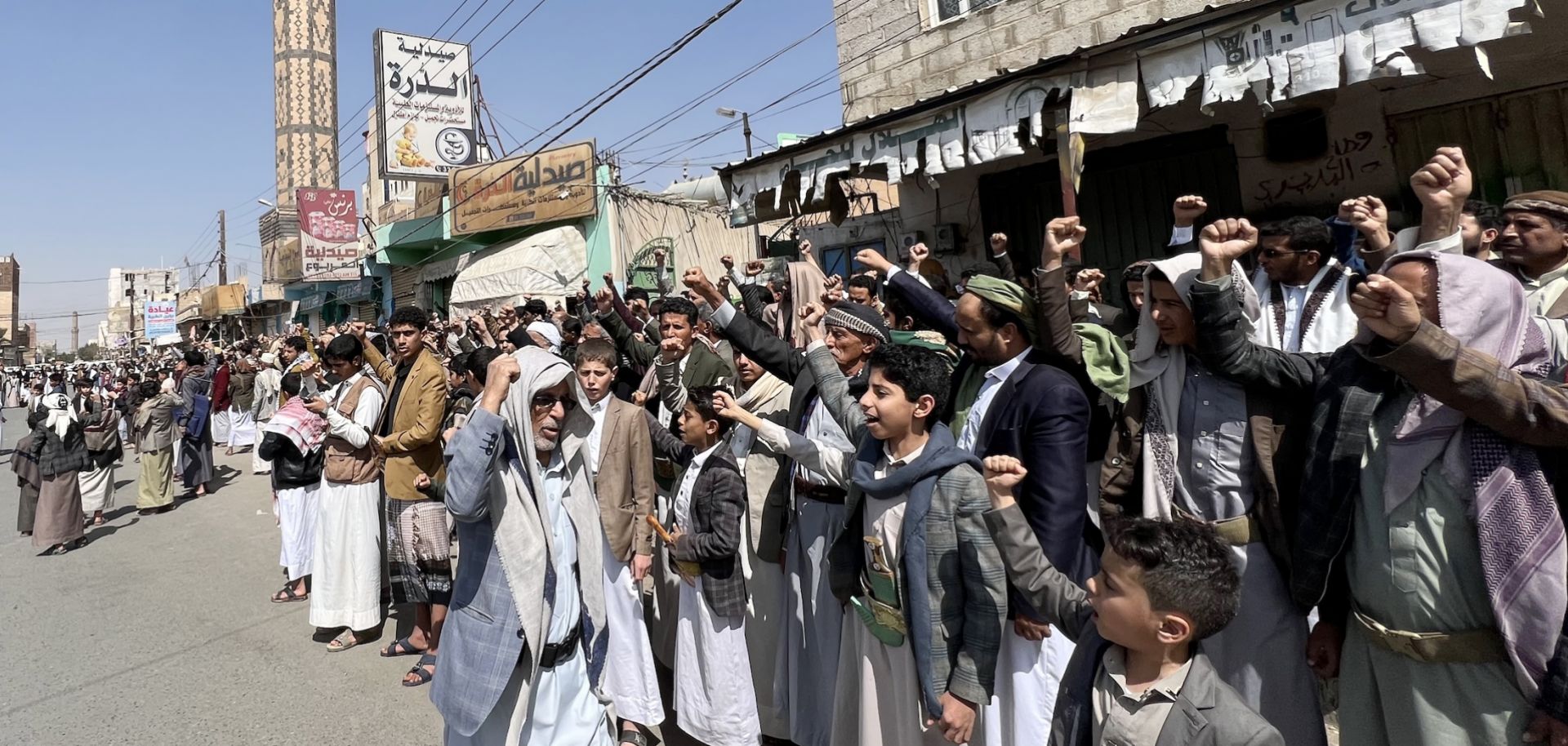
The U.S. military campaign against the Houthis will likely expand to additional locations in Yemen. But should the United States also attack Iranian ships and advisers supporting the Yemeni rebel group, Houthi and Iranian retaliation would become likelier to extend beyond U.S. and Israeli targets to include regional oil and gas installations. On March 15, the U.S. military conducted large-scale strikes against Houthi targets in Yemen, resulting in at least 53 fatalities, reportedly including some Houthi leaders. The strikes represented one of the most extensive U.S. operations against the Houthis since the start of the Hamas-Israel war in October 2023 and the first strikes against the group since U.S. President Donald Trump's Jan. 20 inauguration. In response to the attack, the Houthis launched 11 drones toward the U.S.S. Harry S Truman, all of which the U.S. military intercepted, and a ballistic missile, which did not land near the U.S. aircraft carrier. The strikes came days after a Houthi spokesperson said the group would resume its blockade of Israeli-linked ships through the Red Sea in solidarity with Palestinians in the Gaza Strip. The same day as the U.S. strikes, Trump wrote in a Truth Social post that if Houthi attacks do not immediately end "HELL WILL RAIN DOWN UPON YOU LIKE NOTHING YOU HAVE EVER SEEN BEFORE!" In the same post, Trump also vowed to hold Iran accountable if it does not immediately halt support for its ally. According to U.S. officials, the military campaign against the Houthis is expected to last several weeks. U.S. Secretary of Defense Pete Hegseth said that U.S. strikes would stop if Houthi attacks ceased, otherwise, the U.S. campaign would be "unrelenting." Later, on March 17, the Houthi's foreign minister, Jamal Amer said, "Now we see that Yemen is at war with the U.S. and that means that we have a right to defend ourselves with all possible means, so escalation is likely."
- On March 16, Islamic Revolutionary Guards Corps commander Hossein Salami said on Iranian state media that the Houthis "[make] its decisions independently" and distanced Iran from the Houthi attacks.
- In a March 16 televised speech, Houthi leader Abdul-Malik al-Houthi said, "We will confront escalation with escalation." Although al-Houthi suggested that U.S. military targets — including aircraft carriers and warships — in the region would be primary targets, the Houthis hinted at other unnamed escalation options.
The Trump administration has indicated it will take a hawkish approach against the Houthis to restore maritime shipping traffic amid a recent uptick in Houthi threats following a relatively calm period. The Trump administration seeks to restore Red Sea maritime shipping routes, and has criticized the Biden administration's response as "weak." Just days after Trump's inauguration, the White House on Jan. 22 redesignated the Houthis as a foreign terrorist organization, which took effect March 4, to pressure the Houthis further to stop conducting attacks. The designation is a step further than the Biden administration's designation of the group as a specially designated global terrorist in January 2024, and seeks to isolate the group further financially and diplomatically. Despite these steps, before the recent tit-for-tat strikes, aggressive Houthi moves remained relatively limited during the initial weeks of the Trump administration following the Jan. 19 implementation of the Hamas-Israel ceasefire. In response, the Houthis halted attacks against Israeli territory and Red Sea-area commercial shipping, much of which remains diverted after more than a year of Houthi attacks. The March 2 Israeli blockade of humanitarian aid into the Gaza Strip prompted the Houthis on March 7 to issue an ultimatum giving Israel four days to resume humanitarian aid or the Houthis would resume attacks. After the deadline passed and Israel did not restore aid inflows to the strip, a Houthi spokesperson announced March 11 that Israeli vessels, likely including those with Israeli links, were targets, though no attacks on commercial shipping have since occurred.
- Since January 2024, the U.S. military has conducted a series of attacks against Houthi targets as part of Operation Poseidon Archer, which is jointly led by the United Kingdom, to disrupt Houthi abilities to conduct maritime attacks and attacks against Israeli territory. Most of these attacks targeted Houthi launch sites and weapons stockpiles, though the extent to which these strikes have degraded Houthi capabilities is unclear.
- According to Armed Conflict Location and Event Data, a conflict monitoring organization, Houthi attacks have been decreasing since June and July 2024. Instead of maritime targets, its attacks have focused more on targeting Israeli territory. The decreasing number of attacks may be due to diminished attack capabilities after U.S., U.K. and Israeli strikes and/or fewer maritime targets in the nearby waters due to commercial diversions due to the risk of Houthi attacks and increased shipping insurance premiums.
An expanded U.S. military campaign will likely target additional locations in Yemen and supply routes to degrade Houthi attacks, pushing the Houthis to retaliate against both Israel and U.S. naval assets in the Red Sea in the near term. Rhetoric from top U.S. officials and the extensive March 15 attacks on Houthi targets indicate that the second Trump administration will conduct a more aggressive and escalatory campaign against the Houthis to degrade capabilities and destabilize its domestic position in Yemen. Although U.S. strikes have previously largely focused on Houthi launch sites, the U.S. military will likely take additional measures to degrade Houthi capabilities by expanding their geographic target range and increasing efforts to disrupt Houthi supply lines through the port of al-Hudaydah and overland routes through Oman. In addition, the United States could increasingly target Houthi leadership to weaken the group's political structure while also hitting conventional military targets, like barracks outside of the contested city of Taiz, to weaken the Houthis' against the internationally recognized Yemeni government and Southern Transitional Council. In response to these attacks, the Houthis will retaliate against U.S. naval targets in and around the Red Sea, similar to their response to the March 15 attacks. In addition to the Houthi campaign against Israeli vessels, the Houthis will likely attack Israeli territory, especially since Israel conducted a large-scale airstrike campaign throughout the Gaza Strip on March 18 that reportedly killed more than 400 Palestinians, but also if Israel conducts another round of airstrikes against the Houthis.
An extended U.S. campaign will increase the likelihood that the United States will target Iranian vessels and advisers to undermine Iranian support for the Houthis further and weaken Iran's remaining regional allies, though this risks catalyzing Iran and Houthi regional retaliation against Gulf Arab and U.S. targets. Although in the near term, the U.S. military campaign will likely focus on the Houthis directly, a prolonged campaign will likely result in the United States targeting Houthi supply lines and support from its key backer, Iran. With the United States blaming Iran for Houthi actions, the longer the U.S. military campaign lasts, the more likely the United States will be to take action against Iranian targets, such as Iranian vessels suspected to be part of smuggling operations to supply the Houthis with weapons, Iranian intelligence support vessels or Iranian advisers in Yemen. U.S. attacks against Iranian assets would further heighten tensions and further hinder any nuclear negotiation efforts between the two countries. Although tensions between Iran and Gulf Arab countries have been decreasing following normalization efforts between Iran and Saudi Arabia and Iran and the United Arab Emirates, and Gulf Arab countries have reaffirmed their neutrality in the Iran-Israel conflict, more expansive U.S. attacks that strike Iranian targets in Yemen would raise the likelihood of reigniting Iranian and its allies' threats to target oil and gas infrastructure in the region. Furthermore, Iran and the Houthis could accuse U.S. regional allies such as the United Arab Emirates, Qatar or Saudi Arabia of complicity in a U.S. military campaign since they host U.S. troops. Even if the countries do not directly provide material or logistic support, if they are perceived as aiding the United States, the Houthis could expand their attacks to include targeting oil and gas infrastructure in these or other Gulf countries. This broader regional escalation would increase the likelihood of a regional war, although Gulf Arab countries could de-escalate if damage to infrastructure proved limited.
- In 2022, the Houthis conducted a drone and missile attack against three oil tankers and an airport under construction in Abu Dhabi, resulting in three civilian fatalities. The attack followed Houthis' territorial losses in the Yemeni civil war to the Giants Brigade, a group backed by the United Arab Emirates.
- In September 2019, a drone attack against oil facilities at Abqaiq and Khurais temporarily disrupted oil production, though within weeks production returned to full capacity. The Houthis claimed responsibility for the attack, though Saudi Arabia and the United States blamed Iran for it.
- In addition to the threat the Houthis pose against commercial shipping, emboldened Houthis also risk conducting attacks against regional energy targets. If the Houthis disrupt supplies, oil and gas prices could increase. In such a case, the U.S. imperative to further degrade the Houthis' capabilities would increase.
- U.S. national security adviser Mike Waltz on March 16 said that the March 15 strikes against the Houthis were also a signal to Iran, adding that U.S. military action against Iranian assets in Yemen could be part of the U.S. military campaign against the Houthis. He reiterated Trump's threat to hold Iran accountable and said, "It is Iran that has repeatedly funded, resourced, trained and helped the Houthis target not only U.S. warships, but global commerce, and has helped the Houthis shut down two of the world's most strategic sea lanes."
