
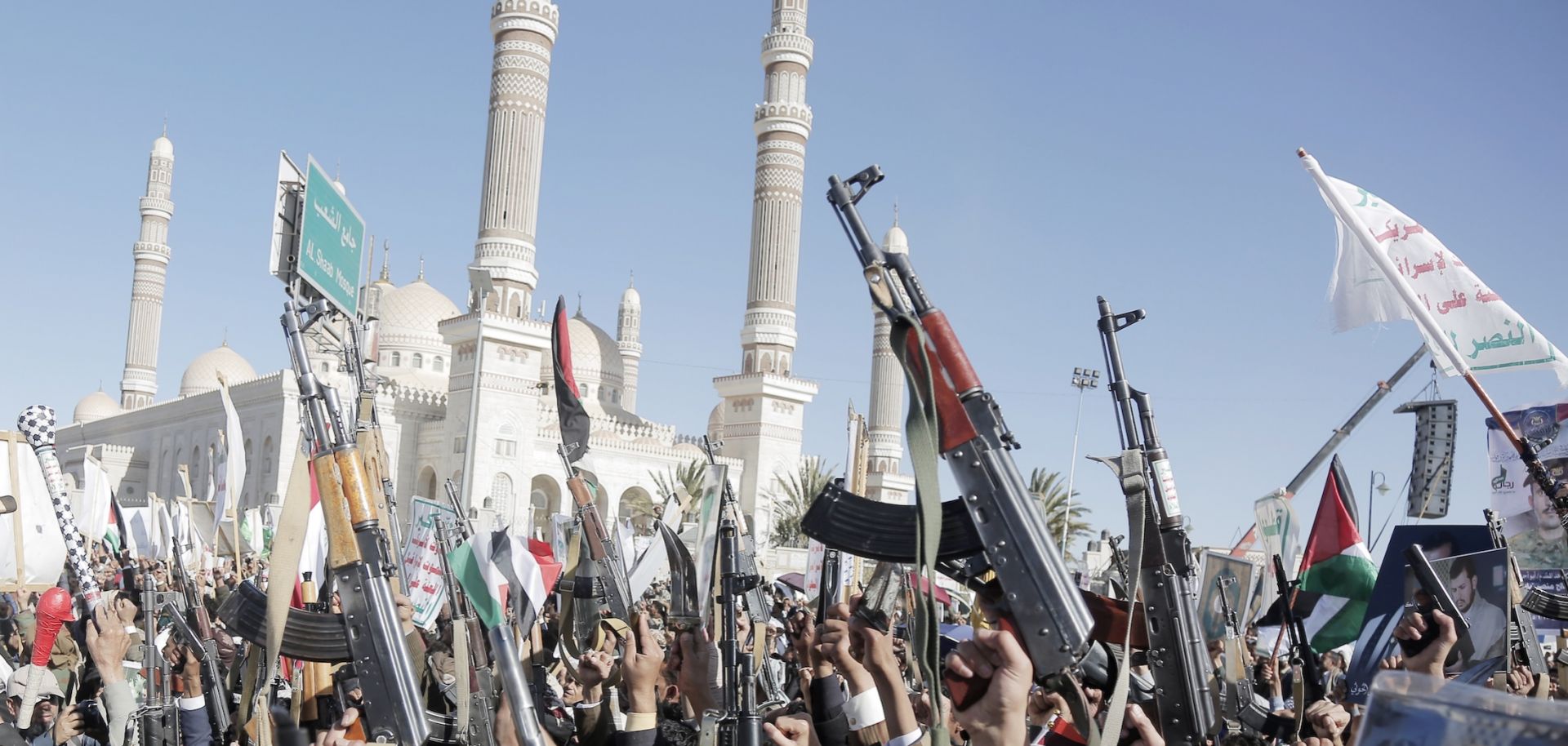
The Houthis' intervention in the Israel-Hamas war strengthened their military capabilities and bolstered their power and political influence in the north of Yemen, which could set the stage for renewed offensives in the south that may force major concessions from — or even the collapse of — the Yemeni government, creating opportunities for extremists and destabilizing the region. Since the Houthis intervened in the Israel-Hamas war in November 2023 by attacking Red Sea shipping and launching missiles and drones toward Israel, various media sources have reported that thousands of new recruits have joined the movement from across Yemen. U.N. experts evaluating the effectiveness of international sanctions on the group estimated in fall 2024 that it has up to 350,000 fighters, an increase from 220,000 in 2022, due to increased consolidation of power in the north and a recruitment boost caused by their intervention in the Gaza war. The Houthis have also demonstrated new drone and missile capabilities likely supplied by Iran, including the Hatem-2 missile, a previously unseen system in Yemen. Along the Houthi front lines with the internationally recognized government of the Yemeni remnant, there have been comparatively few skirmishes and no major offenses by either side since the intervention against Israel began. Meanwhile, the Houthis have also skirmished with the United States in the Red Sea and attacked civilian targets. The group has also endured a recurrent U.S. and U.K. bombing campaign against its launch and storage capabilities in Yemen, and being redesignated as a Foreign Terror Organization (FTO) by the United States.
- The Houthis control northern Yemen through a combination of direct force and an alliance with an array of local actors, like the former rulers, the General People's Congress (GPC), and local tribes. But since the Gaza war broke out in October 2023, these groups have rallied to the Houthis' anti-Israel cause, weakening internal divides.
- The Houthis ideological orientation is anti-Israeli and anti-American, with their flag and movement slogan including ''Death to Israel, Death to America,'' in a direct call to action against the two countries. This viewpoint is popular in Yemen on both sides of the civil war line, where Arab nationalism and Islamism combine to fuel political parties in the north and south. Many Yemenis also blame the United States for the Saudi-led military intervention in the country that began in 2016.
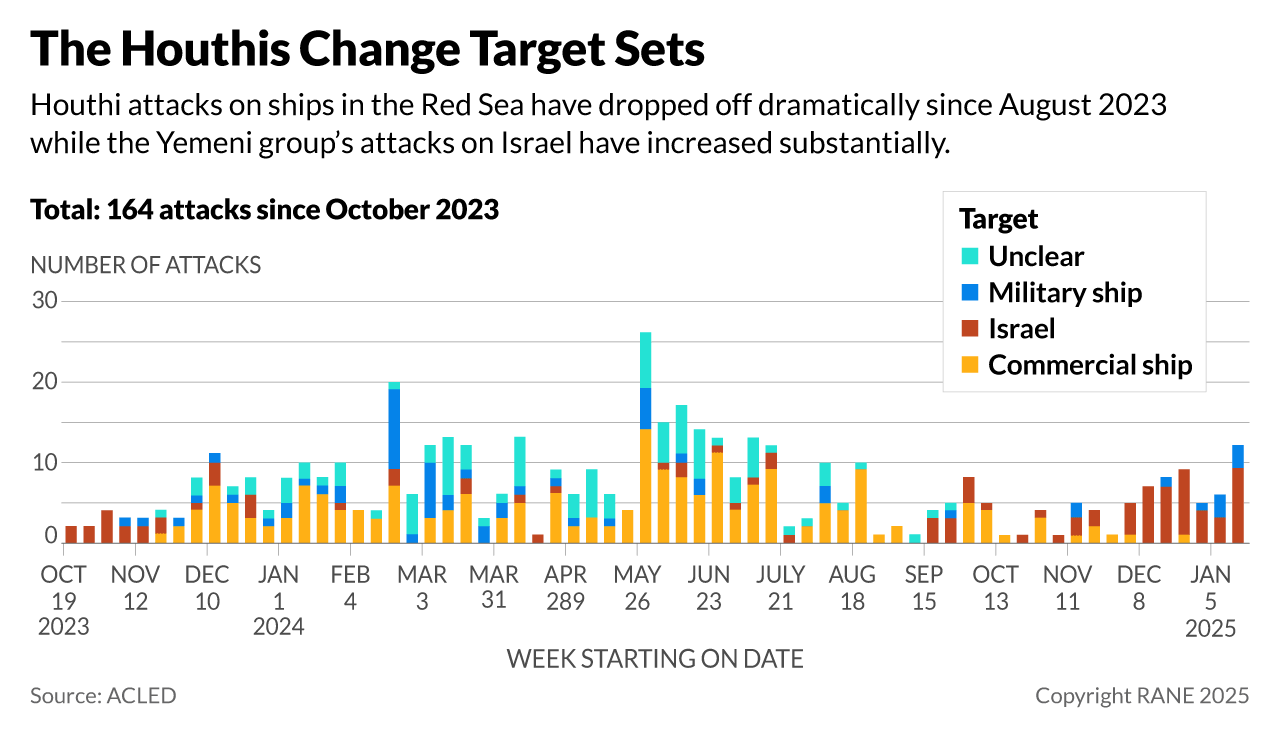
- Since the Gaza war began in October 2023, the Houthis have conducted at least 136 attacks in the Red Sea, according to ACLED data, though they have had comparatively fewer successful strikes on ships, and no damaging ones so far on Western warships. U.S. and U.K. airstrikes have hit the group's arsenal in Yemen multiple times, but it is so far unclear whether these strikes have significantly impacted the Houthi stockpile, which includes Iranian ballistic and anti-ship missiles like the Asif anti-ship missile, the Burkan missile line and various drones.
- Israeli airstrikes on the Houthis have likely fueled more pro-Houthi sentiment in the country, especially as some strikes have targeted key civilian infrastructure like power plants. At the same time, the strikes have deepened the narrative that the Houthis are fighting the country's regional rival, boosting the movement's popularity.
- The Houthis also announced a pause in strikes after the Jan. 2024 ceasefire went into effect between Hamas and Israel, but have threatened to resume attacks should that ceasefire, which faces serious constraints to creating a permanent peace, collapse.
As the Houthis continue to benefit from confrontation with Israel and the West both politically and in terms of Iranian military support, they are likely to focus on their Red Sea campaign and intermittent strikes on Israel, justified by Israel's continued presence in the Gaza Strip. Although the Houthis have pledged to respect the ongoing Gaza ceasefire, violations are likely as Hamas will eventually run low on hostages to trade, while Israel is unlikely to fully exit the Gaza Strip in the near term. This situation will provide the Houthis with continued political justification for intermittent strikes on Israel, which will provoke Israeli counter-strikes on Yemen itself. This dynamic will continue to help the Houthis recruit new fighters into their movement, propelled by overwhelming anti-Israel sentiment among ordinary Yemenis. In addition, due to geographic and military constraints, Israel will be unable to inflict significant military damage on the Houthis as it did on Hezbollah and Hamas, preventing any substantial deterioration of the Houthis' military position in Yemen. Iran is also likely to continue its support for the Houthi movement during this confrontation as it seeks to offset setbacks to its other proxies and allies in Gaza, Lebanon and Syria, potentially deepening military cooperation with the Houthis and providing them with more advanced systems and training. Meanwhile, the Houthis will also carry out intermittent attacks within the Red Sea designed to boost recruitment in Yemen, as the group maintains its anti-Western military confrontation.
- Houthi weapons are stored across the country in underground and camouflaged sites, as well as in villages and civilian buildings, making them more difficult for the United States, the United Kingdom and Israel to destroy. This is further complicated by the lack of significant allied forces on the ground to scout targets, with the anti-Houthi coalition reliant on satellites, local proxies and covert scouts that slow the targeting pace.
Emboldened by their steadily growing battlefield advantage over the Yemeni government, the Houthis may resume attacks around Marib and other key locations on the frontline, raising the likelihood of significant territorial advances and political fragmentation in southern Yemen. Once the Houthis gain enough significant military strength and organize their fighters into military units able to launch large campaigns, they may again consider offensives into the south in an attempt to bolster their leverage in ongoing ceasefire negotiations with Yemen's main ally, Saudi Arabia, and to further consolidate Houthi control over territories claimed in the north. This could lead to escalated offensives against key cities like Taiz and Marib or other locations along the front line, designed to seize territory and potentially critical energy infrastructure. Given Saudi Arabia's overarching interest in disengaging from the civil war in Yemen, it is unclear whether the kingdom or its partners — namely the United Arab Emirates and the United States — would be willing to intervene militarily to halt these Houthi offensives as they did against Marib in 2021. Without coalition air support and with significantly more Houthi fighters on the ground, such offensives would be more likely to produce a breakthrough along the front line for the first time in many years. In addition, the Houthis may have politically benefited from their confrontation during the Gaza war, in which the internationally recognized government of Yemen has remained neutral, potentially significantly increasing their influence on southern institutions, cities, tribes and politicians, casting doubt on the unity of the Yemeni-led south.
- Marib is particularly important as one of the provinces in Yemen with oil and reserve reserves, which made it the subject of a 2021 Houthi offensive that eventually stalled in the face of heavy Saudi air support for the Yemeni government.
- Saudi Arabia has tried to exit the conflict through negotiations with the Houthis, which have been stalled into a frozen ceasefire since 2022. Recurrent Houthi and Iranian attacks on Saudi soil, combined with the failure to roll back the Houthis in Yemen, prompted Riyadh to adjust its foreign policy toward a more pragmatic regional approach after the COVID-19 pandemic. Saudi Arabia is thus eager to avoid inviting more Houthi missile strikes, especially those targeting its crucial oil industry and its capital.
- The United Arab Emirates is also reluctant to involve itself in the Yemeni campaign beyond logistical, monetary and arms support of its southern proxies — especially after the Houthis in 2022 attacked the capital Abu Dhabi, the first major foreign attack on the country.
A breakthrough on the front line would grant the Houthis significant leverage in negotiations with the recognized Yemeni government and the Saudis, potentially forcing significant concessions from the government or even leading to the collapse of much of the anti-Houthi coalition in the country. Should a Houthi offensive capture a city like Marib or Taiz, it would incentivize the Yemeni government to offer concessions to the Houthis, such as autonomy, control of government institutions, prisoner exchanges, and/or payouts through the country's central bank. However, these concessions may not persuade the Houthis to end their offensives if they believe they have military momentum and if the United States, the United Kingdom and Israel do not intervene beyond strikes to deter attacks on commercial shipping in the Red Sea. This suggests that even with opportunities for power sharing, the Houthis might attempt to push further south. If the Yemeni government's forces quickly collapse at Marib, Taiz or elsewhere, the fragile unity among the government's factions, particularly the Southern Transitional Council, could unravel, and the government might become defunct as these groups carve up the country with the Houthis. This might lead to a deep and lasting split between Yemen's north and south, with the south racing to secure independence from the Houthi-led north. However, should their advance be successful enough, the Houthis could continue to march southward as infighting consumes the remnants of the Yemeni government. In this more extreme case, the Houthis would likely take control of major cities like Aden, becoming the de facto rulers of most of Yemen. But the Houthis would be unlikely to be able to control the whole country because of logistical and demographic constraints, allowing groups like al Qaeda and the Islamic State to operate more freely in Yemen — particularly in the country's relatively lawless interior — as anti-terror campaigns are disrupted.
- The Houthis took control of Aden in 2015 but were driven out by government forces later that year, in part because the movement was smaller and its logistics were overstretched during that time.
- The Southern Transitional Council, or STC, and the Yemeni government have fought openly before, in part because the STC sees the Yemeni government as an obstacle to their ultimate objective of rebuilding southern Yemen, which was abolished in 1990 when its Soviet sponsors collapsed. The STC and Yemeni government are held together in part by Saudi and Emirati mediation and support, but the Yemeni government is widely considered illegitimate across the south, suggesting it could collapse quickly under military pressure.
