
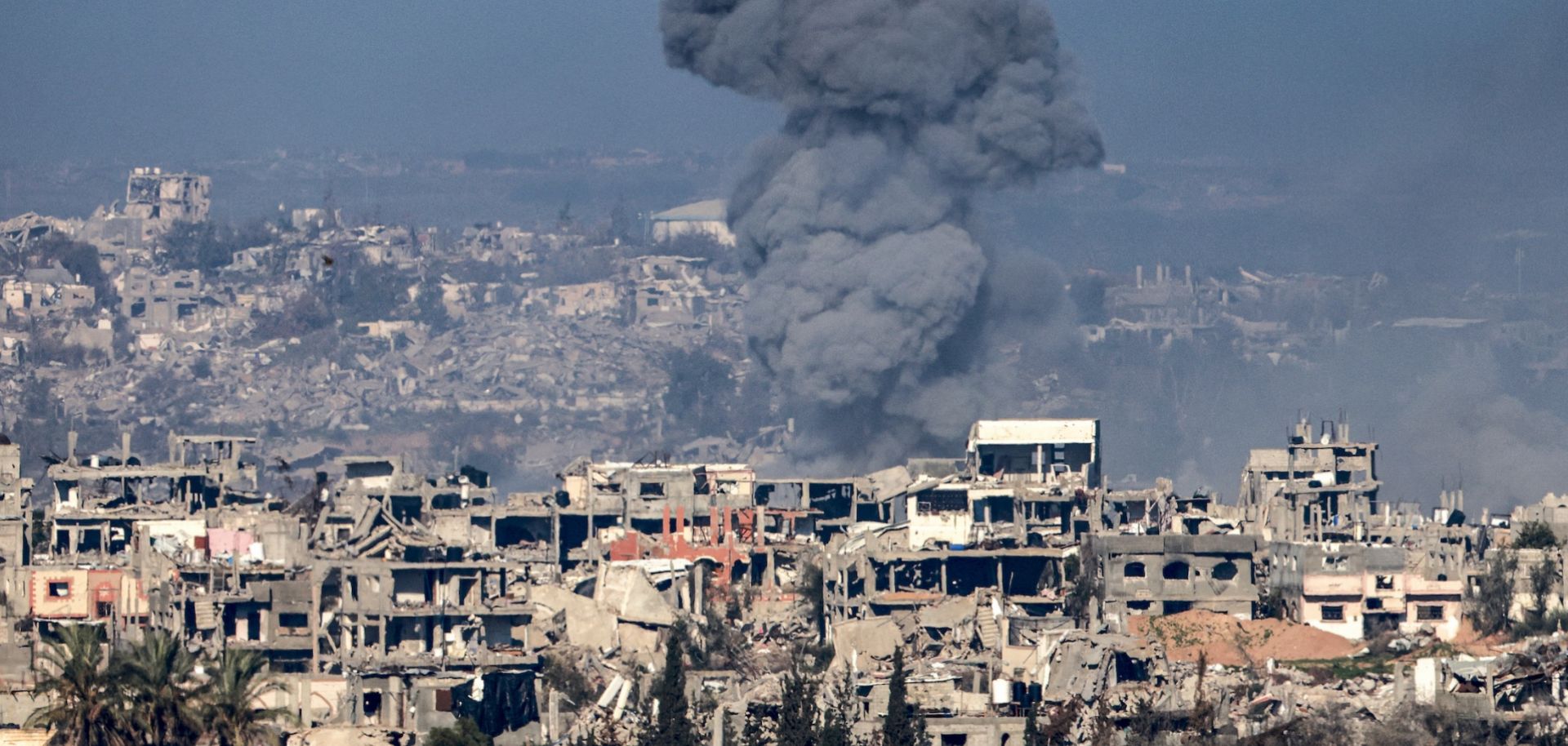
Israel's ceasefire with Hamas will ease tensions with Lebanon and Egypt and decrease attacks by Yemeni Houthis, but it is unlikely to advance normalization with Saudi Arabia, while likely eventual violations of the deal will reignite regional tensions. On Jan. 15, Israel and Hamas agreed to a ceasefire that aimed to end 15 months of war in the Gaza Strip. The truce, which aims to eventually see Israel withdraw from Gaza and enable the territory to self-govern, was welcomed internationally, particularly by countries and militants that had been fighting in solidarity with Hamas. Israel's truce with the Lebanese group Hezbollah, due to expire on Jan. 26, will likely now be extended, as the Hamas-Israel ceasefire will weaken Hezbollah's rationale for intervening in the Gaza conflict. Houthi militants in Yemen, meanwhile, vowed to monitor the Gaza ceasefire and strike Israel in case of violations, but the Houthis did not commit to maintaining the current pace of their anti-Israel campaign that began in November 2023 in solidarity with Hamas so long as the ceasefire persists. Iranian leaders also voiced support for the truce and made no mention of their promise to strike Israel in retaliation for its October 2024 airstrikes on Iran. Neighboring countries with diplomatic ties with Israel, like Egypt and Jordan, welcomed the agreement as well, after having struggled to contain growing anti-Israel sentiment among their Arab populations over the past year.
- Domestic war-weariness — combined with mounting pressure from the United States, with both President Joe Biden and President-elect Donald Trump calling for a truce in Gaza in recent days — drove Israel to finally reach a ceasefire with Hamas. Hamas, for its part — isolated and weakened amid Gaza's humanitarian crisis and reduced regional support — also faced pressure from Qatar and Egypt to end the conflict.
With a Gaza ceasefire in place, Israel will shift focus to the West Bank to counter Palestinian militancy and further expand settlements, which will raise the risk of a Palestinian uprising, potentially triggering a refugee influx into Jordan that could destabilize the country. After confronting the Hamas threat in Gaza, Israeli Prime Minister Benjamin Netanyahu will now seek to appease the far-right members of his coalition government by planning annexations and settlements in the other Palestinian territory: the West Bank. This will involve increasing military raids against Palestinian militant groups and engaging with the Trump administration on a deal to allow Israel to maintain control over the West Bank. Such actions will likely heighten levels of violence in the West Bank, especially as Hamas' popularity has grown there since the Gaza war broke out in October 2023, and as Iran continues its efforts to supply arms to Palestinians through Jordan. If growing Israeli aggression eventually triggers a Palestinian uprising, the consequent turmoil could send a surge of West Bank refugees into neighboring Jordan. This would risk straining Israel's diplomatic and security relations with the Arab nation. It would also risk destabilizing Jordan's security and political climate, as the kingdom would likely impose stricter controls along its border with the West Bank to manage potential migrant inflows, which could anger Jordanian citizens who share strong familial, cultural, and political ties with Palestinians. If this anger prompts pro-Palestine supporters and Islamists in Jordan to take to the streets, the resulting unrest and political instability could create an opening for Iran to deepen its influence in the country and further facilitate arms transfers to the West Bank through Jordan.
- Violence in the West Bank has already increased in recent weeks, with the Israel Defense Forces, or IDF, expanding their raids and airstrikes on Palestinian militants in the territory. With Hamas degraded in Gaza and gaining popularity in the West Bank, Palestinian militants will likely remain active in the West Bank for the foreseeable future, portending more IDF raids to counter any insurgency there.
- On Jan. 16, Trump's nominee for Secretary of State, Senator Marco Rubio, said the incoming administration would reverse Biden-era sanctions on violent Israeli individual settlers and entities in the West Bank as part of its commitment to being ''the most pro-Israel administration in American history.''
- On Sept. 4, 2024, Jordanian Foreign Minister Ayman Safadi stated that any attempt by Israel to displace Palestinians in Jordan would be considered a declaration of war by Israel. Safadi referred to statements by Jordan's King Abdullah, who has consistently emphasized that the matter of forcing Palestinians from the occupied West Bank into Jordan is a ''red line.'' This statement highlights Jordan's worries about Israeli annexation in the West Bank and the escalation of violence there, which would send a wave of refugees to the kingdom.
The ceasefire in Gaza will likely initially defuse diplomatic and security tensions between Israel and Egypt, and will likely also pave the way for an extension of the Israel-Hezbollah truce that has recently eased fighting in Lebanon. The Hamas-Israel ceasefire will enable Palestinians displaced from northern Gaza to return home, which will in turn allow Egypt to avert a refugee crisis along its borders with Gaza and Israel. Cairo will also now be able to re-engage with the Israeli government on efforts to prevent border security incidents and the smuggling of arms into Gaza. This will somewhat improve the domestic situation in Egypt, where an ongoing economic reform path has undermined civilian living conditions. Egypt will thus pressure both Israel and Hamas to adhere to the terms of their new ceasefire, aiming to prevent violations that could reignite fighting in neighboring Gaza and potentially trigger a destabilizing refugee crisis along Egypt's northeastern borders. Additionally, the Hamas-Israel ceasefire bodes well for the continued de-escalation of the conflict in Lebanon. For one, Israel is now more likely to agree to extend its ceasefire with Hezbollah before its Jan. 26 expiration, as the easing of the Gaza conflict will give the IDF more time and resources to maintain a limited presence in Lebanon to dismantle remaining Hezbollah infrastructure and mitigate any potential threats in the country. This period will also enable Lebanon's military and government to progressively fulfill their responsibilities under the ceasefire, which include deploying Lebanese troops near the southern border with Israel, dismantling Hezbollah infrastructure in the country, and negotiating an Israeli withdrawal from Lebanon. With neither Israel nor Hezbollah seeking a full-scale war, the primary risk will be low-intensity skirmishes, particularly if Israel's withdrawal is delayed or if Lebanon's government struggles to enforce compliance, potentially provoking Hezbollah into action.
- The Israel-Hezbollah ceasefire formally took effect on Nov. 27. However, Israel has continued to periodically strike Lebanon, citing imminent threats from Hezbollah and the failure of the Lebanese army to address it. Meanwhile, Hezbollah fired two rockets toward Israel on Dec. 2, stating it was a warning to Israel over its repeated violations. Since then, the Lebanese group has refrained from responding to continuous Israeli strikes.
Despite the ceasefire, Saudi-Israeli normalization will likely remain frozen as Saudi Arabia pushes for a permanent solution to recurrent Israeli-Palestinian violence, limiting Israel's regional integration. Though Riyadh is open to the U.S. defense pact and nuclear deal that Washington has offered in exchange for formalizing ties with Israel, normalization has become too politically risky for the monarchy in the wake of Israel's devastating military campaign in Gaza, which has hardened anti-Israeli sentiment among Saudi citizens over the past year. Against this backdrop, Saudi Arabia will likely maintain its stance that it wants to see a Palestinian state before normalization — a nonstarter for Israel's current government. Covert Israeli-Saudi ties might resume following the Gaza ceasefire, though business-to-business contacts will likely be slow-moving, as Riyadh's prior strategy of gradually normalizing Israel to the Saudi public has become untenable after the Gaza war. The likely lack of progress on normalizing ties with Saudi Arabia will further impede Israel's regional integration — and with it, the Trump administration's aspirations to expand the Abraham Accords.
- Prior to the war, Saudi Arabia had only nominally supported a Palestinian state, with Crown Prince Mohammed bin Salman believing it could be dealt with after normalization with Israel. But after the Gaza war broke out, Riyadh switched to a diplomatic strategy of conditioning normalization with Israel on a ceasefire deal in Gaza and an agreement of an ''irreversible'' path to a two-state solution to the Israeli-Palestinian conflict.
While the Houthis have announced the halting of their attacks on Red Sea vessels, the Yemeni militants will resume these attacks if Israel and its Western allies ramp up the pressure on the group or if the Gaza ceasefire eventually erodes. Having demonstrated their capability to disrupt critical maritime shipping lanes essential for European and U.S. supply chains and free trade, as well as their ability to strike Israel while bypassing its air defenses, the Houthis will likely face escalating economic sanctions from Israel and its Western allies. Additionally, with U.S. and Israeli officials calling for proactive military actions against the Yemeni militant group, the U.S.- and U.K.-led coalition in the Red Sea could increase the pace, scope and frequency of attacks against the Houthis. Israel, having redirected airpower and resources to address the Houthi threat, would likely take part in such an intensified campaign, including by attempting targeted assassinations of Houthi leadership to diminish the group's willingness to engage in conflict, mirroring the tactics Israel used against Hezbollah and Hamas. In the short term, these measures are unlikely to deter the Houthis from retaliating and continuing to harass ships transiting the Red Sea. However, mounting Western and Israeli sanctions will continue to worsen economic conditions in Houthi-controlled areas of Yemen, which over time will likely foster domestic instability, providing opportunities for anti-Houthi factions in Yemen to exploit the situation and reignite the country's civil war. Such a scenario would heighten the risk of Houthi attacks on oil and civilian infrastructure in Saudi Arabia and the United Arab Emirates, both of whom would likely support anti-Houthi factions under the perception of Houthi vulnerability from Western and Israeli pressure, further exacerbating disruptions to global oil supplies and production.
- In recent months, Houthi attacks against commercial vessels in the Red Sea have decreased, but the group has increased its attacks against Israel and the U.S.- and U.K.-led maritime mission.
Breaking the terms of the ceasefire in the second and/or third phases of the agreement risks re-igniting the conflict between Hamas and Israel, and subsequently regional tensions. The first phase of the ceasefire will see an exchange of Palestinian prisoners and Israeli hostages, along with a retrenchment of Israeli troops around Gaza. The second phase will see the return of civilians to their homes in northern Gaza, as well as a significant withdrawal of Israeli forces from the Strip. And the third and final phase will see Hamas turn over the last remaining hostages, and Israel cede power in Gaza to a transitional authority. During the first phase, Israel will likely maintain low-intensity and periodic military operations in Gaza to prevent Hamas from reorganizing and threatening Israeli forces that remain in the Strip. These operations — which could involve limited and periodic air strikes, commando raids, or future ground operations — will risk triggering an escalation with Hamas. The second and third phases of the ceasefire will create more opportunities for Israel to significantly breach the deal and risk its collapse, as Israel will face domestic political pressure to maintain a long-term military presence in Gaza to prevent a future Oct. 7-like incursion. If either side violates the terms of the ceasefire — for example, if Israel resumes large-scale military operations and airstrikes in Gaza, or if Hamas restarts insurgency activities against Israeli troops still in the area — it could reignite full-scale hostilities. A renewed conflict in Gaza would reinforce the risk of Iran and Israel exchanging direct tit-for-tat attacks, as Iran would likely support Hamas again. It would also risk drawing in the U.S. military, both to defend Israel and strike Iran, given Trump's likely hawkish approach to Iran. Additionally, such a scenario would incentivize the remaining active groups of Iran's so-called Axis of Resistance, including Iraqi militias and Yemeni Houthis, to resume their attacks on Israel and other Gulf Arab countries.
- Israel has conditioned a full troop withdrawal from Gaza on Hamas having no role in the territory's future governance. But Israel has yet to formulate a strategy for finding an alternative governing solution for the Strip. The Palestinian Authority — which governs the West Bank — is the most likely candidate, but has conditioned its participation in a future Gazan government on resuming talks with Israel on a two-state solution, which the current Israeli government opposes.
