
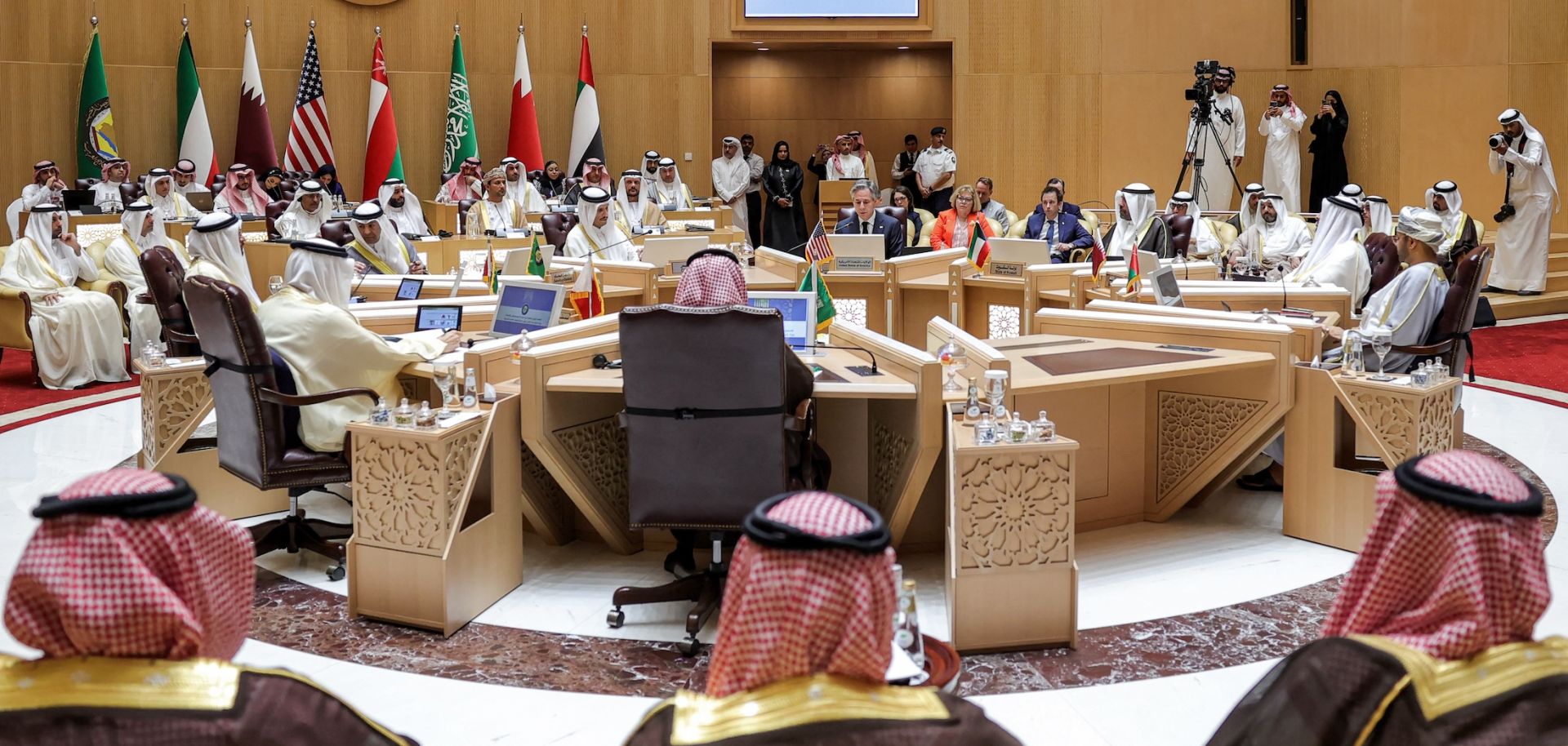
While full Saudi normalization with Israel remains contingent on a credible path to a Palestinian state, Riyadh will continue to advance diplomatic relations with Israel progressively and to deepen defense ties with the United States while maintaining its cautious outreach to Iran. Persistent regional security threats may, however, hinder the Saudi efforts, possibly even threatening its Vision 2030 economic diversification project. U.S. Secretary of State Antony Blinken on April 28 arrived in Saudi Arabia to participate in the World Economic Forum band to meet with Saudi officials including its foreign minister. Speaking on a WEF panel, Blinken said that while "a U.S.-Saudi security pact with Saudi Arabia was near completion," these agreements will need "calm in Gaza and a credible pathway to a Palestinian state." Since the onset of the Israel-Hamas war, Saudi Arabia has positioned itself in defense of the Palestinian people and their right to a state, and condemned Israel's actions in Gaza. As such, Saudi Arabia has placed any normalization agreement with Israel contingent on many security issues, but has made a credible and nonreversible path for a Palestinian state as one of its central demands. The Saudis simultaneously have continued to openly communicate with rival Iran as Riyadh seeks to avoid being targeted by Tehran even as it leaves open the possibility of diplomatic rapprochement with Israel and closer defense ties with Washington.
- During his visit to Saudi Arabia, Blinken also reiterated the U.S. proposal for an integrated air and missile defense system with the Gulf Cooperation Council states and increased maritime patrolling.
- In a balancing act, and to help avoid a wider war between Iran and Israel, the Saudis condemned Israel's April 1 strike on the Iranian Consulate in Damascus without directly naming Israel, and Riyadh reportedly shared intelligence with the United States on the April 13 Iranian missile and drone attack against Israel to limit its potential damage and avert a strong Israeli response.
Saudi Arabia has remained open to U.S.-led efforts to normalize relations with Israel as Riyadh seeks to acquire stronger U.S. security guarantees, along with expanded commercial, infrastructure and tourism ties with Israel. Previously, the United States had conditioned a possible defense pact with Saudi Arabia on normalization with Israel, a path that seemed more likely before the Hamas-Israel War began Oct. 7. But now, domestic and regional Arab pressure to distance itself from Israel has caused Riyadh to make normalizing ties contingent on serious progress toward the formation of a Palestinian state. Recent news reports indicate that Washington is prepared to enter a bilateral security deal with Riyadh given that the present Israeli government appears unprepared for serious moves to create a Palestinian state. For Riyadh, such a deal with Washington would offer significant gains, including stronger security guarantees, access to advanced weapons and support for a civilian nuclear program. But eventual normalization with Israel is, in theory, still desirable from Riyadh's perspective because it would also likely come with some Israeli arms sales to Saudi Arabia, and Riyadh has expressed interest in obtaining Israeli Iron Dome systems and Barak Extended Range Interceptors to intercept short-range and cruise missiles, respectively. Furthermore, improved Saudi-Israeli relations would likely increase tourism, artificial intelligence development and foreign investment in the Gulf country, thus supporting its Vision 2030 plan for economic development and diversification. The potential Israeli rapprochement comes after Saudi Arabia normalized relations with Iran in a China-brokered deal in March 2023 aimed at reducing the security threat posed by Iran and its proxies and expanding bilateral trade relations between the two countries. Persistent distrust between Riyadh and Tehran, however, has stalled progress between the two countries, and little tangible has emerged from the agreement. Nevertheless, Iran and Iranian proxies, including the Houthis, have refrained from targeting Saudi Arabia since the agreement took place, with Houthis maintaining the de facto cease-fire in Yemen since April 2022.
- Absent Netanyahu government support for any progress or pathway toward Palestinian statehood, Saudi-Israeli negotiations have largely stalled. Saudi Arabia has meanwhile reportedly suggested a defense pact with the United States that does not include Israel.
- The Biden administration has previously leveraged Saudi-Israeli normalization as a requirement for a U.S.-Saudi defense pact that would provide U.S. military and economic guarantees in addition to support for a Saudi civilian nuclear program. This would require significant buy-in from Congress and restrictions on a Saudi civilian nuclear program to quell U.S. and Israeli concerns regarding a potential Saudi nuclear weapons program.
- After Israel and the United Arab Emirates normalized relations as part of the Abraham Accords, the U.S.-sponsored agreements that enabled normalization between Israel and a number of Arab countries, the countries signed a free trade agreement to expand the volume of bilateral trade. Between 2021 and 2022, trade increased from $1.22 billion to $2.56 billion and the countries have a long-term goal of reaching $10 billion worth of trade. Furthermore, Israel and the United Arab Emirates have signed multiple cooperative agreements for mutual investment in manufacturing, innovation and technology sectors. If Saudi Arabia normalized relations with Israel, Riyadh would likely pursue a path for similar economic expansion of its non-oil sectors.
- More than a year after normalizing relations, Saudi Arabia and Iran have yet to sign any substantial agreement despite multiple meetings of their foreign, finance, and economic ministers. Saudi Arabia has conditioned increased trade and investment on Tehran exerting more control over its regional proxies.
The Saudis will likely aim to join an informal defensive pact that includes Israel, but are unlikely to join a full-fledged normalization pact with Israel without an end to the Gaza War, substantial progress toward a Palestinian state and a de-escalation in regional tensions. For the past few years, Saudi Arabia has struggled to defend itself against attacks from Iran and its proxies, prompting it to demand more advanced weapons systems from the United States, something it has made a condition for any potential normalization deal with Israel. After witnessing the coalition — which included the United States, France, Jordan and the United Kingdom — that defended Israel from Iran's April 13 attack by shooting down a large portion of the drones and missiles, the Saudis will likely want to become part of a similar coalition that would help it defend Saudi territory in the event of an attack from Iran, its allies or anyone else. Despite this, the Saudis will try to avoid outwardly joining a formal alliance that could be framed as offensive, and thus anger the Iranians as both continue to mend their ties to boost regional stability. To achieve this, Saudi Arabia will likely take a progressive approach to normalization efforts with Israel involving incremental steps to move toward normalization without triggering strong domestic backlash. The Saudis have a strong incentive to insulate themselves from security threats, chiefly from Iran and its proxies, that might hamper their efforts to achieve their goals for Vision 2030, which hinges on domestic and regional security. By implementing this step-by-step approach, Saudi Arabia hopes to continue cooperating with Iran where it can on regional and bilateral issues and avoid having the Iranians decide to reactivate their proxy attacks from Iraq and Yemen against Saudi interests. But if the Iranians did reactivate proxy attacks, the Saudis would have bolstered their air defenses through their security pact with the United States.
- Saudi Arabia has avoided joining Operation Prosperity Guardian, (the U.S.- and U.K.-led operation to protect the Red Sea from Houthi attacks), to avoid being targeted by the Houthis as delicate cease-fire talks in Yemen continue. Furthermore, Saudi Arabia has continued to provide economic investment in regions that were previously targeted by Houthi strikes — indicating some degree of confidence that Houthis will not target Saudi soil.
Even if Saudi-Israeli normalization will not be immediate, Saudi Arabia will leverage increased bilateral trade ties with Israel — and less likely, with Iran — for broader regional economic integration and stability to drive foreign investment. Success for Vision 2030 will necessitate regional security stability to advance its long-term economic goals and provide stability for investor confidence. Even if Saudi Arabia expands ties with Israel only informally, Riyadh would likely benefit from increased scientific cooperation, bilateral trade and infrastructure connectedness, something that would expand in the case of normalized relations. While Israeli tech companies have quietly worked with Saudi Arabia since at least 2015, overt cooperation would expand bilateral partnerships, especially in the technology and renewable energy sectors. Meanwhile, Saudi Arabia and Iran will also likely continue discussions for increased trade deals, however, their economies are not complementary and political distrust will continue to hamper collaboration. Riyadh hopes to use overall regional economic integration to minimize security threats with rivals and improve stability to boost investor confidence regarding the security of Saudi projects.
- Riyadh first unveiled its Vision 2030 plan in April 2016, years after several of its Gulf Arab counterparts announced similar plans for economic and social reforms, economic diversification, infrastructure improvements and private sector growth to modernize the country and reduce its reliance on oil.
- One additional example of potential economic integration is the planned India-Middle East-Europe Economic Corridor, which is a planned ship-to-rail transit corridor that would link Asia, the Gulf states, Israel and Europe, thereby linking Saudi Arabia to Israel and other countries to foster economic development and diversification for Saudi Arabia. While normalization is not a requirement for the project, improved ties would facilitate this plan, although several obstacles remain, including overall anti-Israeli sentiment within the Arab world. The project was announced in September 2023 with eight founders signing a memorandum of understanding. Progress since then has been limited, in part due to the regional instability associated with the Hamas-Israel War. Meanwhile, although IMEC was conceived to challenge China's influence through its Belt and Road Initiative, many countries including Saudi Arabia will try to maintain strong relations with China, potentially reducing IMEC's effectiveness.
Despite the prospect of closer relations with Israel, stronger defense cooperation with the United States, and steady relations with Iran, Saudi Arabia will likely continue to face many regional security threats in its geopolitical balancing in the next few years. Recurring patterns of enmities in the region and decades-old conflicts will likely continue to pose a consistent threat to the Saudis' aspirations to achieve their Vision 2030 plan, a stable and integrated region, and economic diversification. Most immediately, the Israel-Palestinian conflict will likely persist in the coming years, even if a future Israeli government agrees to an irreversible track to achieve a two-state solution to the conflict. The Gaza war will continue to fuel hard-line anti-Israel sentiments in the Palestinian territories, where Islamist groups such as Hamas and the Palestinian Islamic Jihad continue to become more popular at the expense of the Palestinian Authority. In addition, Israeli extremist and far-right factions will continue to become more popular following Hamas' surprise attack. In Saudi Arabia, Israel's expanding settlement policy and increased military raids and settler attacks in the West Bank against Palestinians will create domestic pushback and extremist ire regarding improved ties with Israel. Iran-backed proxy forces in the region in places like Iraq, Lebanon, Syria, and Yemen will also continue to pose a consistent threat to Saudi interests in the region should Riyadh deepen ties with Israel. Some of these groups also have a certain degree of autonomy, such as the Houthis, and may resume attacks on Saudi interests on their own initiative should the war in Gaza continue to drag on or the Saudis move too swiftly to normalize with Israel, or if talks in the Yemen Civil War cease-fire continue to stall or fail.
- Another major obstacle between Iran and Saudi Arabia that persists is the dispute over the Arash/Dorra oil and gas fields in the northern Persian Gulf, with Saudi Arabia and its allies refusing to recognize Iranian claims.
- Despite not attacking Saudi Arabia during the Hamas-Israel War, the Houthis have continued to threaten to resume attacks against Saudi Arabia for many reasons, including direct collaboration with the United States against them, and the stalling of Yemen's April 2022 cease-fire talks.
- Saudi Arabia's foreign minister suggested April 28 during the World Economic Forum that Iran could be invited into regional integration projects should it decide to do so, hinting that the Saudis will want Iran to tame its proxies in order for such improvements in relations to be possible.
