
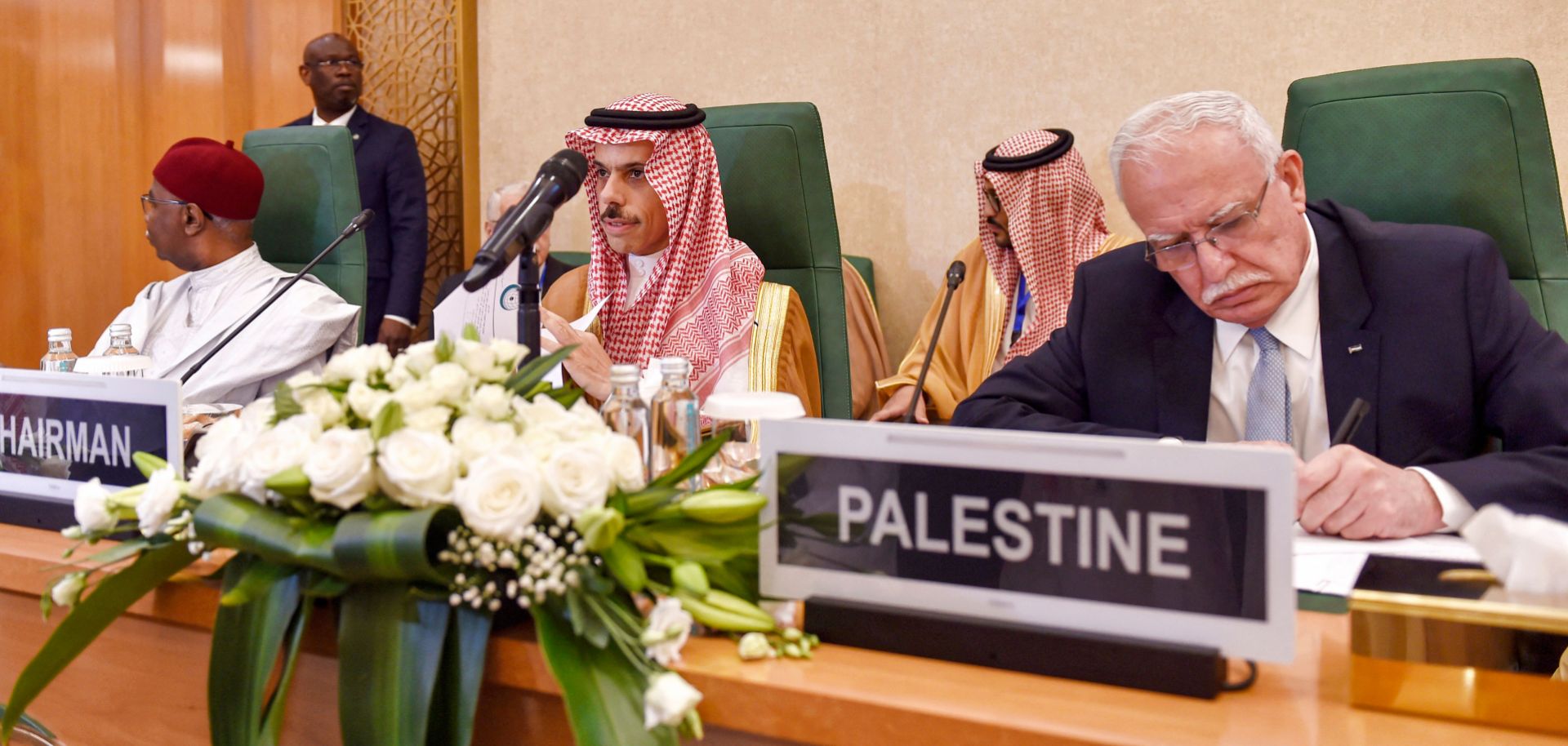
For Saudi Arabia, domestic backlash to the Israeli military operation against Hamas will complicate its efforts to normalize ties with Israel, and may also feed into opposition and radical movements inside the kingdom. Israel's ongoing efforts to remove Hamas from power in the Gaza Strip have sparked significant domestic and political backlash in Saudi Arabia. As media coverage shows images of civilian casualties, the Palestinian question is once again taking center stage in the regional public consciousness. This backlash has already had policy effects: on Oct. 14, Reuters reported that U.S.-brokered normalization talks between Israel and Saudi Arabia had been 'frozen' and would remain so for the duration of the Gaza conflict, following a summer where those negotiations had allegedly made significant progress. Saudi Arabia has also been overtly critical of Israel since the latest flare-up of violence with Hamas. In a statement issued following the Palestinian militant group's initial Oct. 7 assault on Israel, Riyadh said it 'recalled its repeated warnings of the dangers of the explosion of the situation as a result of the continued occupation, and deprivation of the Palestinian people of their legitimate rights, and the repetition of systematic provocations against its sanctities.' The Saudis also blamed Israel for the Oct. 17 explosion at a hospital in Gaza that killed scores of civilians, but which the United States and the United Kingdom said was the result of an errant militant rocket rather than an Israeli airstrike. Online, Saudi social media — one of the few barometers of the public mood in a country without much official polling — continues to widely support the Palestinians and condemn Israel.
- Prior to the latest Gaza conflict, Saudi Arabia, Israel and the United States had been negotiating a normalization agreement that included undisclosed concessions to the Palestinians. But the details on what sort of accommodation Israel had agreed to reach with the Palestinians as part of a prospective deal with Riyadh had remained vague, as it appeared the Saudis didn't have explicit demands on this front.
- In the years leading up to the current war, Palestinian statehood had been a declining issue of political importance in the Middle East, in part because of its stalemated status and in part because states like the United Arab Emirates, Bahrain, Morocco and Sudan had normalized their relations with Israel without any substantial progress on the issue.
Saudi Arabia's Evolving Stance on the Israeli-Palestinian Conflict
Since Israel's independence in 1948, Saudi Arabia has championed the idea of a Palestinian state. At first, the kingdom rejected Israel's existence and sent symbolic troops to support the Arab-Israeli wars in 1948 and 1973. But the rise of revolutionary Iran and the signing of the Camp David Accords between Egypt and Israel convinced Saudi Arabia to take a more moderate stance and develop covert relations with Israel from the 1980s onwards. Nevertheless, Saudi Arabia's kings have remained strongly in favor of Palestinian statehood. In 2000, Riyadh proposed the Arab Peace Initiative, which would have offered Israel full-scale normalization in exchange for a Palestinian state. The initiative collapsed during the Second Intifada of 2000-05, though it remained the baseline for Saudi Arabia's policies toward Israel until Crown Prince Mohammed bin Salman came to power in 2015. The crown prince saw the need to revitalize the kingdom's economy and mitigate the regional threat posed by Iran — two imperatives that stronger ties with Israel would help — as more important than concessions on the Palestinian issue. In 2020, he reportedly even met with Israeli Prime Minister Benjamin Netanyahu shortly after Israel signed the Abraham Accords with the United Arab Emirates and Bahrain. And beginning in 2023, media reports emerged that the kingdom had begun holding formal normalization talks with Israel and the United States. While Saudi officials had continued to reiterate their interest in a solution to the Palestinian question, until the Oct. 7 Hamas attacks, there were few details as to what Riyadh was demanding from Israel in exchange for normalization on this front.
The reawakening of the Palestinian issue in the Saudi public, combined with the likely political solutions Israel will have to impose on the Gaza Strip once the conflict ends, will increase the urgency of Israeli concessions on the Palestinian question ahead of full-scale Saudi-Israeli normalization. After the war, Riyadh will likely demand more concrete concessions from Israel on the Palestinian question, especially if Israel ends up partially or wholly re-occupying the Gaza Strip. Such concessions could include pledges not to resettle the Gaza Strip, something that Israel's far-right ministers have already raised as a potential means to control the territory. Saudi Arabia could also demand substantial Israeli cooperation in the reconstruction of Gaza and the return of refugees. Riyadh might push for restarting peace negotiations between Israel and the Palestinian Authority (PA) as well, while also calling for a freeze or withdrawal of Israeli settlements from the West bank. In addition, Saudi Arabia might push for Israel to pledge East Jerusalem to a future Palestinian state as well, which would be a policy reversal after Israel annexed this part of Jerusalem after the 1967 war with Jordan.
- Israel's military campaign in Gaza will likely remove Hamas from power in the Gaza Strip, but it remains unclear what the post-conflict scenario will look like, with the most probable being a return of the PA and/or an Israeli military occupation.
Saudi demands for concessions on the Palestinian question will run into Israeli government opposition, though if the current Netanyahu government collapses, a center-left successor might be more willing to compromise. The current Israeli government includes far-right parties like Religious Zionism and Otzma Yehudit, both of which openly advocate for a one-state solution that includes annexing the Gaza Strip and the West Bank and placing the two territories under Israeli and Jewish control. These far-right parties are key to the survival of Netanyahu's government, and they will use this leverage to block any concessions to the Palestinians that would reduce the likelihood of a one-state solution. However, anger over the Oct. 7 Hamas attacks and the intelligence failures that led to the surprise assault have already ignited a political firestorm in Israel that largely blames the current government. Against this backdrop, it is unclear if, in the post-war political scene, the current Netanyahu government would be able to hold together both the far-right and the center-right members of its coalition. If the government collapses and triggers another snap ballot, early polling suggests center and center-left parties may be able to win enough seats to form a governing coalition without right-wing parties, which would be a first for Israel in decades. From a political standpoint, such a coalition government would be in a much better position to offer concessions to the Palestinians, as left-wing parties in Israel still back the two-state solution and have long advocated for a peaceful resolution to the Israeli-Palestinian conflict.
- If a new election was held in Israel, an Oct. 20 Maariv poll found that the parties in Netanyau's pre-war governing coalition would secure only 43 seats in the 120-seat Knesset, with a center/center-left coalition potentially led by former alternate Prime Minister Benny Gantz winning 61 seats.
- While the right-wing parties in Israel have rejected the two-state solution, center-left and left-wing parties have remained committed to it in principle. But leftist Israeli parties have failed to enact this policy, as they've either been shut out of power or have had to rule alongside right-wing coalition partners since 2001.
Even if Israel eventually makes concessions, Saudi citizens will most likely continue to oppose normalization; some Saudis may also become more vocal critics of the royal family in the wake of the Gaza conflict, while others may become radicalized by jihadist groups. Even the most far-reaching concessions on the table, like restarting peace negotiations and offering East Jerusalem to the Palestinians, do not address the core drivers of the conflict — namely, Palestinians' lack of a final political status in the region. And many Saudis will not be satisfied until Palestinian statehood is achieved. With this being a slow prospect, many Saudis will continue to oppose normalization, and some will likely be radicalized by jihadist groups that are actively capitalizing on the conflict. This may lead to a resurgence of militant activity in Saudi Arabia — especially individual attacks against not only government targets but Western and Israeli-affiliated interests, which have occasionally emerged in response to the rapid social changes brought by the Saudi government in recent years. Other Saudis may become more vocally critical of Saudi foreign policies and, in particular, of Crown Prince Mohammed bin Salman, especially on online forums and in underground dissident movements. This will prompt the Saudi government to enhance its current strategies to stifle dissent, using generous subsidies to maintain the loyalty of citizens while carrying out police crackdowns and politicized executions.
- According to Amnesty International, Saudi Arabia has so far executed 100 people this year after conducting 196 executions in 2022 — the highest number of annual executions recorded in the country in 30 years. Some have been executed for social media posts critical of the government's policies as Riyadh aggressively polices the online space.
- Saudi Arabia has not seen an organized militant challenge since the al Qaeda uprising in the 2000s, which resulted in a security crackdown and a state-led deradicalization program. However, individual incidents still occur, like a 2019 stabbing at a theater performance in Riyadh, which occurred shortly after the government normalized public performances for the first time in decades.
- Saudi Shiite groups in the oil-rich Eastern Province have long been critical of the government and carried out mass protests after the Arab Spring to try to win political concessions from the Sunni royal family. The kingdom was able to largely suppress the unrest by deploying military force, but anti-royal sentiment lingers among Saudi Shiites and is often inflamed by Iranian media attempting to destabilize the government in Riyadh.
