
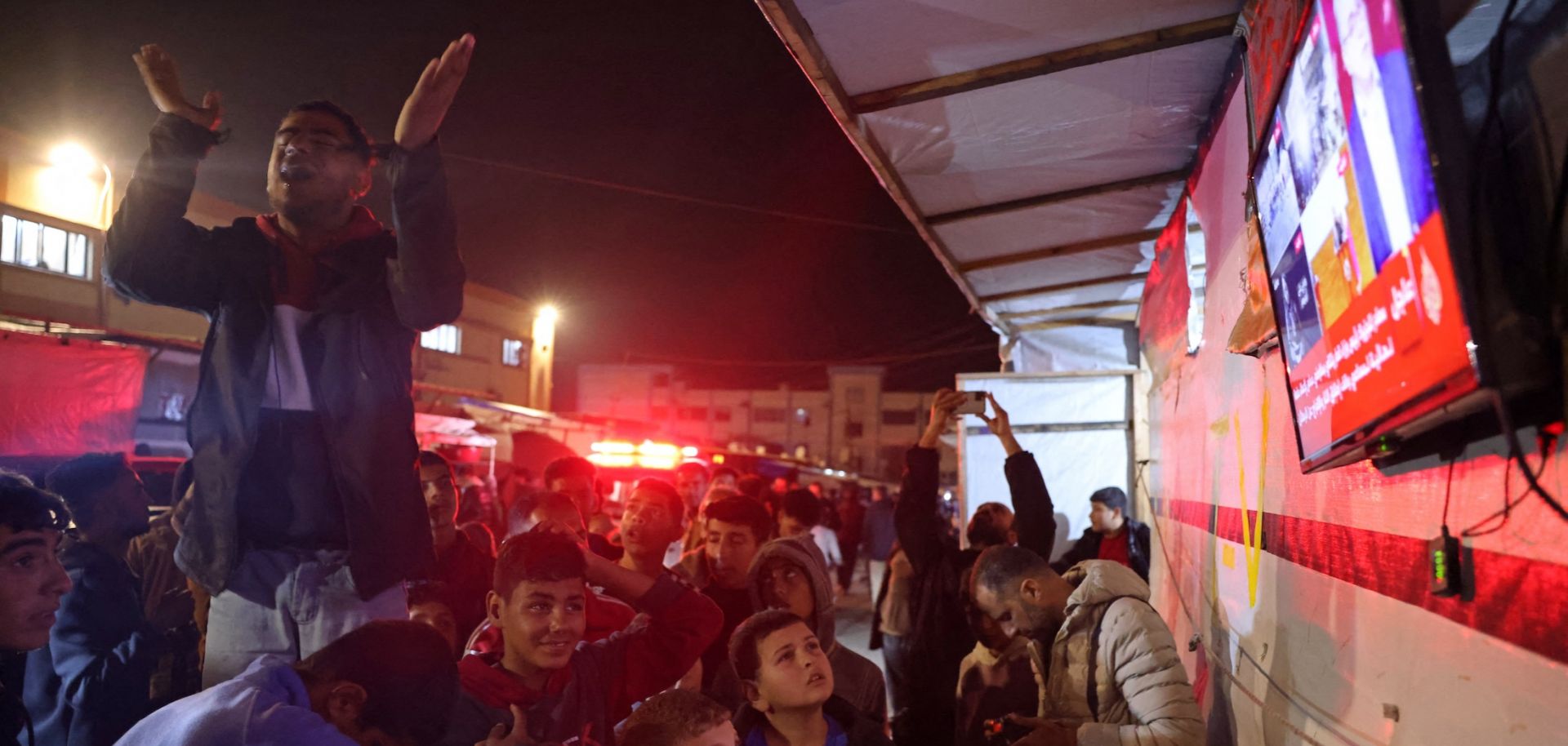
A ceasefire between Israel and Hamas will de-escalate the war in the Gaza Strip, but it will not address all drivers of conflict, and a lack of a post-war strategy for Gaza will over time erode the ceasefire and open the door to early elections in Israel. On Jan. 15, Israel and Hamas reached a ceasefire to end their 15-month-long war in the Gaza Strip. The ceasefire deal, which gained momentum in recent weeks, has three distinct phases. The first phase will see an exchange of Palestinian prisoners and Israeli hostages, along with a retrenchment of Israeli troops around Gaza. The second phase will see the return of civilians to their homes in northern Gaza, as well as a significant withdrawal of Israeli forces from the Strip. Finally, in the third phase, Hamas will turn over the last remaining hostages, and Israel will hand over power in Gaza to a transitional authority that has not been specified. Israel's Knesset is due to vote on the measure tomorrow, and despite opposition from the far-right parties in the coalition government, the deal is poised to pass as opposition parties in the Knesset intend to supply the votes necessary to get it over the 60-majority line.
- For over a year, Israeli, Qatari, U.S, and Hamas negotiators have attempted to produce a ceasefire, but have been hung up on strategic disagreements between Israel and Hamas.
- Far-right Israeli Finance Minister Bezalel Smotrich has long opposed any ceasefire deal that did not see Hamas completely defeated. However, he has not signaled he will exit the government over this proposal, removing the threat of a government collapse that would otherwise be triggered if Smotrich pulled out of the coalition. Meanwhile, opposition leaders like Benny Gantz and Yair Lapid said they would supply votes in the Knesset to ensure the ceasefire can be passed even if the far-right votes against it.
This ceasefire deal is similar to those that have been attempted since the November 2023 truce temporarily halted the fighting in Gaza, but it takes place against a significantly different strategic backdrop in which the drivers of conflict have weakened for both sides. In November 2023, Israel and Hamas agreed to a temporary ceasefire that exchanged some Palestinian prisoners and Israeli hostages. But the deal ultimately collapsed due to Hamas' demands that Israel fully withdraw from the Strip and Israel's demands that Hamas lay down its arms and end its political participation in Gaza permanently. Since then, Israel has conducted more military operations throughout the Gaza Strip and has killed top Hamas leaders, like the group's military leader Yahya Sinwar in October 2024. Israel has also battled with Hamas-aligned Hezbollah in Lebanon, inflicting significant damage to the Iran-backed group, including assassinating its leader Hassan Nasrallah in September 2024. Then, in December 2024, Syria's former President Bashar al-Assad — another key member of the Iran-led Axis of Resistance — was overthrown. With the security threats on its borders now having diminished, Hamas' capabilities largely degraded into an underground movement, and Israeli citizens growing increasingly war-weary, Israel's drivers for an open-ended conflict in Gaza have thus weakened. Additionally, the election of Donald Trump to a second presidential term in the United States shifted Israel's political calculations for continuing to hold out for a full surrender of Hamas, as Trump demanded an immediate end to the war before his entering office on Jan. 20. Meanwhile, for Hamas, its decimation by Israeli military campaigns has also weakened the group's willingness to maintain its maximalist demands for an immediate Israeli withdrawal and a commitment to the end of the war.
- Hamas' rocket arsenal has been exhausted and destroyed by the Israeli Defense Forces' (IDF) combat operations, and although the group appears to have recruited new fighters to replace those lost in the war, they are not yet as armed and organized as the fighters of pre-war Hamas, which operated in battalions capable of pitched battles with the IDF in urban combat zones. Over 43,000 Palestinians have been reported killed in Gaza, a much higher number than during previous Gaza conflicts or the Intifadas, which left hundreds or a few thousand dead. Israel claims up to half of those killed in the latest Gaza war were Hamas, though these figures are unverified.
- A total of 405 Israeli troops have also been killed in the Gaza ground campaign, a number much higher than those lost in Lebanon or in the West Bank since the Oct. 7, 2023, Hamas attacks on Israel. In addition, some 94 Israeli hostages remain, of which the IDF estimates at least half may already be dead.
The first phase of the ceasefire will likely be fully implemented and will see a significant reduction in violence, as well as the release of some hostages, which will temporarily boost support for the Israeli government, improve humanitarian conditions in the Gaza Strip and further pave the way for Israel to escalate against the Houthis and Iran. The first phase is meant to last only six weeks and will see up to 33 hostages released in exchange for an undetermined number of Palestinian prisoners. In the meantime, the Israelis are also set to withdraw from the central part of the Gaza Strip and redeploy many of their forces overall towards a buffer zone along the Israeli-Gaza border. This phase does not force Hamas or Israel to commit to a plan for post-war Gaza and is therefore relatively easy to enact. As a result, public pressure on the Israeli government to secure a hostage deal will decline, which will at least temporarily improve the government's standing. Hamas, meanwhile, will be able to tout that it won increased aid and a halt to fighting that has devastated humanitarian conditions in Gaza. The first phase will also win political support from the United States, where Israel is eager to gain positive relations with the incoming Trump administration to support possible regional escalation against the Houthis in Yemen, who continue to strike Israel, and Iran itself, where Israel believes a window of opportunity may exist to significantly damage Iran's nuclear program after two successful Israeli military airstrikes there in 2024.
- Israeli war hawks have been pushing to use close relations with the incoming Trump administration to expand Israel's aggressive regional campaign, which has, among other things, seen Israel assassinate top militant and Iranian leaders like Hamas leader Ismail Haniyeh in Tehran in July 2024 and Brig. Gen. Mohammed Zahedi of the Islamic Revolutionary Guard Corps in a strike on Iran's consulate in Damascus, Syria, in April 2024.
- The first phase of the ceasefire does not demand Israel leave the so-called Philadelphi Corridor along the Egyptian-Gazan border, which remains a key point of contention. Hamas wants the corridor to be placed under Palestinian control to ensure a free flow of aid and goods from Egypt to Gaza, but Israel has pushed back against this, believing that the corridor is being used to smuggle weapons into the Strip.
The second and third phases are less likely to be fully implemented, leading to violence and an erosion of the ceasefire as Israel moves into de facto occupation of Gaza. The ceasefire envisions Israel removing its military presence from Gaza and ceding control to a transitional authority. However, Israel's right-wing government will oppose policies that might create power vacuums that would allow Hamas to retake control of the Strip, like the complete withdrawal of Israeli troops from Gaza. But there are no other viable Palestinian factions that can run the Gaza Strip without Israeli military support. This means that, in the course of the second phase, the Israeli government will likely slow-walk the agreed-to troop drawdown from Gaza and maintain ground forces and strategic positions in the territory, such as along the buffer zone of the Israeli-Gaza border and the Philadelphi Corridor along the Egyptian-Gaza border. Hamas, in turn, will likely conduct intermittent insurgent operations against these remaining Israeli forces in Gaza, using snipers, rockets and bomb attacks to weaken Israel's political resolve to sustain these positions. Israeli hostages and Palestinian prisoners may still be exchanged during this phase, even as tensions continue to increase, as both sides try to force each other to formally end the ceasefire and endure diplomatic and domestic backlash as a result. Israel will reach out to international partners, like the United Arab Emirates and Egypt, to attempt to set up an international force to control Gaza. But such a force, even if it can be assembled, would likely be ineffective and lack the political mandate to use force to prevent the return of Hamas, leaving the Israeli military as the final guarantor of security in Gaza. Without such security, an international reconstruction program to repair the billions of dollars worth of damage to war-torn Gaza will be extremely challenging, and the Strip will remain reliant on aid flows from Israel that the current government will likely hold up as a way to pressure Hamas.
- Multiple reports have suggested that Egypt, the United Arab Emirates and other Arab partners could send police officers to Gaza to provide security during reconstruction efforts, along with financing to support those efforts. But these Arab countries have suggested they would only do so in coordination with the Palestinian Authority, which governs the West Bank, and as part of a two-state solution. Israel's current government informally rejects the idea of a Palestinian state.
Without a viable, internationally-supported plan to share security responsibilities in Gaza, Israeli public support for an informal occupation will continue to decline and further weaken the government, opening the potential for early elections. Although the Israeli far-right advocates for the reoccupation and resettlement of the Gaza Strip, most Israeli polls suggest that Israelis are not eager to repeat their experience of their decades-long control of the Gaza Strip that ended in 2005, especially after almost a year-and-half of war on multiple fronts. As a result, the Israeli government is unlikely to articulate a formal occupation strategy for Gaza but will de facto remain the responsible military power there, fighting an open-ended insurgency from Hamas. As Israeli casualties rise, public support for the strategy will weaken and anti-war sentiment will strengthen. This will eventually be reflected in public polling, which will see Israeli voters, particularly secular and center-right ones who support the ruling Likud-led coalition government, drift towards other opposition nationalist parties like National Unity or new parties that might emerge to challenge Likud. With such waning support, defections will gradually become more likely, potentially bringing down the Israeli government and triggering elections earlier than scheduled ones in 2027.
- With 68 seats in the 120-seat Knesset, Prime Minister Benjamin Netanyahu's government cannot afford to lose more than nine members of parliament, which could happen if Likud becomes unpopular amid a long and expensive de facto occupation of Gaza.
- The government might also collapse over a break with its far-right or religious parties. The far-right expects the Israeli government to eventually annex the West Bank and authorize settlements in Gaza, while the religious parties remain opposed to the conscription of Haredi into the IDF. Should Netanyahu end up breaking promises on these issues, it could prompt these parties to exit his coalition, which would trigger early elections.
