
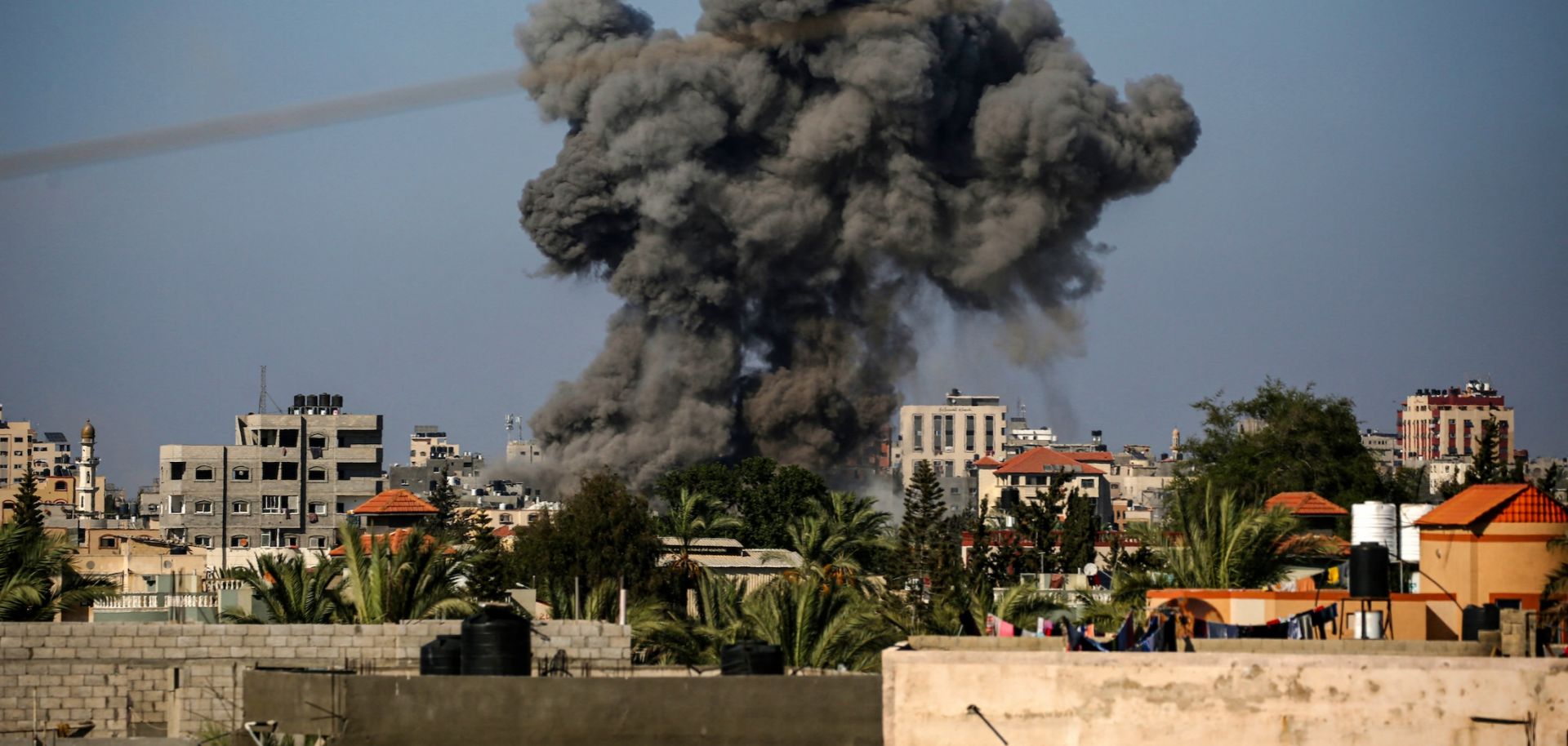
Editor's Note: This is the first installment of a two-part series about Hamas' future in Gaza. The first part considers the goals of Israel and Hamas, and which side is more likely to achieve them. The second will consider the implications of Hamas becoming the undisputed leader of the Palestinian movement.
Nearly a year into the Israel-Hamas war, a definitive resolution remains out of reach. However, as the anniversary of Hamas' Oct. 7, 2023, attack on Israel approaches, the goals of the two sides have grown clearer. Israel wants a maximalist military and political victory that ends Hamas as an armed and governing force in Gaza; Hamas wants to not only survive this campaign but use that victory to enter the Palestine Liberation Organization, or PLO, where it would be notably closer to leading the Palestinian cause overall. Both sides' ability to achieve their goals will be contingent upon whether or not their political systems can outlast the pressures weighing them down. And with Israel being a democracy more susceptible to such pressures, it appears increasingly likely that it will be Israel, not Hamas, that will be forced to moderate its aspirations.
For Israel, the Gaza war is an attempt to reshape regional security dynamics by ending the militant threat from Gaza and turning the strip into a relatively containable security challenge akin to the West Bank. Even in this scenario, Israel largely accepts that Gaza will have to continue to be managed through occasional displays of force. However, by removing Hamas from power in Gaza and bringing in international partners to help govern and reconstruct the strip, Israel aims to make Gaza a manageable challenge. But for Israel to achieve this goal, Hamas would have to accept its end as a governing authority in the Gaza Strip, given both Hamas' role in the Oct. 7 attack and its ability to sustain a long-term insurgency in Gaza that would make reconstruction difficult, if not impossible. And while Israel can suppress Hamas militarily, replacing it would require tens of thousands of troops, civil servants and billions of dollars in aid in a decades-long mission that Israel's political system would not welcome.
Meanwhile, Hamas, as an asymmetric militant movement, was never capable of carrying out a conventional war of conquest against Israel like the Arab armies of the 20th century attempted. Instead, through the Oct. 7 attack, Hamas sought to provoke Israel into a military overreaction that would drive a wedge between Israel and its key benefactors in the West, particularly the United States, while also boosting Hamas' public and political standing among Palestinians to guarantee its inclusion as a governing partner in the PLO. (There are also rumors that Hamas attacked to prevent imminent Saudi-Israeli normalization, which was not imminent in October 2023 but nevertheless may have been a minor factor.) Hamas was aware that an attack on the scale of Oct. 7 would necessitate a massive Israeli military response, but its leadership also gambled that, with a combination of hostages and the ability to resist military conquest, it could leverage hostages for a cease-fire while extolling its ability to withstand intense Israeli military pressure. However, the type of cease-fire matters: Hamas needs a cease-fire that allows it to take on a political role in Gaza and cannot agree to one in which Israel reserves the right to continue assassinating its leaders and conducting military operations once Hamas has exhausted its bargaining chips, particularly the remaining Israeli hostages.
These are the core reasons why the conflict persists. Israel, particularly under the current government of Prime Minister Benjamin Netanyahu, cannot afford to offer Hamas such a political victory, as it would suggest that Hamas may be able to launch attacks on Israel from Gaza and eventually the West Bank. Meanwhile, Hamas cannot accept a temporary cease-fire that allows Israel to shore up public support for further major operations while continuing its covert campaign against Hamas' leadership. The victor, therefore, is the one with the political system most capable of enduring the pressures on it, and both sides have a nexus of interests and forces that could compel their political systems to abandon or adjust their strategies.
For Hamas, the nexus of interests is comparatively simple. It is an unelected group that, having lost formal control of Gaza, is now functioning once more as an underground guerrilla movement, so public opinion cannot be channeled into elections that toss it from power. Israel's July 31 assassination of Ismail Haniyeh, Hamas' political chief, has at least temporarily consolidated the group's military and political wings under a single leader, Yahya Sinwar. Its main sponsor, Iran, is distant and provides comparatively sparing support (as opposed to Hezbollah, which is nearly entirely reliant on Tehran), and Hamas is otherwise isolated from neighbors like Egypt, Jordan and Saudi Arabia, which either view it as a terrorist group or a militant problem to be managed through diplomacy. These are, in many ways, strengths for Hamas, as there are fewer international and domestic pressure points to push its political system into policy changes.
However, Hamas is not immune to such pressure entirely. There are already reports of Gazan Palestinians protesting and criticizing the group for the open-ended war against Israel, and grievances are growing as the humanitarian crisis worsens. Israeli assassinations of top leaders further weaken the group, making it look incapable of protecting its own, let alone the Palestinian people. And Hamas has no clear allies to help it rebuild Gaza, meaning that even if the group can achieve a cease-fire on its terms, the Palestinian public may turn on it should reconstruction be slow. Even militants without elections can be held accountable by the public, which could starve Hamas of fresh recruits, foment new militant groups to challenge Hamas and take grievances to the street, as happened in the summer of 2023 when Hamas raised taxes to address a reported financial crisis.
Hamas' political strategy also, at least implicitly, relies on the United States maintaining its focus on domestic issues amid the country's election season. So far, there has been little to suggest that Vice President Kamala Harris or former President Donald Trump would be willing to pressure Israel into a cease-fire using the substantial leverage Washington has over Israel, such as arms sales. This is largely because of Israel's strategic value to the United States as a partner in the region, particularly against Iran, which weakens Washington's interest in forcing Israel into policy positions the current government opposes. Israel is calculating that, with stalwart U.S. support, Hamas' political system will eventually crack and force it into an unfavorable cease-fire.
Still, for Hamas, these are long-term challenges. Gazan Palestinians overwhelmingly blame Israel over Hamas for their plight, and West Bank Palestinians in survey after survey show wide approval of Hamas and the Oct. 7 attacks. But if the Israeli political system does not buckle first, Hamas cannot withstand open-ended Israeli military pressure.
For Israel, as the more powerful of the two entities, the nexus of interests that influence its overall decisions is more complicated. These include the interests of the Israeli government, the defense establishment, the wider public and opposition parties, the United States, and Arab states. Combined, these are the forces that will define Israel's political system and its ability to utilize military pressure to subdue Hamas.
Israel's pressures are more immediate than Hamas', and numerous reports in Israeli media suggest that most of the above interests are arrayed against the current government's insistence on continuing the war in Gaza. For instance, the security establishment argues that a cease-fire that returns hostages need not be permanent and that the Israel Defense Forces can move back into Gaza should Hamas resume its threat. Additionally, much of the Israeli public now favors a hostage deal over continued fighting with Hamas, particularly as the war in Gaza now seems like a permanent campaign. Furthermore, the United States and Arab states are more concerned about regional escalation than Israel's maximalist goals to eradicate Hamas and believe that a cease-fire in Gaza could restore some calm in the wider Middle East. These forces may push the Israeli government to consider a cease-fire that opens the door to Hamas' political gain.
Additionally, Israel's democracy is tumultuous, and its governments are short-lived. Unlike Hamas, which is largely unaccountable directly to the Palestinian people except in terms of overall sentiment, an Israeli government can collapse quickly if individual members decide that their interests no longer align with those of the coalition. There is already widespread public opposition, led by leaders like Yair Lapid and Benny Gantz, to Netanyahu and his far-right partners. Even within the government, particularly through the defense establishment, there are signs that war weariness could erode Israel's political will to continue fighting Hamas. Defense Minister Yoav Gallant of the Likud party single-handedly stopped Netanyahu's judicial reforms in April 2023, and he remains a critic of some policies within the government itself. Should he choose to exit or threaten to exit the ruling coalition, Israel's political will to continue the conflict could crack.
Israel's politicians know these weaknesses, and a hawkish mood descended across the country after Oct. 7, reinforced by Hezbollah's ongoing attacks along the Israel-Lebanon border and Iran's strike on Israel in April. It's unlikely that a fatal collapse of Israel's political system is imminent, but Israel must take into account the democratic and international pressures that Hamas escapes. Such pressures, formidable as they are, suggest that Israel will eventually walk back its demands, which could presage Hamas' ascendance as the leader of the Palestinian movement.
