
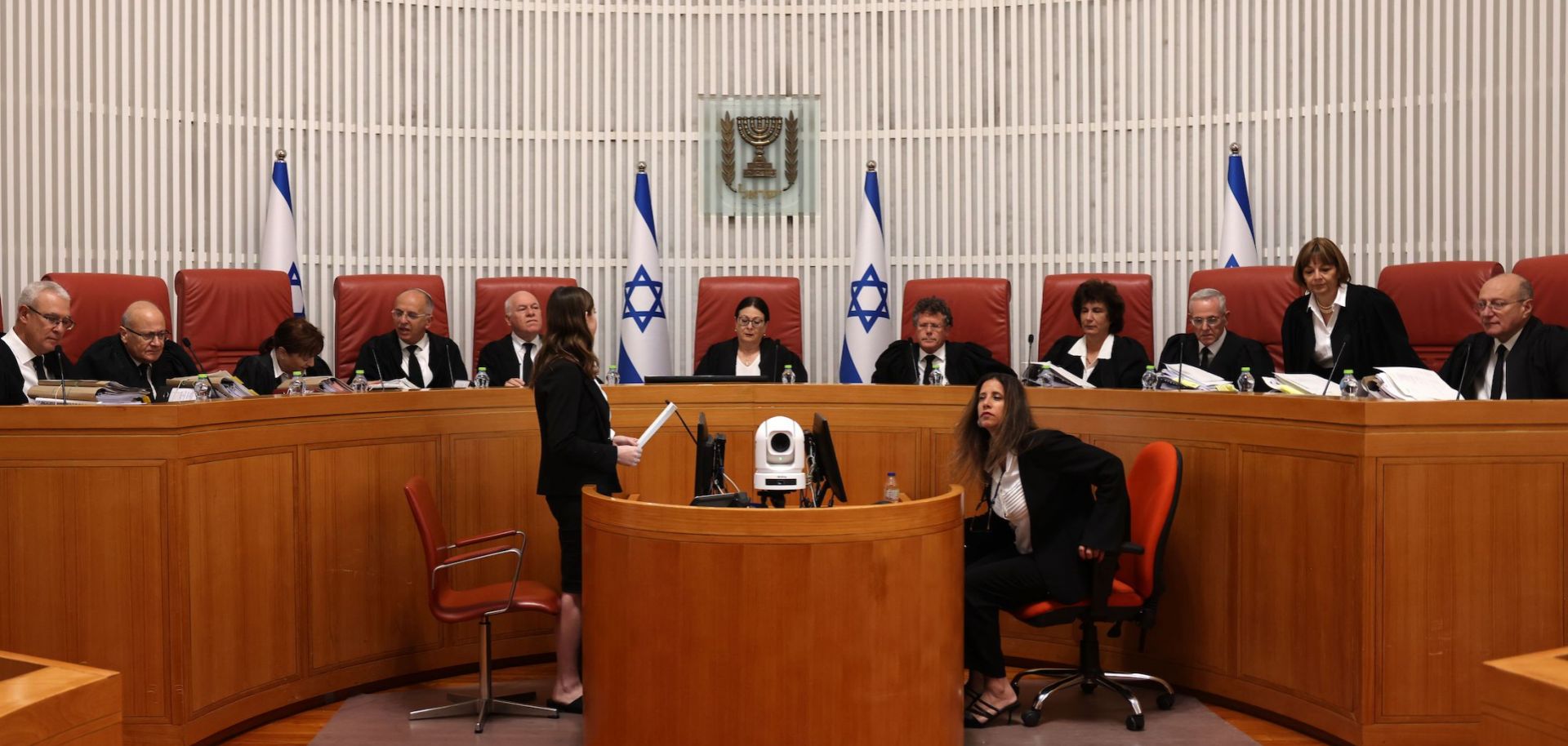
Israel's government will be under intense pressure to provide unpopular concessions to its far-right members, potentially leading to its collapse and its replacement with a center-right government more likely to negotiate concessions with the Palestinians. Israeli Prime Minister Benjamin Netanyahu's government is facing multiple pressures that risk pulling it apart as the coalition's far-right, religious and center-right elements push for competing policies. On Jan. 1, the country's Supreme Court overturned the government's signature judicial reform, annulling the so-called "reasonableness law" that had reshaped the legal doctrine judges were allowed to draw upon to make rulings. This setback sparked a backlash from the ruling coalition's far-right elements, who demanded that the government take up the judicial reform process again despite the ongoing war in Gaza, and despite the reforms' widespread unpopularity among the Israeli public. The same far-right parties, like Religious Zionism, are also trying to convince the government to resettle Palestinians from Gaza and establish Jewish settlements there again, but center-right elements in the ruling Likud party have voiced concern such moves could isolate Israel diplomatically, particularly from the United States. Meanwhile, religious parties have continued to demand that Israel's rapidly growing ultra-Orthodox community be exempt from military service, despite the country's growing wartime needs.
- Defense Minister Yoav Gallant publicly opposed the government's proposed judicial reforms in the spring of 2023 — an event that resulted in the government promising to slow down and even cancel aspects of the controversial reforms, which spurred mass nationwide protests last year
- U.S. President Joe Biden has called out Israel's far-right parties as the most problematic elements of the Israeli coalition both before and during the war in Gaza, amplifying center-right worries that the Netanyahu government is alienating the country's most important ally. Far-right parties' inclusion in the ruling coalition has also split Jewish voters in the United States over their support for the Netanyahu government, giving the White House political space to openly criticize them.
A renewed government effort for judicial reforms is unlikely to be popular with Israel's center-right politicians and voters, which could exacerbate divisions within the ruling coalition. Numerous reservists in the IDF went on strike as a result of the judicial reforms in 2023, which contributed to the public perception that the country was too internally divided to prevent the Hamas attack later that year. Many center-right politicians and voters are more focused on Israel's security imperatives in the wake of the Oct. 7 assault and the subsequent war in Gaza, rather than on the right-wing's social policy agenda. In recent polls, many center-right voters have also said they no longer have confidence in Netanyahu's ability to govern and secure the country after the attack. In response to this political pressure, Netanyahu and his supporters in the government are not eager to take back up the judicial reform process — especially as Israel remains engulfed in major combat operations against Hamas in Gaza, as well as ongoing clashes with the Lebanese militant group Hezbollah along Israel's northern border. But right-wing elements of the ruling coalition, including Justice Minister Yariv Levin, have said that the government has not abandoned its overall goal of reshaping the judiciary in favor of the Knesset, raising the prospect that the government will eventually pick up the reforms again, which could alarm center-right lawmakers enough for them to consider leaving the government.
- In a poll published on Jan. 2 by the Israel Democracy Institute, only 15% of Israelis wanted Netanyahu to remain prime minister after the war was over. This includes supporters of his own Likud party, signaling to Likud lawmakers the risks of remaining attached to Netanyahu.
- There's a division in the government as to how far such judicial reforms should go. Far-right elements have pushed for a more radical restructuring of Israel's judicial system, including through a proposed law that would allow the Knesset to override Supreme Court decisions. Center-right elements, meanwhile, have favored more measured changes, like altering the way Supreme Court justices are selected. There's also a division over the urgency of such reforms, with the far-right tending to see them as a more pressing concern than the center-right
The Israeli government is also facing stress from its religious parties, which are still pushing for religious exemptions from military service — a demand that has become even more unpopular in the wake of the Gaza War, which has seen unprecedented military mobilization. Religious parties like United Torah Judaism and Shas both aim to use their positions in Netanyahu's ruling coalition to permanently entrench the ultra-Orthodox exemptions from military service. However, secular Israelis and the military establishment oppose these exemptions for fear that they could leave Israel without enough troops in the future, given the growing size of the country's ultra-Orthodox community. The Oct. 7 Hamas attack has only deepened these concerns by showcasing that Israel's security threats may require mass mobilization to secure the country. Despite this, the religious parties have not yet shown a sign that they are willing to compromise or abandon their overall goal of ensuring that ultra-Orthodox Israelis remain exempt from such service, even during wartime emergencies.
- Israel's demographers estimate that the ultra-Orthodox community will comprise about 16% of the country's total population by 2030. Owing to their higher birth rates, ultra-Orthodox Israelis will also make up a higher proportion of the youth population that the military draws from. The Israel Defense Forces (IDF) has long cited this growth trend as a security concern.
Finally, the far-right will likely pressure the government to relocate Palestinians in Gaza, even at the expense of Israel's diplomatic relations, which will further alarm the center-right and make their exit from the government all the more likely. Far-right Israeli politicians have long believed that Israel should reoccupy Gaza and rebuild settlements that were destroyed there during Israel's 2005 evacuation from the strip. Although Netanyahu has refused to publicly lay out a post-war occupation strategy for the Gaza Strip, his years of managing Gaza conflicts with relative restraint suggest he is reluctant to resurrect the resettlement strategy that characterized Israel's control of the strip from 1967 to 2005. In addition, the international community, led by the United States, has publicly said that there should be no relocation of Palestinians from the Gaza Strip and no resettlement of the area by Jewish settlers.
As these pressures build, the government will likely offer concessions to the far-right and religious parties at the risk of further angering Israeli citizens, as well as Israel's diplomatic allies. Under such a scenario, center-right lawmakers may defect to the opposition and collapse the current coalition, sparking snap elections that could yield a new government with a fresh mandate to negotiate with the Palestinians. Netanyahu is facing not only political pressure that threatens his current post as prime minister but also ongoing corruption trials that threaten his entire political career (and freedom) if he's convicted. To that end, Netanyahu has been trying to use the coalition to develop legal shielding to shield himself from potential legal repercussions in his ongoing corruption trials. This increases his political imperative to offer concessions to different elements of the coalition to stay in power. For now, Netanyahu may favor the far-right and religious parties over his own center-right Likud, in part because the far-right and religious parties could be more willing to leave the coalition if their demands are not met. But doing so might cause center-right lawmakers to leave the government, triggering new elections that, under current polling, would likely collapse Netanyahu's Likud party as center-right voters flee to other parties. Polls suggest a new government might include center and center-left parties, which would push the government closer to resuming negotiations with the Palestinians over a possible two-state solution.
- Although Israel is currently in a wartime unity government, once combat operations scale down and the government begins to offer concessions to the far-right again on issues like judicial reforms, these temporary allies will return to the opposition and once again leave Netanyahu's government with a narrow five-seat majority.
