
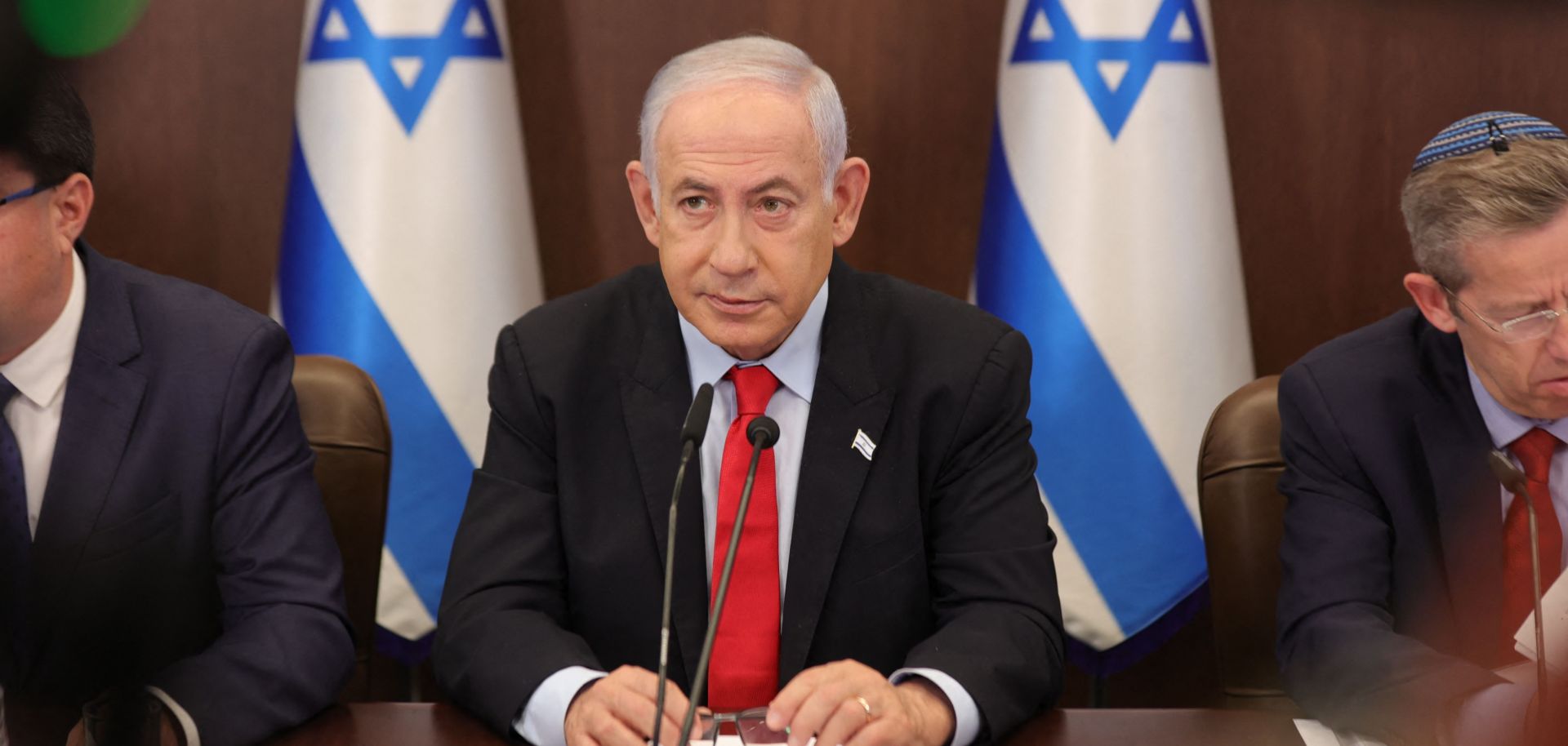
Israel's new unity government will give the military the political support it needs to fight another war against militants in Gaza and potentially Lebanon. But fractures within the government will quickly emerge once the conflict ends, with Prime Minister Benjamin Netanyahu's fate ultimately depending on how voters perceive the outcome of the conflict. In a sudden about-face between otherwise rival political factions, Israel's government reached a deal with the opposition to form an emergency unity government on Oct. 10, three days after Hamas launched an unprecedented assault on the country that prompted Israel to declare war on the Gaza-based Palestinian militant group. The Israeli opposition — which is led by Yair Lapid, Benny Gantz and Avigdor Lieberman — is following in the footsteps of the Israeli public, which has made a massive show of unity in the wake of Saturday's surprise attacks after months of public protests and deep polarization. However, there are still differences in opinion between Israeli politicians over how the military should respond to the Hamas assault, which marked the worst attack on civilians within Israel in the country's history. Lieberman, who leads the nationalist Yisrael Beiteinu party, has demanded that the government commit to ''destroying'' the Palestinian militant group, and has also previously said Israel should reoccupy Gaza — policy positions that fellow opposition leaders Gantz and Lapid, as well as Netanyahu, have traditionally resisted. Personal differences are similarly strong; Gantz and Lapid initially tried to exclude the far-right Religious Zionist politicians Itamar Ben Gvir and Bezalel Smotrich from the unity government. The unity government will also not include Israeli Arab parties, like the Islamist party Ra'am.
- Netanyahu and Gantz also formed a unity government in 2020 to combat the COVID-19 crisis. This marked the second unity government in Israel's history, with the first being the one formed in 1973 in the aftermath of the surprise attack by Egypt and Syria during the Yom Kippur War. Both governments collapsed quickly after the emergencies eased or ended.
- Israel's otherwise divided public has rallied in the face of the Hamas attacks that began on Oct. 7 and have so far killed at least 1,000 Israelis. The scale of the attacks and their surprise nature have papered over the political, religious and ethnic differences between the country's Jewish, Muslim, Arab and Druze populations. This is in stark contrast to the 2021 Gaza conflict, when Israel's far-right stoked nationwide intercommunal violence during anti-war protests dominated by Israeli Arabs.
In the near term, a unity government will make Israel's military strategy more politically cohesive as the Israel Defense Forces (IDF) carries out an extensive campaign against Hamas and other Palestinian militant groups in Gaza and possibly Hezbollah. All of Israel's main political parties will be represented in the new unity government's security cabinet, and will thus all have input on how the military strategy following Hamas' assault — defusing possible tensions over differences that might have otherwise been caused by certain parties being excluded from those strategic decisions. Access to classified briefings will also give the coalition members greater awareness of the military and economic constraints related to fighting extended, multi-front conflicts, which should reduce divergences between the parties over how far to escalate the war against the Lebanese armed group Hezbollah and its sponsor, Iran. This will be particularly important if the war involves extremely high casualties, as each party being part of the government will mean they are politically responsible for the deaths, reducing their incentive to publicly criticize or undermine the military strategy, at least in the short term. If the war escalates to a major campaign in Lebanon, the unity government will also help shape public opinion and defuse anti-war dissent in the near term.
- Israeli-Palestinian violence has a history of spurring political infighting in Israel. In 2018, Lieberman resigned from Netanyahu's government after Netanyahu reached a cease-fire with Hamas that Lieberman opposed.
- Consequential policy decisions that were made without the support of a wide part of the Israeli political spectrum have also triggered significant infighting within previous Israeli governments. For example, former Prime Minister Ariel Sharon's move to withdraw from Gaza in 2005 led to splits in his party, while former Prime Minister Yitzhak Rabin was assassinated by a far-right activist in 1995 for signing the Oslo Accords.
The unity government is unlikely to survive once the war ends, and the opposition will likely use the intelligence failures that led to the Hamas offensive to undermine Netanyahu's government. Without a wartime emergency, there will be no incentive for the opposition to remain in the cabinet, and political divisions will re-emerge as Netanyahu's rivals try to halt the government's domestic agenda. This is because the war will likely only pause, not change, the government's controversial push to reform the judiciary, and the fact that Netanyahu's ongoing corruption trials remain of notable concern to the opposition. The opposition and Israeli citizens will also want to launch a public inquiry into why Hamas was able to get past modernized IDF defenses, and why the plan was not detected and acted upon by the security services — the findings of which will likely place some blame on Netanyahu's government. In addition, the opposition will want to use that inquiry process to win public support and pressure members of the government to defect in the hopes of collapsing the ruling coalition and triggering fresh elections.
- Some reports published by Israeli media outlets, like Haaretz, have already suggested that Netanyahu's policies are to blame for the intelligence failure. In particular, they claim his focus on expanding settlements in the West Bank pulled much-needed security resources and forces away from the Gaza frontier, while his push for judicial reforms also alienated and divided the military and intelligence services to the point where they lost effectiveness. Others have argued that the Oct. 7 attacks show Netanyahu's prior approach to Hamas, which involved offering the group economic aid in exchange for quiet on the border, was a failure as well.
Despite the future criticism, if Netanyahu is able to claim a strategic success, his base will likely remain loyal and he will continue his agenda. But if the war becomes bogged down with high casualties or appears to falter, some supporters may defect to the opposition, making a government collapse more likely. While intelligence failures directly led to the end of Golda Meir's government in the 1970s, Netanyahu's government is operating in a more fractured political and cultural environment, with a loyal base of supporters who are as attached to Netanyahu himself as they are to the ideologies he represents on the right. This will limit the political impact of the intelligence failure on the post-war Israeli government. But Israeli voters — including Netanyahu's supporters — will still give the military outcome of the war considerable political impact. If the war is seen as a success, it will boost the base's loyalty and likely keep Netanyahu in power after the end of the war and the unity government. But if the war is not seen as a victory, as was the case with the 2006 Hezbollah war, it will fracture the base and potentially lead to defections that might bring down the government.
- Netanyahu's government is also united by its right-leaning agenda, which includes supporting annexation and expansionism in the West Bank, exempting ultra-Orthodox citizens from IDF military service, and judicial reforms.
- After the July 2006 Hezbollah war, the Israeli public disapproved of their government's performance, especially after it had promised to decisively defeat the militant group, which saw the approval rating of then-Prime Minister Ehud Olmert drop to as low as 3% in May 2007. Amid the backlash, Olmert did not run for another term, and his Kadima party struggled to regain relevancy and eventually dissolved in 2015.
