
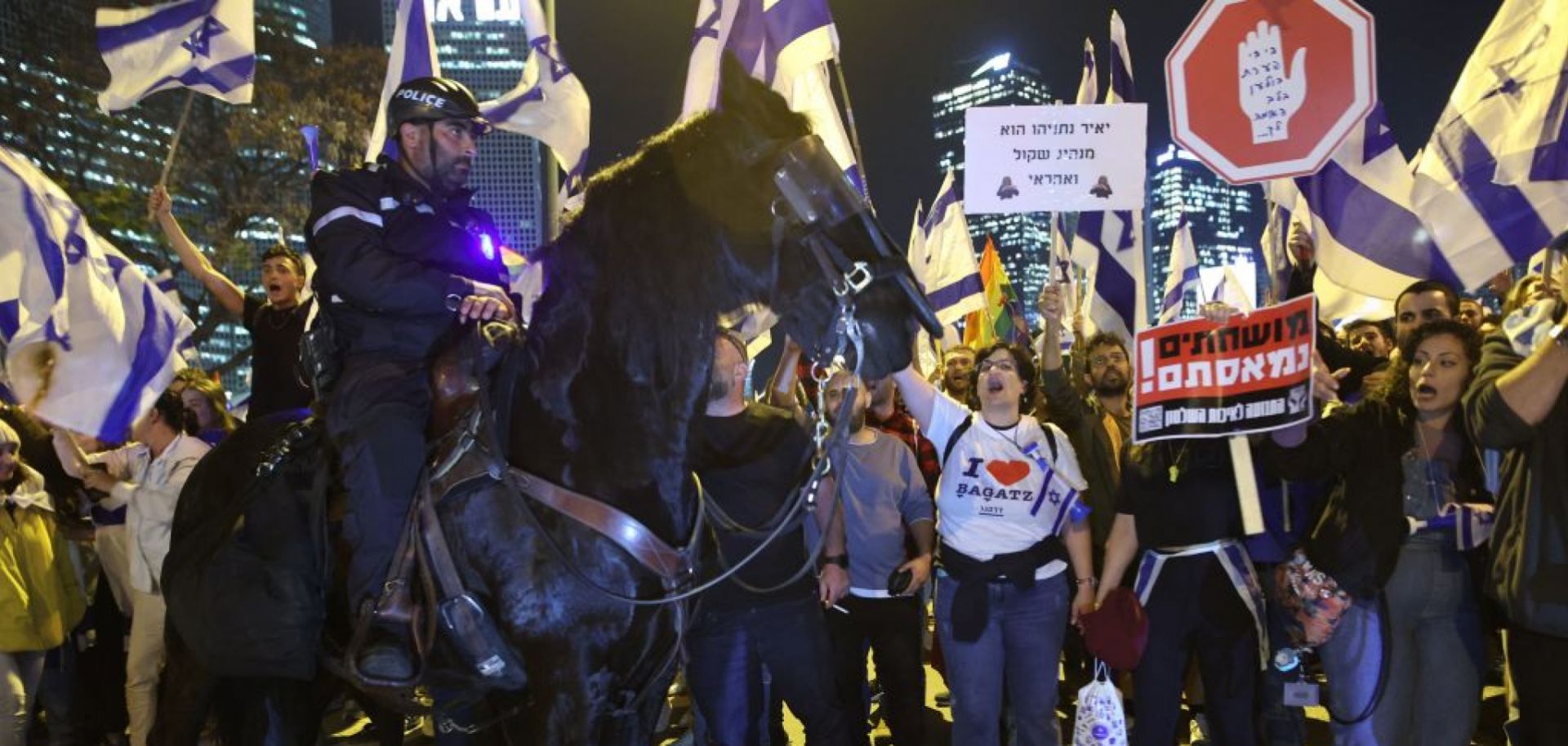
A mounted policeman stands guard during a March 27, 2023, protest in Tel Aviv, Israel.
The Israeli government's pause in its controversial judicial reforms will delay their enactment, but more unrest and protests are likely as negotiations continue. Israel's security services, meanwhile, will push back on a proposal for a new national guard, further sowing distrust between the country's government and the security establishment, while portending more strikes from soldiers. As hundreds of thousands protested in the streets of Israel and around the Knesset, Israeli Prime Minister Benjamin Netanyahu announced on March 27 that he would pause his government's controversial judicial reforms until at least May to allow for a dialogue over their final form. The far-right Religious Zionism party — a key partner in Netanyahu's coalition government that strongly backs the reforms — initially opposed the pause. But the party accepted the move after Netanyahu promised to expand National Security Minister Itamar Ben Gvir's powers with a new "national guard" that would be placed under his command. Some protest and opposition leaders, like former alternative Prime Minister Benny Gantz, welcomed the delay. But others, like former Prime Minister Yaid Lapid, have expressed concern that the move is a gambit to benefit the current government.
- On March 25, Netanyahu fired Defense Minister Yoav Gallant after he made a nationwide speech decrying the judicial reforms. In particular, Gallant said the changes would undermine Israel's security establishment, referring to the growing number of Israeli Defense Forces (IDF) reservists who have also said they would strike in protest of the reforms. Following Gallant's dismissal, mass protests erupted across Israel on March 26 — marking the largest demonstrations against the judicial reforms since they were first announced in January.
- Opponents have decried Netanyahu's proposed judicial overhaul as a step toward dictatorship. The reforms would give the Knesset a bigger role in appointing Supreme Court justices (a process that is currently overseen by mostly lawyers and judges); make Israel's quasi-constitutional Basic Laws immune to judicial review; and, most controversial of all, enable the Knesset to override the Supreme Court with a simple majority. Israeli opposition parties and their supporters fear such changes would enable the country's legislature — which is currently dominated by right-wing and far-right parties — to enact ultra-conservative policies, including anti-LGBTQ and pro-religious laws, that are unpopular with the left and secular public.
Despite the delay, the government will likely continue to pursue the overall goal of the judicial reforms, which will push opposition forces to maintain mass unrest that could spark violence. In his nationwide speech on March 27, Netanyahu gave little indication that he was prepared to abandon the reforms entirely, as he invoked the parable of the Judgement of Solomon — in which the Jewish king offered to divide a child whose maternity was in dispute — as a principle he would use to negotiate the reforms. Netanyahu likely intended these comments to reassure far-right and religious allies that their goals will still be met, thereby assuaging any calls from allies like the Religious Zionism party to leave the ruling coalition in protest, which would collapse the government. Following Netanyahu's speech, several protest leaders called for continued demonstrations, which will likely continue until the next session of the Knesset in early May, and the protests will likely intensify if reports emerge that negotiations between the government and the opposition are failing. It is unclear what compromise scenario would defuse the opposition's protest movement, as some members of the opposition are also demanding new elections to remove Netanyahu and the far-right from power. Meanwhile, counter-protests against the opposition by the right, as well as police action, could result in isolated acts of violence, and there remains a latent risk of Palestinian militant attacks on mass gatherings as the West Bank's security situation continues to deteriorate.
- In 2020, Netanyahu promised to annex the West Bank, but he demurred later in the year following the COVID-19 crisis and growing U.S. opposition, causing pro-settler parties to leave his coalition and push him out of power for over a year.
- The West Bank is also experiencing a grassroots-driven security crisis, which has spilled over into Israel. At least nine Israelis have been killed in related attacks inside Israel so far in 2023, including seven at a synagogue in Jerusalem in a January gunman attack.
The security establishment, led by the IDF and internal security agency Shin Bet, are likely to oppose a new national guard under Ben-Gvir, further straining the relationship between the government and its security forces. It is unclear what form the national guard would take under Ben-Gvir, as well as what public role such an institution would fill given the sophisticated nature of Israel's security establishment. Regardless, the creation of the new national guard will exacerbate preexisting tension between the government and security forces, which has simmered since Netanyahu reportedly gave Ben-Gvir control of Israel's police through his appointment to the recently-created post of national security minister at the end of 2022. The security establishment's likely objection to the national guard will feed this anti-government sentiment, particularly within the security services, which could lead to more strikes by soldiers.
- Israeli police have expressed concerns about Ben-Gvir's past comments supporting the use of violence against anti-government protesters and Palestinians.
- The IDF successfully demanded that Finance Minister Bezalel Smotrich, who is the chair of the Religious Zionism party, not be given any military authority after Netanyahu gave Smotrich civil authority over Israeli settlements in the West Bank in February.
