
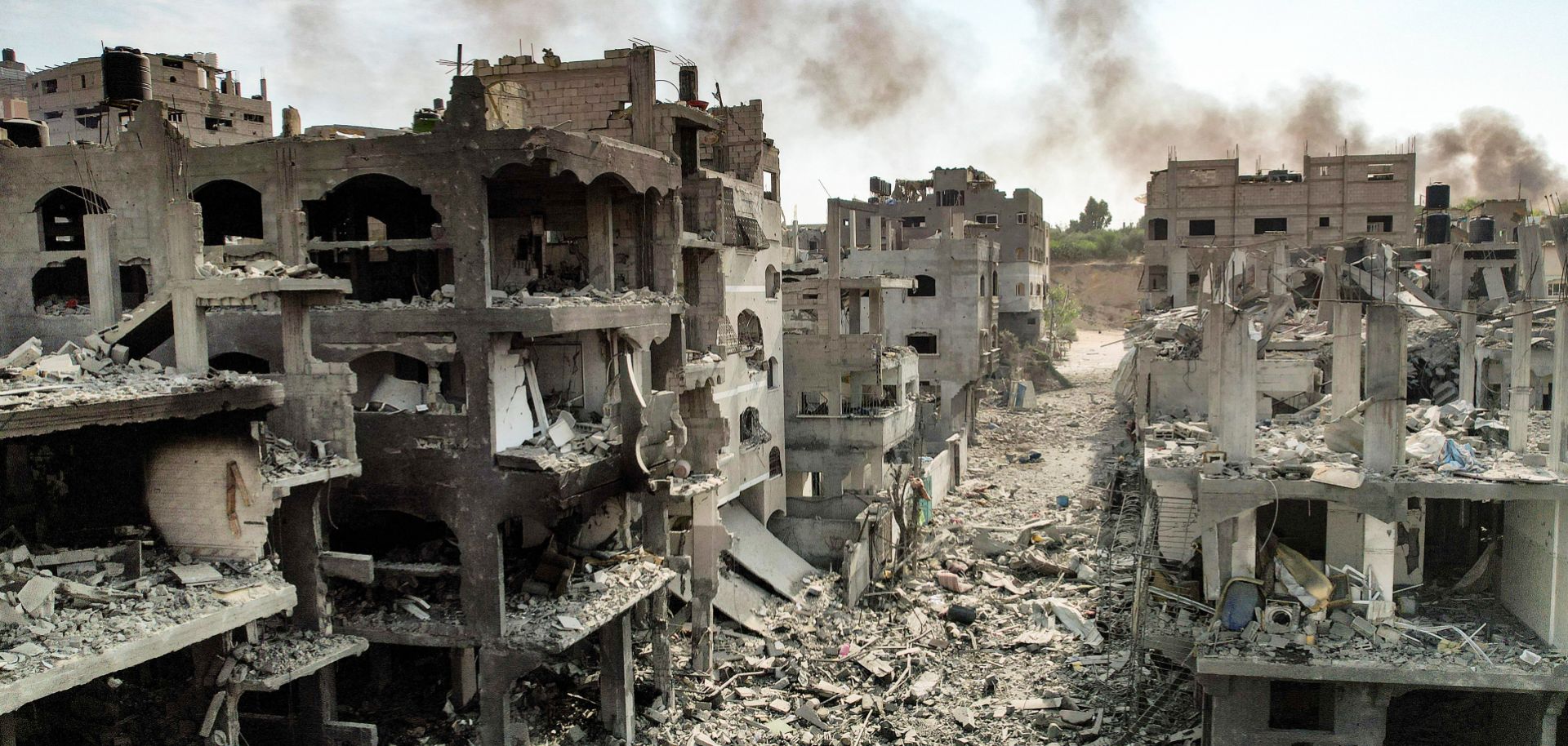
The Israeli government will face increasing domestic and international pressure to meet the conditions of the Palestinian Authority to resolve the governing crisis in the Gaza Strip. However, in doing so, it may destabilize itself and pave the way for early elections. In a Nov. 10 speech, Palestinian Authority (PA) President Mahmoud Abbas said the PA might take over the governing responsibilities of the Gaza Strip once the Israeli military removes Hamas from power, but only if Israel commits to a peace process that would see the establishment of a Palestinian state based on 1967 borders, with East Jerusalem as its capital. This was the first time Abbas had explicitly said the PA might take a governing role in the strip since the current conflict began on Oct. 7. His comments also come just days after Israeli Prime Minister Benjamin Netanyahu ignited a diplomatic uproar by suggesting his country might permanently reoccupy the area. Although neither the United States nor Israel immediately reacted to Abbas's speech, media reports suggest Washington has been actively exploring ways to bring the Palestinian Authority back to the Gaza Strip.
- Hamas violently expelled the PA from power in the Gaza Strip after the former won elections held in 2005. The PA's expulsion came not long after Israel unilaterally withdrew from Gaza in 2005 so that its right-leaning government could focus more on expanding settlements in the West Bank; the strip had also become increasingly difficult to govern via military force, which further factored into Israel's decision to exit the territory.
- U.S. Secretary of State Antony Blinken has said that the PA remains the best option for Gaza, with that option including plans to improve the PA's security effectiveness and political legitimacy.
The return of the Palestinian Authority is the most viable post-war plan for the Gaza Strip, given the constraints of other potential solutions. The PA may lack political legitimacy among ordinary Palestinians, but its security forces remain relatively effective in the West Bank and many of its key institutions, like the presidency, carry out their basic functions. Meanwhile, other possible plans face difficult security, diplomatic or political constraints. So far, media reports have suggested that the United States, Israel and other regional powers have explored the possibility of a joint regional security force in Gaza and a possible peacekeeping force, potentially under the auspices of the United Nations. Some members of the Israeli government have also suggested that Israel permanently reoccupy the strip. However, the prospect of an international security force is already running into diplomatic obstacles. On Nov. 9, Egyptian President Abdel Fattah el-Sisi said his country would take no part in a regional security force in Gaza. And while Turkish President Recep Tayyip Erdogan has said that he would support deploying Turkish peacekeepers to the strip, it is unclear how such a force would operate in the face of a potential violent militant insurgency. Additionally, U.N. peacekeeping missions have had a spotty record of success in the region, particularly when it comes to maintaining peace between Israel and militants. Since its deployment in 1978, the United Nations Interim Force for Lebanon (UNIFIL), for example, has continuously failed to prevent violence between the Israel Defense Forces (IDF) and the Iran-backed Lebanese militant group Hezbollah, including the two sides' full-scale war in 2006 and their various border skirmishes over the years. Finally, a permanent Israeli occupation of the strip would require a sizable amount of troops to maintain control of the 2.1 million Palestinians that live there and, over time, would likely become deeply unpopular among Israeli voters.
- The PA controls most of the major cities in the West Bank, where it has been able to suppress a widespread outbreak of violence despite its deep unpopularity and outrage over the Israeli military operation in Gaza. The PA and IDF have a strained but functional relationship that also helps the former maintain control of the West Bank, with the latter serving as a backup to PA security forces in response to militant threats.
- Israel's current military deployments in Gaza and the West Bank have already spread its security forces thin. Prior to the latest outbreak of violence, Israeli media had reported that the IDF had deployed 15 battalions to the West Bank to stabilize the security situation there. For comparison, Israel has reportedly mobilized 35 battalions for its Gaza combat operations, many of them reservists.
- There are around 2.7 million Palestinians in the West Bank, and the 15 battalions have the cooperation of PA security forces, suggesting that more battalions might be needed to control the Gaza Strip without PA support.
The Netanyahu government will likely struggle to meet domestic and international demands for the PA's return to governing Gaza, due largely to its heavy reliance on far-right factions. With only 64 seats in the 120-seat Knesset, the Netanyahu government's narrow majority makes it heavily dependent on the support of its far-right members, including Religious Zionism and Otzma Yehudit. The leaders of those two parties — Bezalel Smotrich and Itamar Ben Gvir, respectively — have ardently (and unapologetically) pushed for expanding settlements in the West Bank. They also favor eventually expelling Palestinians from Gaza so that the region can be resettled by Jewish settlers, which will make it impossible for them to agree to the PA's conditions for retaking control of the Gaza Strip once the current war is over. Smotrich and Ben Gavir have openly expressed their disdain for the international backlash against their ideological objectives for expanding Israeli settlements in the Palestinian territories, and are thus unlikely to stand down from their positions amid new pressure to reach an agreement with the PA on Gaza's political future. This will severely limit the Israeli government's room for compromise because its fragile majority means that if any disputes over the end-game in Gaza prompt the far-right factions to leave the coalition, it could collapse Netanhahu's government and potentially end his long political career.
- Otzma Yehudit's ideological founding father, Rabbi Meir Kahane, believed in a single state in the former mandate of Palestine and favored the violent expulsion of Arabs from the region. In part due to these beliefs, his political party, the Kach party, was banned from Israeli politics in 1994 and labeled a terrorist organization by the United States.
- Ben Gvir at one point pushed back against U.S. criticism of the government's controversial judicial reforms by saying that Israel was not an American colony.
Its government's need to appease the far-right will likely force Israel to reoccupy the Gaza Strip for a time once the current war is over, which will prove unpopular within Israel. The majority of Israeli citizens and lawmakers do not want to reoccupy Gaza due to the military, economic and diplomatic costs of doing so. Indeed, prior to the current war, only right-wing and far-right politicians (like Smotrich and Ben Gavir) supported reoccupying the strip for ideological and security reasons. But amid pressure from its far-right factions, the Israeli government will have little choice but to pursue such a move after the war, which would probably involve an extended military presence with high Israeli casualties. The mounting costs of such a reoccupation would likely spur domestic backlash, prompting Israeli lawmakers to demand the government find an exit strategy. But without an international option, Israel's ability to withdraw from Gaza would rely on the PA taking over at least some security responsibilities in the strip, again leaving the Netanyahu government in a difficult position in regards to finding a solution that doesn't irk its far-right members.
- Israel's post-war occupation of the Gaza Strip would also impede normalization efforts with Saudi Arabia, which would likely explicitly list a humanitarian and political solution for Gaza as a condition for full-scale normalization with Israel now that the Palestinian cause has been returned to a high priority in the minds of the Saudi public. Israeli-Saudi normalization talks were reportedly making progress before the Oct. 7 Hamas assault on Israel. While those negotiations included Saudi demands for some kinds of concessions to the Palestinians, they did not appear to be contingent upon the restart of two-state solution peace talks. That, however, will likely change following the current war, as Saudi Arabia has become much more overtly critical of Israel's military campaign in the Gaza Strip in recent weeks, and has positioned itself as a more vocal champion of Palestinian self-determination.
If the Israeli government refuses to find a way to bring the PA back to the Gaza Strip, the mounting political backlash could eventually see some center-right lawmakers leave the coalition and force early elections. Conversely, if Netanyahu reaches a deal with the PA, it might result in a snap ballot as well by pushing far-right lawmakers to exit his government. Some members of Netanyahu's Likud party are already concerned about their political futures given the government's unpopularity in the face of its failure to detect the Oct. 7 Hamas assault and, prior to that, its controversial push to overhaul Israel's judicial system via sweeping reforms. Likud lawmakers will likely be looking to center-right figures like Defense Minister Yoav Gallant for guidance as to how to navigate these challenges. Meanwhile, Gallant — like much of the military establishment — will probably oppose a permanent occupation of the Gaza Strip to appease the far-right. Gallant or members like him may decide to defect from the government if this prospect looks likely. However, if Netanyahu decides to appease international opinion and begin talks with the PA regarding Gaza's governance, the far-right may decide to leave his coalition to collapse the government and force elections, in an effort to both sabotage such talks and see if they can bring to power another right-leaning government that would commit itself to rejecting a two-state solution.
- The defection of dissatisfied coalition members has collapsed previous governments led by Netanyahu. For example, in 2018 Avigdor Lieberman pulled his party from Netanyahu's then-government in protest of the prime minister's relatively restrained policies toward the Gaza Strip.
- Should Israel hold a snap election, current polling suggests that a new center-left government might come to power, which would have more ideological leeway in negotiating with the PA over their demands to take control of the Gaza Strip.
