
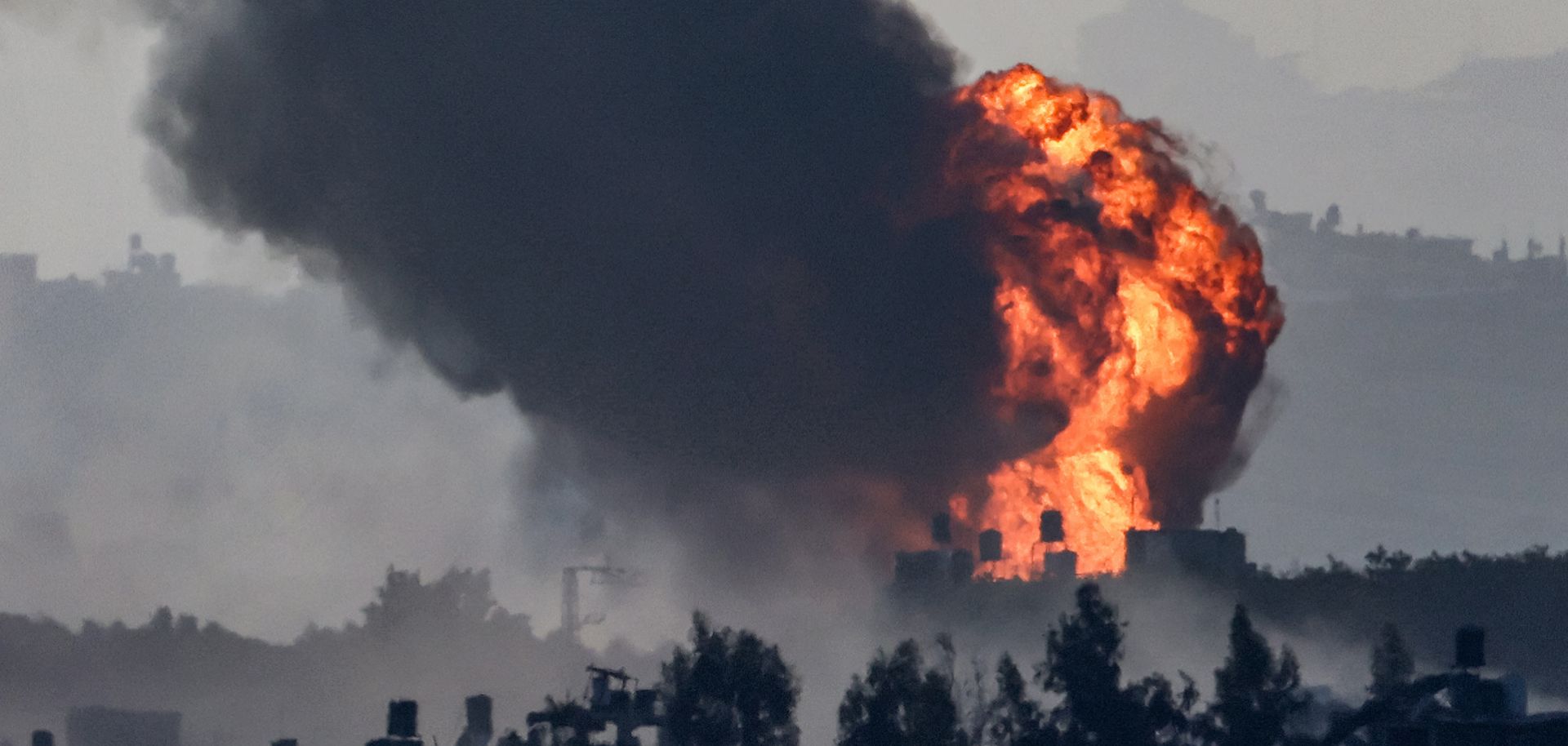
Growing domestic and international pressure may force Israel to either accelerate its ground offensive in the Gaza Strip at the risk of causing a sudden regional escalation or abandon its stated objective of fully destroying Hamas. An article published on Nov. 3 in Foreign Policy cited sources within the Israeli army who suggested that Israel would focus on targeted raids and airstrikes to weaken Hamas and other militant groups in Gaza, rather than launching a full-scale offensive across the entire strip. This report aligns with the Israeli military's early ground maneuvers in the strip. Since commencing ground operations on Oct. 27, Israel has concentrated on isolating Gaza City, the largest city in the strip, and conducting limited operations aimed at dismantling key Hamas strongholds and restricting the movements of Hamas and other militant groups. These operations have involved only a fraction of the mobilized forces on the Gaza-Israel border. Israel's approach seeks to minimize Israeli military and Palestinian civilian casualties and increase the likelihood of discovering hostages held by Hamas. Simultaneously, avoiding a full-scale invasion appears designed to appease the U.S. push for Israel to allow humanitarian pauses as political pressure in Washington grows to secure a cease-fire. Finally, an altered military strategy in Gaza may help limit the scale of financial assistance — which may surpass the levels seen during the peak of the COVID-19 pandemic in 2020 — required to support businesses affected by the full-scale mobilization of the Israeli military and the accompanying war in Gaza by shortening the length of large-scale combat operations.
- Israel has activated around 360,000 reservists in response to the Oct. 7 Hamas assault on southern Israel, marking the largest reserve call-up in the country's history. Not all of these troops have been deployed to the Gaza Strip; some have been stationed along the northern border and in the West Bank to deter potential escalation from Iran and its Lebanese proxy Hezbollah. The Israeli army significantly outnumbers Hamas fighters in the Gaza Strip, with Israeli estimates putting Hamas forces at 25,000 to 30,000 before the war.
- Gaza's Hamas-controlled Health Ministry claims that over 10,000 civilians have been killed in Israeli operations in the Gaza Strip. While these numbers are disputed, the United States has publicly expressed concerns over civilian casualties. Such civilian losses have triggered a significant diplomatic backlash against Israel on the international stage.
A History of External Pressures
Israeli military campaigns have often been constrained by demographic, diplomatic and economic factors, preventing long wars with full mobilization. In the 1956 Suez Crisis, Israel, the United Kingdom and France halted their military campaign when U.S. pressure threatened to destabilize the United Kingdom's economy. In the 1973 Yom Kippur War, concerns about superpower involvement forced cooperation between the Soviet Union and the United States to impose a cease-fire. Most recently, in the 11-day Gaza conflict that erupted in 2021, Israel suspended military operations against Hamas after Washington signaled its desire for an end to the war.
Israel's gradual approach to the military operation in Gaza is likely partially aimed at buying time to craft a plan for the strip's post-war governance. A consensus on the end-game in Gaza once Israel removes Hamas from power has yet to be reached, both domestically and internationally. A Nov. 4 visit to the Middle East by U.S. Secretary of State Anthony Blinken, during which he met with regional allies and partners in Jordan, Turkey, Iraq and the West Bank, did not produce a consensus on how the strip should be governed following the war. Within Israel's wartime Cabinet, there are also reports of ongoing disputes over the governance solution for Gaza. In a Nov. 6 interview with U.S. media, Prime Minister Benjamin Netanyahu indicated that the Israeli army would likely maintain a long-term security role in the Gaza Strip, though this has not been formulated into official policy yet. Meanwhile, other Israeli officials, like Defense Minister Yoav Gallant, have previously said they prefer a new ''security regime'' over an Israeli occupation. While likely driven by tactical considerations on the ground, the slower progress of Israeli military operations in Gaza also provides diplomats and politicians with additional time to craft a framework for a potential governance plan after major combat operations cease.
- The Palestinian Authority has rejected a role in post-war Gaza, fearing that any involvement after an Israeli military operation could further weaken its legitimacy and spark violent protests in the West Bank. The United States has explored the possibility of a multinational force in the Gaza Strip, with countries like Turkey offering to deploy troops if such a force is created. However, it remains unclear how this force would govern the Gaza Strip and manage reconstruction responsibilities.
- Egypt, which governed the Gaza Strip from 1948 to 1967, has shown little interest in taking on a security or governance role in the territory due to concerns about the associated costs and its security forces potentially being forced to battle insurgents there.
For regional security and domestic political reasons, the United States is expected to exert greater pressure on Israel to cease major combat operations if the fighting extends into 2024, while Israel's politicians will likely push to alter the military strategy in reaction to economic pressures that build at home. Most immediately, the White House is concerned that an extended conflict could lead to regional escalation and accompanying energy shocks, both of which could embroil U.S. forces in a regional war and, secondarily, would have negative political implications at home. In a poll conducted by the Arab American Institute last month, only 17% of Arab Americans said they planned to vote for President Joe Biden if the election was held today — a steep drop from the 59% who said so in 2020. Swing states like Michigan, where Arab Americans comprise a significant voting bloc, are crucial to Biden's reelection campaign, so the government is incentivized to facilitate an end to the Israel-Hamas war before the campaign season begins in earnest. Meanwhile, domestically, Israel's politicians and economic officials will eventually signal that the military campaign will create unacceptable economic risks to the country long-term. While Israel's economy can likely withstand the effects of full mobilization for the next few months, the war could cost up to $51 billion, or 10% of GDP, if it lasts 10-12 months, according to the Calcalist newspaper. Additionally, the mass deployment of workers to the army is affecting business transactions and the essential workforce, and tourism to Israel has nearly halted. Adding to these economic strains, it remains unclear whether Israel will be partially responsible for the costly reconstruction of the Gaza Strip.
- The Biden administration has pursued a pro-Israel policy following the Oct. 7 Hamas assault, but this approach has faced growing controversy, particularly among young and Muslim voters within his Democratic Party. Critics have called for a unilateral cease-fire for humanitarian reasons, and President Biden has subtly shifted toward supporting humanitarian pauses in response to this pressure.
- Soon after the war began, Israel's central bank allocated $45 billion of reserves to defend the country's currency, the shekel. Prior to the conflict, Israel held over $200 billion in foreign exchange reserves.
These combined pressures will likely prompt Israel to pursue unattractive adjustments to its military strategy, either accelerating the pace of combat operations in the Gaza Strip or modifying military goals to avoid a full-scale assault. If the Israeli military chooses to speed up the invasion, major combat operations may end more quickly. However, this speed would come at the cost of more Israeli military and civilian casualties, particularly as Israel's army moves south, where most Palestinian refugees have sought refuge. A higher number of civilian casualties would worsen Israel's diplomatic standing and encourage escalation from Hezbollah and Iran, which would likely feel more politically compelled to respond to wide-scale Palestinian casualties with an escalation of attacks on Israeli and U.S. forces regionwide. Alternatively, diplomatic and economic pressures could push Israel's Cabinet to consider other solutions that leave at least part of the Gaza Strip unoccupied by Israel and some of Israel's military objectives unachieved. For example, Israel could agree to humanitarian pauses, which would enable Hamas to reorganize and regroup to further extend the military campaign. Alternative solutions might also manifest as a cease-fire deal under which Hamas withdraws from the strip, which would fall short of Israel's stated goal of destroying Hamas in Gaza. Additionally, Hamas' response to any internationally imposed cease-fire or deal to withdraw and/or surrender remains uncertain, as the group rejects negotiations with Israel. Finally, Israel could allow international forces, such as the United Nations or another international peacekeeping force, to control parts of the strip. However, this strategy may not effectively address Israel's security concerns, as the mandate of such a force would not necessarily include the suppression of Hamas and other militant groups.
- The small geographic size of the Gaza Strip makes a mass ground assault a viable option, given Israel's short supply lines and Hamas' limited defenses.
