
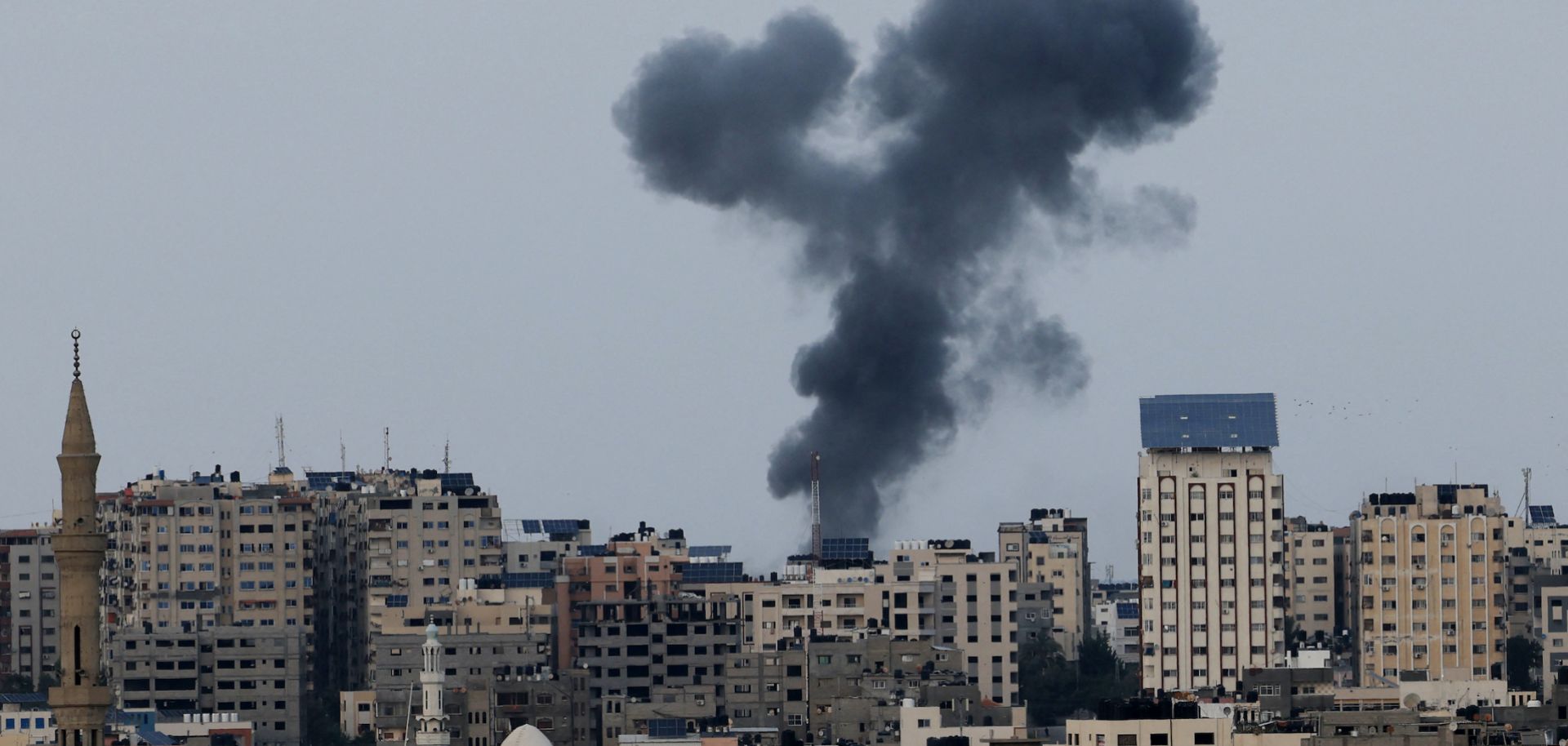
As Israel prepares for a ground invasion, its most likely post-war plan for the Gaza Strip will resemble its occupation of the West Bank, which will tie Israel's military down, alienate its allies abroad and destabilize its current government. Israeli politicians are giving hints about what the post-war political and security situation in the Gaza Strip might be. On Oct. 20, Israeli Defense Minister Yoav Gallant said that Israel's military campaign would create a new ''security regime'' in Gaza, and said the war would proceed in three phases. The first, he said, would be an air and ground campaign to break Hamas' formal control of the Gaza Strip. The second phase would then focus on eliminating pockets of Hamas forces, while the third and final phase would implement a ''new security regime'' that would allow the Israeli military to step back from formal control of Gaza. His comments came a day after opposition leader and former Israeli Prime Minister Yair Lapid said that the best option for a post-Hamas Gaza regime remains the Palestinian Authority (PA), which rules over the West Bank. The same day, CNN reported that Israel plans to build a deeper buffer zone around the whole of the Gaza Strip that would be set up as a demilitarized zone. These comments all came as Israel's war cabinet greenlit the invasion of Gaza, with the timing remaining uncertain as Israeli forces await the order to cross into the territory.
- Israel's stated war aims are to ''destroy'' Hamas and end its governance of the Gaza Strip. This starkly contrasts with the last Gaza wars in 2021 and 2014, where Israel aimed to diminish Hamas' abilities to attack Israel and deter it from harassing the southern border.
- Israel's political decision to invade came after U.S. President Joe Biden visited Israel on Oct. 18, where he backed Israel's war effort. In a phone call with Netanyahu shortly after Hamas conducted its Oct. 7 assault on Israel, Biden compared the Gaza-based militant group to the Islamic State.
A History of the Gaza Strip
Though Gaza has been inhabited for thousands of years, its distinct geography emerged after the 1948 Israeli War of Independence, when Egypt occupied and annexed the area, formerly part of the British Mandate of Palestine, to have a forward military position against the new Israeli state. Israel captured the territory from Egypt in 1967, establishing some settlements there, but Gaza never held the same religious or cultural significance to settlers as the West Bank, and its Palestinian population rapidly swamped the few thousand Jewish settlers living there. It became a hotbed of militant activity in the 1980s and 1990s, often but not exclusively led by Hamas, and Israel's military struggled to control the security situation while its government turned its attention to settlement expansion in the West Bank. In the 1993 Oslo Accords, the Gaza Strip was designated one of the first parts of the region to come under PA control, though Israel reserved the right to control its airspace and waters. In 2005, following the Second Intifada, Israel's right-wing Prime Minister Ariel Sharon decided to unilaterally withdraw from Gaza to hand it over to the PA, pulling settlers out by force and dismantling military bases and settlements, as he hoped to restart peace negotiations that would allow Israel to annex major settlements in the West Bank. A year later, Hamas began an armed rebellion against the PA in the Strip and took control in 2007. Israel imposed a blockade of the Strip, and carried out nearly annual military operations — including major ones in 2009, 2014 and 2021 — to degrade and deter Hamas. After the 2014 war, Israel began to allow Qatari humanitarian aid into the Strip in exchange for relative quiet from Hamas, a strategy which, up until Oct. 7, had convinced Israel's military and intelligence leaders that they were moderating Hamas
After Israel's main ground invasion is over, Israel will likely look to the PA for its first option to govern the Gaza Strip, but the PA's lack of legitimacy and unwillingness to cooperate with Israel may be a major obstacle in restoring the PA to power there. Israel's ground invasion could take weeks to fully carry out, and will presumably result in many more casualties, including among Israeli soldiers, Palestinian civilians, Hamas fighters and militants of other groups like Palestinian Islamic Jihad (PIJ). When it is complete, Israel's politicians will want to demobilize its 300,000 reservists to help the Israeli economy return to normal and avoid returning direct Israeli governance to the Gaza Strip which would involve a potentially interminable deployment of Israeli soldiers who would be under constant threat. However, given that the roughly 2 million people living in Gaza will still need security to both assure their own humanitarian needs and prevent a return of Hamas, Israel will likely try to bring the PA in to govern the territory. But the PA is already struggling to govern the West Bank, in part because it lacks popular legitimacy there because of its record of corruption and cooperation with Israel. After all, the PA's budget is strained as international aid has dried up, partially due to the fact that current PA President Mahmoud Abbas is ailing and has no clear successor. This will make it difficult for the PA to function effectively in the Gaza Strip, where it is also highly unpopular. In addition, President Abbas has made it clear he opposes the Israeli invasion of Gaza, and on Oct. 18 pulled out of a U.S.-led summit in Jordan to protest both the war and the Oct. 17 hospital attack in Gaza that Abbas blamed on Israel. Abbas is thus unlikely to quickly accept an offer from the Israelis to govern the Gaza Strip in a manner that might make the PA look like a cooperating occupation force.
- The PA was meant to hold elections in the West Bank in May 2021 but canceled them for fear that Hamas would gain enough votes to take the PA legislature. A similar Hamas electoral victory in 2006 led to the PA's ouster of control in the Gaza Strip and raised questions as to whether Western powers like the United States and the European Union could financially aid the PA if it was under the control of Hamas, an organization legally designated as a terror group by both.
- Abbas described the recent blast at Gaza's Al-Ahli al-Arabi hospital as a ''war massacre'' and blamed Israel. Nevertheless, PA security forces clashed with protesters across the West Bank, as many Palestinians blamed the PA for enabling Israel's current military campaign in Gaza.
If the PA does eventually take control of Gaza, it will be dependent on Israeli military support to maintain power, forcing the Israel Defense Forces (IDF) to intervene routinely in Gaza to keep the PA in power when popular unrest breaks out. Despite facing resistance from locals, if offered the option by Israel, the PA will be incentivized to retake Gaza in part because doing so would be one way to restore international aid that has otherwise been dwindling for the government; the Gulf Cooperation Council has already announced $100 million in pledges of emergency aid for the Gaza Strip. It would also be a way for Fatah, the ruling party of the PA, to help weaken and suppress Hamas, its rival, as the PA prepares for the eventual succession of Abbas. This makes it probable that once the immediate public outrage over Israel's invasion fades domestically and internationally, the PA will take up control of the Gaza Strip. But it would remain unpopular, as there is no guarantee that the PA would have enough international aid to develop sufficient numbers of security forces, let alone to rebuild Gaza and meet the economic expectations of its residents, which would likely spark protests and riots against the PA. The IDF would, in turn, likely have to play the same role for the PA in the Gaza Strip as it does in the West Bank, where its forces intervene frequently to bolster the PA and prevent the rise of militants. IDF forces would also likely have to carry out a long-term strategy of making raids and arrests even in PA-held territory to prevent the resurgence of Hamas or the emergence of new militant groups. Israel's apparent plan to create a larger buffer zone around Gaza would also, to some degree, help mitigate weakness from the PA in policing the territory by offering an additional layer of security.
- Under the Oslo Accords, the West Bank is divided between areas of PA control, joint PA and Israeli control, and exclusive Israeli control. The Gaza Strip, meanwhile, is meant to be exclusively under PA control. But given the moribund state of the Oslo Accords and the outrage caused by the Oct. 7 Hamas attacks, Israel seems likely to modify this condition, reserving the right for the IDF to operate and maintain a presence in the Gaza Strip long term. In the West Bank, the IDF tends to leave the major cities under PA control, preferring to control transport routes and the countryside.
- The PA's budget is entirely dependent on international aid and taxes collected by Israel from Palestinians and then delivered to the PA. But international aid has been drying up — particularly from the United States and Arab Gulf states — as recurrent Israeli-Palestinian violence reduced hope for a two-state solution, and as the COVID-19 pandemic, the war in Ukraine, and global economic problems fueled general aid wariness.
If the PA does not take over the Gaza Strip, the territory will end up back under IDF military occupation, forcing Israel to engage in a long-term occupation to mitigate militant threats and reduce the risk of rocket and missile attacks from Gaza. For Israel, an extended occupation of Gaza would also portend greater casualties, economic costs and political fissures. If the PA refuses to govern Gaza, Israel's Coordination of Government Activities in the Territories (COGAT) would take over instead, while Israel's government would look for alternative Palestinian partners to govern the Strip in the long term. This would expose the IDF to continual clashes with Palestinians and a long-running insurgency, but it would still prevent the resurgence of Hamas as a governing authority and curtail the rocket and missile threat that has emerged from Gaza since Hamas took over in 2007. Although militants would still be able to carry out hit-and-run attacks and fire isolated rockets toward Israel, the overall militant threat would be dramatically reduced, and operations at the scale of the Oct. 7 attacks would no longer be possible. Nevertheless, in a long-term occupation, the IDF would suffer casualties and a likely uptick in broader terrorism risks from various regional armed groups angry over Israeli control of the Gaza Strip, while the military would have to extend its budget to cover the costs of occupation. Additionally, Israel's civilian government would have to face the tall order of reconstructing the war-torn territory, further straining the country's post-war budget and causing friction in the Israeli government, where far-right parties would resist allocating funding to a re-occupied Gaza Strip. Meanwhile, some far-right parties in Israel would also push to establish settlements in Gaza and eventually annex it, which would strain the cohesion of the government as center-right parties resist this.
A long-term Israeli military presence in Gaza, either with the PA or especially without it, will alienate key states in the Arab world, most notably Saudi Arabia. Israel's Western allies, like the United States, would also press the Israeli government to find a lasting solution to the Israeli-Palestinian conflict that would prevent a replication of the Oct. 7 attacks. Such a solution, however, would involve highly unpopular political concessions that could lead to defections in Israel's post-war government and early elections. Saudi Arabia was already pressing for concessions to the Palestinians ahead of Israeli-Saudi normalization, but the Israeli-Hamas war has increased the domestic political urgency for such concessions ahead of any deal. Moreover, the war is a reminder of the region's fragile order in which fighting between Israel and Palestinian factions could produce an expanded war that would rattle global energy markets, with Israel and its allies on one side, and Iran and its proxies on the other. Such a conflict would threaten to engulf not just Saudi Arabia but other Arab states like Jordan, the United Arab Emirates and Bahrain, all of which will want Israel to take steps to reduce the likelihood of this scenario by defusing tensions with the Palestinians. Washington will add to this pressure, trying to restart the two-state solution, as a means to reduce the risk of another Israeli-Palestinian war dragging the United States back into the region as it tries to focus attention on Russia and China. However, this pressure will run up against the far-right priorities of much of the current Israeli government, which continues to favor settlement expansion in the West Bank, annexing territory and even a permanent reoccupation and resettlement of the Gaza Strip. When the wartime government dissolves after combat ends, attempts by the government to meet foreign demands for concessions to the Palestinians could result in far-right individuals defecting from it and bringing early elections, which will incentivize the government to resist such foreign pressure in hopes that it will fade over time. However, resisting this pressure could also alienate more moderate members of the government eager to retain good ties with the United States and normalize with Saudi Arabia, possibly causing defections from these parties as well that could still produce early elections.
- In a televised national address on Oct. 19, U.S. President Joe Biden re-emphasized America's traditional commitment to the two-state solution in the Israeli-Palestinian conflict. Biden has also stated repeatedly that he hopes Israel will learn from the United States' own policy mistakes after 9/11 that led to overreach in places like Afghanistan and Iraq, in a bid to convince Israelis that concessions may be necessary in the post-war environment to stabilize the region's security.
- The current Israeli government is made up of center-right, far-right and religious parties, of which the center-right, led by Likud, has members who have already expressed concern about the government's affiliation with the far-right and its plans for the judiciary. Only five members of the government would need to defect to call early elections.
