
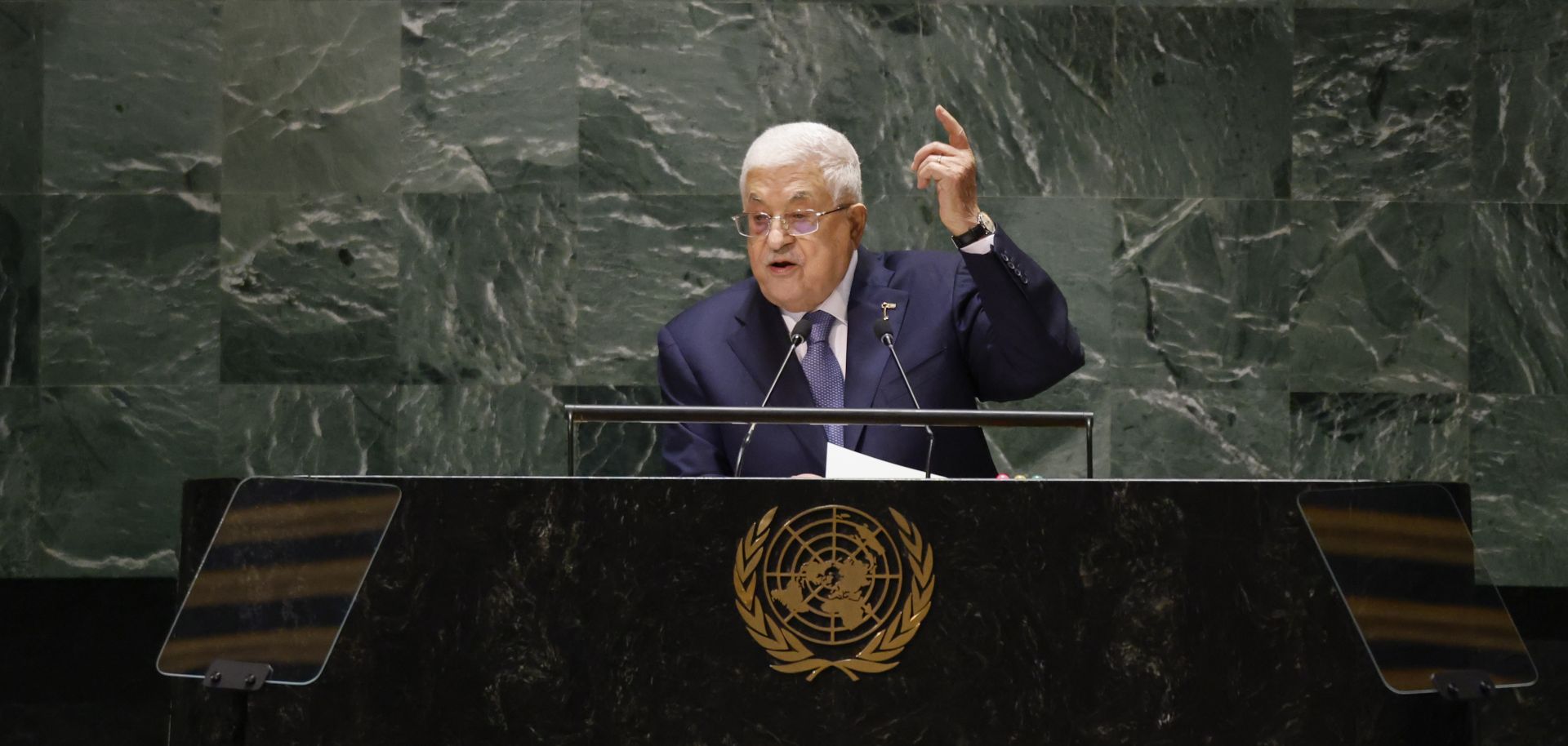
The Palestinian Authority (PA) faces a succession crisis that risks leaving the governmental body without a leader, which could cause major political upheaval and social unrest in the West Bank, especially in light of the escalating Israel-Hamas war in nearby Gaza. 87-year-old PA President Mahmoud Abbas has yet to name a successor, despite his age and allegedly ailing health. While different members of Fatah, the dominant political party within the PA, are already vying to replace Abbas, none have so far gained enough legitimacy within the party or the government to emerge as a clear successor.
- Abbas has served as the president of the PA, which governs the Palestinian-controlled parts of the West Bank, since his election in 2005 following the death of Yasser Arafat. Arafat's death was the only time since the PA's inception in 1994 that there has been a leadership transfer of power. As prime minister of the PA and a close associate of Arafat (who was extremely popular among Palestinians at the time), Abbas was quickly accepted as the natural successor to Arafat as the leader of the Fatah party. His nomination was endorsed by Fatah's Revolutionary Guard council and was then solidified upon his victory in the 2005 election in which he won 67% of the vote.
- Following its victory in the 2006 election, Hamas split from the PA. This eventually saw Hamas gain control of Gaza in 2007 after a brief conflict with Fatah, while the Fatah-dominated PA remained in the Palestinian-controlled areas of the West Bank.
- Under Palestinian law, if the PA president dies in office, the speaker of the Palestinian Legislative Council should be sworn in as the Interim President for 60 days until an election is held. However, the Palestinian Legislative Council has been virtually defunct since 2007, and the Speaker is Aziz Dweik, a Hamas member, whose authority would most likely be extremely limited in the Fatah-dominated PA. Because of this, there is significant uncertainty over how the legal process for succession would play out.
Throughout Abbas's tenure, public opinion of the PA has steadily declined, leading to growing challenges from within the party, as well as its more hard-line rivals. Years of endemic corruption — especially among senior officers, including Abbas himself allegedly — have undermined the PA's popularity. Moreover, while the West Bank's economic situation has improved since the end of the COVID-19 pandemic, it nonetheless remains bleak, with high unemployment and inflation. Most importantly, Palestinians in the West Bank have become increasingly skeptical of the PA's ability to negotiate or pressure Israel into ending its occupation of the territory. In recent years, Israeli settlements have dramatically expanded, as have Israeli settler attacks on Palestinian homes and property, resulting in popular grievances that the PA and specifically Fatah have proven themselves to be weak and ineffective defenders of Palestinian interests. Against this backdrop, the PA and Fatah have been losing influence to a host of other groups pledging to take a stronger stance in regards to Israel. The outbreak of the Israel-Hamas war in Gaza last month has only since amplified these grievances and worsened popular unrest in the West Bank. Abbas's popularity, in particular, appears to have taken a major hit amid Israel's expanding military operation in Gaza. In recent weeks, Palestinians in the West Bank have staged frequent anti-government protests, which PA security forces have cracked down on forcefully, drawing further scrutiny on the government. And Abbas himself has come under pointed criticism for being ineffectual in pushing back against Israel.
- During protests on Oct. 19 over the blast at the al-Ahri Arab Hospital in Gaza, PA security forces shot and killed a 12-year-old Palestinian girl in Jenin. Protesters have frequently called for Abbas to step down over the PA's weak response to escalating violence between the Israel Defense Forces (IDF) and the Palestinian residents of the West Bank. Since the latest Hamas-Israel war broke out on Oct. 7, more than 120 Palestinians have been killed in the West Bank by Israeli forces, further exacerbating the sentiment that the PA is incapable of deterring Israeli military action in the West Bank.
- The Al Aqsa Martyrs Brigade (AAMB), Fatah's militant wing, has called on Abbas to step down from some of his Presidential duties. The AAMB said that if he does not, he will be the target of militant attacks.
- Despite a two-year unity government with Hamas (Fatah's main rival) between 2014 and 2016, Abbas's leadership has also seen a deterioration of relations with the militant group, whose support among Palestinians has increased in recent years.
- According to a poll conducted by the Palestinian Center for Policy and Survey Research in March 2022, 73% of Palestinians want Abbas to resign, indicating the extent to which the Abbas-led PA government is unpopular.
Due to the ongoing Israel-Hamas war, a succession crisis within the PA would have the potential to further destabilize the West Bank and Gaza. Given that Israel's stated objective is to destroy Hamas's government in Gaza, some post-war plans envision reincorporating Gaza under PA control if Israel is successful in this aim. While there are many stumbling blocks to such a plan, a succession crisis that destabilizes the PA, especially if its security forces were to break down, would make it even harder for the PA to regain control of Gaza, and more likely that a prolonged Israeli-controlled military occupation government would instead gain control of the strip. In general, there are three primary scenarios for how a PA succession crisis could unfold:
Scenario 1: Managed Chaos (Most Likely)
A somewhat chaotic transition involving a crisis within the Fatah party is the most likely scenario to play out in the event of Abbas's death, resulting in street protests and isolated acts of violence, but no major conflict in the West Bank. The most obvious person to replace Abbas is Hussein Al-Sheikh, head of the General Authority of Civil Affairs in the PA, and Secretary General of the Executive Committee of the Palestinian Liberation Organization. However, he has virtually no grassroots political support and effectively owes all of his power to his proximity to Abbas, meaning he would likely face challengers. The two most likely candidates to challenge Al-Sheikh for the position are Jibril Rajoub and Mahmoud Al-Aloul. Jibril Rajoub is the Secretary General of Fatah, and he has managed to build popularity and support as a result of his cultural prominence as the head of the Palestinian Football Association. Mahmoud Al-Aloul is Fatah's current Deputy Chairman, as well as former Governor of Nablus, and has garnered significant support among older Palestinians and Fatah party members. However, given the fact that neither Al-Aloul nor Rajoub are PA members, they do not have access to any of the bureaucratic mechanisms that PA leaders have in order to gain support for their government appointments (such as the ability to easily bribe or intimidate government members for support). Therefore, these candidates would have to rely on outside support, which they'd likely try to garner among the Palestinian population. This would likely result in street protests, strikes and other grassroots activism in retaliation for the corruption and ineffectiveness of the PA as it currently stands. It would also increase the likelihood of Hamas and/or Palestinian Islamic Jihad (PIJ) trying to take advantage of the situation by carrying out attacks in the West Bank against the PA. However, as long as the war in Gaza continues, they will likely need to prioritize fighting the IDF there and, as long as the conflict remains mostly within the Fatah party, escalation will be limited to disruptions and disturbances rather than major violent conflict. Despite a chaotic transition period, this situation would nevertheless result in a weakened yet intact PA dominated by the Fatah party. Over the longer term, such a situation could also increase Israel's imperative to control the West Bank and feed into the Israeli far-right demands to annex the area. While it may provide near-term stability, this scenario would still leave fundamental questions about West Bank governance unanswered, meaning tensions between the PA and Israel would persist.
Scenario 2: A Stable Transition (Less Likely)
The most stable and somewhat less likely potential outcome would be a short and orderly transition to one of Abbas's close political allies and fellow PA officials, most likely Al-Sheikh. Al-Sheikh is seen as a pragmatic power broker, who has the added advantage of being trusted by his Israeli counterparts. However, like Abbas, he is viewed as being a part of the old guard of the Fatah party who maintains hope that negotiations with Israel could yield a two-state solution, an outcome that a decreasing number of Palestinians and Israelis desire or even see as a possibility. While al-Sheikh's position was undermined by a recording leaked to the press in 2022 of him cursing Abbas, he has recently regained standing as his potential rival, Majed Faraj, has endorsed his attempt to replace Mahmoud Al-Aloul as the Deputy Chair of Fatah at its Revolutionary Council conference this December. A smooth transition to Al-Sheikh — a close Abbas ally — would portend policy continuity, thus resulting in the least immediate impact on Palestinian society. Al-Sheikh would also likely lack either the will or power to end the systemic corruption within the PA, meaning there would be minimal disruption to the status quo as well. This scenario is not currently the most likely outcome of a succession crisis within the PA, but it would become significantly more likely if Abbas steps down prior to his death, while throwing his full support behind a single candidate and personally overseeing the transition himself. This scenario would lead to an outcome in which the PA remains stable in the short-to-medium term, yet continues to face similar challenges when it comes to corruption and a lack of popular support that threaten its long-term viability to exist in its current form. Additionally, this scenario would increase the likelihood of Gaza coming back under PA control if Israel succeeds in destroying the Hamas government in the West Bank, because an orderly PA leadership transition would provide some credence to its internal unity and ability to govern.
- In 2023, a Gallup poll found that Palestinian support for a two-state solution had reached an all-time low of 24%. Meanwhile, a 2023 Pew Research survey found similarly low levels of support for a two-state solution among Israelis, with only 35% believing that an Israeli and a Palestinian state can coexist peacefully.
Scenario 3: The PA Collapses (Least Likely)
The most chaotic potential outcome would be one in which the PA collapses as a result of either internal fissures or being challenged by militants, likely leading the Israeli military to forcefully intervene to try to prevent a more extreme group from taking over. This is currently the least likely scenario. But its likelihood is steadily rising as the ongoing war between Israel and Hamas escalates. Israel's ground incursion into Gaza and stepped-up operations in the West Bank are raising the risk of violent mass unrest in the latter territory, where many Palestinian residents see the PA as a puppet for the Israeli occupation. This is increasing the probability that the already fragile PA collapses under the weight of its own internal fissures, or under pressure from more extreme militant forces (such as fighters from local groups like the Lions' Den or factions allied to Hamas and PIJ). The likelihood of this scenario would also increase if Abbas suddenly dies before Fatah and PA officials have coalesced around a candidate. In such a scenario, Israel would radically increase its military operations in the West Bank with the goal of deterring a militant takeover. One significant danger in this scenario would be a potential breakdown of the Palestinian security forces, which would result in a devastating conflict directly between militant groups and the Israeli military for control of the West Bank. If this scenario were to occur during the current Israel-Gaza war, it would also significantly increase the risk of a larger-scale regional conflict, as Israeli military resources would be spread thin across a multi-front conflict. Such a conflict would open the door for other actors (such as the Iran-backed Lebanese militant group Hezbollah) to increase their involvement; Israeli forces, meanwhile, might not be able to quickly regain control of the West Bank.
- The Oslo Accords, signed between Israel and the Palestine Liberation Organization in 1993 and 1995, divided the West Bank into three areas: Area A, administered solely by the PA; Area B, administered by both the PA and Israel; and Area C, fully controlled by Israel. Area C covers the majority of the West Bank. Assuming that the IDF eventually did regain control of the rest of the territory, the above scenario would almost certainly include the prospect of Israel moving into the West Bank to reoccupy Area A.
