
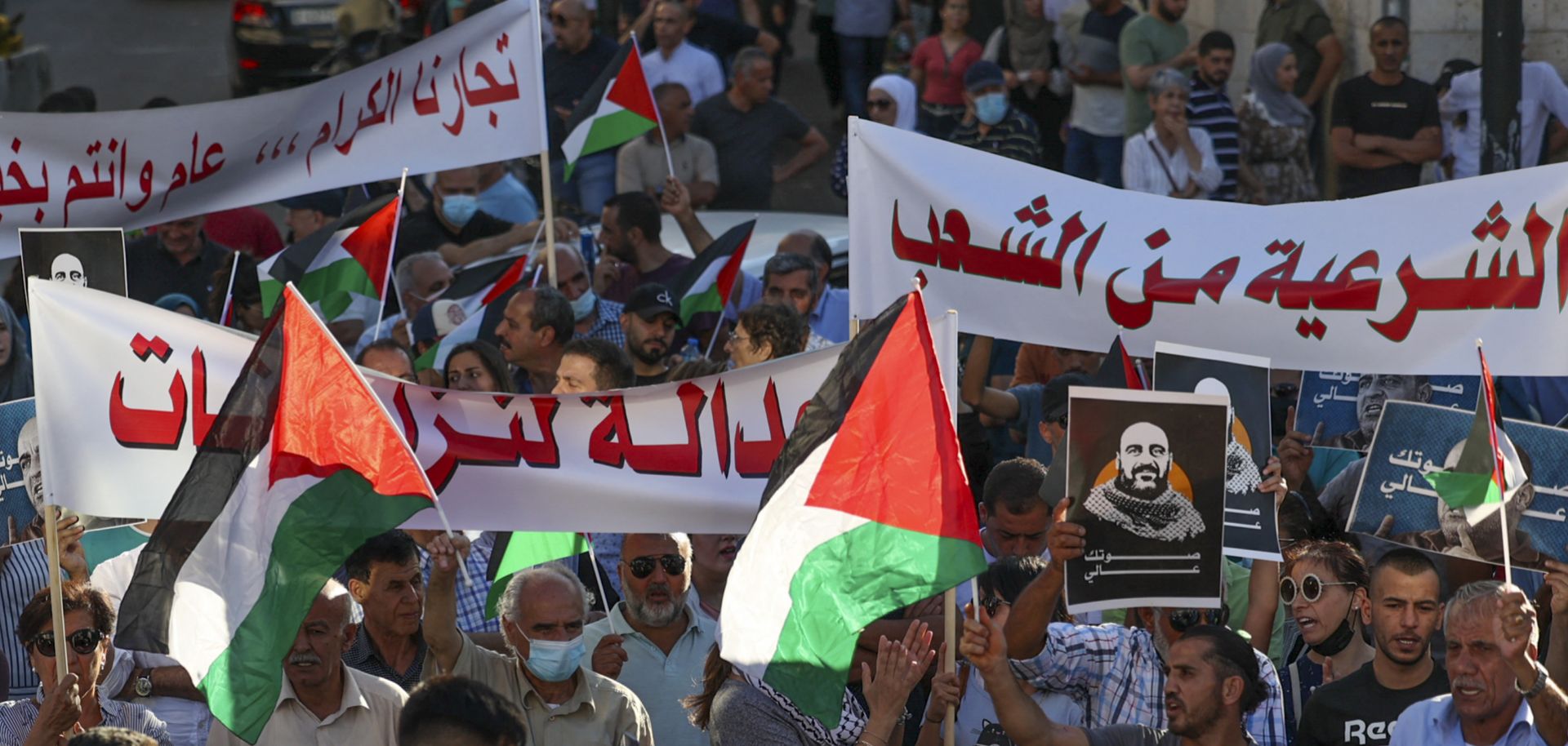
Palestinian protesters rally in Ramallah city on July 17, 2021, denouncing the Palestinian Authority after activist Nizar Banat died while in the custody of its security forces.
Israel is hoping to prevent a major security crisis by helping improve the West Bank’s economy and, in turn, the Palestinian Authority (PA)’s political legitimacy. But there’s little Israel can do to stop militants from using Palestinians’ growing frustration with the PA to recruit and inspire attacks on Israeli forces. On Aug. 29, Israeli Defense Minister Benny Gantz and Palestinian President Mahmoud Abbas met to discuss the West Bank’s economy, security situation and mutual challenges. The meeting, approved by Israeli Prime Minister Naftali Bennett, marked the highest-level dialogue that the two sides have engaged in since 2010, signaling Israel’s interest in boosting the Abbas administration. As part of the push, Israel also announced on Aug. 30 that it would send $155 million worth of Palestinian tax revenue in the form of a “loan.”
- The Palestinian economy has struggled in recent years following the collapse of aid from the United States and Arab states. COVID-19 lockdowns and reduced tourism rates then exacerbated those financial woes, with the Palestinian economy shrinking by 11.5% in 2020.
- In 2018, Israel also passed a law that has prevented a large amount of Israeli-collected Palestinian revenue from being transferred to PA coffers as long as the PA continued paying out families of those arrested by Israel or killed in fighting against Israeli forces.
- A series of recent political controversies have further reduced the PA’s domestic popularity as well. This includes the government’s move to cancel what would have been the first Palestinian elections in 15 years this summer, the June death of PA critic Nizar Banat while he was in Palestinian police custody, and the PA’s perceived acquiescence to Israeli military action during the May 2021 flare-up in Gaza.
Israel is likely to offer more economic concessions, including new work permits and tax revenues, while leaning on the United States and its Arab Gulf allies to restore some of their aid to the PA. Gantz has already floated the prospect of issuing 15,000 more work permits for Palestinians to work in Area C, the Israeli-controlled section of the West Bank. More permits are likely for both Area C and for Israel itself, especially as the Israeli economy recovers from initial pandemic-related shocks. Israel is also likely to push through more financial support despite the 2018 law, using creative ways like the recent “loan” to bypass the law. Through its warm ties with states like the United Arab Emirates and Qatar, Israel will probably seek fresh Arab Gulf aid for the PA as well, much of which was reduced or suspended during the administration of former U.S. President Donald Trump. To that end, Israel will lean on the new White House administration, which is also restoring aid to the PA cut during the Trump years.
- Donations for the U.N. Relief and Works Agency for Palestine Refugees in the Near East (UNRWA), a key aid mechanism to support the West Bank’s economy, totaled $619 million in 2019. The bulk of those donations came from Europe and private donations following the Trump administration’s move to cut U.S. aid to the Palestinian territories that year. Currently, the UNRWA has only $458 million in pledged donations, with $150 million is coming from the United States so far under the new Biden administration.
But while such efforts may help bolster the Palestinian economy, more violence remains possible as Israel has few means to keep militants from taking advantage of anti-PA sentiment caused by Abbas’s controversial political decisions. The PA’s waning legitimacy will create political space for the growth of militant groups like Hamas and Palestinian Islamic Jihad, who will both seek to create tension with Israel and inspire new recruits in the West Bank by attacking Israeli military forces. Relying on Israeli aid also runs the risk of Palestinians accusing the PA of acting as an Israeli proxy rather than a representative of the Palestinian people, further undermining the Abbas administration’s legitimacy.
- The PA is unlikely to revive elections after canceling them earlier this year — worried that Hamas might win the vote and trigger sanctions from the United States and the European Union, which both list Hamas as a terrorist organization.
- The PA lacks a clear successor for 85-year-old President Abbas, increasing frustration among those who want a clear political future for the Palestinian territories.
- The PA has also struggled to gain diplomatic leverage over Israel and many Palestinians accuse it of acquiescing to Israeli expansion in the West Bank.
