
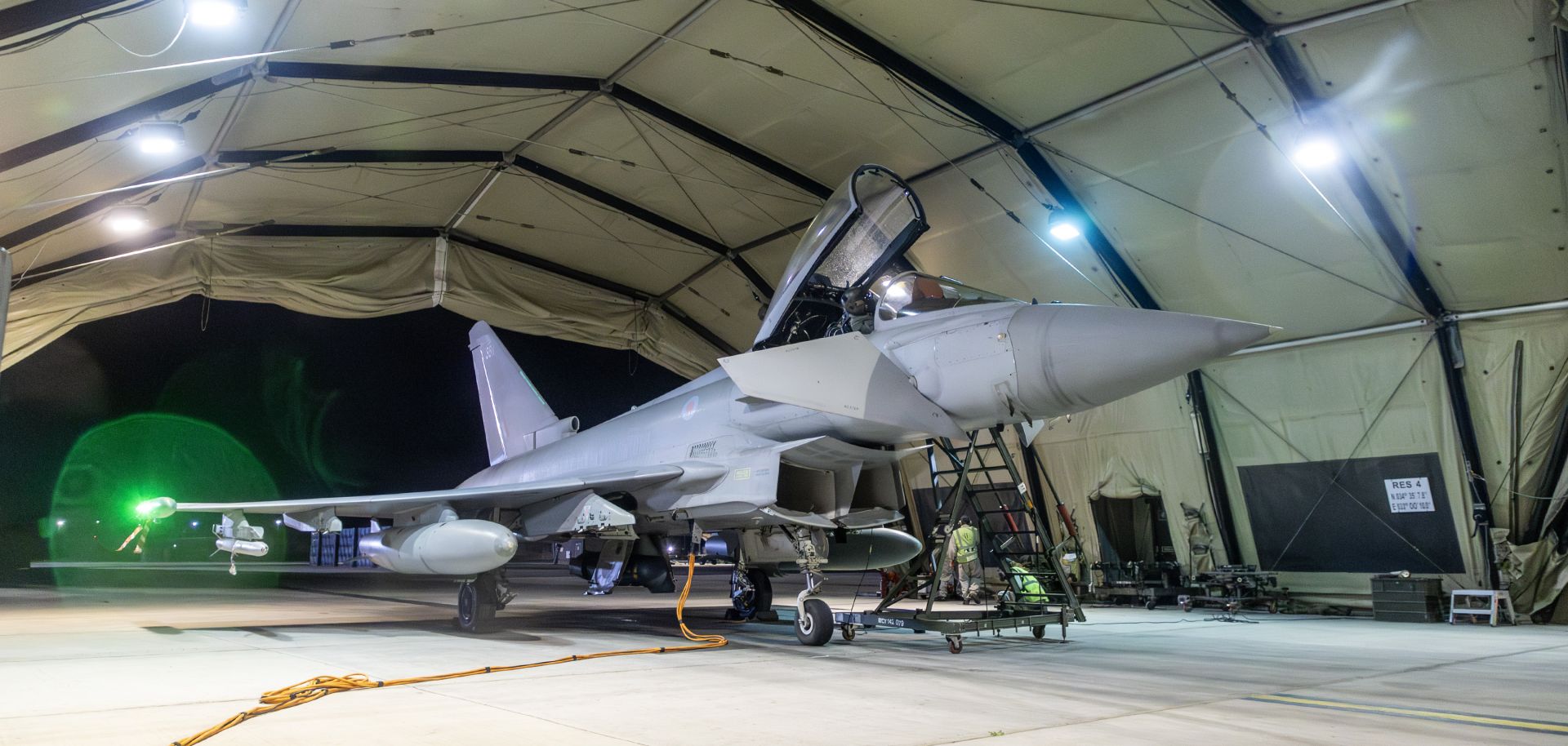
While U.S.-British joint strikes on the Houthis will degrade some of their capabilities, they are highly unlikely to dissuade the Yemeni militant group from continuing to target shipping in the Red Sea. They also open the door to Houthi attacks directly against U.S. and partner naval vessels and increase the likelihood of more significant regional escalation, though this still remains unlikely. In their overnight Jan. 11 military strike, the United States and the United Kingdom launched more than 100 precision-guided bombs and Tomahawk missiles at Houthi positions in Yemen. The strikes hit 60 targets at 16 different locations, including command-and-control nodes, munitions depots, UAV and missile launching systems, production facilities, and air defense radar systems. Explosions reportedly occurred at sites in the Yemeni cities of Dhamar, al-Hudaydah, Saada, Sanaa, Taiz and Zabid, spanning most of the Houthi-controlled territory in western Yemen adjacent to the Red Sea. Statements by President Joe Biden, U.S. Central Command and the defense secretary all warned that the United States was prepared to follow up with more strikes on Yemen if the Houthis continue targeting ships in the Red Sea.
- In a show of force, as the U.S. rarely reveals the location of its submarines, U.S. defense officials said the USS Florida nuclear-powered guided-missile submarine was also involved in the strikes.
- The strikes were carried out with the support of Australia, Bahrain, Canada and the Netherlands; U.S. officials said they considered ensuring the operation was not unilateral was important.
- Houthi spokesperson Yahya Saree said in a Jan. 12 televised statement that five Houthi fighters were killed and six were wounded, vowing that the Houthis would retaliate against U.S. and British targets and continue attacking ships in the Red Sea. On Jan. 12, the United Kingdom Maritime Trade Operations said it received the report of "an incident" 90 nautical miles southeast of Aden, but at the time of this publication, no further details about the incident had been reported.
The Houthi militant group is highly likely to continue to strike commercial targets in the Red Sea and will likely also escalate by retaliating directly against U.S. and British navy ships in the Red Sea. For strategic and ideological reasons, the Houthis appear to have been inviting Western strikes on Yemen soil, as the group ignored a Jan. 3 final warning by the United States and its partners in the Operation Prosperity Guardian — a U.S.-led multinational force created in December to protect ships from Houthi attacks — to stop its attacks or face consequences. Instead, the Houthis responded with their largest barrage yet on Jan. 9, firing 21 missiles and UAVs into the Southern Red Sea. U.S. officials called the attack the last straw, thus triggering the decision to move forward with the military strikes. The Houthi militant group's aggressive targeting of shipping in the name of supporting Palestinians in Gaza in their conflict with Israel has also drawn thousands of new recruits to the Yemeni militant group. The Houthis' disregard for previous warnings and the recruitment windfall is highly likely to persuade Houthi military leaders to continue launching strikes in the Red Sea, including on ships participating in Operation Prosperity Guardian. Thus far, the Houthis have focused on targeting commercial ships. That appears to be changing, as the British Defense Ministry has said some of the UAVs or missiles in the Jan. 9 barrage deliberately targeted U.S. and U.K. naval ships, and the Houthi movement in years past has shown a willingness to target U.S. Navy vessels. If the Houthis were to strike a U.S. British naval ship, the United States and/or United Kingdom would likely respond with follow-up strikes; and potentially even if U.S. or U.K. forces shoot down a barrage of missiles and UAVs targeting a ship.
- In 2016, the Houthi militant group unsuccessfully fired multiple missile barrages targeting the USS Mason destroyer, prompting the United States to strike Houthi radar sites in response.
- As an alternative response strategy to targeting U.S. and U.K. ships, the Houthis may instead launch missile and UAV attacks against U.S. and British defense partners in the region, such as Saudi Arabia and the United Arab Emirates, if Houthi leaders decide retaliatory strikes against Western targets would significantly damage the Houthis' operational capabilities or if the Saudis or Emiratis offer public support for U.S. and U.K. military action against the Houthis. The Houthis may also begin targeting oil and liquefied natural gas tankers, which have largely been spared from Houthi attacks thus far, in the Red Sea in recognition — as Iran recognizes — that oil prices are a politically sensitive topic in the West.
From a strategic perspective, the Houthis' political ambitions are likely to restrain the level of retaliation against naval ships, although the escalation between the Houthis and the United States puts peace talks in Yemen in peril. While Houthi attacks against U.S. and partners' naval vessels are on the table, the Houthis are unlikely to launch a major campaign to frequently target Operation Prosperity Guardian vessels over concerns that such attacks would invite follow-up U.S.-British joint strikes on the same scale as the Jan. 11 strikes and put increased American and Emirati pressure on Saudi Arabia to refrain from offering the Houthis concessions in Yemen peace talks. Both would put Houthi political gains at risk in Yemen, where they now control a region with about two-thirds of the country's population and are on the verge of reaching a cease-fire deal with the Saudis. Such a deal would represent de facto Saudi recognition of the Houthis as a legitimate political entity, something that has eluded the militant group since Saudi-led military intervention in Yemen was launched in 2015 after the Houthis took over the capital of Sanaa along with vast tracts of territory.
The large scope of the U.S.-British strikes will degrade some of the Houthi group's capabilities to launch attacks, but a single wave of attacks is unlikely to have taken out enough infrastructure to prevent follow-up Houthi attacks. While the loss of radar and command-and-control nodes will reduce the Houthis' ability to successfully track and target ships in the Red Sea and to communicate with UAVs, Iran's military and intelligence presence in the Red Sea remains. A series of military strikes would likely be needed to completely degrade the Houthis' capabilities, as the Houthis have a significant arsenal. Nevertheless, if the tempo and sophistication of Houthi attacks declines, then the strikes will have achieved London and Washington's goal.
Western military strikes on Yemen also risk retaliation against U.S. and British military interests elsewhere in the region, particularly the Persian Gulf and surrounding waters and Iraq, and increase the likelihood of a low-probability high-impact scenario of significant regional escalation. Thus far, Iran has mainly relied on its allied militias like the Houthis in the region to escalate with the West and Israel in the wake of Israel's invasion of the Gaza Strip, with Iran itself carrying out just two operations against ships, a Dec. 23 UAV strike on a chemical tanker off the coast of India and a Jan. 11 seizure of a crude oil tanker off the coast of Oman. Now that the United States and its defense partners have gotten directly involved in the conflict in Yemen with a large military operation, Tehran is more likely to engage in activity in the Persian Gulf and Gulf of Oman, not only in solidarity with the Houthis, but also to draw U.S. military assets and attention away from the Red Sea, where the United States sent a carrier strike group to from the Gulf of Oman. Still, the political imperatives that have led Tehran to refrain from significant escalation that would invite U.S. strikes on Iran remain in place, though this could shift after March 1 Iranian Assembly of Experts and parliamentary elections. Iran, for example, would not want to start targeting Gulf oil and gas infrastructure, which would jeopardize the ongoing normalization process of ties with Saudi Arabia and give the Saudis reason to back U.S. initiatives against the Houthis and pull out of talks with the Houthis. Iraqi militias may engage in some solidarity attacks against the U.S. presence in Iraq, but these attacks have already been occurring en masse since the Hamas-Israel war broke out. The United States has carried out retaliatory strikes against Iraqi militias, including a significant Jan. 3 strike that killed a senior commander from Harakat Hezbollah al-Nujaba, that have not led to broader conflict, suggesting U.S. strikes on Yemen will not do so either. That said, pro-Iranian militias in Iraq and Syria could escalate the frequency or sophistication of their attacks as part of a broader Iranian-backed escalation against the United States and its partners.
