
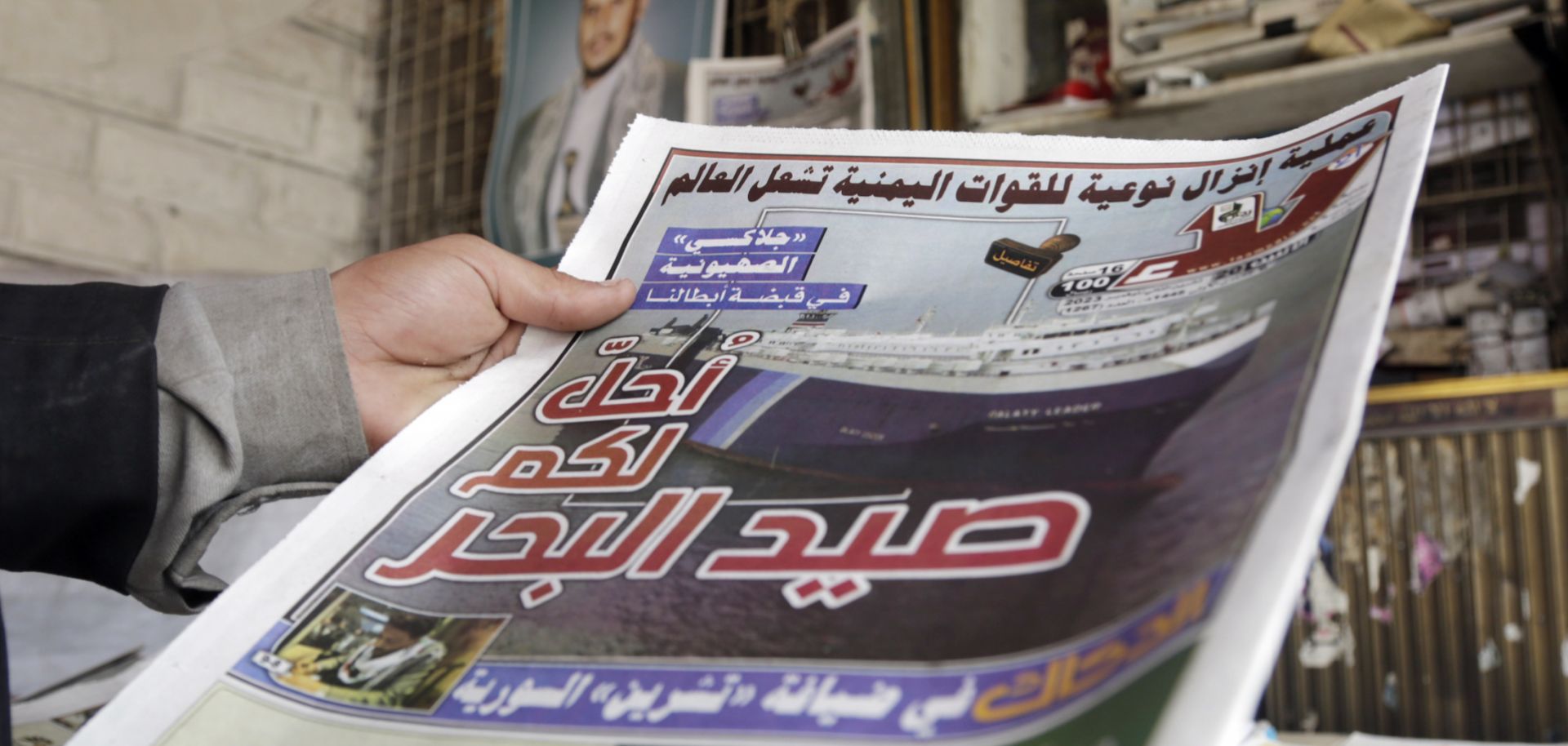
Iranian-backed Houthi rebels in Yemen will likely continue to conduct hijackings and drone attacks against Israeli-linked ships amid the ongoing war in Gaza, potentially embroiling the United States and/or Israel in retaliatory strikes. Houthi attacks off the coast of Yemen have escalated since Nov. 19, when the Iran-backed rebel group seized an Israeli-owned commercial ship in the Red Sea and took its crew members hostage, subsequently sharing a video of the hijacking to claim responsibility. A suspected Iranian drone, likely a Shahed-136 drone, then attacked an Israeli-owned container ship on Nov. 24 in the Indian Ocean (Houthis have a variant of the Shahed-136 drone called the Waid). A couple of days later, two missiles were fired from Houthi-controlled territory in Yemen after a U.S. Navy vessel responded to an Israeli-linked ship's distress call during an attempted hijacking by Somali pirates. On Nov. 28, an Iranian-made drone flew near the USS Dwight D. Eisenhower, positioned in the Arabian Gulf. And most recently, on Nov. 29, a U.S. Navy warship shot down an Iranian-made KAS-04 drone near the Bab el-Mandeb Strait that was launched from Yemen. The Nov. 19 seizure of the Israeli-owned vessel, and Houthis' subsequent attempted hijackings and drone attacks, have all occurred outside the immediate conflict zone in the Gaza Strip, indicating new Houthi tactics amid the ongoing Israel-Hamas war. The attacks have continued despite Israel and Hamas' temporary cease-fire in Gaza that went into effect on Nov. 24, which other Iran-linked groups in the region — such as Lebanese Hezbollah and Iraqi Kataib Hezbollah — have committed to respecting.
The recent series of hijackings and drone attacks come after Houthi rebels threatened to start targeting ships linked to Israel and its allies, and mark an escalation from earlier strikes made by Iranian-backed groups during the Hamas-Israel war. Since the Israel-Hamas war broke out last month, Houthi rebels in Yemen — along with other Iranian-backed militant groups in the region — have intermittently launched missiles and drones toward Israel in solidarity with the Palestinian cause, targeting assets linked to Israel and its key partner, the United States. But so far, these attacks have been mostly symbolic and have caused limited damage and casualties in an effort to avoid a greater regional escalation. However, on Nov. 14, Houthis' supreme leader said the group would start targeting Israeli-linked ships transiting the Red Sea and Bab al-Mandeb Strait — a threat that his fighters began making good on when they hijacked the Israeli vessel near Yemen on Nov. 19. Houthis' decision to begin targeting Israeli-linked ships near Yemen marks a shift from the tactics the group deployed earlier in the war, which saw Houthis launch drone and missile attacks toward Israel that were all either intercepted or did minimal damage. The recent attacks on vessels off the coast of Yemen also mark a notable strategic divergence from Iran, which has sought to avoid widening the conflict beyond Gaza for fear of making itself a target of direct Israeli or U.S. attacks. This, in turn, indicates that the Houthis are operating more independently from Tehran compared with other Iranian proxies in the region, including those in Lebanon (i.e. Hezbollah), Syria and Iraq.
- On Oct. 31, a Houthi military spokesperson claimed responsibility for missiles and drones that were launched toward Israel in solidarity with Palestinians in Gaza and that such attacks would continue ''until the Israeli aggression stops.''
- The Red Sea has become a key theater in Iran and Israel's covert war in recent years. In 2019, Israel attacked Iranian ships that were carrying oil and weapons around the Red Sea. Tehran also conducted missile and drone attacks against Israeli ships around the Arabian Peninsula. In November 2022, the U.S. Central Command also attributed an attack against an Israeli-owned oil tanker off the coast of Oman to an Iranian-made drone.
If Houthis' maritime attacks significantly damage U.S. military vessels and/or Israeli ships, the United States and Israel may be forced to conduct retaliatory strikes against Houthi interests in Yemen. The recent hijackings and missile attacks show that Houthis are willing and able to not only target Israeli-linked vessels but also U.S. military vessels. They also come as Hamas and other Iran-backed militant groups have de-escalated their attacks as part of the temporary cease-fire Hamas reached with Israel on Nov. 24. This suggests that Houthi rebels will continue to target Israeli-linked shipping in the Red Sea, as well as U.S. ships, causing more disruptions and damage than the previous missile and drone launches toward Israel. U.S. and Israeli forces will likely tolerate some drone attacks without retaliation to prevent a greater regional escalation. But if strikes cause significant fatalities or damage to ships, the United States and Israel may be compelled to respond by conducting strikes in Houthi-controlled regions of Yemen. Such a military response could prompt Iran to provide more material support to the Houthis and launch additional drone strikes in the region, though Tehran would likely still seek to avoid entering into a direct conflict with Israel or the United States. As a result of the increased tension due to the attacks, vessels will also likely begin to divert from traveling in the affected areas, increasing the transportation and insurance costs and potentially leading to supply chain delays as ships are forced to take longer, less efficient routes. In addition, Houthis' pivot to maritime attacks will likely garner international attention and increase the likelihood of attacks that damage Israeli vessels and cause economic impacts by disrupting transportation.
- Saudi Arabia, like Israel, is a U.S. ally. However, Houthis remain unlikely to target Saudi vessels and assets in response to the Hamas-Israel war due to Riyadh's pro-Palestinian stance. Such attacks would also risk jeopardizing the rebel group's ongoing cease-fire talks with Saudi Arabia amid Yemen's eight-year civil war, which will further deter Houthis from attacking the kingdom and its assets. The latest round of cease-fire negotiations wrapped up in September and included discussions on reconstruction efforts, removing foreign forces in Yemen, and reopening Houthi-controlled ports and the Sanaa airport.
