
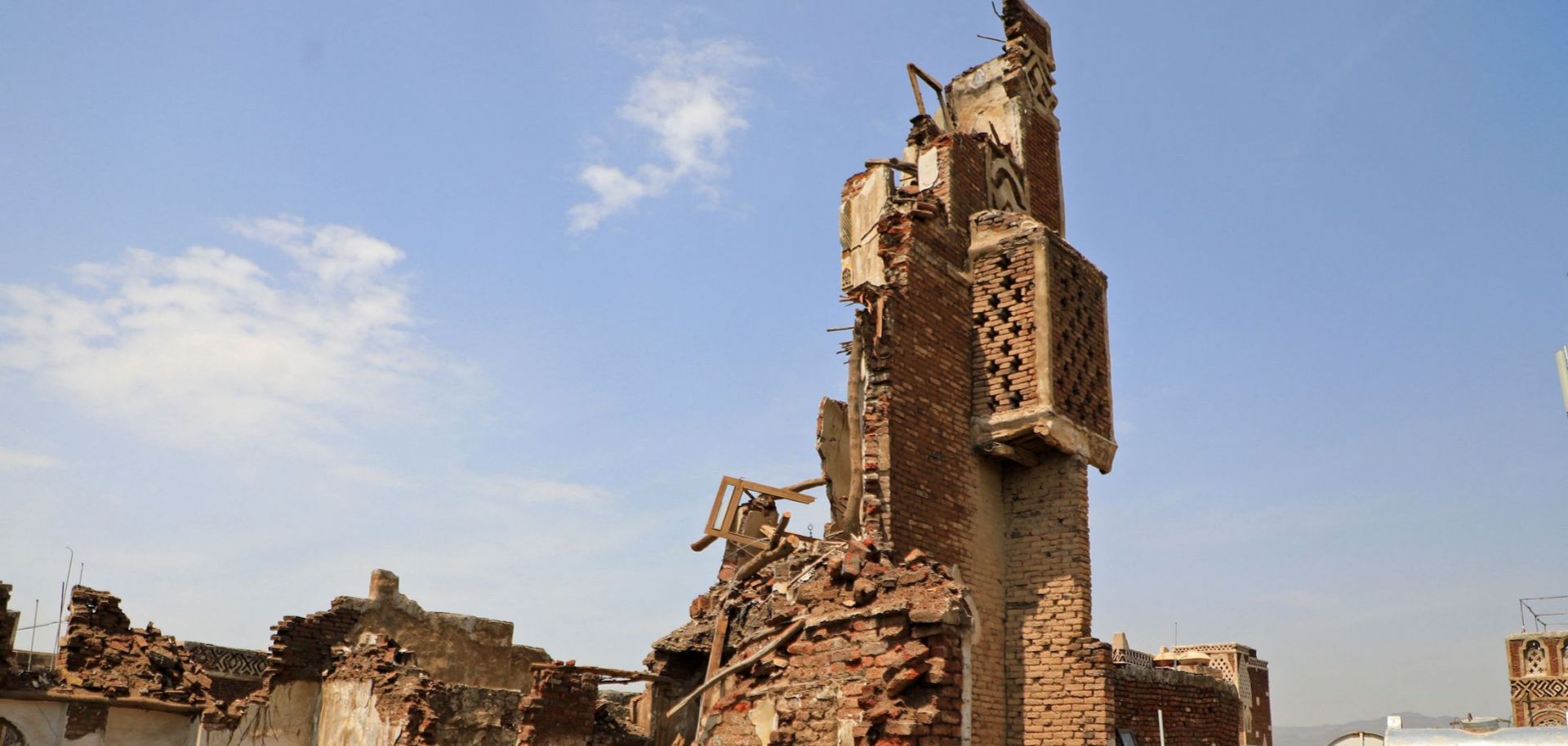
A partial view shows a collapsed UNESCO-listed building in the old city of the Yemeni capital Sanaa on Aug. 10 following heavy rains.
Yemen's warring parties have agreed to another extension of a now four-month-old cease-fire — opening the door, ever so slightly, to the possibility of at least freezing the war-torn country's seven-year conflict.
The factors compelling the Yemeni government and Houthi rebels to continue prolonging their truce — namely, waning foreign support, fuel and food insecurity, and the lack of a clear way for either side to achieve their military objectives — are unlikely to change anytime soon. But even if this results in a sustained period of reduced fighting, real and lasting peace in Yemen — while not impossible — remains improbable. And that's because a frozen Yemeni war would likely resemble the unstable conflicts in Gaza and Syria, where periods of violence alternate with long swathes of relative calm.
Why Yemen (Still) Matters
If one says ''Yemen matters,'' the question that might follow is ''to whom?'' Of course, there are the Yemeni themselves, who live under constant famine and the threat of violence daily. But Yemen's geopolitical significance lies in the country's potential to affect its neighbors and global trade routes. Its position on the Red Sea and the Gulf of Aden makes it a potential safe harbor (or pirate warren) for ships going along the east-west transit routes to the Suez Canal. A power that controls Yemen, or at least part of Yemen, can extract wealth from its ports or threaten the ships of rivals passing by. To the north, Yemen's position as Saudi Arabia's neighbor means that a power based in Sanaa (or Aden, for that matter) can project influence northward into the peninsula.
This geography has long drawn in powers both near and far who seek to control part or all of the Arabian Peninsula. The Ottoman Turks anchored their Arabian provinces with a Yemeni outpost; the British used Aden to link their Suez Canal to the Persian Gulf Trucial states and India; the Soviets replaced the British in Aden as they tried to turn the Gulf of Aden, through other alliances in Ethiopia and Somalia, into a Soviet lake. After the Cold War, the jihadists then came to Yemen, first al Qaeda and later the Islamic State, who even now want Yemen as a base to attack the Western-aligned monarchies of the Arab Gulf. Then came the Iranians who, in their competition with Saudi Arabia, have sought to turn the civil war's rebel Houthi movement from allies to proxies as part of Tehran's region-wide network.
But it is the internal dynamics of Yemen that often define how well a foreign power can do there. Yemen's poor resource base and multiple conflicts have long hampered economic and political development; its ancient tribal structures remain much stronger politically and even militarily than the ones of the rapidly developing Arab Gulf states.
The country also remains divided among religious tribal lines. Some Yemenis (including Houthi rebels) are Zaydi, a branch of Shiite Islam, though most are Sunni. But among the Sunni Yemenis, politics divide them yet more, between Islamists and relative (even secular) moderates. No Yemeni state has ever been able to fully bridge these divisions, only temporarily paper over them. And these cracks in the social fabric have created entry points for foreign influence to seep into the country, enabling outside actors to turn Yemeni factions against each other on the battlefield by funding, arming and weaponizing different groups.
The current Yemeni civil war, which began in 2014, overlays all of this complexity. In its broadest stroke, the conflict is between the theocratic, Iran-backed Zaydi Houthi movement and the U.N.-backed (but mostly Saudi-financed and -armed) Yemeni government. But jihadists, present well before the civil war, have also sought to expand their foothold in the ensuing power vacuum, creating a concurrent counterterrorism fight that has seen the United States deploy troops to Yemen for the past 21 years.
Why Yemen's War Is Slowing
So long as the Houthis and the Yemeni government both claimed the right to govern the entire country, and their tribal allies and foreign allies supported them, the war seemed destined to grind on. But that began to change earlier this year.
To the surprise of many observers, the Houthis and the Yemeni government agreed to a two-month cease-fire in April. Then, just before the truce was set to expire in June, the warring factions agreed to extend it another two months. And on Aug. 2, they agreed to a third extension, which is now set to expire in October — marking the longest pause in fighting Yemen has seen in the seven-year conflict.
So what changed? Neither the Houthis nor the Yemeni government have begun peace talks or abandoned their wartime goals. Rather, it appears the global shocks brought on by Russia's invasion of Ukraine in February convinced both sides that they needed to focus on keeping humanitarian lifelines open in Yemen, at least for the time being. The trade and economic disruptions caused by the ongoing conflict in Ukraine has further increased the cost of food and fuel in Yemen, which was already unaffordable for many of those living in the war-torn nation (the United Nations estimates that roughly half Yemen's population is food insecure). Fears of disrupting flows of humanitarian aid into the country appeared to be the final factor that needed to come into alignment to spur Houthi and government forces to lay down their arms.
From a military standpoint, the Yemeni civil war had also slowed down in the lead-up to the current cease-fire. The Houthis' much-touted offensive on the strategic and energy-rich city of Marib in central Yemen, which was launched in February 2021, had gotten bogged down. Houthis' increased willingness to conduct attacks outside Yemen had also reduced the Saudi-led coalition's appetite for counteroffensives — especially after Houthi rebels launched their first-ever drone and missile strikes into Emirati territory earlier this year in response to a UAE-backed government offensive in Yemen's Shabwa province.
Saudi Arabia, in particular, had long been seeking some kind of disengagement from Yemen as well, with Riyadh unwilling to commit to retaking control of the capital of Sanaa.In addition, geographic, strategic and financial constraints had kept Iran from providing Houthi rebels — who remain Tehran's allies, rather than direct, controllable proxies — with the military hardware and support that might break the stalemates along the front lines.
With those factors in place, a cease-fire, even one as riddled with violations as these have been, appeared the preferable policy for both sides. And there's not yet a sign that these factors will change, creating the real possibility that Yemen's civil war might, if not fully freeze, at least grow cold.
The Path to an Unstable, But Frigid, Conflict
Yemen would not be the first regional conflict to cool without seriously addressing the drivers of war. In Gaza, Israeli forces and Palestinian militants have an unsteady, adversarial relationship, and are certainly no closer to peace than the Houthis and the Yemeni government. But they have a similar dynamic.
Israel, the more powerful of the two sides, is unwilling to re-occupy Gaza — deterred by the costs in blood, treasure and a probable insurgency. In Yemen, the more powerful Saudi-backed government also remains unwilling to eject Houthis rebels from Sanaa, which would almost certainly cost the Saudis thousands of troops and turn them into an unpopular occupying force. Both Palestinian militants and Houthi rebels also lack the military capacity to achieve their ultimate goals of replacing Israel with an Islamic Arab state and taking control of Yemen, respectively.
In Gaza, this dynamic — of one actor being able but unwilling, and the other actor being willing but unable — has turned the Israel-Palestinian conflict into a cycle of violence characterized by long stretches of quiet. (That cycle just repeated itself in August 2022, when three days of fighting gave way to the unstable peace of the status quo ante).
A similar pattern is also emerging in Syria's 11-year-long civil war — with Russia, Iran, Turkey and the United States being in the ''able but unwilling'' camp, and the government in Damascus in the ''willing but unable'' camp. The Syrian government has won back most of the major cities but still does not control much of the north and northeast. But the regime's backers — Russia and Iran — do not want to provide the support needed to help Damascus retake the rest of the country for fear of triggering direct clashes with Turkey and the United States, who protect those areas. The United States and Turkey, both militarily capable of defeating the Syrian army, are unwilling to do so out of fear of escalation with Russia and Iran and because neither wants to occupy the whole of Syria. Once more, the actors that have the means are unwilling, while the actor with the will is unable. The result is static front lines that may lack a cease-fire but functionally look similar to what is emerging in Yemen.
In Yemen, both sides may be forced to freeze the front lines in a permanent military confrontation with occasional and deadly violations of the peace, but without major offensives that could change the trajectory of the war. This could ease Yemen's humanitarian problems and halt spillover violence into countries like Saudi Arabia and the United Arab Emirates, though this easing would be unstable.
In the other two examples — Gaza and Syria — it is clear a frozen conflict is no formula to peace. In Gaza, Israel and Palestinian militants have fought two separate wars in the past two years alone. And although these wars were short, they nevertheless showcase how leaving the underlying drivers of conflicts unresolved simply invites future violence. The same can be said of Syria, where it is a matter of when, not if, Damascus and its allies resume military offensives against the final rebel redoubts.
For Yemen, a frozen conflict would carry the same risk, with both sides bolstering their military powers in the interim, as they wait for just the right moment to take advantage and resume fighting. Unless international diplomats can find a political solution amenable to both the Houthis and the Saudi-led coalition, another round of war is inevitable in Yemen.
If the current cease-fire becomes an excuse for powers like Saudi Arabia and the United States already trying to leave Yemen to disengage before a peace deal is struck, future battles could result in Houthi victories by leaving the Yemeni government with less support. Such victories might leave the rebel group in charge of not only strategic cities like Marib and Taiz, but perhaps even pushing further south towards Aden. That would weaken, perhaps fatally so, the fragile Yemeni government, and allow radical extremists the space to recruit and organize in the instability that would follow. If the Houthis appear to be gaining the upper hand on the battlefield, the powers that looked to extricate themselves from the war — namely, the Saudis and Americans — might be forced to retake the frontlines, leaving Yemen lodged in yet another cycle of violence with devastating humanitarian costs.
