
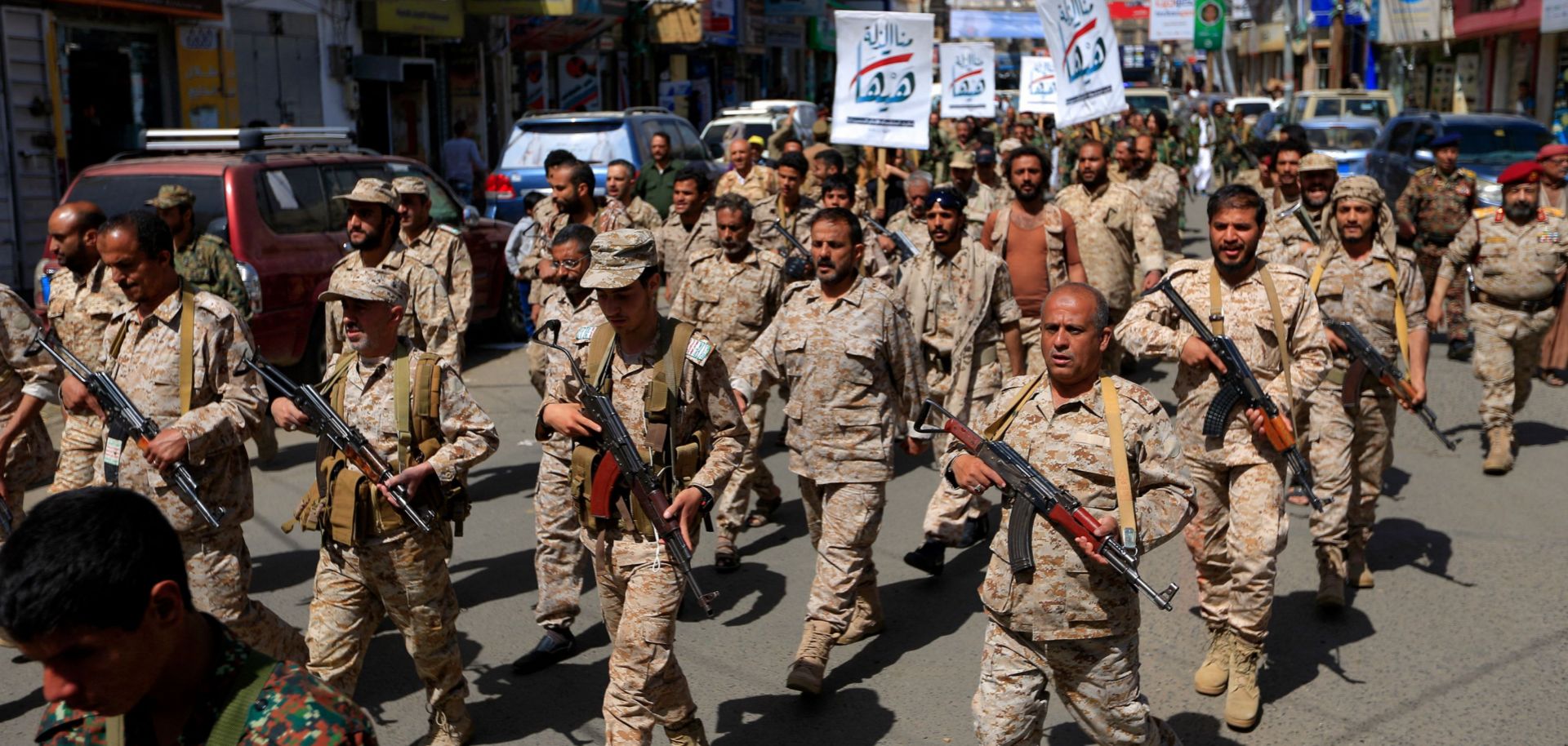
Forces loyal to Yemen's Houthi rebels take part in a military parade in Sanaa on March 31, 2022.
A two-month cease-fire in Yemen faces major hurdles to creating lasting peace, suggesting more fighting in the future, and a low but greater impact risk of escalation beyond Yemen that could widen attacks against Saudi Arabia and the United Arab Emirates. On April 2, the United Nations announced that the warring sides in Yemen had agreed to a two-month cease-fire, with agreements to trade prisoners, reopen the Sanaa airport, and allow ships to supply fuel to Houthi-held Hoediah. Yet despite the truce, violations, especially around the key city of Marib, have already been reported. And unless the Houthis abandon their offensive or the Saudi-led coalition loses the city, it appears this truce will not hold permanently. Instead, the cease-fire is more likely to presage another round of fighting, which will include the potential escalation of the conflict beyond Yemen, as the Houthis may attempt to build leverage over the Saudis and Emiratis with more attacks on their economies, and the Saudis and Emiratis try to convince the United States to provide them with more logistical and military support to change the battlefields in Yemen in their favor.
- Some of the drivers of the cease-fire include the holy month of Ramadan, which gave the warring parties a religious excuse to reduce fighting, the probable spike in prices in food and fuel caused by the Russian invasion of Ukraine, and the lack of accompanying international aid for Yemen. All of these could have influenced the Houthis to give at least tacit support for the cease-fire in order to bring in humanitarian aid to their controlled territories.
- The Yemen civil war is stalemated on the battlefield, with the most dynamic front around the energy-rich province of Marib, now held by Saudi-backed government forces but subject to a year-long military campaign by the Houthis. The control of the province gives the owner access to the prospect of Yemen's few energy deposits.
- Prior to the cease-fire, the Houthis focused on damaging both Saudi and Emirati economies by attacking symbols of their economic strength. The Houthis deliberately messaged that the United Arab Emirates was unsafe for investment during their January-February drone and missile attacks on Abu Dhabi. Meanwhile, on March 25, the Houthis struck a Saudi Aramco facility in Jeddah, Saudi Arabia, just as a Formula 1 race was underway. The Houthis have also continued strikes on Saudi Aramco targets in so far unsuccessful bids to rattle energy markets and spook investors from doing business in the kingdom. In both the United Arab Emirates and Saudi Arabia, the Houthis' strikes have not been aimed at causing widespread civilian casualties, which would shift international opinion in favor of the Saudis and incentivize the United States to support coalition retaliation.
Without either side abandoning Marib, more fighting is likely, especially once the Ramadan holiday passes on May 2. So long as coalition forces and Houthis are near one another at Marib, cease-fire violations are likely to be common. Once the holiday passes, the Houthis could return to their attacks on Saudi Arabia and even the United Arab Emirates in strikes designed to undermine the economic attractiveness of these two countries. The Houthis are less likely to deliberately escalate their strikes to inflict significant civilian casualties or damage to energy facilities for fear that could bring the United States back into an active role in supporting the Saudi-led coalition.
- The Houthis have not yet shown a willingness to abandon their offensive on Marib which, if captured, would help the Houthis control most of the former territory of North Yemen. Taiz, also a major former North Yemen city, remains under coalition control, meaning even the fall of Marib might not end the war.
- Some of the potentially targeted high-profile events could include the Saudis' and Emiratis' national holidays (in September and December, respectively), as well as during the World Cup in the fall (when the United Arab Emirates will host thousands of tourists who will travel to Qatar) and other high profile cultural sports events (including those linked with the West).
- The Houthis may also decide to strike Emirati energy infrastructure at a greater scale, like gas processing facilities at Das Island or refining operations at Ruwais, both of which are in the demonstrated range of attack.
If the Houthis return to an escalated campaign against them, Saudi Arabia and the United Arab Emirates are more likely to absorb the attacks than escalate in the hopes of pressuring the United States to provide them with more substantial military aid. Such U.S. support would likely include logistical, military, and intelligence support to break the siege of Marib, allowing the coalition to advance against the Houthis towards the Red Sea port of Hodeidah and/or re-designating the Houthis as a Foreign Terrorist Organization (a decision that would hamper Houthi efforts to bring in goods for civilians that help keep the movement in power in the north).
- Saudi Arabia and the United Arab Emirates have been pressured by the United States, their primary arms supplier, to de-escalate their military campaign to cut down on civilian casualties and ease humanitarian conditions in the country. Under the administration of U.S. President Joe Biden, Washington has emphasized human rights globally as part of its foreign policy.
- Riyadh and Abu Dhabi also lack the military power to fully eject the Houthis from the north, constraining their ability to take unilateral action. Outside support from the United States would help make up for the lack of military hardware and troop numbers.
But the United States will only return to backing an aggressive coalition campaign against the Houthis if they inflict significant casualties in Arab Gulf states (especially of Westerners) or if U.S.-Iran nuclear talks fail and there is a regional escalation with Iran. Houthi strikes on Saudi Arabia and the United Arab Emirates could accidentally cause more damage than intended, especially if they strike a civilian area and cause casualties or destroy energy infrastructure that leads to a major supply disruption. While the Houthis are unlikely to intentionally target an internationally-attended event or location frequented by Westerners, a stray missile or drone might result in unintended casualties as well. Finally, the Houthis will join Iran in a potential regional escalation against targets in Arab Gulf states if U.S.-Iran nuclear negotiations, currently still underway with no clear resolution, collapse. That escalation could be designed to pressure the United States into granting serious concessions by threatening energy markets at a greater scale.
- The United States is particularly sensitive to energy markets after the Russian invasion of Ukraine upended prices and OPEC+ signaled it would take no extraordinary measures to offset the rise in prices by providing further supplies.
- Increased U.S. support is less likely to involve direct U.S. involvement, but the United States can restore refueling for the coalition jets, increase arms sales, provide intelligence, and/or greenlight an escalated bombing campaign against Houthi targets.
