
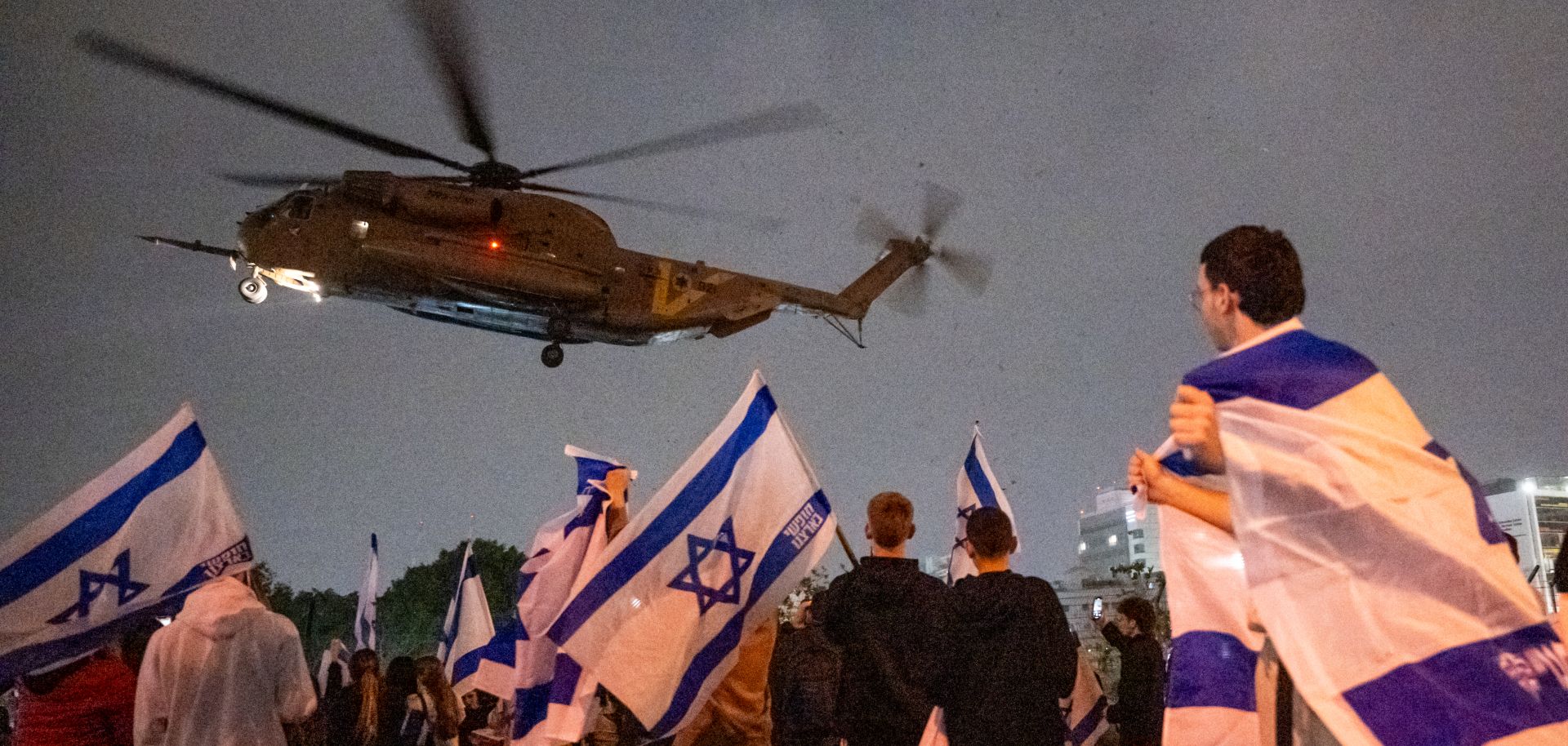
Fighting in the Gaza Strip will likely resume once the diplomatic process to exchange hostages for prisoners has exhausted itself, but the next phase of Israel's military campaign will risk straining U.S.-Israeli ties in the future, even if military and economic aid will continue to flow during the current conflict. On Nov. 27, Israel and Hamas agreed to a two-day extension of the cease-fire they reached last week in an effort to provide more time for aid to enter Gaza and for additional hostages-for-prisoners swaps. International actors are already at work trying to further extend the cease-fire, with U.S. Secretary of State Antony Blinken due to again visit the region, and with the head of Israel's Mossad, David Barnea, in Qatar for further negotiations with Hamas and the Qatari government. New discussions have reportedly centered on the possibility of Hamas releasing captured Israel Defense Force (IDF) soldiers as part of such an extension. But signs continue to show that the pause in fighting will remain temporary, as the IDF is reportedly preparing military options to clear the rest of the northern part of the Gaza Strip and to eventually invade the south as well. Additionally, on Nov. 28, the IDF and Hamas exchanged accusations that the other side had violated the cease-fire in clashes between the two in Gaza City. Abroad, reports emerged that the United States was pushing Israel to conduct a more surgical and precise campaign in the south once fighting resumed, with the White House warning it does not want to see a repeat of the mass civilian displacement that took place in the northern part of the Gaza Strip.
- Since the original cease-fire took effect on the morning of Nov. 24, 50 of the 240 hostages that were taken during Hamas' Oct. 7 attack have been released, and 20 more have been pledged to be released, in exchange for around 210 Palestinian prisoners (of an estimated 5,000 Palestinians held in Israeli jails).
- In the U.S. Congress, senior progressive Senators, like Bernie Sanders and Chris Murphy, have now openly talked about conditioning aid to Israel based on its military behavior in the Gaza Strip. Congress is due to vote on an aid package for Israel in the coming weeks.
- Since beginning its ground invasion of Gaza in late October, the IDF has taken control of much of Gaza City, the biggest city in the Strip. But the Israeli military has also come under intense international criticism for its tactics, which have so far resulted in up to 10,000 Palestinian civilian casualties and has seen the IDF carry out combat operations at controversial places like the Shifa Hospital, which the IDF claimed was a Hamas operational headquarters — a claim backed by the United States and the United Kingdom, but not by many Arab and Muslim states.
Further hostages-for-prisoners exchanges and cease-fire extensions are possible, but there are only so many hostages Hamas and other militants can trade, meaning a resumption of fighting is likely. The current cease-fire deal has seen Hamas release 10 hostages per day, which implies that there may only be around 17 days' worth of hostages left for Hamas to exchange. However, not all 170 of the hostages that were taken during Hamas' Oct. 7 assault are in the group's hands; at least 40 or so are being held by other militant groups, like Palestinian Islamic Jihad (PIJ), which have said they won't trade their hostages for anything less than politically impossible demands, like releasing all Palestinian prisoners in Israel. Meanwhile, even if there is some societal pressure on the Israeli government to prioritize hostage releases, no members of Israel's War Cabinet support negotiations with Hamas short of its surrender. Shortly after the cease-fire was enacted on Nov. 24, wartime cabinet member and former IDF head Benny Gantz, who is also a frontrunner to replace current Prime Minister Benjamin Netanyahu should elections be held, said that military operations would resume as soon as the cease-fire expired.
- Israel has continued to say its wartime goal is to remove Hamas from power in Gaza, an objective that the United States has publicly continued to back.
- Despite high IDF casualties in Gaza, wartime interruptions to daily life and the threat of regional escalation, Israel's public continues to support the goal of toppling Hamas from power, with 90% agreeing with the policy, according to a poll conducted by the Israel Democracy Institute that was released on Nov. 24 and took into account opinion in the weeks before the cease-fire was announced.
Once fighting likely resumes in Gaza, the United States will probably intensify pressure on Israel to limit civilian casualties — especially in the south, where some 1.7 million Palestinian refugees have now fled. Israel's military campaign in northern Gaza was characterized by an intense bombardment of built-up areas to degrade and deter Hamas. But the campaign also resulted in significant civilian casualties and allegations of war crimes. While southern Gaza doesn't have as large of built-up areas as the north, there are some 1.7 million Palestinian refugees in the region crowded largely along the Egyptian-Gaza border. These refugees will be difficult to protect if Israel decides to carry out another wide-scale aerial bombardment before moving ground troops into the southern part of the Gaza Strip. Hamas militants will likely also infiltrate civilian areas, leaving civilians caught in the crossfire between the IDF and Hamas. With these factors in mind, the United States will be eager to avoid repeating incidents like the hospital explosion at the al-Ahli Hospital and the battle at the Shifa Hospital, which produced significant Muslim and Arab grassroots outrage and threatened to provoke Iranian or Iranian-aligned militia escalation against the United States and Israel. Washington will likely push Israel to carry out more targeted and surgical attacks in the south and to avoid battles in areas where there are large numbers of refugees, while also attempting to establish safe zones for civilians.
- The deadly Oct. 17 explosion at the al-Ahli Hospital has largely been blamed on an errant Palestinian rocket (including, most recently, by Human Rights Watch). But the incident nevertheless provoked widespread popular outrage and protests around the world, with demonstrators in Jordan and Turkey targeting Israeli embassies. Regardless of the IDF's involvement, further Palestinian mass casualty incidents would likely inflame anti-Israeli and -U.S. sentiment and provoke more protests and unrest globally.
- The United Nations estimates that up to 60% of housing in Gaza has so far been destroyed since the latest Israel-Hamas war broke out last month. This means Palestinians cannot return readily to the north as combat operations wind down there.
If Israel is unwilling or unable to minimize Palestinian civilian casualties once it begins its expected military campaign in southern Gaza, U.S.-Israeli ties will strain as lawmakers in Congress, particularly Democrats, become more openly critical of Israel's policies. Even in highly surgical campaigns, civilian casualties are inevitable and operations, especially in densely packed areas, could result in significant civilian losses. This is particularly likely to be the case as Israel has signaled its intent to return to the same intensity of fighting that existed before the cease-fire. Israeli Defense Minister Yoav Gallant said on Nov. 27 that fighting would resume ''with the same power and more'' when speaking to IDF troops, in a sign that the IDF is disinclined to utilize restraint despite U.S. pressure. Moreover, restraint may also extend the length of the military campaign in the Gaza strip — something that is not in Israel's interest, with the Israeli government eager to declare victory, demobilize its population from war footing, and offset global criticism. However, if there are significant civilian casualties in the south and Israel appears to be fighting an unrestrained campaign, it will further mar Israel's image around the world, particularly in the United States, where sentiment critical of Israel's policies is rising, will manifest in the Congressional debate over aid to Israel. While Congress is unlikely to block aid to Israel, individual lawmakers will increasingly demand the White House use the United States' military and economic leverage over Israel to alter its behavior. This more overt criticism of Israel in Congress — especially if the administration of U.S. President Joe Biden also becomes more openly critical of the country to appease its left-wing critics ahead of the November 2024 elections — will shape norms and perceptions of the U.S.-Israeli relationship, alter public narratives about the strategic value and liabilities of Israel, and open up space for U.S. politicians more openly criticize their country's ties with the Middle East country.
- The IDF regularly practices surgical operations to limit civilian casualties, including so-called ''roof knocking'' exercises that try to warn civilians to evacuate from imminent targets. Nevertheless, high civilian casualties are typical during IDF operations in Gaza.
- U.S. polling shows a large partisan and demographic divide over Israel, with younger and Democratic voters wanting extended or permanent cease-fires, while older and Republican voters tending to favor continued backing of Israel's current strategy. Younger voters are key to Biden's re-election in 2024 and may play an instrumental role in a handful of swing states to decide the presidency.
