
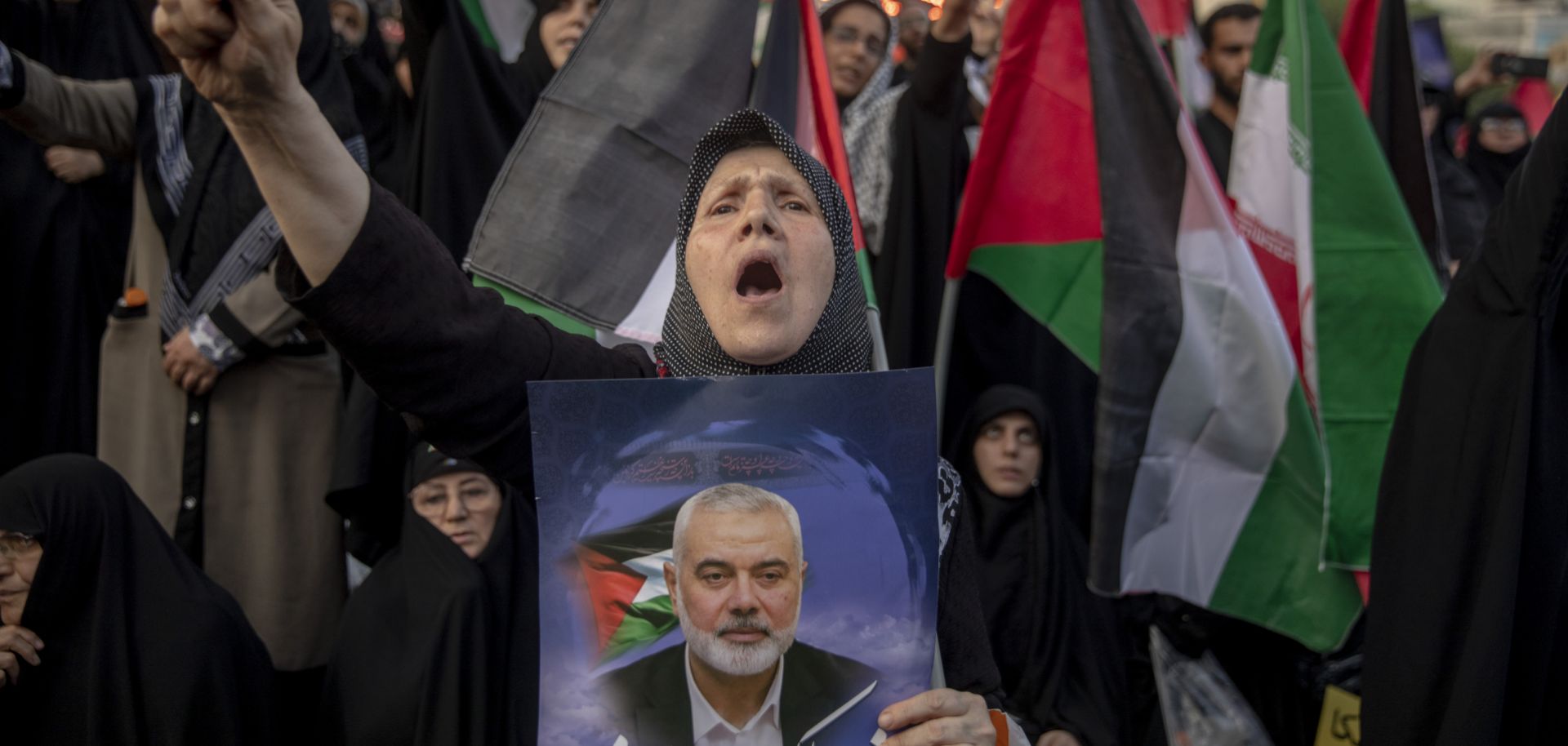
Iran and Hezbollah will respond to Israel's assassinations of top Hezbollah and Hamas leaders, and while both will aim to avoid a regional war, incidental miscalculations could cause rapid escalation that could nonetheless lead to such an outcome, especially as Israel will likely continue to conduct escalatory operations. On July 30 and 31, Israel carried out two major assassinations of top Hezbollah and Hamas leaders. First, on July 30, Israel struck a Hezbollah stronghold in the suburbs of Beirut, Lebanon, killing Fuad Shukr, one of the group's most prominent commanders and senior members of its Jihad Council, Hezbollah's military leadership. In the early morning hours of July 31, Israel assassinated the chief of Hamas' political bureau, Ismail Haniyeh, who was in Tehran, Iran, attending the inauguration of newly elected Iranian President Masoud Pezeshkian. The attack was likely carried out by air using a projectile launched from an undetermined location and targeted at an Islamic Revolutionary Guards Corp (IRGC) residential compound in the capital where Haniyeh was present. In a statement, Iranian Supreme Leader Ayatollah Ali Khamenei vowed that Iran itself would take revenge given that the attack occurred on its soil. In addition, the al-Qassam Brigades, the military wing of Hamas, released a statement noting that Haniyeh's killing had ''escalate[d] the war to a new level'' and would have ''enormous consequences for the entire region.'' In the wake of the Shukr assassination, Hezbollah is reportedly gearing up for retaliation as well, though as of writing, the group had not yet publicly commented on the attack. Separately on July 30, the United States conducted airstrikes in Baghdad, Iraq, for the first time since February, targeting Iraqi militias and killing at least four prominent Iranian-aligned Kataib Hezbollah commanders.
- The Jihad Council, where Shukr served as a member, is one of several Hezbollah councils and is responsible for directing the Lebanese militant group's military wing and operations.
The recent spate of attacks is part of an escalating tit-for-tat cycle of violence between Israel, the United States, Iran and regional militant movements. The attacks come as Israel is fighting an ongoing war with the Iran-backed Palestinian militant group Hamas in Gaza, escalating clashes with the Iranian proxy Hezbollah in neighboring Lebanon, and continued attacks on its territory and maritime interests from Iran-backed Houthi militants in Yemen. Israel said it conducted the operation to kill Hezbollah leader Shukr in Beirut in retaliation for a July 28 rocket attack on the Golan Heights that killed 12 people, which Israel and the United States quickly attributed to Hezbollah despite the group denying being involved in the deadly strike. Meanwhile, though Israel did not, as the norm, take credit for the killing of Hamas leader Haniyeh, several ministers, including National Security Minister Itamar Ben Gvir, celebrated the operation as revenge for Hamas' Oct. 7 assault on Israel. The United States, for its part, was reportedly unaware and not involved in the assassination of Haniyeh, according to U.S. Secretary of State Antony Blinken. On July 30, the United States conducted strikes in Baghdad against the Iraqi faction Kataib Hezbollah, likely in response to the Iraqi militia's attacks on U.S. bases in Iraq and Syria in recent weeks. The recent spate of attacks exemplifies escalating tensions between Israel, the United States and the network of regional proxies supported by Iran, and the consequent growing specter of a wider war in the Middle East that could draw in direct involvement from the United States and Iran.
- The killing of Haniyeh marks the continuation of the assassination campaign against Hamas officials that Israel announced shortly after the Oct. 7 attacks. Such assassinations align with Israel's tactical goals in the ongoing Gaza war, as it seeks to pressure Hamas to surrender and/or agree to a cease-fire on Israel's terms.
The attack in Beirut represents a significant Israeli escalation against Hezbollah and will likely lead the militant group to retaliate by striking a major Israeli city, a development that will keep the risk of a wider war on the table. The Beirut attack violated a Hezbollah political red line, as the group has promised to strike an important Israeli city if Israel attacked Hezbollah targets in Beirut. In the wake of Shakr's killing in the Lebanese capital, Hezbollah will thus likely feel compelled to maintain a level of credible deterrence by targeting a major Israeli city, but whether this significantly raises the prospect of a wider war will hinge on the extent of Hezbollah's retaliation. While Tel Aviv is a more likely target due to the city's political and economic importance to Israel, Hezbollah may also adopt a more restrained approach to reduce the chances of Israeli civilian casualties and, in turn, further Israeli escalation, which could see the group instead target the northern Israeli port city of Haifa or limit its attacks to Israeli military positions and bases. Should a Hezbollah attack on Tel Aviv cause significant damage and casualties, Israel would likely retaliate by launching more attacks on Beirut and other high-profile Hezbollah targets and officials, worsening tit-for-tat escalation that would likely eventually lead to a broader conflict. Conversely, if Hezbollah's attack results in minimal damage, or should the group choose to target military locations instead, Israel would be positioned to limit its own retaliation to southern Lebanon.
- Israel's policy against Hezbollah has been to use limited force and the threat of greater escalation to try to convince Hezbollah to withdraw from the border. The Israeli government is worried that, especially amid continuing military operations in the Gaza Strip, a major invasion of Lebanon could trap Israeli forces in a long-running ground war with no clear path to victory and might lead to the collapse of support for the current Israeli government.
- Hezbollah's campaign against Israel has focused on conducting solidarity attacks without moving the combat zone out of border areas in southern Lebanon and northern Israel. But the July 28 rocket attack on the Golan Heights — which Hezbollah disavowed and may have been accidental rather than deliberate – sparked fierce backlash from Israel's government that Hezbollah fears could weaken the militants' domestic position in Lebanon.
In regards to the Israel-Hamas conflict in Gaza, the assassination of Haniyeh is a blow to any potential cease-fire talks to bring an end to the war, and may presage the appointment of a more hard-line political chief who would back further Hamas attacks against Israel. Hamas had been softening its demands for an immediate Israeli pullout from Gaza prior to the assassination. But with the killing of Haniyeh, as well as Israel's likely killing of Hamas' second in command of its military wing Mohammed Deif on July 13, Hamas is now all the more unlikely to offer concessions or make progress toward reaching a cease-fire deal with Israel. Moreover, with the loss of Haniyeh, Hamas will now have to elect a new head of its political wing, probably from the current ranks of the group's Politburo. In the wake of the recent Israeli attacks, this new Hamas political chief is much more likely to push for continued hawkishness against Israel rather than seek some sort of agreement to lessen violence in Gaza.
- Haniyeh and Hamas' political wing periodically clashed with the group's military wing, headed by Yahya Sinwar, over the best approach to confronting Israel. Haniyeh was intimately involved in cease-fire talks and was often described as a comparative moderate in the group, though reports also emerged that he at times opposed a cease-fire based on the belief that the diplomatic situation was favoring Hamas throughout the current Gaza war.
Following the assassination of a Hamas leader on its soil, Iran will likely calibrate its retaliation against Israel to limit the threat of further escalation, but another direct Iranian attack on Israel will nonetheless raise the risk of an all-out regional war. Iran will likely leave Hezbollah to retaliate for Shukr, given he was killed on Lebanese soil. Iran will, however, be compelled to avenge the death of Hamas leader Haniyeh, especially as it dealt a direct blow to Tehran since the surprise assassination occurred on Iranian soil. But Iran will likely still aim to carefully calibrate its response, as Haniyeh was not an Iranian nor a direct Iranian proxy. As of July 31, initial reporting from the New York Times suggested that Iran would conduct a direct strike on Israel again, as it did in April 2024. Because Haniyeh was Palestinian and not Iranian, Tehran could justify firing a smaller barrage than what it fired in April, which would reduce the risks of causing significant damage in Israel and therefore sparking Israeli and/or U.S. counterattacks. Iran is likely to want a single round of retaliation as it aims to avoid general war, but even so, should retaliation kill Israeli civilians or cause significant damage in Israel or to its assets abroad, Israel would likely respond with another direct strike on Iran, potentially near its nuclear facilities again. These strikes could also take place in coordination with Iranian regional proxies like Hezbollah, militias in Syria and Iraq, and Iranian allies like the Houthis in Yemen, which would substantially increase the chances of a deadly incident caused by Israeli and U.S. interceptions and air defenses being overwhelmed. Such a cycle would risk sparking a wider regional conflict involving Iran, Israel and the United States, and in turn increase risks to regional countries like the Gulf Arab states, whose energy infrastructure could be targeted by Iran and its proxies. But in addition, and possibly further in the future, Iran could respond covertly to the Haniyeh assassination by, for example, conducting cyberattacks against Israeli entities or physical attacks against Israeli targets abroad (like Israeli embassies, tourists and/or officials), which would reduce the risks of sustained escalation with Israel.
- It may take days or weeks for Iran to prepare and conduct its response to the recent Israeli attack on its soil. It took from April 1 to April 13 for Iran to signal and fire the barrage at Israel, as Tehran tried to telegraph its intent and prepare operations for a salvo designed to demonstrate its resolve to respond to Israeli provocations but not necessarily spark a general war.
Despite these retaliations and the risks of sparking a wider regional conflict, Israel is unlikely to de-escalate against Hamas, Hezbollah or Iran, as the Israeli government seeks to capitalize on the hawkish public mood to degrade and reframe its relationships with these groups in Israel's favor. The April 13 Iranian barrage did not stop Israel from counterattacking Iran directly, nor did it bring an end to Israeli strikes on Iranian-linked targets in Syria. Iran's April 13 attack also did not deter Israel from conducting its recent operation to assassinate Haniyeh in Tehran. This is because the Israeli government calculates it can continue to escalate covertly against Hamas, Hezbollah and Iran without triggering a general war that might isolate Israel diplomatically and severely impact its security. With the current Israeli government under hawkish far-right influence and needing far-right votes to remain in power, Israel will likely continue to escalate against these rivals, as it presses maximalist goals of military and political victory in Gaza over Hamas and for a buffer zone against Hezbollah in Lebanon. This means that regional tensions are unlikely to de-escalate anytime soon and the risk of a wider conflict triggered by either a deliberate action or a miscalculation will remain on the table for the foreseeable future.
