
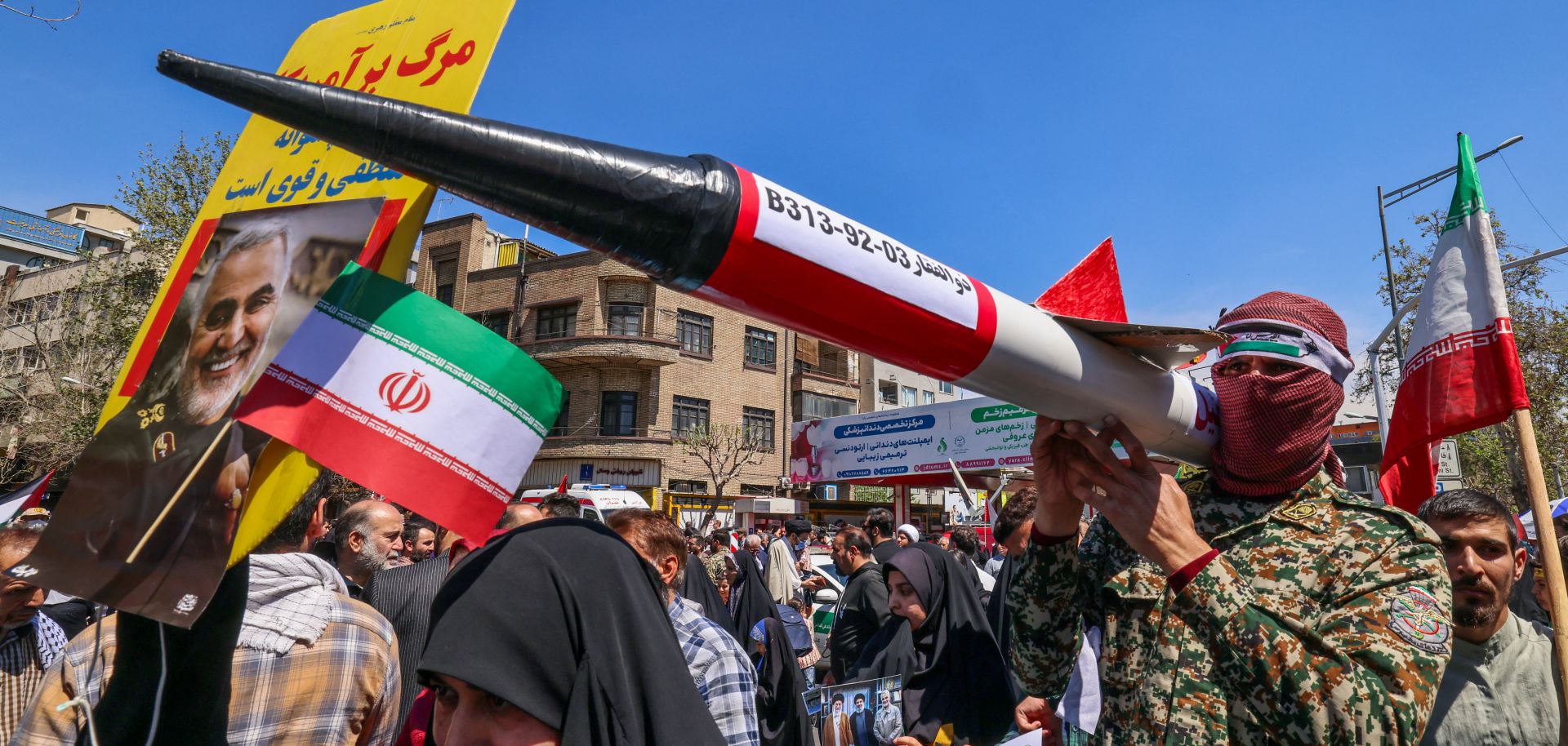
Israel and Iran have now broken the taboo of directly attacking one another's territory, but, remarkably, they have once more avoided climbing an escalation ladder neither wants. The more they believe this, however, the more they might find themselves trapped in the very war they hope to avoid. The shape of their mutual deterrence has been altered but not yet broken, and it seems that the Middle East, though fragile and riven with conflict, has deeper anchors that pull its prime rivals away from much-feared open wars. Doubtless, both Iran and Israel understand how close they came, but also, almost assuredly, they have realized that catastrophic accidental escalation is perhaps not the most likely outcome of their inevitable clashes.
The Calculus Behind April's Exchange
Israel and Iran have been locked in a shadow conflict for decades, typically played out through assassinations, bombings, proxies, cyberattacks and deniable kinetic action. Until April 2024, it had been a conflict of unclaimed airstrikes, unmanned drones, weapons transfers, proxy militias, bombing plots and assassinations. There are many drivers of this shadow conflict, but in recent years, it has evolved toward a relationship in which Iran and Israel seek to shape each other's behavior. For Iran, this often means trying to find a means to deter the technologically and militarily superior Israeli armed forces from conducting strikes on Iran itself or carrying out campaigns that efficiently degrade and destroy Iranian proxies like Hezbollah in Lebanon. For Israel, prior to Oct. 7, this has meant slow covert escalation designed to degrade Iran's ability to use this network of deterrence against Israel and convince Iran of the futility of trying to scramble for an atomic bomb.
But the pace of this covert escalation changed after Hamas' Oct. 7 attack on Israel, and the new hawkishness that emerged is part of the reason why on April 1, Israel conducted an airstrike on the Iranian consulate in Damascus where two top Islamic Revolutionary Guard Corps (IRGC) generals were meeting. Israel saw an opportunity to further disrupt IRGC leadership and signal to Iran the risks of deploying such leadership so close to the Israeli border, particularly as Israel continues its full-scale war in Gaza against Hamas — a war that Iran's proxies and allies have partially entered in solidarity. According to the existing, publicly available information, the Israelis believed that the strike, while escalatory, would nevertheless fit into the confines of its shadow war with Iran, and that if there were to be an Iranian retaliation, it would be covert, possibly against Israeli diplomatic facilities elsewhere.
Iran, however, did not interpret Israel's strike the same way, seeing the consulate as Iranian territory and the assassination of General Mohammad Reza Zahedi (who was key to coordinating Iran's relationship with both the Syrian government and the Lebanese militant group Hezbollah) as a political red line. Iran thus prepared its retaliation against Israel itself. Tehran decided that it needed to establish a firmer red line, given that Israel was increasingly ignoring the current one. The vast ballistic and drone barrage Iran launched on April 13 was designed to show Israel that Iranian military technology could penetrate its formidable air defenses and cause significant damage to military targets. Implicitly, the barrage also showed that Iran could extend such strikes toward Israeli civilian targets with further escalation. And finally, the attack demonstrated that Iran had the political will to brush past U.S. warnings about regional escalation.
The April 13 strike marked the first time Iran had ever explicitly and directly attacked Israeli territory, and it prompted the Israelis to respond with their own demonstration of being able to strike Iranian soil. Subsequently, on April 19, the Israeli Air Force struck a radar site associated with an S-300 air defense battery outside the nuclear facilities at Isfahan in central Iran.
Pulling Back From the Brink
Then, remarkably, the escalation came to an end. There were no diplomatic breakthroughs or shuttle diplomacy, nor was there a U.N. resolution calling for a halt to the fighting. Rather, there was a mutual, quiet understanding that further rounds of escalation would drag both powers into a war that neither currently wants. Iran claimed the Isfahan attack was ineffective, while Israel claimed that deterrence had been restored by its airstrike near Isfahan. Politically, the two governments had the narrative necessary to walk away from the overt conflict they had found themselves in.
Israel and Iran had good reasons to de-escalate. Israel remains locked in a war in Gaza, where its primary national security imperative still lies in its battle against the Palestinian militant group Hamas. It is also fighting a border conflict with Hezbollah and preparing for a possible ground war in Lebanon. And Israel has no clear victory in a major conflict with Iran. It cannot overthrow the Islamic Republic, as Israel has no land corridor by which to deploy its capable ground forces against it; and Israel's air force, while advanced, cannot conduct the kind of crushing campaign against Iran that would be needed to end the threat of recurrent ballistic missile strikes and drone attacks.
Iran, too, can only reach Israel via missile, drone and proxy. An open-ended war with Israel would thus mean significant damage to military and civilian infrastructure that Tehran, hobbled by years of U.S. sanctions, can ill-afford. Such an extended conflict might also finally pull the United States into it alongside Israel. These bruising constraints have always been a ceiling on how far the two sides wish to escalate, but there's always been concern that Israel or Iran could rapidly push past those constraints accidentally. But at least from this episode, such concerns have less grounding: Israel and Iran have shown they can stand on the brink and still step back.
Israel and Iran's Takeaways
Nevertheless, a taboo has been broken in which both sides now have the precedent to strike one another's soil without necessarily triggering a general war. At least from this episode, the contours of this dynamic are clear: strikes on military targets that cause neither casualties nor significant damage are apparently tolerable for their governments.
What can both sides take away from the breaking of this taboo? For Iran, it shows that Tehran can now countenance direct strikes on Israel itself in reaction to major covert provocations. It also shows that Israel's allies — particularly the United States, as well as the Gulf Arab states — are so determined to avoid regional escalation that they will only play a defensive role in the course of such confrontations. Additionally, it shows that Iranian technology is capable of overcoming some of Israel's advanced air defenses, a reality that will shape public debate within Israel as to how far an Israeli government can go in its covert escalation against the Iranians. And finally, it has enabled the Iranians to learn valuable real-world combat information about the effectiveness of its barrage tactics and its drone and missile technologies against advanced powers.
There is little in these lessons that suggests that Tehran is eager for a repeat of this episode. With its capabilities flexed, Iran seems poised to await another Israeli provocation rather than seek to create one themselves. And despite threats to potentially push its nuclear program toward weaponization, Iran, at least for this round, is guarding itself for the next Israeli action rather than taking preemptive steps to overhaul its foreign and nuclear doctrines. Iran, in other words, can now assume it can strike back directly against Israel without causing war or direct conflict with the United States, but that its overall strategic doctrine is best served by awaiting sufficient Israeli action to justify such a move.
Israel has its own lessons, some of which suggest its own hawkish turn has been reinforced, rather than deterred, by this episode. Certainly, Iran has shown a willingness to strike Israel directly, but that threat is, at least for now, offset by Israel's allies' deep desire to avoid regional confrontation to the point where they served as a shield against Iran's April 13 attack. Meanwhile, although some Iranian missiles did strike Israeli soil, the vast majority were intercepted by Israel's advanced air defenses like its Arrow system and David's sling, meaning the ballistic missile threat from Iran may not carry the same physical risks as once feared. The episode also shows that Israel can directly strike territory near sensitive Iranian nuclear facilities, and Tehran's overall desire to avoid wars is high enough that such strikes may go unanswered. For a certain type of Israeli government, these are lessons that lean toward further escalation.
Setting the Stage for Higher-Risk Confrontations
Certainly, Israel's preferred strategy against Iran remains covert escalation in which it continues to degrade Iran's allies and reshape its near abroad so that events like Oct. 7 cannot be repeated. But the degree to which Israel is willing to take risks in the pursuit of this strategy has certainly changed after the events of April 2024, which have provided a new input to the answer to the question of how far Israel will go to secure its near abroad from its ideological rivals.
Yet if we are to see a repeat of this pattern — in which Israel and Iran conduct direct strikes on each other's territory but quickly pull back from the brink, with the assumption on both sides that the fear of general war is high enough to restrain dangerous escalation — we may also see a new element of what miscalculation looks like. In future rounds, Israel or Iran may conduct strikes they believe are within the altered strategic paradigm, but instead of reinforcing the pattern, this puts them on a politically driven path of escalation. A repeat of April's events is entirely possible, with Israel still seeking shadow conflict in Syria where Iranian forces remain. But next time, both Iran and Israel may decide their tit-for-tat requires more force to demonstrate a desire to return to deterrence. And greater forces mean a greater prospect of miscalculation.
But their escalation may come through another path, perhaps in southern Lebanon, which Israel has signaled it may invade once its Gaza campaign shifts away from major combat. Israel may want to signal to Iran the dangers of directly intervening in another Israel-Hezbollah war, and conduct an escalated covert campaign to cut Iranian supplies and logistical support and erode Iranian political will to potentially intervene in such a conflict. In the case of another Lebanon War, Israel might decide to strike Iran's embassy in Beirut, or other sites sensitive to Iran that would be key parts of Hezbollah's campaign against Israel. And such strikes might push Iran back into direct confrontation with Israel, tempted to repeat the escalation of April to convince Israel to scale down its anti-Iran element of a war in Lebanon.
Such a hypothetical scenario could result in a similar outcome as April, with great tension but eventual strategic logic returning. But each confrontation between Israel and Iran runs the risk of derailing strategic logic in their behavior and injecting political logic instead. And if that becomes the case, then the dangers of war will rise rapidly.
