
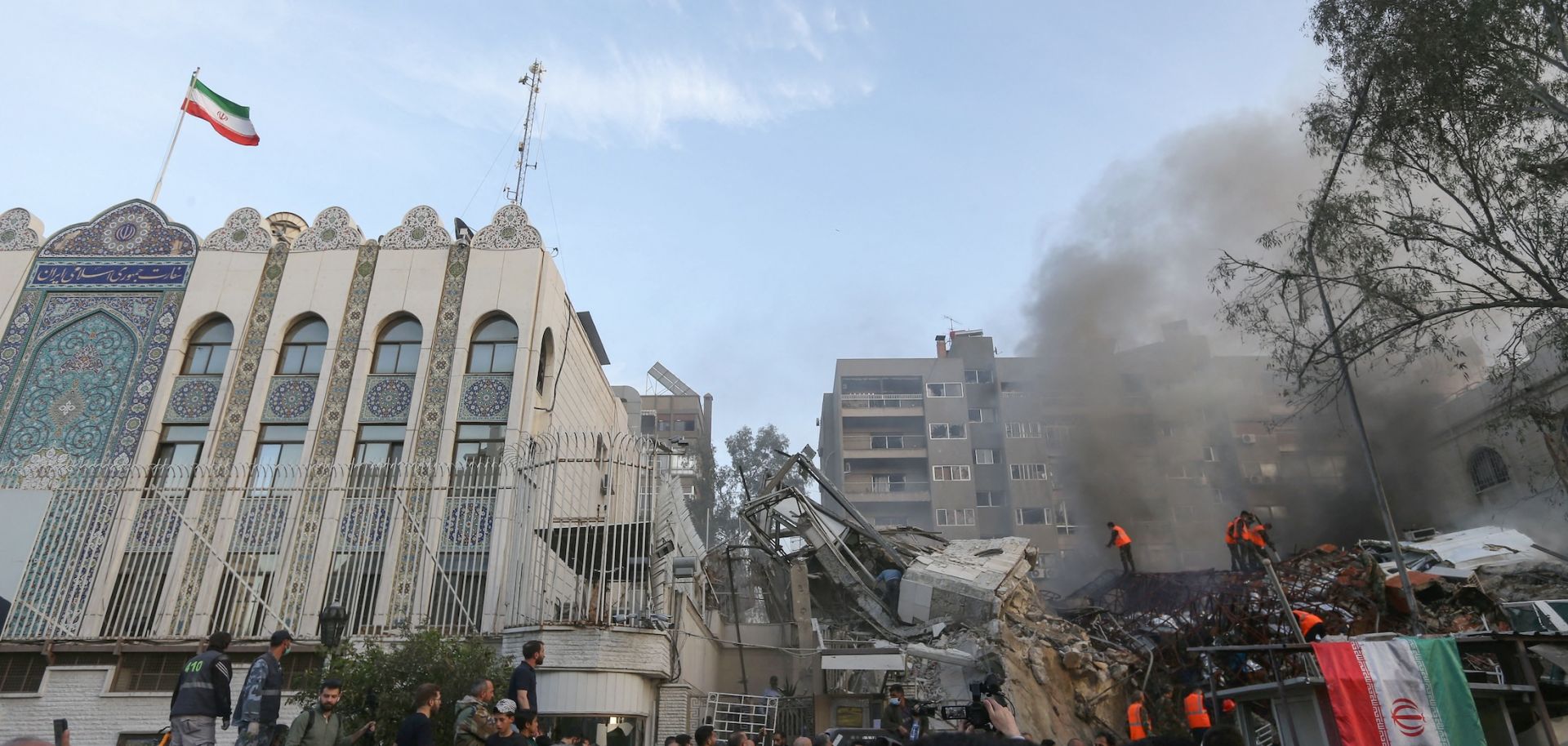
Iran's likely retaliation against Israel will focus on minimizing the risk of further escalation, but in so doing, its response is unlikely to deter Israel from further attacks on Iranian targets in the region — deepening regional turmoil and potentially expanding the conflict. Israel called up Israel Defense Forces Aerial Defense Array reservists April 3 and the IDF canceled leave for all combat units as the country braced for potential Iranian retaliatory attacks following Israeli strikes April 1 on the Iranian Consulate in Damascus, Syria. That attack killed dozens of Islamic Revolutionary Guard Corps officials, including senior Gen. Mohammed Reza Zahedi, a top leader in the IRGC Quds Force, which is responsible for overseas operations. Israeli civilians also reported possible signs of GPS jamming in central Israel designed to confuse enemy guidance systems. While common in the north, this has been relatively rare around Tel Aviv, which has so far been spared attacks by Iranian-backed groups like Hezbollah and the Houthis. Also April 3, Iranian Supreme Leader Ayatollah Ali Khamenei tweeted in Hebrew that Iran would "make the Zionists repent of their crime of aggression against the Iranian Consulate in Damascus." And U.S. Air Force Commander in the Middle East Lt. Gen Alexus Grynkewich warned that Iran might push its militias to end their pause on attacks on U.S. forces that began early in February after a militia drone killed three U.S. soldiers in Jordan. Israel is bracing for potential Iranian strikes potentially on or around Al Quds Day on April 5, which coincides with Zahedi's funeral and might factor into the timing of Iranian retaliation.
- Iran sees Israel's airstrike on the Iranian consulate in Damascus as a direct attack on Iran itself. Israel had avoided hitting the consulate, which is part of Iran's overall embassy complex, throughout its roughly decadelong covert operations against Iran and Iranian proxies in Syria to degrade the Iranian military buildup there.
- Zahedi was one of the most high-profile Iranian officials assassinated since the January 2020 U.S. killing of Gen. Qassem Soleimani. His killing provoked a U.S.-Iranian crisis that ended after Iran fired ballistic missiles at U.S. forces based in Iraq in an attack that wounded, but did not kill, any U.S. personnel. As a result, the United States did not directly retaliate for the barrage.
- Quds Force and IRGC leaders also use Iranian embassies and consulates in other third-party countries, like Lebanon and Iraq, to coordinate activities with proxy militias like Hezbollah given they are nominally protected from military action under international law.
The least escalatory of Iran's options involves directly striking Israeli assets in the region outside of Israel, but this may not be enough to satisfy the IRGC. While Iran will likely retaliate to Israel's attack, Tehran will stick to its approach since Oct. 7. This has involved trying to avoid direct conflict with Israel or the United States despite backing pro-Iran militias around the region with their attacks on Israeli targets, U.S. military personnel and assets, and Red Sea shipping lanes, to avoid a potentially damaging war against militarily superior opponents. In one of the more likely retaliation scenarios, Iran would directly strike Israeli assets in the region outside of Israel. This attack would take place with advanced drones or ballistic missiles, similar to its January attack on the purported Mossad headquarters in Arbil, Iraq. Iran could repeat this retaliation tactic in Iraq, or possibly target Israeli assets elsewhere such as in Azerbaijan, which has close relations with Israel. But such retaliation would not satisfy the Iranian desire to establish a measure of deterrence and may not appease hard-liners in the IRGC who want revenge for the killing of one of their own. Such a course of action would also prompt the Israelis to continue their attacks against IRGC commanders and assets in the region.
- Iran has a long history of proportionate and limited strikes on its rivals and targets, most recently a short military confrontation with Pakistan after Tehran fired missiles into Balochistan in response to an Islamic State attack in January in the Iranian city of Kerman.
A higher impact but riskier option may be an Iranian ballistic missile or drone swarm attack against Israeli military targets in the Golan Heights. Iran and Syria argue the heights are occupied Syrian territory, though Israel annexed the area in 1981 and the United States recognized the Israeli claim in 2019. Hezbollah has already attacked Israel's Northern Command bases at Safed near the Golan Heights with volleys of unguided and inaccurate Katyusha rockets without prompting broad Israeli retaliation. Iran may now choose to target the Golan with a limited volley of drones, rockets and/or missiles without encouraging the Israelis to escalate in response. This would allow the Iranians to directly claim strikes on Israeli military assets and territory while minimizing potential civilian or military casualties to avoid war with Israel.
A final unlikelier, but higher impact, scenario would involve an Iranian strike on vital Israeli infrastructure, military facilities or cities beyond the Golan Heights. The consequences of such an attack would depend on its scale. Israeli air defenses would likely intercept a smaller volley of drones, missiles and rockets, which would provoke a limited response from Israel. But Iran can overwhelm even advanced air defenses with swarm attacks, and if it chose to do so, it would cause a much more significant impact within Israel and spark a more sustained retaliation. Such a relatively high-impact retaliation would likely spark a very harsh Israeli response and would bring Iran closer to the direct confrontation with Israel and possibly the United States that Tehran has signaled it is eager to avoid.
- Iran's large ballistic missile arsenal gives it the range and technical ability to strike targets as far away as Eastern Europe, but its most advanced and powerful missiles are part of its deterrence strategy designed to prevent an attack on Iran itself and/or respond to such an attack. Tehran has been hesitant to use such powerful systems despite repeated provocations and confrontations with Israel and the United States for fear of expending its deterrent missiles in addition to being pulled into a major military confrontation with the more advanced air forces of Israel and the United States. Moreover, such missile systems have mixed records for accuracy, meaning they could strike unintended targets and spark a much greater escalation.
A restrained Iranian response is unlikely to convince Israel to cease its escalating covert and overt operations against Iran, potentially presaging more Israeli strikes on sensitive Iranian targets in Lebanon, Syria and Iran, and potentially Yemen and Iraq. Israel's post-Oct. 7 hawkishness toward not only Hamas but also Iran and its proxies is manifesting in a more aggressive regional strategy unlikely to be deterred by restrained counterstrikes. Should Iran carry out a limited counterattack, Israel may conclude that it can continue to escalate its operations against Iran, and especially against its military leadership in third-party countries like Iraq, Lebanon, Yemen and Syria. Israel's covert campaign in Syria may continue to strike the Iranian embassy and/or consulate in the future, particularly if Israel concludes the IRGC is using these sites to coordinate operations against Israel. Meanwhile, to the west, Israel has already assassinated high-level Hezbollah and Hamas officials in Lebanon since Oct. 7, and may expand operations against Iranian officials there. Israel may also conclude that despite regional tensions, it can carry out further covert action against Iranian military infrastructure, facilities and/or officials inside Iran itself. Though Israel has not yet conducted strikes or major covert action in Yemen, it may do so against Iranian-linked officials or embassies there in the future. Finally, should Israel receive U.S. support, Israel might also strike Iranian-linked targets in Iraq again.
- Israel has assassinated numerous officials and carried out covert strikes inside Iran itself, including a January 2023 suicide drone attack on military facilities in Isfahan and the 2020 assassination of nuclear scientist Mohsen Fakhrizadeh.
- Since the Oct. 7 war, Israel has also assassinated Hamas Politburo official Saleh al-Arouri in Beirut in territory nominally protected by Hezbollah. Israel has also assassinated several high-level Hezbollah military officials, including members of its elite Radwan Forces.
Iran might press its allies and proxy forces in the region to resume and increase their attacks against Israeli and U.S. assets in the region, pulling the United States back into the conflict with Iranian-backed groups. Tehran may calculate that U.S. unwillingness to be dragged into another Middle Eastern war creates an opening for it to resume military pressure on U.S. targets, with Washington then pressing Israel to reduce the scope of its targeting of Iranian forces and top leaders. A renewed militia campaign against the United States will likely pull the United States back into the conflict against pro-Iran militias in the region. Such a scenario would be a catalyst for a wider regional war, particularly if successful militia attacks result in U.S. casualties along the lines of the Jan. 28 Tower 22 attack in Jordan. Furthermore, Iran may relaunch covert operations, targeting Israeli diplomatic officials and assets in Israeli embassies around the world, especially in Latin America, South Asia, sub-Saharan Africa, and the Middle East and North Africa. While its security measures are generally robust, and will likely be enhanced — especially around embassies — a successful attack would likely create diplomatic rows between Tehran and the host countries. This could also result in a cycle of covert operations between Israel and Iran targeting their diplomats and embassies around the world, and could presage more overt conflict between Iran and Israel.
- Iranian-backed militias in Syria and Iraq have reduced their attacks on U.S. forces since early February after the United States conducted a bombing campaign against them in Syria and Iraq.
