
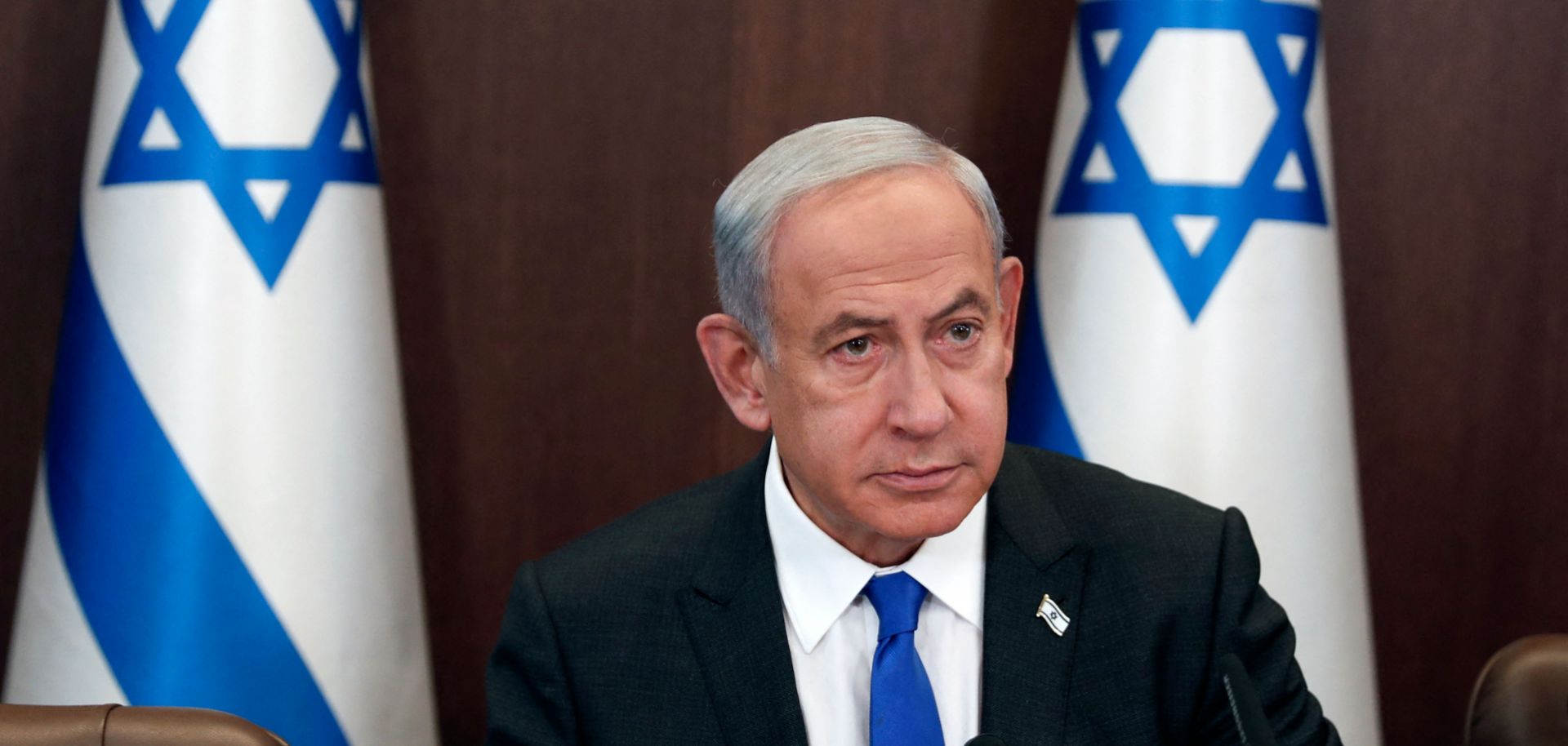
Israeli Prime Minister Benjamin Netanyahu chairs a cabinet meeting in Jerusalem on Jan. 3, 2023.
A suspected Israeli attack on an Iranian military facility indicates that Israel and Iran's covert war will continue under the former's new government — creating a constant risk of escalation that could threaten Iran's other regional rivals. On Jan. 29, Iran's defense ministry said bomb-carrying drones attacked a military complex in the central city of Isfahan the previous night, causing some damage to the facility. U.S. officials cited by major U.S. outlets have since said Israel conducted the strike in response to national security concerns over Iran's recent military activities. While Israel has not officially confirmed these statements, it remains the most plausible culprit of the Jan. 28 attack given Israel's history of conducting similar attacks against Iran's military capabilities, including the suspected Israeli strike against an Iranian drone base in Kermanshah in February 2022.
- Israel is Iran's primary regional rival and vice versa. The two countries have been engaged in a covert war for several decades.
- The targeted Isfahan facility is a munitions depot that could be connected to Iran's growing missile production — a trend that has left Israeli leaders increasingly on edge.
The attack shows how the new Israeli government's national security priorities remain fixed on Iran under longtime hawk Prime Minister Benjamin Netanyahu. In the likely case that Israel was behind the Isfahan attack, it would be the first major publicly reported action that Israel has conducted against Iran since Netanyahu's new government took office in December. In his first speech to the Israeli Knesset after being sworn in for another term, Netanyahu (who previously served as prime minister from 2009-2021) made clear that confronting Iran and protecting Israeli interests from Iranian threats were among his government's top priorities. The competing objectives of the far-right and conservative parties that make up Netanyahu's new ruling alliance risk prolonging Israel's recent string of politically fragile governments. Israel and the Palestinian territories have also seen one of the worst upticks in violence in their longstanding conflict in recent weeks, as evidenced by Israeli security forces' Jan. 26 raid in the West Bank that killed seven gunmen and two civilians. But the Isfahan attack underscores that even with these sizable threats to Israel's internal stability, Israeli leaders still view Iran as the most dangerous threat to their country's security — especially as Tehran continues to expand its nuclear and missile programs, and maintains its focus on Israel as its top enemy.
- The former governments under Netanyahu also conducted occasional covert operations against Iran, including damaging cyberattacks, assassinations of key scientists and engineers, and explosions at nuclear sites.
While it remains unlikely, a direct conflict between Israel and Iran cannot be ruled out as the cycle of escalation continues. The likely Israeli attack against the Isfahan facility is only the latest in a series of similar attacks designed to degrade Iran's military capabilities, which Tehran has repeatedly responded to with a variety of reprisal attacks. In response to this latest strike, Iran will likely again retaliate to demonstrate the risks of attacking Iranian territory to Israel (and any other potential adversary). This could see Iran conduct cyberattacks against Israeli targets in the broader Middle East region, or deploy its vast network of proxy militias to conduct drone or missile attacks against Israeli interests in countries like Iraq, Syria, Lebanon and Yemen. Given Israel's historically close security ties with the United States, Iran may also target U.S. military bases, government infrastructure and potentially commercial companies in the Middle East in response to the Isfahan attack. There's a chance Iran could seek to provoke Palestinian attacks against Israel as well by fostering greater political and economic ties with the Gaza Strip's powerful militant groups (namely, Hamas and Palestinian Islamic Jihad), which could exacerbate the latest surge in violence in Israel.
- Israel has ramped up its attacks on Iranian targets in recent years, including assassinating a prominent Iranian nuclear scientist in November 2020 and a 2021 attack on the underground Natanz nuclear facility that damaged some advanced nuclear centrifuges. Iran has responded to each of these attacks in various ways and in various regions (including in third-party countries like Iraq). In March 2022, for example, Iran claimed responsibility for a dozen ballistic missile strikes targeting an Israeli intelligence base in the Iraqi Kurdistan capital of Erbil. The missile strikes came a month after the suspected Israeli airstrike against an Iranian drone base in Kermanshah.
- Media reports published on Jan. 30 indicate that Iranian foreign minister Hossein Amir-Abdollahian has invited the head of Hamas' political bureau, Ismail Haniyeh, to visit Tehran. The Iranian government could plausibly extend political and economic support to Hamas, though Israel monitors such contact closely and interdicts what it can.
- U.S. officials believe that Iran was behind an October 2021 suicide drone attack on a U.S. military base in Syria, which came shortly after Israel conducted airstrikes against Iran-backed militias in the country. U.S. forces evacuated the base before the drone attack after being tipped off by Israeli intelligence.
U.S. and Israeli military targets will likely be prime targets for Iranian retaliation, but other Iranian rivals in the region could get caught in the crossfire, including the Arab Gulf states. Rising tensions between Iran and Azerbaijan could see Tehran blame the Azerbaijani government for helping enable the Isfahan attack. Iran could also launch another attack on Iraqi Kurdistan, similar to the March 2022 Erbil attack. This threat is especially of concern for the Arab Gulf states that have recently deepened their diplomatic and security ties with Israel (including the United Arab Emirates and Bahrain) and thus risk being viewed by Tehran as complicit in helping support Israel's military actions and policy. Maritime attacks on military or commercial targets in the Persian Gulf, Sea of Oman or the Red Sea are also possible and would create financial risks for shippers and insurers in the broader area.
- The United Arab Emirates had an uneasy diplomatic and security relationship with its Persian Gulf neighbor Iran even before Abu Dhabi normalized its ties with Israel in 2020. Anwar Gargash, the United Arab Emirates' presidential diplomatic adviser, tweeted on Jan. 29 that the Isfahan explosion was ''not in the region's interests,'' indicating the Emirati government's likely desire to urge peace — potentially in self-preservation.
In addition, Iran will likely further advance its nuclear and ballistic missile programs, which will continue the cycle of escalation with Isreal and further reduce the chances of Tehran and the West reaching a nuclear deal. The Isfahan attack will probably compel Iran to accelerate its nuclear program and, in turn, build up one of its most powerful defensive tools and main sources of negotiating capital. However, any further advancement will prompt Israel to find ways to degrade any of Iran's new capabilities, prolonging the cycle of escalation and risk of tit-for-tat conflict. It would also risk completely derailing the chance of Iran and the West negotiating a nuclear deal, which remains a low likelihood but plausible scenario for the coming year. If Iran makes moves to advance its nuclear capabilities (like stockpiling more highly enriched uranium between 60 and 90%, adding more advanced centrifuges, or denying the International Atomic Energy Agency access to Iranian nuclear sites), the United States and its European allies will find it increasingly difficult to use negotiations as a way to slow the risk of Iranian nuclear proliferation. Iran could also announce advancements to its ballistic missile technology research, including to its hypersonic missile capabilities, which will provoke alarm in Israel and Arab Gulf states and, more broadly, further raise concerns about Iran's missile transfers to Russia for use in Ukraine.
