
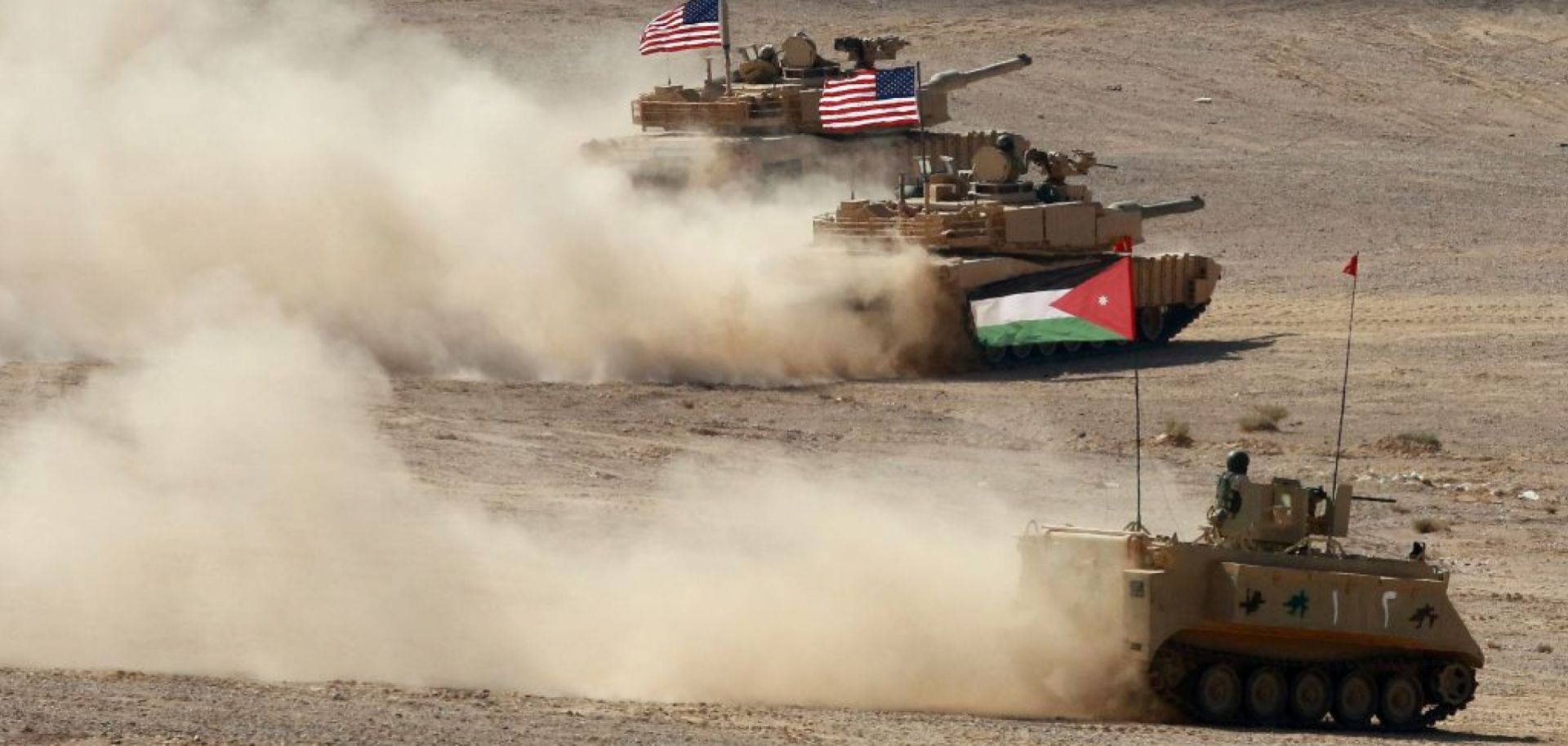
The initial U.S. retaliation to a lethal attack by Iran-backed militias on U.S. forces in Jordan will likely focus on limited attacks against targets in Iraq and potentially Syria. While unlikely, a more extended campaign would increase the risk of a direct confrontation between the United States and Iran. Three U.S. soldiers were killed and up to 34 wounded in an attack at a training outpost on the Jordanian-Syrian border, the White House announced Jan. 28, in a strike they claimed was a drone attack by Iranian-backed militias based in Syria and Iraq. It was the first killing of U.S. troops since the Oct. 7 Hamas attack on Israel sparked the current regional crisis. In response, U.S. President Joe Biden vowed to respond to the attacks "in a time and manner of our choosing." The attack reportedly took place at a location called Tower 22 on the Syrian-Jordanian border just inside Jordan, according to U.S. officials, which is part of a network of installations that helps support the U.S. mission at Al-Tanf in Syria. A senior official from the Islamic Resistance in Iraq umbrella group claimed the attack, according to The Washington Post.
- U.S. troops have been attacked multiple times in Syria and Iraq since Oct. 17, when Iranian-linked militias began drone, rocket, mortar and other attacks on U.S. forces based in those countries. But no troops had been killed up to this point, with the U.S. preferring to respond with localized attacks against militia-linked bases and installations in both Syria and Iraq. On Jan. 4, the U.S. killed Iran-linked Iraqi militia leader Mushtaq Jawad Kazim al-Jawari in an airstrike in retaliation for recurrent attacks on U.S. troops in that country. Al-Jawari was a leader of Harakat al-Nujaba, one of the Iraqi groups under the Islamic Resistance in Iraq umbrella group. For its part, Jordan denied the attack took place in Jordan itself, though this is likely driven by a desire for Amman to remain outside of a potential escalation.
- In October 2023, Alwiyat al-Waad al-Haq, a front for Iran-aligned Kataib Hezbollah, said it might target U.S. forces regionwide, including in Gulf Cooperation Council countries like the United Arab Emirates and Kuwait.
The United States is most likely to retaliate against militia targets in Iraq but may also include strikes on Syria-based infrastructure associated with Iranian-supplied drones to degrade militia capabilities for future strikes. The U.S. response will likely be targeted toward degrading and deterring further drone attacks on U.S. forces in the region, which will likely include a target set of airstrips, hangars and infrastructure associated with assembling and/or storing such drones in both Iraq and Syria. But such strikes would spur Iranian-backed militias in Iraq to potentially respond with escalated strikes on U.S. forces in Iraq, prompting a longer cycle of attacks and counterattacks between the two, and could feed anti-U.S. sentiment in the country among some nationalist and pro-Iran Iraqi politicians. Iraq and Syria have long been a theater of tit-for-tat exchanges between the United States and Iranian-backed forces and militias, which has also seen a yearslong Israeli covert war against the Islamic Revolutionary Guard Corps that has resulted in notable IRGC casualties but never prompted a regional escalation between Iran and Israel. Once the round of strikes are conducted, U.S. forces would then return to a defensive position and wait to respond to future attacks.
- Since the Israel-Hamas war began, U.S. forces in Iraq have been attacked up to 60 times; 2,500 U.S. forces remain in Iraq for training and anti-Islamic State operations, but they have been pulled increasingly into tit-for-tat exchanges with Iranian-backed Iraqi militias.
- The United States has struck Iran-linked sites in Syria multiple times since the Biden administration took office in 2021, including in February and June 2021, August 2022, and multiple times in late 2023 since the start of the Israel-Hamas War, without spurring regional escalation from Iran.
- There are 900 U.S. troops in Syria, many of them at Al-Tanf, a base that trains forces for anti-Islamic State operations; 3,000 more U.S. soldiers are stationed in Jordan to train and advise Jordanian forces.
The United States has the option to carry out extended campaigns against these militias in both Syria and Iraq, but such a course of action would face U.S. domestic opposition, a deterioration of security conditions in Iraq, a regional spillover to the GCC, and potentially create the threat of a direct escalation between the United States and Iran. In a low-probability but high-risk scenario, the United States could opt for a campaign to more substantially deter and degrade the infrastructure and capabilities of Iran-backed militias in Syria, Iraq or both. Such a campaign would not involve a substantial increase in U.S. troop numbers but would see an increase in air sorties and a lower threshold for the authorization of airstrikes on Iranian-linked targets. But this scenario remains improbable for now because such a campaign could face congressional and domestic public opposition in the United States, where deeper military involvement in Syria and Iraq remains unpopular and where there is growing concern regarding a possible military confrontation with Iran — especially as the United States is now also actively involved in an extended air and sea campaign against the Houthis in Yemen. Moreover, the Biden administration is eager to avoid a foreign crisis during an election year. An extended campaign in Iraq would also feed into anti-U.S. sentiment there, strengthening the political incentive for Baghdad to accelerate talks to reframe the U.S.-Iraqi strategic relationship, and could see anti-U.S. protests that could escalate to violence against U.S. or Western institutions and companies there. Finally, a more proactive campaign might result in the deaths of IRGC forces in U.S. strikes, which would incentivize Iran to more directly respond to the United States through covert and/or direct military means, like encouraging its proxies and allies to attack U.S. forces in other third-party countries or escalating IRGC support for militia swarm attacks on U.S. forces in Syria and Iraq designed to incur casualties.
- On Jan. 12, the U.S. opened a campaign against the Houthi movement in Yemen in response to Houthi maritime harassment of civilian shipping in the Red Sea, which has seen the United States move into a proactive position to strike infrastructure associated with imminent Houthi attacks.
- U.S. forces remain based in Bahrain, Saudi Arabia, Qatar and the United Arab Emirates, where they could eventually become targets in a sustained pattern of escalation. The Houthis struck the United Arab Emirates multiple times in 2022, including launching attacks on bases that house U.S. troops in Abu Dhabi.
