
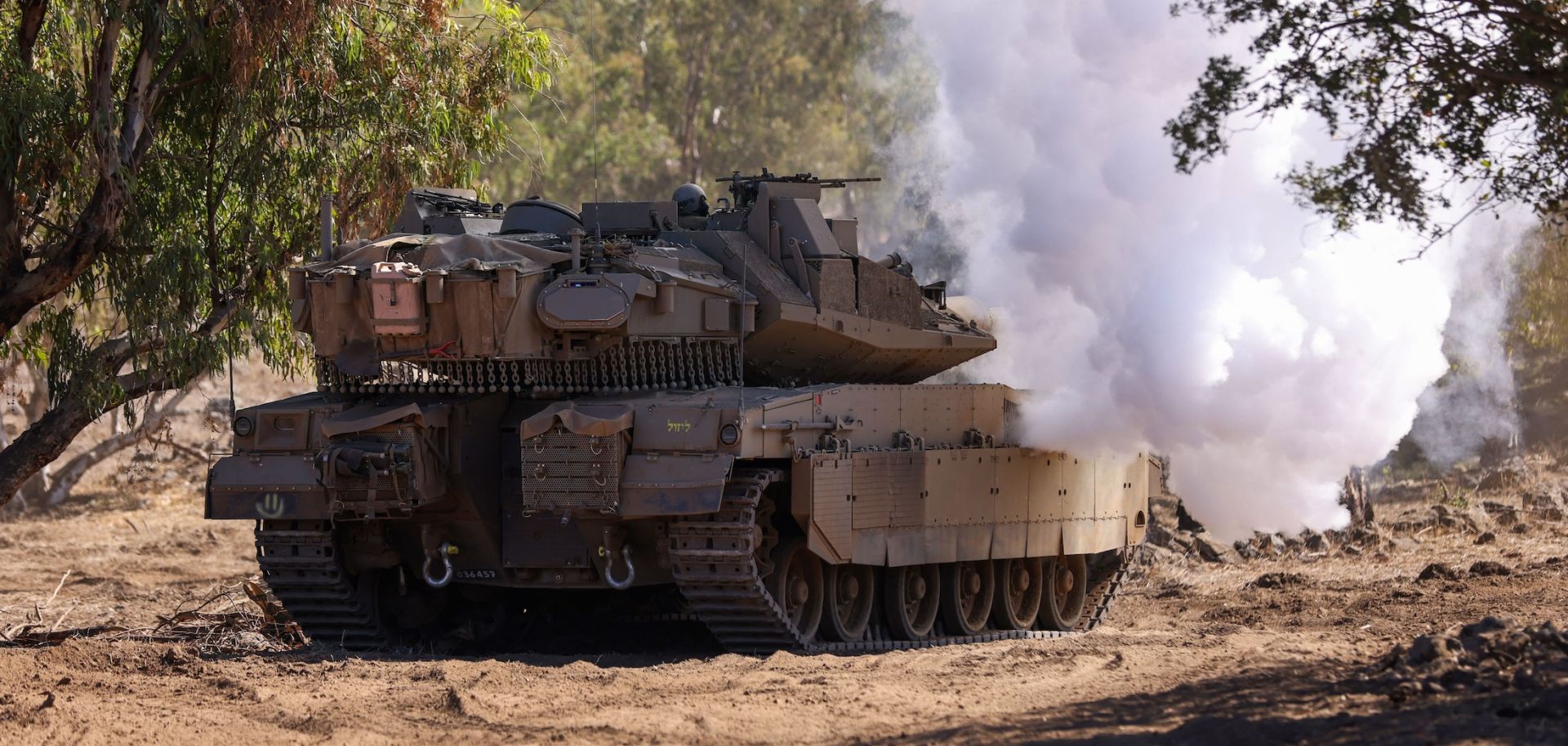
In the likely event of a limited Israeli incursion into Lebanon, Iran's regional proxies would likely provide mostly symbolic support for Hezbollah, reducing the risk of a regional war. However, should Israel undertake a broader campaign in Lebanon, the risk of a regional war — potentially involving direct participation from the United States and Iran — would increase. In recent weeks, U.S. political and military officials have cautioned Israel against starting an expansive military offensive against Lebanon's Iranian-backed militant and political group Hezbollah, warning that Iran and its proxies could be drawn into the conflict and that the United States would not be able to defend Israel. The U.S. warnings come amid Hezbollah and Israel's recent escalations at the Israel-Lebanon border and their leaders' increasingly aggressive rhetoric threatening war.
- In a July 23 interview, Israeli Prime Minister Benjamin Netanyahu said the war in Gaza was moving to a less "intense phase" and that forces would be freed up for war in the north. Simultaneously, Israeli Defense Minister Yoav Gallant met U.S. officials in Washington to garner support for what he labeled "phase 3" of the Gaza campaign, which is meant to shift away from major combat operations in Gaza toward escalation against Hezbollah in the north.
Amid escalating rhetoric and clashes along the Lebanon-Israel border, members of the Iranian-led "axis-of-resistance" have voiced their support for Hezbollah in a potential wider conflict with Israel. The axis of resistance is an informal political and military grouping of Iran's regional allies that are united by opposition to Israel and the United States. Most militant groups within this axis have already been participating in the Israel-Hamas war by striking Israel and Israeli assets in the region. Pro-Iranian Iraqi militias (most notably Kataib Hezbollah) have recurrently attacked Israeli civilian and military infrastructure in Israel itself, while Yemen's Houthi rebels have been attacking both commercial and military vessels in the Red Sea, the Arabian Sea and the Indian Ocean. While Iran tends to lead these groups, Tehran's strategic imperatives can differ from those of its proxies and allies, and Iran has played a mostly rhetorical and diplomatic role for its proxies in the region, especially Hezbollah, as they prepare for a wider conflict in Israel; Iran also maintains supply routes for these groups. This strategy serves as a deterrent to Israel by surrounding the country on several fronts, but the decentralization of decision-making in the axis of resistance means this strategy has its limitations.
- The wide umbrella of militias and militants who make up the "axis of resistance" include Lebanon's Hezbollah, Yemen's Houthi movement, the Palestinian militant group Hamas, Iraq's Kataib Hezbollah, and various militants in Syria and Iraq. All groups receive some level of diplomatic, financial and military support from Iran, but the level of Tehran's direct control over them varies widely. Additionally, all have national imperatives that sometimes lead them to diverge. For instance, the Houthi movement struck Abu Dhabi in the United Arab Emirates in January 2022, just weeks after notable signs of improving Iranian-Emirati relations emerged in late 2021. The attack was a reaction to the Emirates' backing of forces that threatened their position in northern Yemen.
- In recent weeks, the Houthis claimed attacks against Israel and Israeli assets in the eastern Mediterranean at least twice in coordination with pro-Iranian Iraqi militias. Though there is no evidence that these attacks were impactful, they highlight the aspirational level of operational coordination between the different groups of the Iranian alliance despite being geographically distant.
- There are several examples of the limitations of the "Unity of Fields" strategy that has most recently sought to link support for Palestinians in the Israel-Hamas war across the region. For instance, Hezbollah was reluctant to go to war with Israel when Hamas initiated its surprise Oct. 7 attack on Israel, partly because Hamas likely did not coordinate with the rest of the alliance, as well as Hezbollah's initial strategic imperatives that constrained it from jumping into the conflict from the start. Additionally, Hezbollah did not participate significantly in the April 13 Iranian missile and drone attack on Israel due to concerns about escalating with Israel and about Lebanese public opinion, which has increasingly criticized Hezbollah's relationship with Tehran.
In the event of a limited Israeli military offensive against Hezbollah, the axis of resistance's support for the group would be mostly symbolic, while Iran would maintain its supply line of weapons, averting a wider regional war. From Iran's and its proxies' perspectives, a limited Israeli offensive similar to the 2006 Lebanon War in which Israeli ground troops primarily fought in areas in southern Lebanon would be insufficient to defeat Hezbollah. As a result, in the event of a limited Israeli assault aimed at establishing a buffer zone a couple of kilometers into Lebanese territory, militant groups in the axis of resistance would likely launch symbolic attacks against Israeli assets in the region and Israel itself, in a continuation of their attacks in support of Hamas in Gaza. Palestinian militant groups based in Lebanon — most notably Hamas — would likely join the fight with Hezbollah to support it as Hezbollah did for Hamas in Gaza, in part because Israel is targeting these groups already. The Houthis would likely continue to sporadically attack Israeli or Israel-bound commercial vessels in the Red Sea, the Arabian Sea and the Indian Ocean while also trying to target the eastern Mediterranean. Iran, for its part, would likely maintain its flow of weapons to Hezbollah through Iraq and Syria, extending a lifeline to the Lebanese militant group should the limited conflict grow into a prolonged war of attrition. In this scenario, the United States would aid Israel in intelligence gathering and sharing while maintaining flows of weapons and ammunition to Israel. In this case, given that the war remains limited and that Iranian and U.S. support for their allies does not involve direct military intervention, the war would likely remain contained between Hezbollah and Israel rather than become a wider regional conflict between Iran, the United States and their allies.
- In the 2006 Lebanon War, despite Israel's declared intention to destroy Hezbollah, Iran did not become directly involved beyond supplying arms via Syria. Meanwhile, other members of the axis, like Syria, remained neutral, as they did not want to participate in a regional escalation that might have drawn the United States into new conflicts.
However, a wider Israeli war against Hezbollah would likely prompt Iran's proxies to escalate their participation, increasing the risk of broader and more aggressive attacks against Israel and the United States. While a limited offensive is currently more likely, Israel may conclude that it needs a major ground invasion, which could include expansive bombings of Lebanon and high-profile assassinations of Hezbollah's leaders. In such a campaign, Iranian-aligned militants would become much more directly involved in Lebanon. Fearing a possible loss of its most formidable proxy force in the region, Iran would likely press its regional proxies to participate directly in the conflict. This could mean an escalation of attacks on the Golan Heights from Iranian-backed militias in Syria and Iraq; an increase of long-range missile and drone attacks from pro-Iranian armed groups in Iraq and Yemen; increased attacks against shipping in the Red Sea, the eastern Mediterranean, the Persian Gulf and the Arabian Gulf by the Houthis; and a flow of fighters to fight alongside Hezbollah from Syria, Iraq, Yemen, Pakistan and Afghanistan. Some groups would likely resume attacks on U.S. forces in Syria and Iraq, potentially carrying out barrages against U.S. troops to try to signal the risks of regional conflict to Washington and pressure it to lean on Israel to restrain its campaign. Proxies might also target companies and assets that are seen as pro-Israel in Iraq, Syria and Lebanon, particularly those affiliated with France and the United Kingdom, in addition to existing threats that exist to the United States.
- In recent weeks, Iran's proxies in Iraq and Syria have reduced their attacks on U.S. forces after the United States carried out bombing campaigns against them in response to the Tower 22 attack in Jordan in January, which killed three U.S. soldiers.
Though still a low-likelihood scenario, an escalated militant involvement against Israel and its partners would increase the risk of U.S. involvement and potentially spark a regional war. The United States will respond to attacks on U.S. forces and civilian naval vessels. In these tit-for-tat cycles of violence, substantial casualties on either side will further reinforce the escalation pattern, dragging the United States and militants into open-ended conflicts as long as Israel's campaign against Hezbollah continues. In such open-ended conflicts, the United States may inadvertently kill senior Iranian leaders advising militants, dragging Iran into a direct confrontation with the United States. Such a confrontation could propel Iran to increase support for proxies attacking U.S. forces and/or spur an Iranian covert response to the United States, like cyber attacks, an overseas bombing, or attacks on American civilians or businesses abroad. Meanwhile, militants may decide that they need to target U.S. bases in the region beyond Syria and Iraq (in places such as Kuwait, Bahrain, Saudi Arabia, Qatar or the United Arab Emirates) to pressure Washington to restrain its campaign. Though Iran would likely avoid resuming militant attacks on Gulf Cooperation Council (GCC) countries given recent improvements in diplomatic relations, individual militant groups might be incentivized to strike back anyway in reaction to high-profile U.S. assassinations of senior leaders or a sustained U.S. bombing campaign against them that threatens their domestic positions. Should militants expand strikes to GCC states, U.S. strikes on these groups would increase, creating the prospect of an open-ended conflict.
