
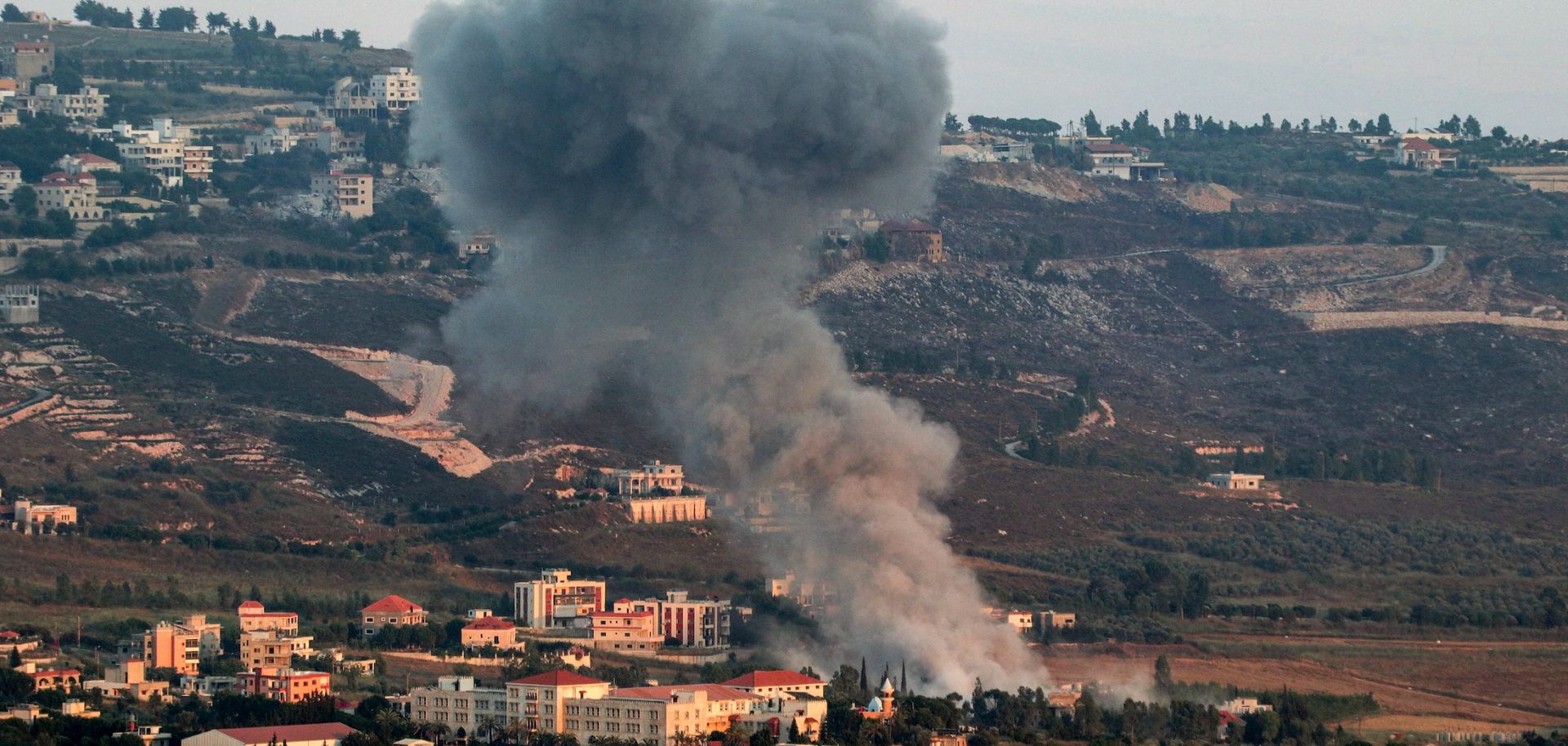
While Israel and Hezbollah are ultimately interested in a negotiated solution, both are currently on an escalatory path that could shift their conflict from cross-border attacks to limited Israeli incursions within southern Lebanon and, in a low-probability but high-impact scenario, to a full-on war that could eventually also involve the United States and Iran. On June 18, the Israel Defense Forces (IDF) approved operational plans for a cross-border operation into southern Lebanon, in the latest sign of steady Israeli intent to conduct major military operations to push the Iran-backed Lebanese militia Hezbollah away from the Israeli border. On June 19, in a televised address, Hezbollah's chief Hassan Nasrallah threatened Israel with a war without redlines, should one be ''imposed'' on the group amid growing threats of an Israeli military offensive against Lebanon. The Hezbollah chief also threatened EU member Cyprus for the first time, declaring that if Cyprus allowed the IDF to use its bases or territories to attack Lebanon, it would be considered as part of the war and a legitimate target for the group's missiles and drones.
- The address came as Hezbollah commemorated Israel's June 11 assassination of a regional commander in southern Lebanon, and following U.S. special envoy Amos Hochstein's visit to Israel and Lebanon, who was dispatched by the White House to defuse the recent escalation in Israel-Hezbollah clashes. According to Arab diplomats, Hochstein reportedly told Lebanese officials that Israel would have U.S. backing should an outright war break out.
- In recent weeks, Hezbollah has escalated its attacks against Israel's north, using heavy rockets, loitering munitions and introducing anti-air defense missiles to fight off Israeli fighter jets and drones over Lebanese airspace. Simultaneously, Israel has continued its assassination campaign of senior Hezbollah members, striking southern towns deeper inside Lebanon's territory.
- On June 5, Hezbollah published a video using for the first time an Iranian Almas advanced anti-tank guided precision missile (ATGM) targeting an Israeli Iron Dome battery and claiming to have destroyed it.
- While the fighting has mostly remained along the borders since Oct. 8, despite expanding geographically at times, the recent wave of attacks suggests that both sides are intensifying their clashes as the window for diplomacy narrows. The recent escalation also coincided with the administration of U.S. President Joe Biden laying out what it deemed as an acceptable cease-fire proposal to end the ongoing fighting between Israel and Hamas, which if accepted, could potentially shift Israel's focus from Gaza toward Lebanon.
The Strategic and Political Dynamics of Israel-Hezbollah Clashes
Hezbollah began launching strikes into northern Israel shortly after Hamas' Oct. 7 assault, seeking to capitalize politically on the groundswell of regional sympathy for Palestinians during the Israeli counterattack. But for months, Hezbollah kept such attacks geographically limited, preferring to operate close along the Lebanese-Israeli border to avoid triggering another 2006-style war with Israel that could prove disastrous for Lebanon's struggling economy and Hezbollah's political and security position there. Meanwhile, Israel began a series of retaliatory, targeted strikes on Hezbollah, steadily escalating to assassinations and strikes deeper inside Lebanon, like in Hezbollah's stronghold of the Bekaa Valley. But Israel's political and military leaders signaled greater ambition than only retaliation, saying they wanted a new buffer zone based on the U.N. Security Council (UNSC) resolution 1701 that ended the 2006 war, which would see Hezbollah withdraw from the border in order to prevent another mass incursion by militants into Israel. With Israel's most combat-capable brigades fighting in Gaza, this remained largely rhetoric. However, with the slow wind-down of operations in the Gazan city of Rafah, Israeli forces are increasingly freed up to increase military pressure on Hezbollah, as no diplomatic breakthrough has taken place with either Hezbollah or Hamas.
Hezbollah's recent rhetorical and military escalation is aimed at strengthening Hamas' position in cease-fire negotiations, as well as deterring Israel from launching a wider war in Lebanon as major operations in Gaza come to an end. Given Hamas' largely degraded military capabilities and their switch into an insurgency, Hezbollah is now increasingly acting as a pressure card for Hamas in its stalling negotiations with Israel on a cease-fire deal in Gaza. Hezbollah is also trying to deter an Israeli offensive against Lebanon by escalating its attacks against Israeli military targets, introducing newer and more advanced weapons while showcasing the group's intelligence capabilities to spot key Israeli targets, like the Haifa Port. This strategy is designed to feed into Israel's internal divisions as well, as Israel's military leaders favor escalation more than some Israeli political leaders like Prime Minister Benjamin Netanyahu, who worries about his government's future in a possible expensive and open-ended campaign in southern Lebanon.
- Hezbollah possesses thousands of unguided short-range rockets and precision-guided anti-tank rockets, in addition to a large stockpile of drones and longer-range missiles, including ballistic and cruise missiles. Most recently, the group has also introduced medium-range air-defense systems, such as the Sayyad-2C anti-air missiles, from Iran. Hezbollah has recently boasted about its large arsenal of advanced missiles and drones in a bid to deter the Israelis through psychological warfare.
- Amid Hezbollah's escalation in the past few weeks, Israeli hard-line politicians like Finance Minister Bezalel Smotrich and National Security Minister Itamar Ben Gvir have sharply criticized the government's handling of the situation in northern Israel, and have frequently demanded stronger military strikes against the group in Lebanon. Their influence on the government increased after centrist politician Benny Gantz left Israel's wartime unity government on June 10.
- Statements made by Hezbollah's Secretary General and other officials have repeatedly emphasized that while the group does not seek a wider war, it is ready and able to wage one should Israel launch a military offensive.
Despite their recent waves of escalation, Hezbollah and Israel have more incentives to reach a diplomatic settlement rather than go to war. Israel's goal is to establish a buffer zone inside of southern Lebanon at a distance that prevents Hezbollah from using anti-tank guided missiles against Israeli border communities, and to demand the withdrawal of Hezbollah's elite Radwan Brigade forces from southern Lebanon. Israel's priority is ensuring Israelis who have been displaced amid the ongoing border clashes can return to their homes in the north — something that a wider war against Lebanon would postpone for a significant amount of time, and would also have a greater economic and political cost than the war in Gaza. Hezbollah's goal, meanwhile, is to prevent an Israeli war on Lebanon and to maintain the status quo ante that the group assesses has so far deterred Israel from launching such a war since the 2006 conflict. In addition, the United States is pressuring both Israel and Hezbollah to avoid a wider war that may drag the United States and Iran into the conflict.
- Divisions between Israel's military and its elected government and military on how to proceed in the north also limit the likelihood of Israel launching an offensive, as the government fears an open-ended campaign could weaken overall public support for it.
- Hezbollah has already established a buffer zone inside of Israeli territory by forcing thousands of Israelis in the north to evacuate their towns, which the group will use as leverage in any negotiations with Israel and its international partners like the United States.
- Hezbollah continues to have territorial demands over disputed territory with Israel, like the Shebaa Farms area in the Golan Heights region, which has long been subject to moribund diplomatic efforts. Hezbollah claims the Shebaa Farms are part of Lebanon, and that Israel's occupation of the area thus justifies Hezbollah's continued armed resistance. However, the United Nations demarcates the farms as part of the Golan Heights.
- Hezbollah is also demanding that Israel implements its part of the UNSC resolution 1701, as well as seize Israeli fighter jets' daily incursions into Lebanese airspace to conduct mock raids.
Despite their shared interest in avoiding a war, in the near term, Israel and Hezbollah will escalate the scope and scale of their targets as the former builds up the ground forces needed for cross-border operations. While both Hezbollah and Israel are interested in avoiding a full-on war, they will continue to push the limits of their conflict by intensifying their cross-border exchanges, in a bid to further deter one another from waging another major war, and maximize their demands and conditions in a potential diplomatic settlement. As Israeli forces are freed up and retrained after the Gaza campaign, Israel will increase its pace of airstrikes on mainly Hezbollah military targets but also potentially on civilian infrastructure and Hezbollah positions deeper in Lebanon, such as in the Bekaa or the Beirut Suburbs and Sidon. Israel could also launch a wider air campaign against Hezbollah targets in Syria, such as weapons depots, supply convoys and fighters being transferred to Lebanon. In response, Hezbollah will deepen its target set inside Israel, striking military assets further from the northern border, attempting to shoot down Israeli drones, fighters and other aircraft, and increasing the scope of its strikes on Israeli troop positions along the border in a bid to increase Israeli military casualties.
- Israel has called up to 360,000 reservists to join the ongoing fight against Hamas in Gaza. But for a cross-border operation into Lebanon, Israel would utilize only a handful of armored and special force brigades, many of whom have already seen combat in the Gaza Strip since October 2023. These forces would need to be re-equipped and trained before beginning another ground campaign, even a limited one, in southern Lebanon — a process that might take weeks depending on how events unfold in Gaza, where a Hamas-led insurgency is now taking hold.
If Hezbollah does not withdraw from the border, Israel is likely to send in ground forces to conduct clearing operations across southern Lebanon. There are two ways in which an Israeli ground campaign inside Lebanon might unfold. The less risky option for Israel is through localized, brigade-by-brigade assaults into southern Lebanon, designed to weaken Hezbollah's overall position, destroy infrastructure, and increase pressure on Hezbollah to withdraw. This would reduce the number of Israeli troops on the ground and decrease casualties; it would also avoid creating the political appearance of a major Israeli invasion like that one conducted in 1982, somewhat mitigating the inevitable diplomatic and regional backlash. In addition, such localized Israeli assaults would weaken Lebanon's nationalistic response to the operation, as they would be clearly targeted against Hezbollah and reduce the group's political benefit as Lebanese rally to the defense of the country's borders. This ground pressure, combined with an escalated air and assassination campaign, could weaken Hezbollah's political resolve to continue resisting and open up the possibility of a diplomatic solution to the conflict. However, from Israel's standpoint, it would also be less militarily effective due to Hezbollah's de-centralized chain of command and its fighters' knowledge of the terrain, in addition to the group's military capabilities and gained experience over the years. Indeed, Hezbollah fighter squads would dig into the dense forests and rocky terrain of the territory to launch hit-and-run ambushes using their advanced ATGMs. This would also enable Hezbollah to focus on a handful of locations and, so long as it maintains the political will to fight, enable its militants to try to erode the limited pockets of Israeli ground invasions, fueling domestic criticism of the Israeli government's policies at home and sapping public morale for the campaign.
- Israel conducted similar style operations in 2006 to try to pressure Hezbollah, but made little headway against entrenched guerillas and suffered notably high casualties. The campaign was widely seen as a failure in Israel and led to the government's collapse, but it also enabled Israel to avoid triggering a wider regional conflict by drawing in Iran and the United States.
As a much riskier option, Israel could also launch a major ground operation in Lebanon, which would result in a large-scale war that could draw in Iran and the United States. Fueled by its insecurities over Hamas' surprise Oct. 7 attack, Israel may see a Gaza-style mass combat operation designed to push Hezbollah physically from the border as its only option to secure its northern flank. In addition, the country's far-right factions might push for a much more sustained invasion of southern Lebanon that tries to physically create a buffer space with ongoing clearing operations. For such an operation to be effective, Israel would also need to strike Hezbollah's supply lines to Iran, escalate its assassination campaign of the group's key leaders and strike Hezbollah safe zones in major cities like Beirut, to both weaken Hezbollah's military effectiveness and sap its political will to fight. This would likely mean escalating strikes against Hezbollah and Iranian-linked targets in Syria. It could also mean a resumption of risky Israeli strikes on Iran assets (like consulates, embassies, and/or Islamic Revolutionary Guards Corp leaders) that might spark an Iranian retaliation. With the support of Iranian supplies and other Iran-backed militias in the region, Hezbollah would likely respond by striking deeper into Israel, like against Tel Aviv and Jerusalem, resulting in mass civilian casualties. This would increase the possibility of a direct U.S. intervention to defend Israel via increased ammunition supplies, intelligence sharing, and missile and drone defense. In such a case, Hezbollah would use its more advanced ballistic and cruise missiles, as well as drones, to strike Israeli civilian and military infrastructure, and gas fields such as Karish in the Eastern Mediterranean, in a bid to cripple the Israeli economy. In the event of such a scenario, Iran-backed Houthi militants in Yemen would have another incentive to continue their attacks on shipping lanes and vessels bound for Israel in support of Hezbollah, while Iranian proxies in Syria and Iraq would also continue to strike Israel. Finally, should Iran be compelled to once more strike Israel, the United States and its regional allies would act defensively to limit the impact of such an attack, while Israel would be compelled to again retaliate directly against Iran, creating the risk of accidental escalation that spurs a regional conflict.
