
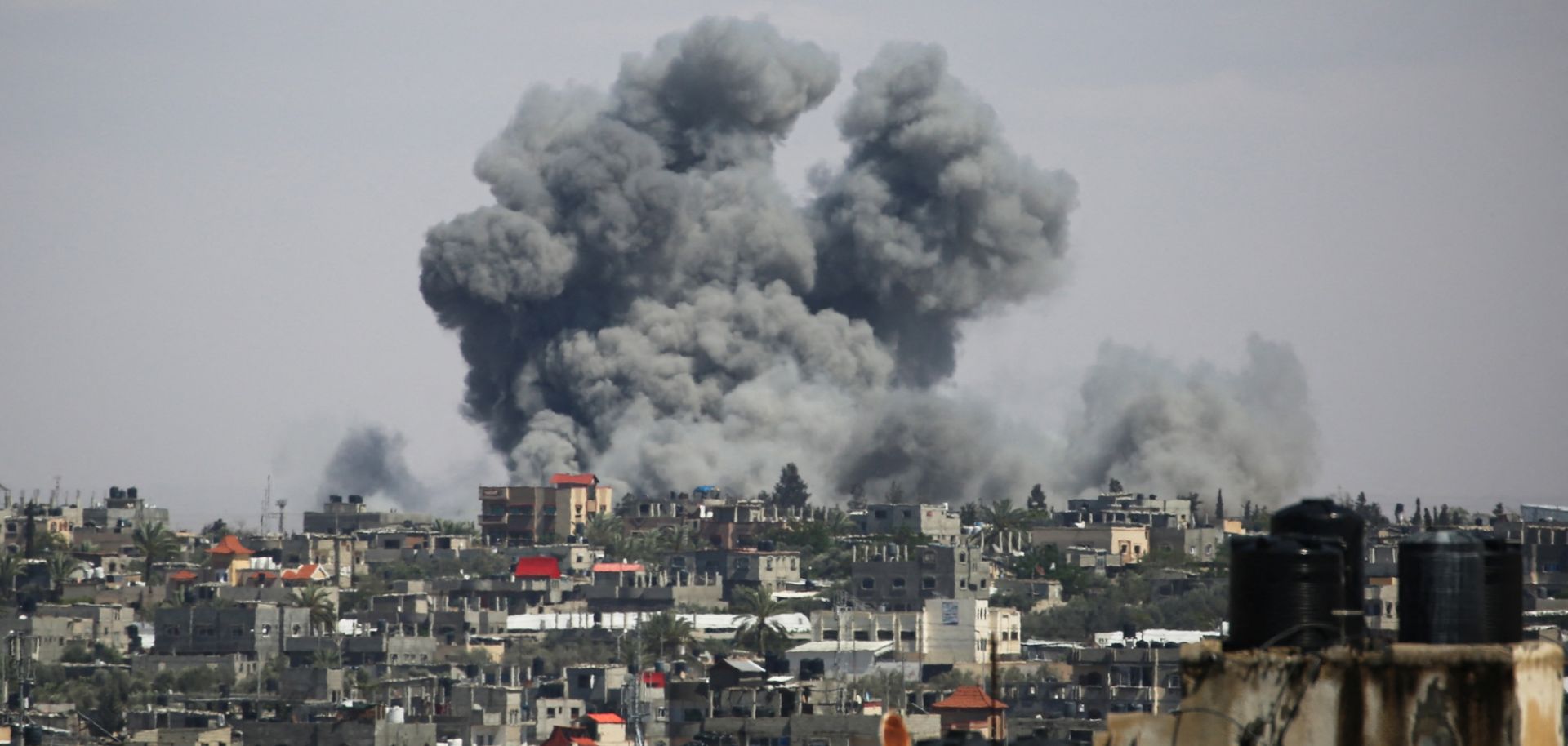
Israel's operation in Rafah is designed to pressure Hamas in ongoing cease-fire talks, but should those fail, the Israeli military will scale up combat to take the entire area, which would strain Israel's diplomatic relations abroad and stoke divisions at home, while also potentially incentivizing Israel to escalate regionally once the Rafah campaign is complete. On May 7, the Israeli Defense Forces (IDF) started a limited ground operation into the eastern parts of Gaza's southernmost city of Rafah, following volleys of strikes against Hamas positions in the city earlier the same day. Throughout the day, Israel issued a call for Palestinians to immediately evacuate the eastern parts of the city, hinting at an imminent offensive. The launch of the long-awaited ground operation comes after Israel on May 6 rejected a U.S., Egyptian and Qatari-brokered cease-fire proposal that Hamas had accepted, claiming the deal's framework was not the same as the one Israel had agreed to in negotiations. The next day, the IDF announced it was taking control of the crucial Rafah border crossing that lies between Gaza and Egypt, which has served as a lifeline for humanitarian aid flows into the war-torn enclave; the zone surrounding the Rafah crossing also houses more than 100,000 Palestinians.
- On May 5, Hamas claimed a rocket attack against Israeli positions on the Kerem Shalom border crossing near Rafah, killing 3 Israeli soldiers and wounding several others. This initially prompted Israel to close the crossing, but after a May 6 call with U.S. President Joe Biden, Israeli Prime Minister Benjamin Netanyahu reportedly agreed to reopen the Kerem Shalom crossing.
- Before Hamas accepted the cease-fire deal, its negotiations with Israel had stalled on May 5 after both sides failed to agree on the terms of the proposal. The United States dispatched the CIA director to Doha to continue negotiation efforts on May. 6.
- Hamas and Israel disagree on whether a cease-fire could end the war, with Israel wanting a more comprehensive solution that precludes Hamas' control of Gaza before agreeing to end military operations there.
The limited ground operation suggests Israel is trying to militarily pressure Hamas into accepting a cease-fire deal with more favorable terms. But if this fails, the Israelis will likely expand their offensive in Rafah. The cease-fire proposal that Hamas accepted on May 6 included three phases that would eventually lead to an end to the war, as well as the release of the Israeli hostages still being held by Hamas in Gaza in exchange for the release of Palestinians being held in Israeli prisons. But Israeli officials rejected the deal, saying it fell ''short of Israel's demands'' (which include a demilitarized Gaza Strip and the end of Hamas' governance of the territory). Israel's move to capture the Rafah border crossing, instead of directly pushing into the center of the city itself, indicates that it is seeking to coerce Hamas into accepting a more favorable cease-fire agreement that meets Israel's wartime objectives. Indeed, the Rafah crossing was the last international crossing under Hamas' control; Israel's seizure of the crossing will thus further pressure the Palestinian militant group by cutting off its last major supply line. Hamas, however, remains unlikely to agree to such concessions because the group is still trying to achieve a political victory that keeps its presence in Gaza intact. Without a more palatable cease-fire deal in place, Israel will likely expand the scope of its operations in Rafah to occupy the entire area, in order to free Israeli hostages being held there and significantly degrade what remains of Hamas' organized battalions stationed in the city.
- An Israeli official cited in a May 6 CNN report described Israel's Rafah offensive as being limited in scope, and that it was designed ''to pressure Hamas'' into accepting a more palatable cease-fire deal.
In the likely case that Israel eventually scales up its operations in Rafah, the government will come under increasing domestic and international pressure as Gaza's humanitarian situation worsens and the lives of Israeli hostages are put at risk. Israeli forces will likely launch its ground incursions in phases, ordering evacuations ahead of each phase, to minimize civilian casualties and, in turn, appease U.S. humanitarian concerns. But regardless of Israeli military pacing, the cut-off of the Rafah crossing and the consequent increase in fighting between the IDF and Palestinian militants in and around the city will inevitably worsen humanitarian conditions, deepening Israel's diplomatic isolation from the West and Arab world. In response to Israel's push into Rafah, Israeli protesters — including the families of the hostages who were kidnapped by Hamas on Oct. 7 — will also likely intensify their calls to halt the invasion, which they fear could endanger the remaining hostages, by taking to the streets in larger numbers. Concurrently, far-right Israeli parties key to Netanyahu's governing coalition will continue to press for a full-scale invasion of Rafah.
- The launch of Israel's Rafah operation has put Saudi-Israeli normalization on hold again. In response to Israel's evacuation order, the Saudi Foreign Ministry issued a statement in which it called Israeli troops ''occupation forces'' whose actions against the Palestinians constituted ''genocide.'' This statement comes after the United States reportedly said that U.S.-Saudi security pacts are directly tied to Saudi-Israeli normalization.
- Following Israel's rejection of the truce deal accepted by Hamas, Israeli protesters — including families of hostages — held several demonstrations across the country, blocking roads in Tel Aviv to demand that their government halt its push into Rafah and accept a cease-fire agreement that would ensure the release of the remaining hostages.
- On May 6, far-right Israeli National Security Minister Itamar Ben Gvir demanded that Israel reject the Hamas-accepted cease-fire proposal and start invading Rafah. Earlier that day, Israeli settlers also intercepted and vandalized Jordanian aid trucks in Jerusalem that were heading toward Gaza.
Though a cease-fire remains possible, a military outcome to the war appears more likely, incentivizing Israel to further escalate regionwide in the future, especially in Lebanon. Hamas may be willing to cut a last-minute cease-fire deal that meets Israel's wartime objectives (namely, a demilitarized Gaza Strip that is no longer governed by Hamas) — especially as Israeli troops make gains in Rafah, with the United States and international community appearing unable or unwilling to halt Israel's advances. But short of that unlikely scenario, the Rafah campaign is poised to establish a military end (and not a diplomatic one) for the major combat phase of the current Gaza war, transitioning the Israeli mission there from large-scale ground operations to raid and counter-insurgency missions. After this, Israel's government may conclude that it can withstand the international and domestic pressure for de-escalation and turn its attention to its next most pressing theater: southern Lebanon. There, the Israeli government will be incentivized to escalate military operations against Hezbollah to pressure the Lebanese militant group into withdrawing from the border era, especially if Hezbollah escalates its attacks throughout the Rafah offensive. Indeed, Israel may even conclude that it can resist the inevitable international pressure that would accompany ground operations in southern Lebanon to establish this buffer zone.
- On May 5, Netanyahu promised to achieve Israel's objectives in Gaza, even if it meant ''standing alone'' in the face of intense international criticism of its operations there. This pledge has been increasingly echoed by other Israeli officials who believe that freezing the war in Gaza and/or Lebanon short of Israel's objectives would undermine the country's long-term security.
- Israel has threatened to conduct a major military operation in southern Lebanon to establish a buffer zone against Hezbollah, though it has kept a substantial number of its most capable combat brigades in and around Gaza, and has preferred to deploy reservists to the north to respond to and deter Hezbollah attacks.
