
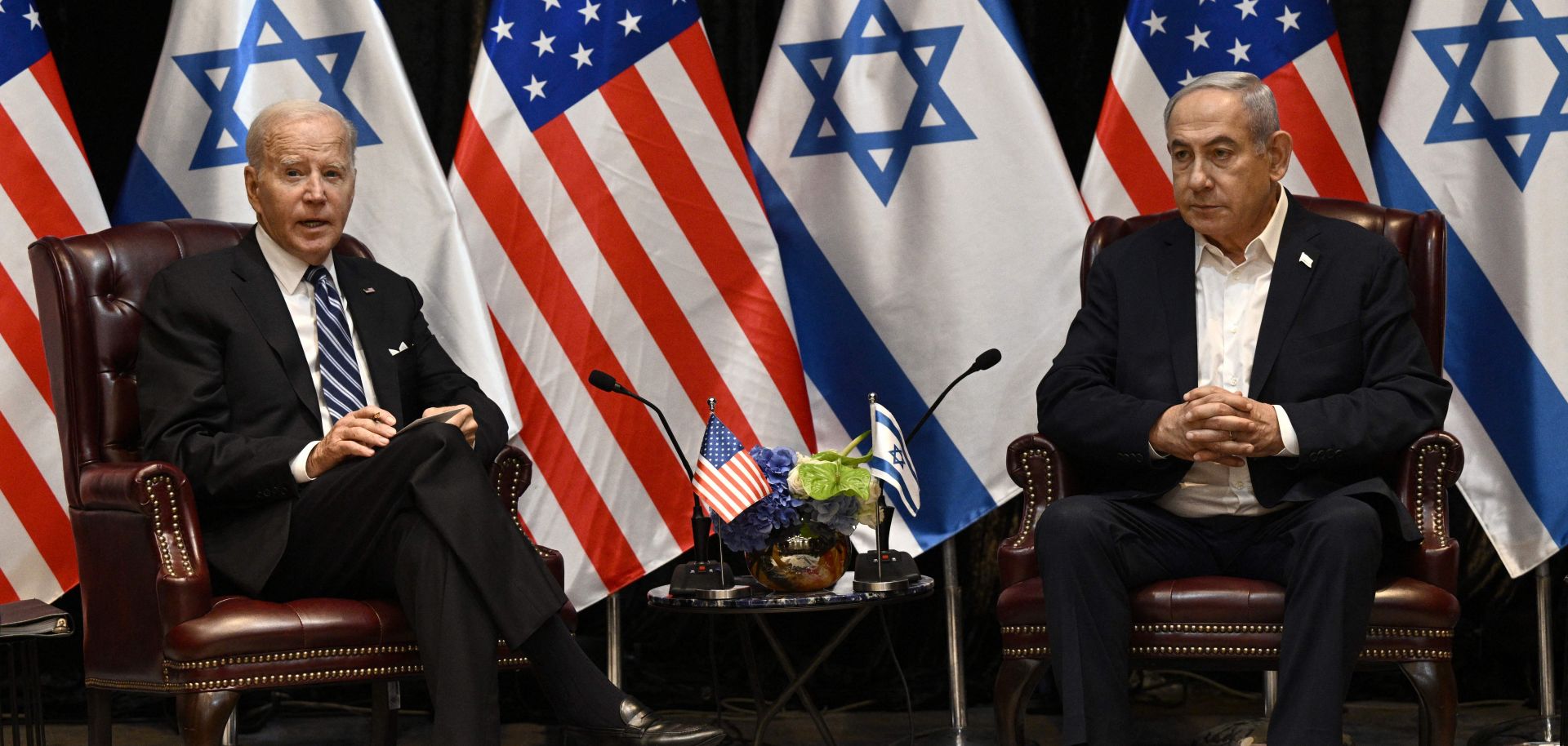
The United States' increasing criticism of Israeli foreign policies and its gradual disengagement from the Middle East will feed into Israel's larger debate about defense self-sufficiency and encourage future Israeli governments to pursue policies that aim to reduce their country's reliance on Washington. On March 14, U.S. Senate Majority Leader Chuck Schumer of New York called for new elections in Israel and criticized the leadership of Prime Minister Benjamin Netanyahu. The criticism was particularly notable in part because of Schumer's strong pro-Israel record and his previous alignment with Netanyahu over issues like the 2015 Iran nuclear deal, which they both opposed. This comes against the backdrop of rising tensions between the U.S. government and Israel since the beginning of the Gaza war on Oct. 7. The administration of U.S. President Joe Biden has repeatedly pushed the Israeli government to restrain its military tactics to preserve civilian lives and improve humanitarian conditions in Gaza. Even before the war, the United States was growing increasingly critical of the current Israeli government, with Biden calling far-right cabinet members like Itamar Ben-Gvir and Bezalel Smotrich problematic.
- Tensions have surfaced between the U.S. and Israeli governments before — particularly during the administration of former U.S. President Barack Obama, when Israel strongly opposed the 2015 nuclear deal that the United States and Iran signed to limit the latter's nuclear program. During that time, Democratic Senate Majority Leader Chuck Schumer sided with Israel in criticizing the deal and voted against it in the Senate, which helped prevent the agreement from becoming a legal treaty.
- Israel's bipartisan relationship with the U.S. government has been showing cracks for years. Younger and more liberal U.S. voters, including Jewish ones, have become more critical of Israel's right-wing drift and more concerned about Israel's reluctance to engage in a substantial two-state solution negotiation process with the Palestinians. Meanwhile, on the right, U.S.-Israeli ties have come under scrutiny among Republicans as a form of isolationism takes hold in the party's base that is skeptical of foreign aid and diplomatic relations across the board.
U.S. criticism of the current Israeli government will likely grow, particularly ahead of the November election as the Democratic Party tries to find ways to placate its base that has signaled strong disapproval of Israeli military policies in Gaza, which may compel Washington to use financial, political and diplomatic leverage over Israel to try to get it to change its behavior. With the U.S. election set to be decided in a few key states with a limited number of voters, the Biden administration and its Democratic Party are taking the potential electoral threat of boycott votes seriously by emphasizing greater criticism of Israel's government. This has manifested in the U.S. government openly disapproving of potential major Israeli military operations, like Israel's planned offensive into the northern Gazan city of Rafah, Hamas' last stronghold in the strip. It has also manifested in Democrats in Congress talking about limiting arms sales to Israel if their Palestinian and Gaza war policies don't change. While the White House has so far not shown any substantial sign that it is prepared to limit arms sales to Israel, such a move would not be unprecedented, as the Biden administration has carried out reviews of strategic arms ties with other countries like Saudi Arabia for using U.S.-supplied weapons in ways that might violate human rights. However, to get Israel to change its behavior, Washington is more likely to first use diplomatic, political and eventually financial leverage over the country before reducing arms support in the middle of the Gaza war.
- Democratic activists who are critical of Biden's policies — particularly on Israel — have called on supporters to cast ''uncommitted'' votes in the party's ongoing, largely uncontested presidential primary, instead of votes for Biden, to signal their numerical strength in the polls going forward. This saw an unusually large number of Democratic voters cast ''uncommitted'' ballots in key swing states like Michigan that have already held the primary election, which the Biden administration has interpreted as a possible boycott vote that could cost them such states — and potentially the presidency — in November.
- On March 12, six Democratic senators and one independent senator signed a letter urging President Biden to suspend the sale of offensive arms to Israel unless the country substantially improved humanitarian conditions in the Gaza Strip. These senators represented what are usually considered safe Democratic states (like Connecticut, Massachusetts, and Oregon); their letter thus indicates that much of the party's base believes more needs to be done to change Israel's military policies.
- On March 25, the United States abstained from a U.N. resolution demanding an immediate cease-fire in Gaza, marking the first time Washington hadn't vetoed such a resolution. The move signals the United States is starting to use its diplomatic leverage over Israel to try to coerce it into changing its policies.
Israel, however, is unlikely to substantially change its Gaza strategy anytime soon, which remains focused on defeating or dismantling Hamas, even in the face of U.S. criticism. Prime Minister Netanyahu himself has rejected the United States' mounting criticism of his government, and said that Israelis would decide whether the country should hold fresh elections to elect a new government. His comments echo widespread sentiment among right-wing Israelis who see such criticism by U.S. Democrats as unsubstantiated. But even more centrist elements of the Israeli government, like opposition leader and unity cabinet member Benny Gantz, have avoided joining in on criticizing Netanyahu. And this sense of unity within the Israeli government will continue as long as the country is conducting major combat operations against Hamas militants in the Gaza Strip, and stands on the threshold of potential regional escalation with Hezbollah militants in neighboring Lebanon.
- Right-wing Israelis have been pursuing U.S.-condemned policies for years, including the expansion of Israeli settlements into the West Bank, which the United States sees as an obstacle to the implementation of the Oslo Accords and the formation of a Palestinian state. U.S. disapproval of such policies has usually expressed itself through condemnations by the U.S. State Department, but has rarely manifested in direct criticism from the White House or Congress.
- Despite the public pushback, Israel's defense establishment is aware of how reliant Israel is on U.S. political goodwill for its own military readiness.
In the longer term, U.S.-Israeli ties will weaken as the United States attempts to retrench out of the Middle East to refocus its attention and resources on other theaters, like the Indo-Pacific. The United States' current, overarching goal in the Middle East is to establish a network of allies that can help fill the security vacuum left by a steady retrenchment of American power out of the region. As Washington implements this strategy in the coming years, Israel is thus bracing for a future where it will be increasingly responsible for its own security and not necessarily a primary benefactor of U.S. military aid, particularly if the United States is forced to respond to a major security crisis in another region. This burgeoning reality — combined with U.S. Democrats' growing criticism of Israeli policies — means future Israeli governments will likely pursue policies that aim to enhance the country's self-reliance and ability to mobilize its economy, in order to prepare for a scenario in which Israel finds itself at war without the full American backing it is used to.
- As part of its strategy to retrench from the Middle East, the United States is trying to normalize relations between Israel and Saudi Arabia so the two can coordinate policies and develop ties to balance Iran's regional ambitions.
- U.S. efforts to reduce its military presence in the Middle East have prompted countries across the region to diversify their defense ties in recent years. Turkey, Saudi Arabia, the United Arab Emirates and Qatar have all launched defense diversification programs that seek to either boost their capacity to domestically develop weapons platforms, or deepen their ties with alternative arms suppliers like France, the United Kingdom, and even Russia and China.
- Israel is already in an indirect arms competition with Ukraine, where both are trying to maintain access to the supply of the 155mm artillery shell they utilize.
But increasingly critical U.S. political opinion will nonetheless constrain Israel's future foreign policy, as even with a greater emphasis on defense self-sufficiency, Israel will remain highly reliant on the United States for its most advanced equipment and will be limited in what it can develop domestically or find alternative supply lines for. As Israel prepares for a potential future of reduced U.S. support, the most likely sectors where the country will be able to increase its defense independence will be small arms, drones and cyber warfare, in which it already has established domestic industries. These systems will provide Israel with a measure of defensive self-sufficiency that might enable it to withstand future regional escalations for longer with less U.S. support. However, Israel's offensive capabilities remain heavily reliant on U.S. supplies of advanced military equipment. Israel's Air Force, for example, uses 5th-generation U.S. fighter jets, like the F-22 and the F-35, which cannot readily be replaced by another foreign arms supplier. In addition, the bulk of its air force is trained on American equipment like the F-16. Even military equipment like the Merkava battle tank, which is mostly made in Israel, uses U.S.-made components to make them state-of-the-art, further complicating Israel's path to offset American influence over its defense sector. Replacing such top-line American equipment would require decades of sustained focus on alternative suppliers. Israel's offensive capabilities will thus remain highly dependent on maintaining a close relationship with the United States for the foreseeable future, which will constrain Israel's ability to carry out more expansive and/or hawkish military campaigns — particularly when the United States opposes such campaigns.
- Israel already has a robust indigenous drone development program similar to that of other regional powers like Turkey and Iran, but these systems are nevertheless reliant on components that are sourced abroad.
