
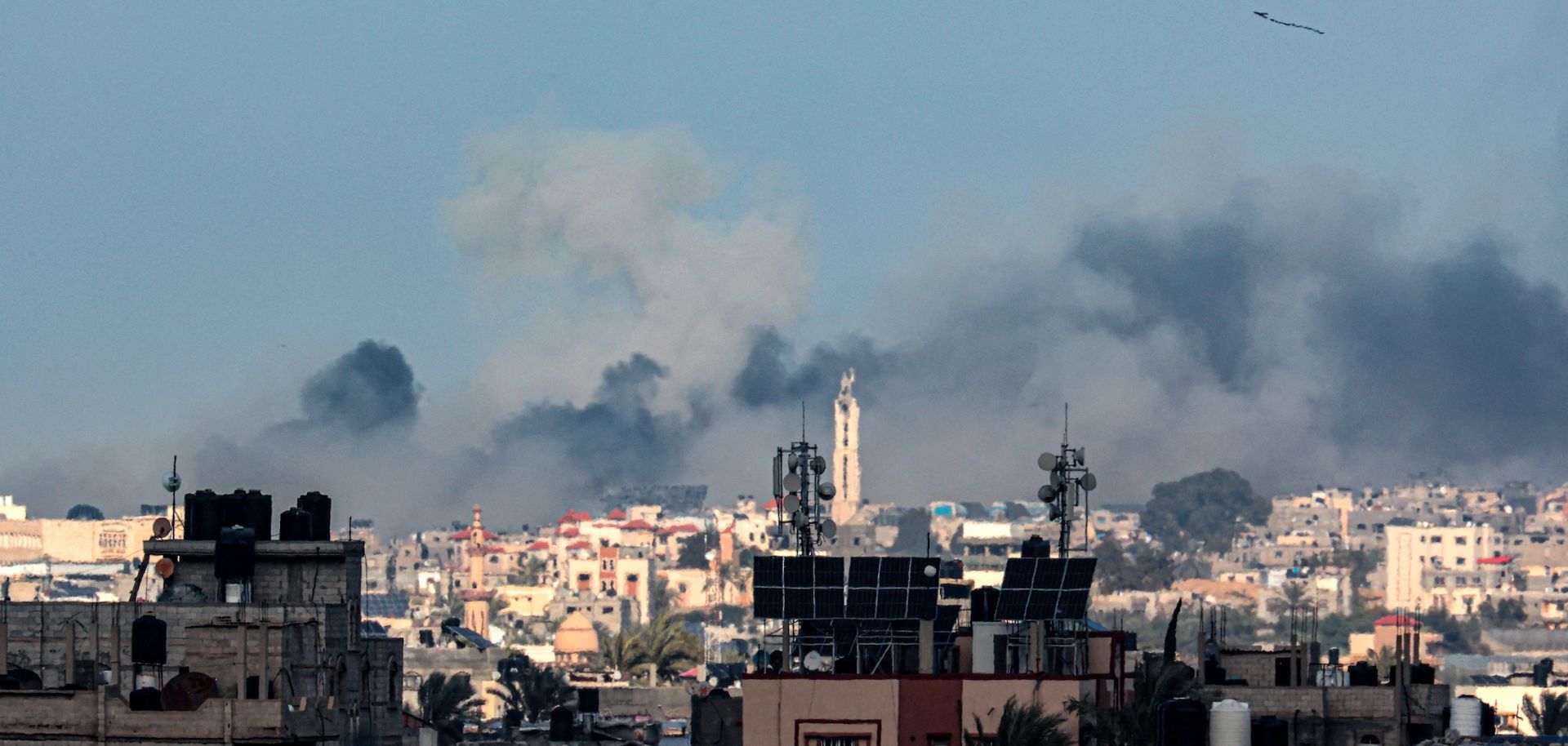
Israel's threatened offensive into Rafah would end the current phase of the Gaza war, but unless it also reaches a diplomatic breakthrough with Hamas, the region will remain unstable and exposed to attacks by pro-Palestinian forces. Cease-fire talks between Israel and Hamas floundered again on Feb. 13, as delegations in Cairo failed to reach an agreement amid mounting signs that Israel is preparing a major, and possibly final, offensive in the Gaza Strip. Days earlier, on Feb. 9, Israeli Prime Minister Benjamin Netanyahu ordered the Israel Defense Forces (IDF) to prepare evacuation plans for civilians ahead of a widely anticipated military offensive into the Gazan city of Rafah, which lies on the territory's southern border with Egypt and is the last major city in Gaza that remains under Hamas' control. The order was just one of many recent signs portending an imminent Israeli military offensive in Rafah. On Feb. 12, the IDF also carried out a hostage rescue operation, freeing two hostages while also continuing to conduct shaping operations, including airstrikes, to disrupt the remaining Hamas fighters entrenched there. These moves come against the backdrop of intensifying international diplomatic pressure on Israel to safeguard civilian lives in Rafah, where an estimated 1.1 million of Gaza's 2.1 million people have relocated after Israeli offensives steadily moved south. Although reports indicate that Israel intends to evacuate the civilians toward tent cities along the coast, foreign governments and NGOs continue to warn that civilian casualties could be high if Israel's military offensive in Rafah repeats the ferocity of its battles in Gaza City and Khan Younis.
- Israel ordered civilians to evacuate to the Rafah area as it carried out prior offensives in Gaza City and Khan Younis, resulting in the current refugee crisis.
- The IDF estimates that Hamas' remaining military leaders, like military wing head Yahya Sinwar, are somewhere in the Rafah area, most likely in the tunnel system, making the Israeli capture of the city a vital war goal as the IDF presses to defeat Hamas in Gaza.
- Israel reports 134 Israeli hostages are still being held in Gaza, with most believed to be somewhere near Rafah, though the IDF has estimated that up to one-fifth of those hostages have died in captivity since being abducted by Hamas on Oct. 7.
Because of intense diplomatic pressure, particularly from the United States, Israel will likely avoid another mass offensive in favor of targeted raids and localized battles with remaining Hamas militants, in a strategy that could extend the campaign for Rafah for several more weeks. Although Israel has sufficient military power to quickly surge forces across Rafah, such tactics risk repeating the intense bombardments and battles that characterized its campaign for Gaza City, which resulted in the bulk of civilian casualties reported since the start of the current Israel-Hamas war on Oct. 7. If Israel were to launch a similar mass offensive in Rafah, it would significantly deepen diplomatic backlash from the United States, as well as Arab partners like Egypt, which has warned against such a campaign in the border city for fear that it would send a surge of Palestinian refugees into the Sinai Peninsula. Israel is thus instead likely to carry out a more restrained version of its battle for Khan Younis, in which individual battalions slowly move through Rafah with comparatively limited airstrikes on civilian infrastructure. However, this approach will probably extend the length of the battle for Rafah and potentially leave Israel exposed to increasing diplomatic pressure from the United States and its Western allies to implement a cease-fire as the war continues.
- On Feb. 12, U.S. President Joe Biden called Israel's campaign in Gaza ''over the top.'' His remarks were the latest sign of escalating U.S. criticism of Israel's conduct in the strip, which has so far resulted in over 28,000 civilian deaths since its war against Hamas began over three months ago. Many of these deaths occurred during the intense aerial and artillery bombardment of Gaza in October and November.
- Israeli forces first entered the southern Gazan city of Khan Younis in early December and continue to fight isolated pockets of Hamas fighters there, as the IDF switched to more restrained tactics in the face of escalating international criticism. Israel's more intense campaign to secure Gaza City, the largest city in Gaza, also took just under two months, despite being a bigger city with more complex infrastructure than Khan Younis.
Should Israel capture or kill senior Hamas leaders, it could precipitate a shift within Hamas from a centrally-directed resistance movement to a grassroots insurgency. With Israel in control of approximately two-thirds of the Gaza Strip, there is a shrinking geography for Hamas' remaining military leaders to operate. As Israel carries out the Rafah campaign, it will reduce this geography even further. On a long enough timeline, the IDF will likely eventually capture or kill these military leaders, weakening military leadership in the Gaza Strip that could result in a reduction in organized fighting by Hamas. This would not see Hamas completely surrender or withdraw from Gaza, but it would transform the group into an underground militant movement whose strategic focus in the strip would be to harass Israeli forces, shifting into a more occupation-resistant insurgency led by small cells rather than central leadership.
- Hamas leaders may attempt to escape from Gaza, either by sea (which would require evading the Israeli Navy) or by going through the Sinai (which would require slipping past the Egyptian military). However, both of these options would prove difficult given Hamas' diminishing resources and the intense security cordon around Gaza. And even if the group's leaders successfully escape, it could still be seen as Hamas' formal defeat in Gaza.
- Israel has assassinated numerous Hamas leaders over the years, including the group's spiritual founder, Sheikh Yassin, in 2004. But in the wake of such losses, Hamas has repeatedly proven able to reorganize and find new leaders.
For Hamas, Israel's intensifying military pressure on its leaders may soften the group's demands in ongoing cease-fire talks, or it could fracture the movement by creating a split between its Gaza-based militant wing and its overseas-based political wing. There are already reports that Hamas' military leaders in Gaza — including Yehya Sinwar, the group's leader of the military wing in the Strip — are open to reaching a temporary cease-fire with Israel, but that Hamas' overseas political leaders want to maintain maximalist demands that would see the IDF withdraw from the Gaza Strip before a new cease-fire could take place. As Israel's upcoming campaign in Rafah further reduces the geography where they can safely operate, Sinwar and other militant leaders may decide to cut their own deal with the IDF to secure their safety and withdrawal from the Gaza Strip. This could happen even without the support of Hamas' political leaders, resulting in a split in strategy between the two wings that weakens or even ends the Palestinian militant movement's unity. Should Sinwar and other Hamas senior military leaders cut a deal with the Israelis, it would also likely presage the formal collapse of organized Hamas resistance in the Gaza Strip, with surviving militants once more shifting into an insurgency focus.
- Recurrent cease-fire negotiations in Cairo have run aground on Hamas' demands that Israel agree to a deal that ends the war entirely, which Israeli Prime Minister Benjamin Netanyahu has rejected as a nonstarter for Israel.
- Israel has repeatedly signaled it is open to exiling Hamas leadership from Gaza in exchange for the release of the remaining Israeli hostages, though Hamas' political leadership perceives this to be a defeat for the group akin to Yasser Arafat's exile from Beirut after Israel invaded Lebanon in 1982.
No matter how it develops, Israel's offensive in Rafah will raise the risk of significant hostage casualties, which would result in major domestic political backlash for the Netanyahu government. With the remaining Israeli hostages' precise locations unknown, but presumed to be in the Rafah area, the IDF may accidentally injure or kill hostages in the course of its military operations in the Gazan border city, as Israeli soldiers have several times already. Meanwhile, some militants who are holding hostages may decide to execute them in the face of military defeat. Although isolated rescues like those seen on Feb. 12 are likely as Israeli troops advance, it will be impossible for the IDF to secure the safety of all hostages without a diplomatic breakthrough with Hamas. Hostage casualties are likely to worsen anti-government sentiment in Israel itself, where anti-Netanyahu political leaders and factions are starting to resurrect the street protest movement that paralyzed Israel throughout much of 2023. Such anti-Netanyahu sentiment could eventually collapse the unity government and return Israel to a period of political instability that may again lead to new elections.
Even if Israel succeeds in taking Rafah by force, the political imperatives driving Hamas, Hezbollah and other Iranian-backed forces to harass international shipping, as well as Israeli and U.S. troops throughout the region, will remain in place. Without a clear path to postwar governance in Gaza, Israel is currently on a course to militarily occupy the territory for the foreseeable future, which will incentivize further attacks by pro-Palestinian forces throughout the region. Should Hamas shift into an insurgency in the Gaza Strip without a diplomatic breakthrough that would allow key actors to declare an end to the current war, the remnants of the Palestinian militant group (not just in Gaza, but also in the West Bank and southern Lebanon) — along with the Lebanese militant group Hezbollah and Iran-backed militias in Iraq, Syria and Yemen — will thus continue carrying out intermittent attacks on U.S. and Israeli interests in the region. This means that disruptions to Red Sea commercial shipping and attacks against U.S. and allied military forces will persist, even if at a lower frequency than before. The risk of a greater confrontation between Israel and Hezbollah will also persist amid their ongoing border clashes, which could eventually culminate in an Israeli incursion or invasion of southern Lebanon if the two sides fail to reach a diplomatic solution to halt their fighting.
- Hezbollah has said that it would reject any attempts to de-escalate tensions along the Israel-Lebanon border before the resolution of the war in Gaza, demands echoed by other militant groups, like the Houthis in Yemen, who have said they would keep up their attacks until the war ends. Militants and their supporters are unlikely to interpret an Israeli military conquest of Gaza as an acceptable end to the war.
